
Join Our JEE Preparation Group
Prep with like-minded aspirants; Get access to free daily tests and study material.
Sign in
Please select an account to continue using cracku.in
↓ →
Join Our JEE Preparation Group
Prep with like-minded aspirants; Get access to free daily tests and study material.
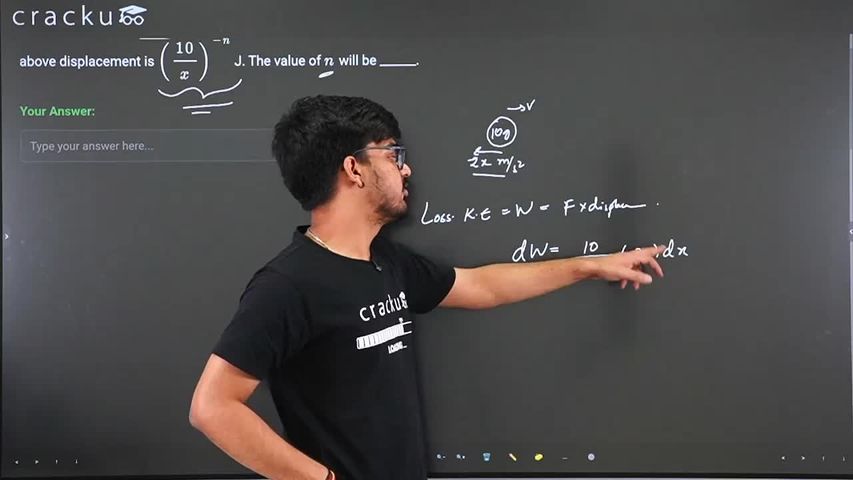
A particle of mass 10 g moves in a straight line with retardation 2x, where $$x$$ is the displacement in SI units. Its loss of kinetic energy for above displacement is $$\left(\dfrac{10}{x}\right)^{-n}$$ J. The value of $$n$$ will be ______.
Correct Answer: 2
We have a particle of mass $$m = 10$$ g $$= 10^{-2}$$ kg moving in a straight line with retardation $$2x$$, where $$x$$ is the displacement in metres. Since it is retardation, the acceleration is $$a = -2x$$ m/s$$^2$$.
The retarding force is $$F = ma = -2mx$$. Using the work-energy theorem, the work done by this force over a displacement from 0 to $$x$$ is:
$$W = \int_0^x (-2mx) \, dx = -2m \left[\frac{x^2}{2}\right]_0^x = -mx^2$$
Since $$W = KE_f - KE_i$$, the loss of kinetic energy is:
$$\text{Loss of KE} = -W = mx^2 = 10^{-2} \times x^2 \text{ J}$$
We can verify this using kinematics. Since $$a = v\dfrac{dv}{dx} = -2x$$, integrating both sides:
$$\int_{v_0}^{v} v \, dv = \int_0^x (-2x) \, dx$$
$$\frac{v^2 - v_0^2}{2} = -x^2$$
or $$v_0^2 - v^2 = 2x^2$$
So the loss of kinetic energy is $$\frac{1}{2}m(v_0^2 - v^2) = \frac{1}{2} \times 10^{-2} \times 2x^2 = 10^{-2} \times x^2$$ J, which confirms our result.
Comparing with $$10^{-n} \cdot x^2$$, we get $$n = 2$$.
Hence, the answer is $$2$$.
Was this solution helpful?
Click on the Email ☝️ to Watch the Video Solution
Create a FREE account and get:
_1.webp)

Educational materials for JEE preparation

Ask our AI anything

AI can make mistakes. Please verify important information.
AI can make mistakes. Please verify important information.
