NTA JEE Main 10th April 2015 Online
For the following questions answer them individually
NTA JEE Main 10th April 2015 Online - Question 21
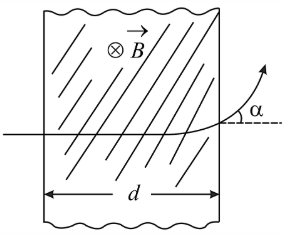
A proton (mass $$m$$), accelerated by a potential difference $$V$$, flies through a uniform transverse magnetic field $$B$$. The field occupies a region of the space by a width $$d$$. Let $$\alpha$$ be the angle of deviation of the proton from the initial direction of motion (see the figure), then the value of $$\sin \alpha$$ will be:
NTA JEE Main 10th April 2015 Online - Question 22
When the current in a coil changes from 5 A to 2 A in 0.1 s, an average voltage of 50 V is produced. The self-inductance of the coil is
NTA JEE Main 10th April 2015 Online - Question 23
An electromagnetic wave travelling in the $$x-$$ direction has frequency of $$2 \times 10^{14}$$ Hz and electric field amplitude of 27 V m$$^{-1}$$ oscillates in $$Y-$$direction. From the options given below, which one describes the magnetic field for this wave?

NTA JEE Main 10th April 2015 Online - Question 24
A telescope has an objective lens of focal length 150 cm and an eyepiece of focal length 5 cm. If a 50 m tall tower at a distance of 1 km is observed through this telescope in a normal setting, the angle formed by the image of the tower is $$\theta$$, then $$\theta$$ is close to
NTA JEE Main 10th April 2015 Online - Question 25
You are asked to design a shaving mirror assuming that a person keeps it at 10 cm from his face and views the magnified image of the face at the closest comfortable distance of 25 cm. The radius of curvature of the mirror would then be:
NTA JEE Main 10th April 2015 Online - Question 26
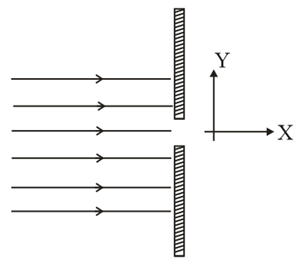
A parallel beam of electrons travelling in x - direction falls on a slit of width d (see the figure below). If after passing the slit, an electron acquires momentum $$p_y$$ in the y - direction, then for a majority of electrons passing through the slit (h is Planck's constant):
NTA JEE Main 10th April 2015 Online - Question 27
De-Broglie wavelength of an electron accelerated by a voltage of 50 V is close to $$(|e| = 1.6 \times 10^{-19}$$ C, $$m_e = 9.1 \times 10^{-31}$$ kg, $$h = 6.6 \times 10^{-34}$$ J s$$)$$
NTA JEE Main 10th April 2015 Online - Question 28
If one were to apply the Bohr model to a particle of mass $$m$$ and charge $$q$$ moving in a plane under the influence of a magnetic field 'B', the energy of the charged particle in the $$n^{th}$$ level will be:
NTA JEE Main 10th April 2015 Online - Question 29
In an unbiased p - n junction electrons diffuse from n-region to p-region because:
NTA JEE Main 10th April 2015 Online - Question 30
Diameter of a steel ball is measured using a Vernier calipers which has divisions of 0.1 cm on its main scale (MS) and 10 divisions of its Vernier scale (VS) match 9 divisions on the main scale. Three such measurements for a ball are given as:
S.No. MS (cm) VS divisions
1. 0.5 8
2. 0.5 4
3. 0.5 6
If the zero error is -0.03 cm, then mean corrected diameter is: