
Join Our JEE Preparation Group
Prep with like-minded aspirants; Get access to free daily tests and study material.
Sign in
Please select an account to continue using cracku.in
↓ →
Join Our JEE Preparation Group
Prep with like-minded aspirants; Get access to free daily tests and study material.
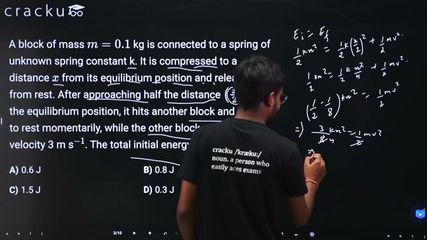
A block of mass $$m = 0.1$$ kg is connected to a spring of unknown spring constant k. It is compressed to a distance $$x$$ from its equilibrium position and released from rest. After approaching half the distance $$\left(\frac{x}{2}\right)$$ from the equilibrium position, it hits another block and comes to rest momentarily, while the other block moves with velocity 3 m s$$^{-1}$$. The total initial energy of the spring is:
A block of mass $$ m = 0.1 $$ kg is attached to a spring with an unknown spring constant $$ k $$. The block is compressed to a distance $$ x $$ from its equilibrium position and released from rest. At this initial point, the block has zero kinetic energy because it is stationary, and the total energy is stored as spring potential energy, given by $$ E_i = \frac{1}{2} k x^2 $$. This energy is conserved until the collision occurs.
As the block moves towards the equilibrium position, it reaches a point where the displacement from equilibrium is $$ \frac{x}{2} $$. At this position, the spring potential energy is $$ \frac{1}{2} k \left( \frac{x}{2} \right)^2 = \frac{1}{2} k \cdot \frac{x^2}{4} = \frac{1}{8} k x^2 $$. Let the velocity of the block at this point, just before collision, be $$ v $$. The kinetic energy at this position is $$ \frac{1}{2} m v^2 $$.
By conservation of energy between the initial compressed position and the point at $$ \frac{x}{2} $$, the initial total energy equals the sum of potential and kinetic energy at $$ \frac{x}{2} $$:
$$ \frac{1}{2} k x^2 = \frac{1}{8} k x^2 + \frac{1}{2} m v^2 $$
Subtract $$ \frac{1}{8} k x^2 $$ from both sides:
$$ \frac{1}{2} k x^2 - \frac{1}{8} k x^2 = \frac{1}{2} m v^2 $$
$$ \frac{4}{8} k x^2 - \frac{1}{8} k x^2 = \frac{1}{2} m v^2 $$
$$ \frac{3}{8} k x^2 = \frac{1}{2} m v^2 $$
Multiply both sides by 8 to eliminate the denominator:
$$ 3 k x^2 = 4 m v^2 $$
Rearrange to solve for $$ k x^2 $$:
$$ k x^2 = \frac{4 m v^2}{3} \quad \text{(Equation 1)} $$
At the displacement $$ \frac{x}{2} $$, the block collides with another block. After the collision, the first block comes to rest momentarily, and the second block moves with a velocity of 3 m/s. Let the mass of the first block be $$ m_1 = m = 0.1 $$ kg and the mass of the second block be $$ m_2 $$ (unknown). Before the collision, the second block is at rest, so its velocity is 0 m/s. After the collision, the first block has velocity 0 m/s, and the second block has velocity 3 m/s.
Apply conservation of momentum. The momentum before the collision equals the momentum after the collision:
$$ m_1 v + m_2 \cdot 0 = m_1 \cdot 0 + m_2 \cdot 3 $$
$$ m_1 v = 3 m_2 \quad \text{(Equation 2)} $$
For the collision to result in the first block stopping and the second block moving with 3 m/s, it must be an elastic collision where the masses are equal. This is a standard result for head-on elastic collisions between objects of equal mass. Thus, $$ m_1 = m_2 $$. Since $$ m_1 = 0.1 $$ kg, $$ m_2 = 0.1 $$ kg. Substitute into Equation 2:
$$ 0.1 \cdot v = 3 \cdot 0.1 $$
$$ 0.1 v = 0.3 $$
$$ v = \frac{0.3}{0.1} = 3 \text{ m/s} $$
So, the velocity of the first block just before the collision is $$ v = 3 $$ m/s.
Now substitute $$ m = 0.1 $$ kg and $$ v = 3 $$ m/s into Equation 1:
$$ k x^2 = \frac{4 \times 0.1 \times (3)^2}{3} $$
First, compute $$ (3)^2 = 9 $$:
$$ k x^2 = \frac{4 \times 0.1 \times 9}{3} $$
$$ k x^2 = \frac{4 \times 0.9}{3} $$
$$ k x^2 = \frac{3.6}{3} $$
$$ k x^2 = 1.2 $$
The initial energy of the spring is $$ E_i = \frac{1}{2} k x^2 $$:
$$ E_i = \frac{1}{2} \times 1.2 = 0.6 \text{ J} $$
Hence, the total initial energy of the spring is 0.6 J.
Therefore, the correct answer is Option A.
Was this solution helpful?
Click on the Email ☝️ to Watch the Video Solution
Create a FREE account and get:
_1.webp)

Educational materials for JEE preparation

Ask our AI anything

AI can make mistakes. Please verify important information.
AI can make mistakes. Please verify important information.
