
Join Our JEE Preparation Group
Prep with like-minded aspirants; Get access to free daily tests and study material.
Sign in
Please select an account to continue using cracku.in
↓ →
Join Our JEE Preparation Group
Prep with like-minded aspirants; Get access to free daily tests and study material.
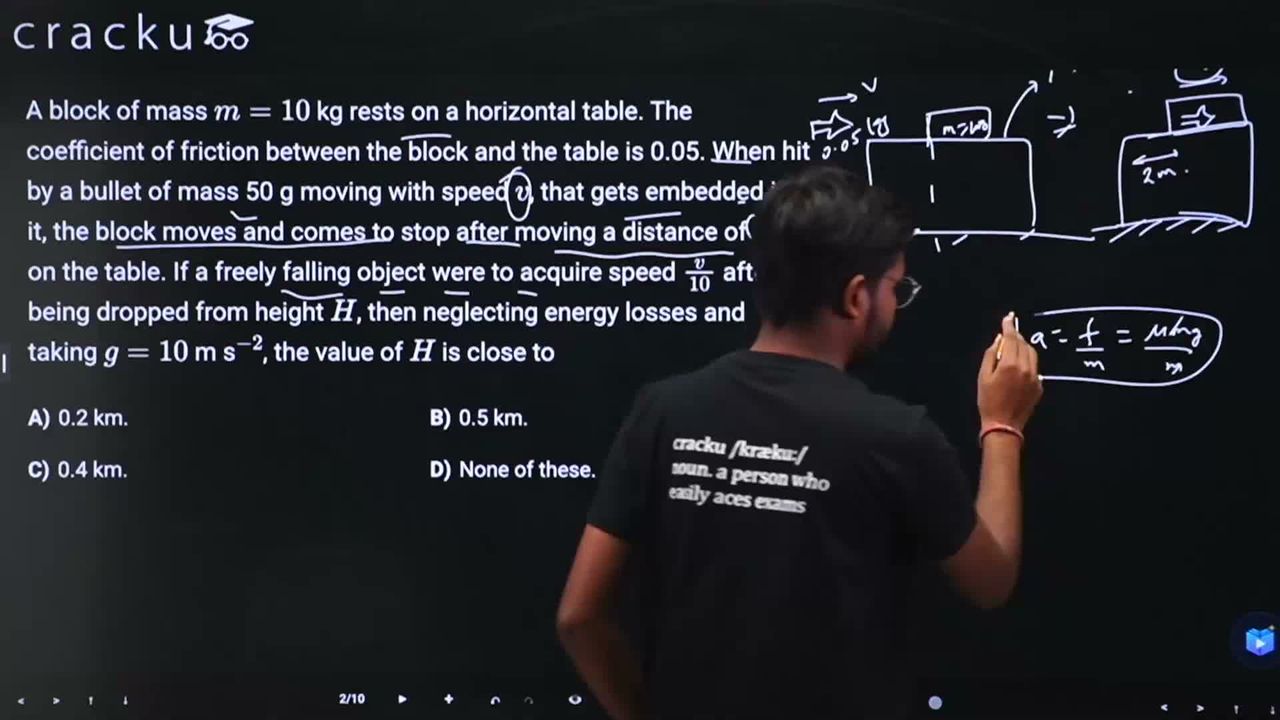
A block of mass $$m = 10$$ kg rests on a horizontal table. The coefficient of friction between the block and the table is 0.05. When hit by a bullet of mass 50 g moving with speed $$v$$, that gets embedded in it, the block moves and comes to stop after moving a distance of 2 m on the table. If a freely falling object were to acquire speed $$\frac{v}{10}$$ after being dropped from height $$H$$, then neglecting energy losses and taking $$g = 10$$ m s$$^{-2}$$, the value of $$H$$ is close to
A block of mass $$ m = 10 $$ kg rests on a horizontal table with coefficient of friction $$ \mu = 0.05 $$. A bullet of mass $$ 50 $$ g, which is $$ 0.05 $$ kg, moving with speed $$ v $$, embeds itself in the block. After the collision, the combined system moves and stops after traveling $$ 2 $$ m. We need to find the height $$ H $$ from which a freely falling object would acquire speed $$ \frac{v}{10} $$, neglecting energy losses and using $$ g = 10 $$ m/s².
First, consider the inelastic collision between the bullet and the block. Conservation of momentum applies:
Initial momentum = Momentum of bullet + Momentum of block = $$ (0.05) \times v + (10) \times 0 = 0.05v $$ kg·m/s.
After collision, the combined mass is $$ 10 + 0.05 = 10.05 $$ kg. Let the common velocity be $$ V $$.
Final momentum = $$ 10.05 \times V $$ kg·m/s.
Equating initial and final momentum:
$$ 0.05v = 10.05V $$
Solving for $$ V $$:
$$ V = \frac{0.05v}{10.05} = \frac{5v}{1005} = \frac{v}{201} $$
So, $$ V = \frac{v}{201} $$ m/s.
After the collision, the block with embedded bullet slides on the table with initial velocity $$ V $$ and stops after $$ s = 2 $$ m due to friction. The friction force causes deceleration.
The normal force $$ N $$ equals the weight of the combined system:
$$ N = (10.05) \times 10 = 100.5 \text{ N} $$
Friction force $$ f = \mu N = 0.05 \times 100.5 = 5.025 $$ N.
Deceleration $$ a = \frac{f}{\text{total mass}} = \frac{5.025}{10.05} = 0.5 $$ m/s². Alternatively, $$ a = \mu g = 0.05 \times 10 = 0.5 $$ m/s².
Using the equation of motion: final velocity² = initial velocity² + 2 × acceleration × distance
$$ 0^2 = V^2 + 2 \times (-0.5) \times 2 $$
$$ 0 = V^2 - 2 $$
$$ V^2 = 2 $$
$$ V = \sqrt{2} \text{ m/s} \quad (\text{taking positive value}) $$
But $$ V = \frac{v}{201} $$, so:
$$ \frac{v}{201} = \sqrt{2} $$
$$ v = 201 \sqrt{2} \text{ m/s} $$
Now, for the freely falling object: it starts from height $$ H $$ with initial velocity 0 and acquires speed $$ \frac{v}{10} $$ at the bottom. Using conservation of energy:
Potential energy loss = Kinetic energy gain
$$ m g H = \frac{1}{2} m \left( \frac{v}{10} \right)^2 $$
Cancel $$ m $$ from both sides:
$$ g H = \frac{1}{2} \times \frac{v^2}{100} $$
$$ 10 H = \frac{v^2}{200} $$
$$ H = \frac{v^2}{2000} $$
Substitute $$ v = 201 \sqrt{2} $$:
$$ H = \frac{(201 \sqrt{2})^2}{2000} = \frac{201^2 \times 2}{2000} $$
Calculate $$ 201^2 $$:
$$ 201^2 = (200 + 1)^2 = 200^2 + 2 \times 200 \times 1 + 1^2 = 40000 + 400 + 1 = 40401 $$
So,
$$ H = \frac{40401 \times 2}{2000} = \frac{80802}{2000} = 40.401 \text{ m} $$
Convert meters to kilometers (1 km = 1000 m):
$$ H = \frac{40.401}{1000} = 0.040401 \text{ km} $$
The options are:
A. 0.2 km
B. 0.5 km
C. 0.4 km
D. None of these
Comparing $$ H \approx 0.0404 $$ km with the options:
0.0404 km is not close to 0.2 km, 0.5 km, or 0.4 km (which are 200 m, 500 m, and 400 m respectively, while 0.0404 km is 40.4 m).
Hence, the correct answer is Option D.
Was this solution helpful?
Click on the Email ☝️ to Watch the Video Solution
Create a FREE account and get:
_1.webp)

Educational materials for JEE preparation

Ask our AI anything

AI can make mistakes. Please verify important information.
AI can make mistakes. Please verify important information.
