
Join Our JEE Preparation Group
Prep with like-minded aspirants; Get access to free daily tests and study material.
Sign in
Please select an account to continue using cracku.in
↓ →
Join Our JEE Preparation Group
Prep with like-minded aspirants; Get access to free daily tests and study material.
A proton (mass $$m$$), accelerated by a potential difference $$V$$, flies through a uniform transverse magnetic field $$B$$. The field occupies a region of the space by a width $$d$$. Let $$\alpha$$ be the angle of deviation of the proton from the initial direction of motion (see the figure), then the value of $$\sin \alpha$$ will be:
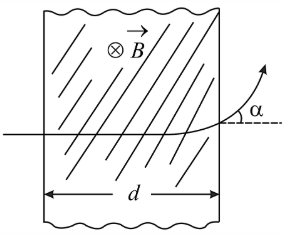
When a proton of mass $$m$$ and charge $$q$$ is accelerated through a potential difference $$V$$, it gains kinetic energy.
$$\frac{1}{2}mv^2 = qV \implies v = \sqrt{\frac{2qV}{m}}$$
As the proton enters the uniform transverse magnetic field $$B$$, it experiences a Lorentz force that causes it to move in a circular arc of radius $$R$$. The magnetic force provides the necessary centripetal force.
$$qvB = \frac{mv^2}{R}$$
$$R = \frac{mv}{qB}$$
$$R = \frac{m}{qB} \sqrt{\frac{2qV}{m}} = \frac{1}{B} \sqrt{\frac{2mV}{q}}$$
In the right-angled triangle formed by the radius and the width of the field, $$\sin \alpha = \frac{d}{R}$$
$$\sin \alpha = \frac{d}{\frac{1}{B} \sqrt{\frac{2mV}{q}}}$$
$$\sin \alpha = Bd \frac{1}{\sqrt{\frac{2mV}{q}}}$$
$$\sin \alpha = Bd \sqrt{\frac{q}{2mV}}$$
Was this solution helpful?
Create a FREE account and get:
_1.webp)

Educational materials for JEE preparation

Ask our AI anything

AI can make mistakes. Please verify important information.
AI can make mistakes. Please verify important information.
