
Join Our JEE Preparation Group
Prep with like-minded aspirants; Get access to free daily tests and study material.
Sign in
Please select an account to continue using cracku.in
↓ →
Join Our JEE Preparation Group
Prep with like-minded aspirants; Get access to free daily tests and study material.
Which of the following is not an assumption of the kinetic theory of gases?
The kinetic theory of gases is based on several key assumptions that help explain the behavior of ideal gases. Let's recall these assumptions:
1. A gas is composed of a large number of identical particles (atoms or molecules) that are in continuous, random motion.
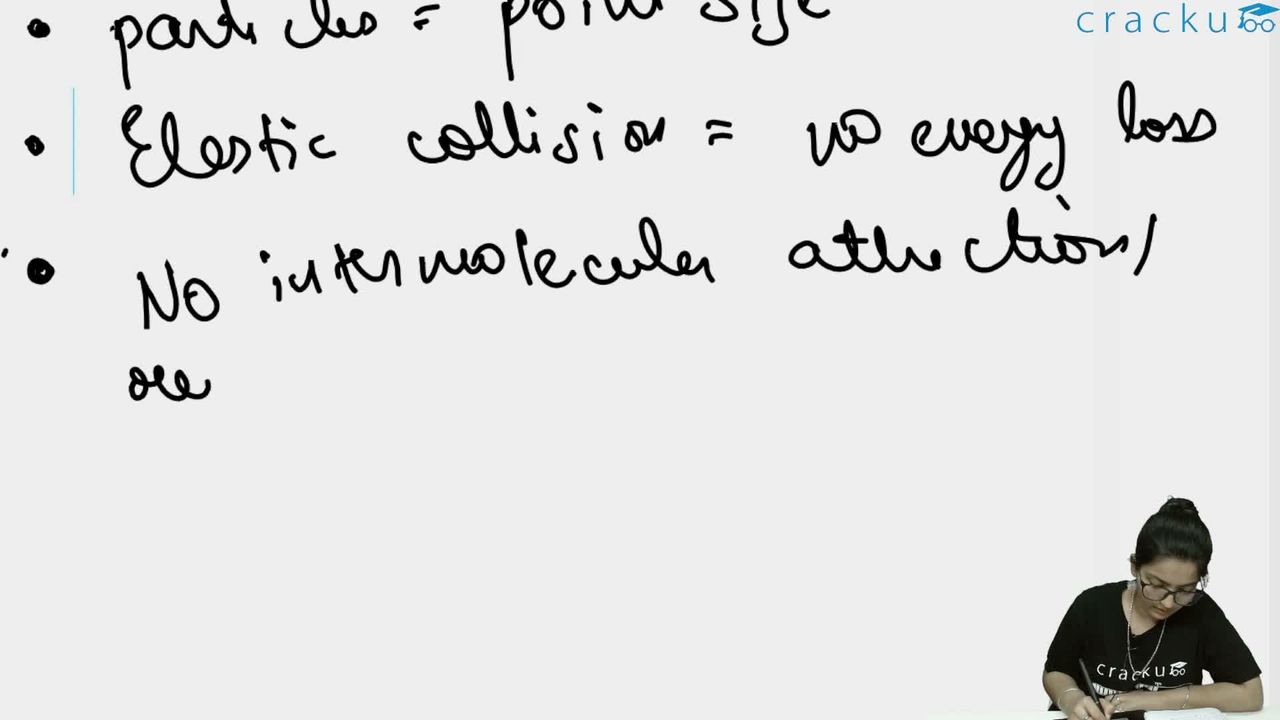
2. The volume occupied by the gas particles themselves is negligible compared to the total volume of the gas (i.e., the particles are considered point masses).
3. The collisions between gas particles and between particles and the container walls are perfectly elastic, meaning no kinetic energy is lost during collisions.
4. There are no intermolecular forces of attraction or repulsion between the gas particles, except during collisions.
5. The average kinetic energy of the gas particles is directly proportional to the absolute temperature of the gas.
Now, let's evaluate each option:
Option A states: "Collisions of gas particles are perfectly elastic." This matches assumption 3 above. Therefore, this is an assumption of the kinetic theory.
Option B states: "A gas consists of many identical particles which are in continual motion." This matches assumption 1 above. Therefore, this is an assumption of the kinetic theory.
Option C states: "At high pressure, gas particles are difficult to compress." This is not an assumption of the kinetic theory. The theory assumes that gas particles have negligible volume at all pressures, and it does not claim that particles themselves become difficult to compress. In reality, at high pressures, real gases deviate from ideal behavior because the volume of the particles becomes significant, but this is a limitation of the theory, not an assumption. The kinetic theory does not include any condition about compressibility changing with pressure.
Option D states: "Gas particles have negligible volume." This directly matches assumption 2 above. Therefore, this is an assumption of the kinetic theory.
After reviewing all options, we see that option C is not an assumption of the kinetic theory of gases.
Hence, the correct answer is Option C.
Was this solution helpful?
Click on the Email ☝️ to Watch the Video Solution
Create a FREE account and get:
_1.webp)

Educational materials for JEE preparation

Ask our AI anything

AI can make mistakes. Please verify important information.
AI can make mistakes. Please verify important information.
