
Join Our JEE Preparation Group
Prep with like-minded aspirants; Get access to free daily tests and study material.
Sign in
Please select an account to continue using cracku.in
↓ →
Join Our JEE Preparation Group
Prep with like-minded aspirants; Get access to free daily tests and study material.
Let the sum of the first three terms of an A.P. be 39 and the sum of its last four terms be 178. If the first term of this A.P. is 10, then the median of the A.P. is:
We are told that the first term of the arithmetic progression (A.P.) is $$a_1 = 10$$. Let the common difference be $$d$$ and let the total number of terms be $$n$$. In an A.P. every term is obtained from the previous one by adding the common difference, so in general we have the formula
$$a_k = a_1 + (k-1)d.$$
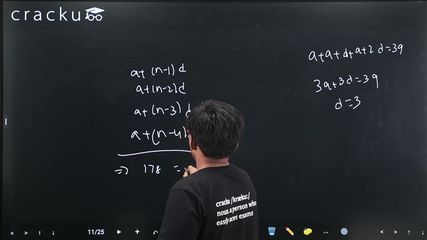
First, we use the information about the sum of the first three terms. The first three terms are $$a_1,\; a_2,\; a_3$$, and their sum is given to be $$39$$. Writing each term with the above formula:
$$a_1 + a_2 + a_3 \;=\; 10 + \bigl(10 + d\bigr) + \bigl(10 + 2d\bigr) = 39.$$
Simplifying the left side step by step, we collect all constants and all $$d$$ terms:
$$10 + 10 + 10 + d + 2d = 39 \quad\Longrightarrow\quad 30 + 3d = 39.$$
Subtracting $$30$$ from both sides, we have
$$3d = 9.$$
Now we divide by $$3$$:
$$d = 3.$$
So the common difference of the A.P. is $$3$$, and the sequence begins
$$10,\; 13,\; 16,\; 19,\dots$$
Next, we are told that the sum of the last four terms equals $$178$$. Let the last (i.e. $$n^{\text{th}}$$) term be $$a_n$$. Then the last four terms are $$a_{n-3},\; a_{n-2},\; a_{n-1},\; a_n.$$ Using the general term formula with $$d=3$$, we write each explicitly:
$$$ \begin{aligned} a_n &= 10 + 3(n-1) = 3n + 7,\\ a_{n-1} &= 10 + 3(n-2) = 3n + 4,\\ a_{n-2} &= 10 + 3(n-3) = 3n + 1,\\ a_{n-3} &= 10 + 3(n-4) = 3n - 2. \end{aligned} $$$
Adding these four expressions, we get their sum:
$$$ (3n + 7) + (3n + 4) + (3n + 1) + (3n - 2) = 12n + 10. $$$
We are told this sum equals $$178$$, so
$$12n + 10 = 178.$$
Subtracting $$10$$ from both sides,
$$12n = 168.$$
Dividing by $$12$$,
$$n = 14.$$
Thus the progression has $$14$$ terms. The median of an ordered list with an even number of entries is the average of the middle two terms, i.e. the $$\frac{n}{2}$$-th and $$\bigl(\frac{n}{2}+1\bigr)$$-th terms. Here $$n=14$$, so we need the $$7^{\text{th}}$$ and $$8^{\text{th}}$$ terms.
Using $$a_k = 10 + 3(k-1)$$ again, we compute
$$$ \begin{aligned} a_7 &= 10 + 3(7-1) = 10 + 18 = 28,\\ a_8 &= 10 + 3(8-1) = 10 + 21 = 31. \end{aligned} $$$
The median is their average:
$$\text{Median} \;=\; \frac{a_7 + a_8}{2} = \frac{28 + 31}{2} = \frac{59}{2} = 29.5.$$
Hence, the correct answer is Option B.
Was this solution helpful?
Click on the Email ☝️ to Watch the Video Solution
Create a FREE account and get:
_1.webp)

Educational materials for JEE preparation

Ask our AI anything

AI can make mistakes. Please verify important information.
AI can make mistakes. Please verify important information.
