
Join Our JEE Preparation Group
Prep with like-minded aspirants; Get access to free daily tests and study material.
Sign in
Please select an account to continue using cracku.in
↓ →
Join Our JEE Preparation Group
Prep with like-minded aspirants; Get access to free daily tests and study material.
A thin disc of radius $$b = 2a$$ has a concentric hole of radius $$a$$ in it (see figure). It carries uniform surface charge $$\sigma$$ on it. If the electric field on its axis at a height h (h $$<<$$ a) from its centre is given as Ch then the value of C is
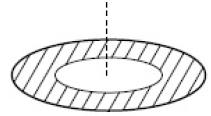
The electric field on the axis of a uniform solid disc of radius $$R$$ at a height $$h$$ from its center is:
$$E = \frac{\sigma}{2\epsilon_0} \left( 1 - \frac{h}{\sqrt{R^2 + h^2}} \right)$$
$$E_{net} = E_b - E_a$$
$$E_{net} = \frac{\sigma}{2\epsilon_0} \left( 1 - \frac{h}{\sqrt{b^2 + h^2}} \right) - \frac{\sigma}{2\epsilon_0} \left( 1 - \frac{h}{\sqrt{a^2 + h^2}} \right)$$
$$E_{net} = \frac{\sigma}{2\epsilon_0} \left( \frac{h}{\sqrt{a^2 + h^2}} - \frac{h}{\sqrt{b^2 + h^2}} \right)$$
$$E_{net} = \frac{\sigma h}{2\epsilon_0} \left[ \frac{1}{a\sqrt{1 + \frac{h^2}{a^2}}} - \frac{1}{b\sqrt{1 + \frac{h^2}{b^2}}} \right]$$
Since $$h \ll a$$ (and consequently $$h \ll b$$), $$\sqrt{1 + \frac{h^2}{a^2}} \approx 1 \quad \text{and} \quad \sqrt{1 + \frac{h^2}{b^2}} \approx 1$$
$$E_{net} \approx \frac{\sigma h}{2\epsilon_0} \left[ \frac{1}{a} - \frac{1}{b} \right]$$
$$E_{net} = \frac{\sigma h}{2\epsilon_0} \left[ \frac{1}{a} - \frac{1}{2a} \right]$$
$$E_{net} = \left( \frac{\sigma}{4a\epsilon_0} \right) h$$
$$C = \frac{\sigma}{4a\epsilon_0}$$
Was this solution helpful?
Create a FREE account and get:
_1.webp)

Educational materials for JEE preparation

Ask our AI anything

AI can make mistakes. Please verify important information.
AI can make mistakes. Please verify important information.
