
Join Our JEE Preparation Group
Prep with like-minded aspirants; Get access to free daily tests and study material.
Sign in
Please select an account to continue using cracku.in
↓ →
Join Our JEE Preparation Group
Prep with like-minded aspirants; Get access to free daily tests and study material.
Shown in the figure are two point charges $$+Q$$ and $$-Q$$ inside the cavity of a spherical shell. The charges are kept near the surface of the cavity on opposite sides of the centre of the shell. If $$\sigma_1$$ is the surface charge on the inner surface and $$Q_1$$ net charge on it and $$\sigma_2$$ the surface charge on the outer surface and $$Q_2$$ net charge on it then:
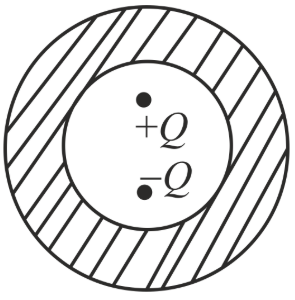
1. Inner surface:
According to Gauss’s Law, the electric field inside the material of a conducting shell must be zero ($$\vec{E} = 0$$). If we draw a Gaussian surface entirely within the metal of the shell, the total enclosed charge must be zero. $$Q_{enclosed} = Q_{net, cavity} + Q_1 = 0$$
Net Charge ($$Q_1$$): Since the charges inside the cavity are $$+Q$$ and $$-Q$$, their sum is zero. Therefore, $$0 + Q_1 = 0 \implies \mathbf{Q_1 = 0}$$.
Surface Density ($$\sigma_1$$): Although the net charge is zero, the point charges inside are not at the same location. The $$+Q$$ charge will attract negative charges to the nearby inner surface, and the $$-Q$$ charge will attract positive charges. This electrostatic induction causes a redistribution of charge.
Because the distribution is not uniform, the surface charge density $$\sigma_1 \neq 0$$ (it is positive in some areas and negative in others).
2. Outer surface:
The shielding effect of a conductor means that the distribution of charges on the outer surface depends only on the net charge enclosed by the shell and any external electric fields.
Net Charge ($$Q_2$$): Since the shell is neutral and the net charge induced on the inner surface ($$Q_1$$) is zero, the net charge on the outer surface must also be $$Q_2 = 0$$ to maintain charge conservation.
Surface Density ($$\sigma_2$$): Because the net charge enclosed by the inner surface is zero, there is no net electric flux leaking out to induce a charge on the exterior. In the absence of an external field, the charge remains perfectly balanced.
Therefore, the outer surface charge density is $$\sigma_2 = 0$$.
$$\sigma_1 \neq 0, Q_1 = 0, \sigma_2 = 0, Q_2 = 0$$
Was this solution helpful?
Create a FREE account and get:
_1.webp)

Educational materials for JEE preparation

Ask our AI anything

AI can make mistakes. Please verify important information.
AI can make mistakes. Please verify important information.
