
Join Our JEE Preparation Group
Prep with like-minded aspirants; Get access to free daily tests and study material.
Sign in
Please select an account to continue using cracku.in
↓ →
Join Our JEE Preparation Group
Prep with like-minded aspirants; Get access to free daily tests and study material.
If two glass plates have water between them and are separated by very small distance (see the figure below), it is very difficult to pull them apart. It is because the water in between forms cylindrical surface on the side that gives rise to lower pressure in the water in comparison to atmosphere. If the radius of the cylindrical surface is R and surface tension of water is T then the pressure in water between the plates is lower by:
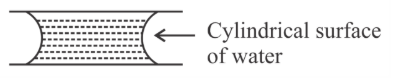
The pressure difference ($$\Delta P$$) across a curved liquid surface is determined by the surface tension ($$T$$) and the two principal radii of curvature ($$R_1$$ and $$R_2$$) is $$\Delta P = T \left[ \frac{1}{R_1} + \frac{1}{R_2} \right]$$
This excess pressure is the same as the excess pressure inside a drop or air bubble.
So, $$R_1 = R_2 = R$$
$$\Delta P = T \left[ \frac{1}{R} + \frac{1}{R} \right]$$
$$\Delta P = \frac{2T}{R}$$
Was this solution helpful?
Click on the Email ☝️ to Watch the Video Solution
Create a FREE account and get:
_1.webp)

Educational materials for JEE preparation

Ask our AI anything

AI can make mistakes. Please verify important information.
AI can make mistakes. Please verify important information.
