
Join Our JEE Preparation Group
Prep with like-minded aspirants; Get access to free daily tests and study material.
Sign in
Please select an account to continue using cracku.in
↓ →
Join Our JEE Preparation Group
Prep with like-minded aspirants; Get access to free daily tests and study material.
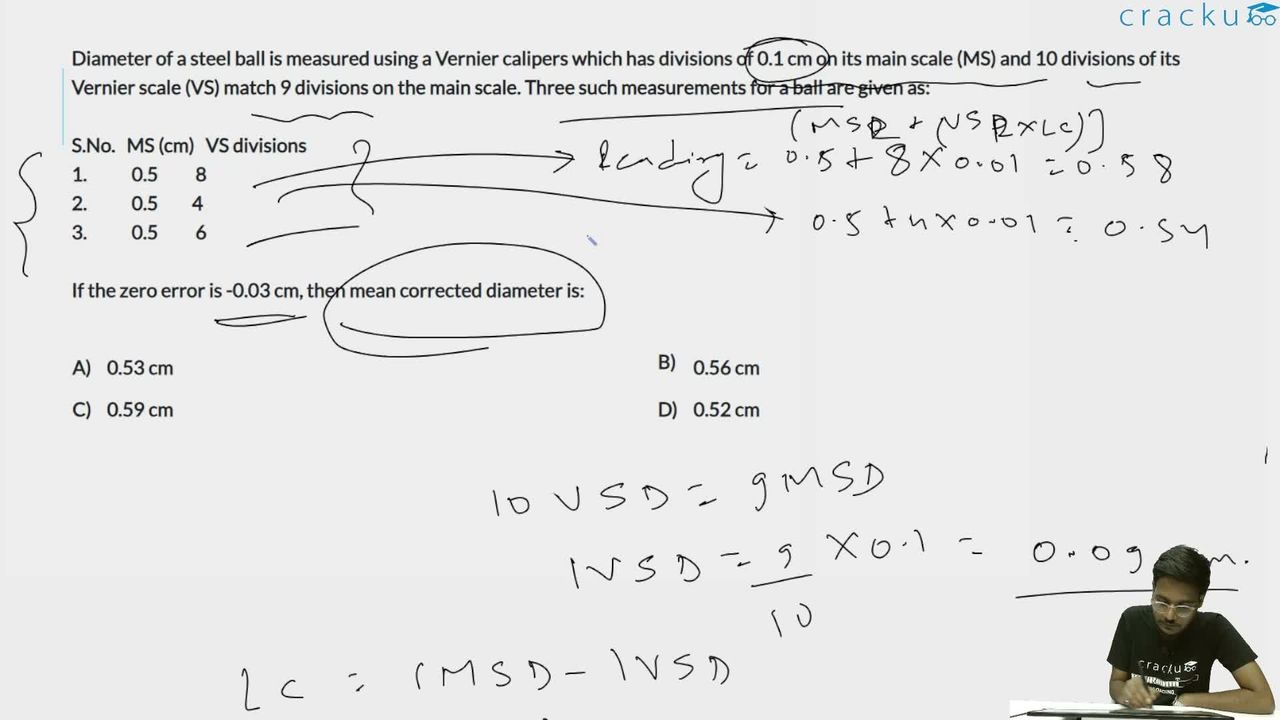
Diameter of a steel ball is measured using a Vernier calipers which has divisions of 0.1 cm on its main scale (MS) and 10 divisions of its Vernier scale (VS) match 9 divisions on the main scale. Three such measurements for a ball are given as:
S.No. MS (cm) VS divisions
1. 0.5 8
2. 0.5 4
3. 0.5 6
If the zero error is -0.03 cm, then mean corrected diameter is:
The Vernier calipers have main scale divisions of 0.1 cm each. Given that 10 divisions of the Vernier scale match 9 divisions of the main scale, we first determine the least count (LC), which is the smallest measurement the calipers can make.
The value of one main scale division (MSD) is 0.1 cm. Since 10 Vernier scale divisions (VSD) equal 9 MSD, one VSD is calculated as:
$$ \text{One VSD} = \frac{9 \times \text{MSD}}{10} = \frac{9 \times 0.1}{10} = \frac{0.9}{10} = 0.09 \text{ cm}. $$
The least count is the difference between one MSD and one VSD:
$$ \text{LC} = \text{MSD} - \text{VSD} = 0.1 - 0.09 = 0.01 \text{ cm}. $$
Alternatively, LC can be found using the formula:
$$ \text{LC} = \frac{\text{Value of one MSD}}{\text{Number of divisions on Vernier scale}} = \frac{0.1}{10} = 0.01 \text{ cm}. $$
Now, we have three measurements:
The observed reading for each measurement is given by:
$$ \text{Observed reading} = \text{MSR} + (\text{VSR} \times \text{LC}). $$
Calculating for each:
For S.No. 1:
$$ \text{Observed reading} = 0.5 + (8 \times 0.01) = 0.5 + 0.08 = 0.58 \text{ cm}. $$
For S.No. 2:
$$ \text{Observed reading} = 0.5 + (4 \times 0.01) = 0.5 + 0.04 = 0.54 \text{ cm}. $$
For S.No. 3:
$$ \text{Observed reading} = 0.5 + (6 \times 0.01) = 0.5 + 0.06 = 0.56 \text{ cm}. $$
The zero error is given as -0.03 cm. Zero error is subtracted from the observed reading to get the corrected reading:
$$ \text{Corrected reading} = \text{Observed reading} - (\text{Zero error}). $$
Since zero error is negative, subtracting a negative is equivalent to adding the absolute value:
$$ \text{Corrected reading} = \text{Observed reading} - (-0.03) = \text{Observed reading} + 0.03. $$
Correcting each observed reading:
For S.No. 1:
$$ \text{Corrected reading} = 0.58 + 0.03 = 0.61 \text{ cm}. $$
For S.No. 2:
$$ \text{Corrected reading} = 0.54 + 0.03 = 0.57 \text{ cm}. $$
For S.No. 3:
$$ \text{Corrected reading} = 0.56 + 0.03 = 0.59 \text{ cm}. $$
The corrected diameters are 0.61 cm, 0.57 cm, and 0.59 cm. The mean corrected diameter is the average of these three values:
$$ \text{Sum} = 0.61 + 0.57 + 0.59 = 1.77 \text{ cm}. $$
$$ \text{Number of readings} = 3. $$
$$ \text{Mean} = \frac{\text{Sum}}{\text{Number of readings}} = \frac{1.77}{3} = 0.59 \text{ cm}. $$
Hence, the mean corrected diameter is 0.59 cm. Comparing with the options:
So, the answer is Option C.
Was this solution helpful?
Click on the Email ☝️ to Watch the Video Solution
Create a FREE account and get:
_1.webp)

Educational materials for JEE preparation

Ask our AI anything

AI can make mistakes. Please verify important information.
AI can make mistakes. Please verify important information.
