
Join Our JEE Preparation Group
Prep with like-minded aspirants; Get access to free daily tests and study material.
Sign in
Please select an account to continue using cracku.in
↓ →
Join Our JEE Preparation Group
Prep with like-minded aspirants; Get access to free daily tests and study material.
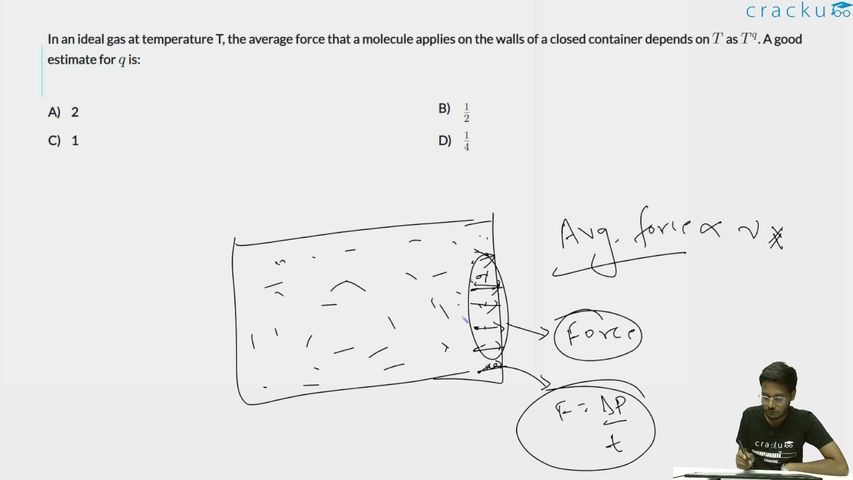
In an ideal gas at temperature T, the average force that a molecule applies on the walls of a closed container depends on $$T$$ as $$T^q$$. A good estimate for $$q$$ is:
To solve this problem, we need to determine how the average force exerted by a single molecule on the walls of a closed container depends on the temperature $$T$$ for an ideal gas. Specifically, we are told that this force varies as $$T^q$$, and we must find the exponent $$q$$.
First, recall that the pressure $$P$$ exerted by an ideal gas is given by the kinetic theory equation:
$$ P = \frac{1}{3} \rho \overline{v^2} $$
where $$\rho$$ is the density (mass per unit volume) and $$\overline{v^2}$$ is the mean square speed of the molecules. Since $$\rho = \frac{N m}{V}$$, where $$N$$ is the number of molecules, $$m$$ is the mass of one molecule, and $$V$$ is the volume, we can write:
$$ P = \frac{1}{3} \frac{N m}{V} \overline{v^2} $$
From the kinetic theory of gases, the average kinetic energy per molecule is related to the temperature $$T$$ by:
$$ \frac{1}{2} m \overline{v^2} = \frac{3}{2} k T $$
where $$k$$ is Boltzmann's constant. Solving for $$\overline{v^2}$$:
$$ \overline{v^2} = \frac{3 k T}{m} $$
Substitute this into the pressure equation:
$$ P = \frac{1}{3} \frac{N m}{V} \cdot \frac{3 k T}{m} $$
Simplify by canceling $$m$$ and the factor of 3:
$$ P = \frac{N k T}{V} $$
This is the ideal gas law in terms of the number of molecules.
Now, pressure is force per unit area, so the total force on a wall of area $$A$$ is $$F_{\text{total}} = P A$$. Substituting the expression for $$P$$:
$$ F_{\text{total}} = \frac{N k T}{V} A $$
This total force is the result of all molecules colliding with the wall. However, we need the average force exerted by a single molecule. Since the molecules are identical and the gas is isotropic, the total average force on the wall is the sum of the average forces from each molecule. Therefore:
$$ F_{\text{total}} = N \overline{F} $$
where $$\overline{F}$$ is the average force per molecule. Equating the two expressions for $$F_{\text{total}}$$:
$$ N \overline{F} = \frac{N k T}{V} A $$
Divide both sides by $$N$$:
$$ \overline{F} = \frac{k T A}{V} $$
For a closed container, both the area $$A$$ of the wall and the volume $$V$$ are constant. Therefore, the average force per molecule $$\overline{F}$$ is proportional to $$T$$:
$$ \overline{F} \propto T $$
This implies that $$\overline{F}$$ depends on $$T$$ as $$T^q$$ with $$q = 1$$.
Hence, the correct answer is Option C.
Was this solution helpful?
Click on the Email ☝️ to Watch the Video Solution
Create a FREE account and get:
_1.webp)

Educational materials for JEE preparation

Ask our AI anything

AI can make mistakes. Please verify important information.
AI can make mistakes. Please verify important information.
