
Join Our JEE Preparation Group
Prep with like-minded aspirants; Get access to free daily tests and study material.
Sign in
Please select an account to continue using cracku.in
↓ →
Join Our JEE Preparation Group
Prep with like-minded aspirants; Get access to free daily tests and study material.
A parallel beam of electrons travelling in x - direction falls on a slit of width d (see the figure below). If after passing the slit, an electron acquires momentum $$p_y$$ in the y - direction, then for a majority of electrons passing through the slit (h is Planck's constant):
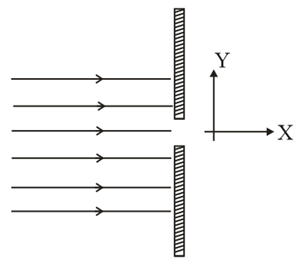
The uncertainty in the y-position ($$\Delta y$$) is approximately equal to the width of the slit, $$\Delta y \approx d$$
According to Heisenberg’s Uncertainty Principle, $$\Delta y \cdot \Delta p_y \ge \frac{h}{4\pi}$$. This implies that by restricting the position, an uncertainty in the y-momentum ($$\Delta p_y$$) is inevitably introduced.
$$d \sin \theta = \lambda$$, where $$\lambda$$ is the de Broglie wavelength ($$\lambda = \frac{h}{p}$$)
The y-component of momentum for an electron deflected at an angle $$\theta$$ is $$p_y = p \sin \theta$$
$$p_y = p \left( \frac{\lambda}{d} \right)$$
$$p_y = \frac{h}{d} \implies p_y d = h$$
The relationship $$p_y d = h$$ corresponds to the electrons reaching the first minimum of the diffraction pattern. However, the question asks for the majority of electrons.
The majority of electrons fall within the central maximum of the diffraction pattern. For these electrons, the angle of deviation is less than the angle of the first minimum. Consequently, their y-momentum magnitude $$|p_y|$$ is less than $$\frac{h}{d}$$.
Therefore, $$|p_y| < \frac{h}{d}$$
$$|p_y| d < h$$
Was this solution helpful?
Create a FREE account and get:
_1.webp)

Educational materials for JEE preparation

Ask our AI anything

AI can make mistakes. Please verify important information.
AI can make mistakes. Please verify important information.
