
Join Our JEE Preparation Group
Prep with like-minded aspirants; Get access to free daily tests and study material.
Sign in
Please select an account to continue using cracku.in
↓ →
Join Our JEE Preparation Group
Prep with like-minded aspirants; Get access to free daily tests and study material.
A uniform solid cylindrical roller of mass $$m$$ is being pulled on a horizontal surface with force $$F$$ parallel to the surface and applied at its centre. If the acceleration of the cylinder is $$a$$ and it is rolling without slipping then the value of $$F$$ is:
A uniform solid cylinder of mass $$m$$ is being pulled horizontally with a force $$F$$ applied at its center. The cylinder rolls without slipping and has a linear acceleration $$a$$. We need to find the value of $$F$$ in terms of $$m$$ and $$a$$.
Since the cylinder is rolling without slipping, both translational and rotational motions occur. We will apply Newton's second law for translation and the torque equation for rotation.
Consider the forces acting on the cylinder. The applied force $$F$$ acts horizontally at the center. Friction acts at the point of contact with the ground. Let $$f$$ be the friction force. Since the cylinder is accelerating to the right and rolling clockwise, friction opposes the applied force and acts to the left. This friction provides the torque for rotation.
Apply Newton's second law for translational motion in the horizontal direction. The net force equals mass times acceleration:
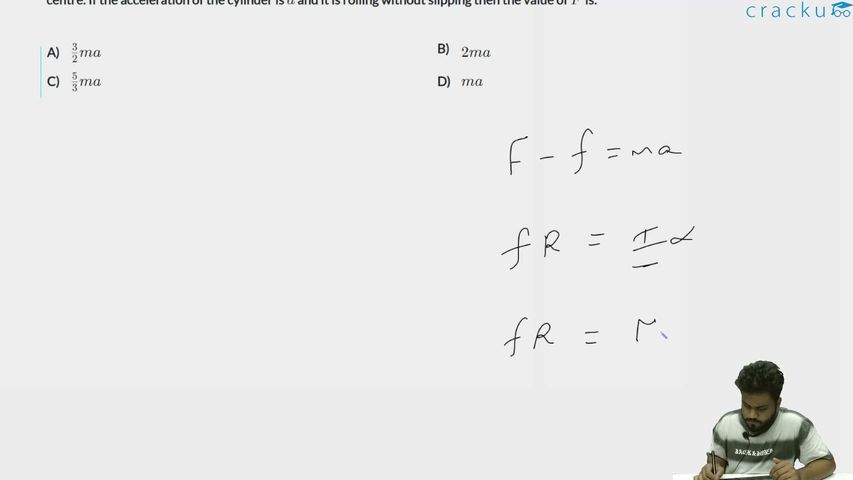
$$F - f = m a \quad \text{(Equation 1)}$$
Now, consider rotation about the center of the cylinder. The applied force $$F$$ acts at the center, so its torque is zero. The friction force $$f$$ acts at the rim, so its torque is $$f \times R$$, where $$R$$ is the radius. This torque causes angular acceleration.
The moment of inertia $$I$$ of a solid cylinder about its central axis is $$I = \frac{1}{2} m R^2$$. Let $$\alpha$$ be the angular acceleration. The torque equation is:
$$\text{Torque} = I \alpha$$
$$f R = \left( \frac{1}{2} m R^2 \right) \alpha \quad \text{(Equation 2)}$$
Simplify Equation 2 by dividing both sides by $$R$$:
$$f = \frac{1}{2} m R \alpha \quad \text{(Equation 2a)}$$
Since the cylinder rolls without slipping, the linear acceleration $$a$$ and angular acceleration $$\alpha$$ are related by:
$$a = R \alpha \quad \text{(Equation 3)}$$
Solve Equation 3 for $$\alpha$$:
$$\alpha = \frac{a}{R}$$
Substitute $$\alpha = \frac{a}{R}$$ into Equation 2a:
$$f = \frac{1}{2} m R \times \frac{a}{R}$$
Simplify by canceling $$R$$:
$$f = \frac{1}{2} m a \quad \text{(Equation 4)}$$
Now substitute Equation 4 into Equation 1:
$$F - \frac{1}{2} m a = m a$$
Solve for $$F$$:
$$F = m a + \frac{1}{2} m a$$
$$F = \left(1 + \frac{1}{2}\right) m a$$
$$F = \frac{3}{2} m a$$
Comparing with the options, $$\frac{3}{2} m a$$ corresponds to Option A.
Hence, the correct answer is Option A.
Was this solution helpful?
Click on the Email ☝️ to Watch the Video Solution
Create a FREE account and get:
_1.webp)

Educational materials for JEE preparation

Ask our AI anything

AI can make mistakes. Please verify important information.
AI can make mistakes. Please verify important information.
