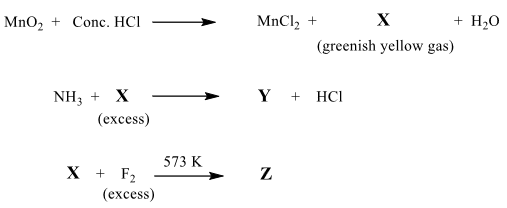
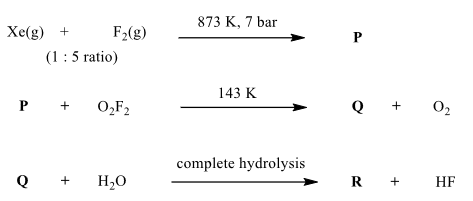
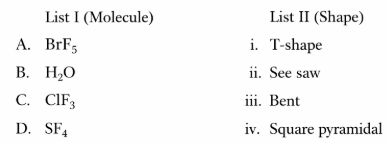
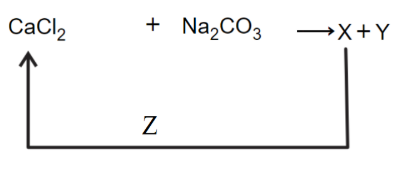
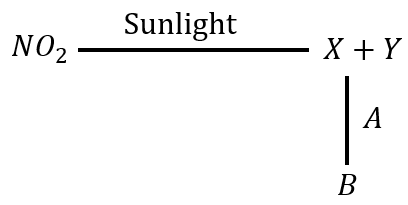
Correct statement(s) about the compounds $$\mathbf{X}$$, $$\mathbf{Y}$$ and $$\mathbf{Z}$$ is(are)
Sign in
Please select an account to continue using cracku.in
↓ →
Join Our JEE Preparation Group
Prep with like-minded aspirants; Get access to free daily tests and study material.
Correct statement(s) about the compounds $$\mathbf{X}$$, $$\mathbf{Y}$$ and $$\mathbf{Z}$$ is(are)
Correct statement(s) about the compounds P, Q and R is(are)
It is noticed that $$Pb^{2+}$$ is more stable than $$Pb^{4+}$$ but $$Sn^{2+}$$ is less stable than $$Sn^{4+}$$
Observe the following reactions.
$$ PbO_2+Pb\rightarrow 2PbO;\triangle_rG^{o}(1) $$
$$ SnO_2+Sn\rightarrow 2SnO;\triangle_rG^{o}(2) $$
Identify the correct set from the following
For any reaction under standard conditions, the criterion for spontaneity is given by the sign of the standard Gibbs free energy change:
$$\Delta_{r}G^{o} \; \lt \; 0\quad\text{(reaction is spontaneous)}$$
$$\Delta_{r}G^{o} \; \gt \; 0\quad\text{(reaction is non-spontaneous)}$$
Case 1: Reaction $$PbO_{2} + Pb \;\longrightarrow\; 2\,PbO$$
Oxidation states involved are $$Pb(+4)$$ in $$PbO_{2}$$, $$Pb(0)$$, and $$Pb(+2)$$ in $$PbO$$. It is given that $$Pb^{2+}$$ is more stable than both $$Pb^{4+}$$ and $$Pb^{0}$$. Therefore the reaction that converts $$Pb(+4)$$ and $$Pb(0)$$ into the more stable $$Pb(+2)$$ will proceed spontaneously.
Hence for reaction (1): $$\Delta_{r}G^{o}(1) \; \lt \; 0$$.
Case 2: Reaction $$SnO_{2} + Sn \;\longrightarrow\; 2\,SnO$$
Oxidation states involved are $$Sn(+4)$$ in $$SnO_{2}$$, $$Sn(0)$$, and $$Sn(+2)$$ in $$SnO$$. It is given that $$Sn^{4+}$$ is more stable than both $$Sn^{2+}$$ and $$Sn^{0}$$. Thus the reverse reaction
$$2\,SnO \;\longrightarrow\; SnO_{2} + Sn$$
is spontaneous, implying the forward reaction is non-spontaneous.
Therefore for reaction (2): $$\Delta_{r}G^{o}(2) \; \gt \; 0$$.
Thus the correct signs are $$\Delta_{r}G^{o}(1)\; \lt \;0$$ and $$\Delta_{r}G^{o}(2)\; \gt \;0$$. This corresponds to Option B.
The correct statements from the following are:
A. Ionic radii of trivalent cations of group 13 elements decreases down the group.
B. Electronegativity of group 13 elements decreases down the group.
C. Among the group 13 elements, Boron has highest first ionisation enthalpy.
D. The trichloride and triiodide of group 13 elements are covalent in nature.
Choose the correct answer from the options given below :
"X" is an oxoanion of the lightest element of group 7 (in the periodic table). The metal is in +6 oxidation state in "X". The color of the potassium salt of X is
We need to identify the oxoanion X of the lightest element of group 7, with metal in +6 oxidation state.
First, the lightest element of group 7 (Group VIIB / Mn group) is Manganese (Mn).
Next, Mn in +6 oxidation state forms the manganate ion: $$MnO_4^{2-}$$. Check: Mn + 4(-2) = -2, so Mn = +6. ✓
Then, potassium manganate $$K_2MnO_4$$ has a green color (this is different from $$KMnO_4$$ which is purple, and $$K_2Cr_2O_7$$ which is orange).
Therefore, the color is Option 4: green.
Given below are two statements:
Statement I: The correct order of electronegativity of fluorine, oxygen and nitrogen is $$F > O > N$$.
Statement II: The oxidation state of oxygen in $$OF_2$$ is +2 and in $$Na_2O$$ is $$-2$$.
In the light of the above statements, choose the correct answer from the options given below
Statement I: The correct order of electronegativity of fluorine, oxygen and nitrogen is $$F > O > N$$.
Correct,
Electronegativity increases across a period in the periodic table from left to right.
As nitrogen, oxygen, and fluorine all belong to the same period and follow this trend, fluorine is the most electronegative element, followed by oxygen, and then nitrogen (forming the exact order $$F > O > N$$.
Statement II: The oxidation state of oxygen in $$OF_2$$ is +2 and in $$Na_2O$$ is $$-2$$.
Correct,
For $$OF_2$$,
Since, fluorine is $$-1$$
$$x+\left(-1\right)\times\ 2=0$$
$$x=+2$$
For $$Na_2O$$,
Since, sodium is always $$+1$$
$$\left(+1\right)\times\ 2+x=0$$
$$x=-2$$
Therefore, Statement II is also correct.
Hence, it is Option A$$\longrightarrow\ $$ Both Statement I and Statement II are true.
Given below are two statements:
$$\textbf{Statement I :}$$ The number of pairs among $$[\text{Al}_2\text{O}_3, \text{Cr}_2\text{O}_3]$$, $$[\text{Cl}_2\text{O}_7, \text{Mn}_2\text{O}_7]$$, $$[\text{Na}_2\text{O}, \text{V}_2\text{O}_3]$$ and $$[\text{CO}, \text{N}_2\text{O}]$$ that contain oxides of same nature (acidic, basic, neutral or amphoteric) is 4.
$$\textbf{Statement II :}$$ Among $$\text{Na}_2\text{O}$$, $$\text{Al}_2\text{O}_3$$, $$\text{CO}$$ and $$\text{Cl}_2\text{O}_7$$, the most basic and acidic oxides are $$\text{Na}_2\text{O}$$ and $$\text{Cl}_2\text{O}_7$$, respectively.
In the light of the above statements, choose the correct answer from the options given below:
The correct set that contains all kinds (basic, acidic, amphoteric and neutral) of oxides is :
An oxide is classified as:
• Basic oxide - reacts with acids to give salt + water.
• Acidic oxide - reacts with bases to give salt + water (often an anhydride of an oxy-acid).
• Amphoteric oxide - reacts with both acids and bases.
• Neutral oxide - shows neither basic nor acidic behaviour (does not react with either dilute acids or dilute bases).
We need one oxide of each type in the same option.
Checking Option C : $$K_2O,\, Cl_2O_7,\, As_2O_3,\, NO$$
1. $$K_2O$$ - metal oxide of an alkali metal. It dissolves in water giving $$2KOH$$, a strong base. Hence it is a basic oxide.
2. $$Cl_2O_7$$ - highest oxide of chlorine; in water it forms $$2HClO_4$$. Therefore it is the anhydride of perchloric acid and behaves as a very strong acidic oxide.
3. $$As_2O_3$$ - reacts with dilute $$HCl$$ (forming $$AsCl_3$$) and also dissolves in alkali (forming arsenites). Thus it shows dual behaviour and is an amphoteric oxide.
4. $$NO$$ - does not react with either dilute acids or dilute bases and therefore is a neutral oxide.
All four kinds are present, so Option C is correct.
Why the other options fail
• Option A: $$Na_2O$$ and $$K_2O$$ are both basic, $$Al_2O_3$$ amphoteric, $$As_2O_3$$ mainly acidic/amphoteric. No neutral oxide present.
• Option B: $$Al_2O_3$$ amphoteric, $$As_2O_3$$ acidic/amphoteric, $$CO$$ neutral, $$NO$$ neutral. No basic oxide present.
• Option D: $$Na_2O$$ basic, $$Al_2O_3$$ amphoteric, $$N_2O$$ neutral, $$CO$$ neutral. No acidic oxide present.
Therefore, the only set containing all four kinds of oxides is:
Option C which is: $$K_2O$$, $$Cl_2O_7$$, $$As_2O_3$$ and $$NO$$
The electronegativity of a group 13 element 'E' is same as that of Ge (on Pauling scale and upto one decimal point). The CORRECT statements about E$$^{3+}$$ are
A. It can act as a reducing agent.
B. It can act as an oxidizing agent.
C. E$$^{3+}$$ is more stable than E$$^+$$.
D. The standard electrode potential value for E$$^{3+}$$/E is positive.
choose the correct answer from the options given below
The Pauling electronegativities (to one decimal place) of the Group 13 elements are: B = 2.0, Al = 1.5, Ga = 1.6, In = 1.7, Tl = 1.8.
Germanium has electronegativity 2.0. Therefore the only Group 13 element whose value matches Ge is boron. Hence $$E = B$$.
We now examine the properties of $$B^{3+}$$ one by one.
Statement A: “$$B^{3+}$$ acts as a reducing agent.”
A species behaves as a reducing agent when it can donate electrons (i.e. get oxidised). $$B^{3+}$$ is already in the highest common oxidation state of boron; it can only gain electrons, not lose more. Thus it cannot act as a reducing agent.
Statement A is false.
Statement B: “$$B^{3+}$$ acts as an oxidising agent.”
An oxidising agent accepts electrons and gets reduced. $$B^{3+}$$ can be reduced to the lower states $$B^{+}$$ or $$B$$ (0). Therefore it behaves as an oxidising agent.
Statement B is true.
Statement C: “$$B^{3+}$$ is more stable than $$B^{+}$$.”
For the lighter Group 13 elements (B, Al, Ga) the inert-pair effect is insignificant, so the +3 state is decidedly the more stable one. The +1 state becomes competitive only for In and dominant for Tl.
Hence $$B^{3+}$$ is indeed more stable than $$B^{+}$$.
Statement C is true.
Statement D: “$$E^{0}(B^{3+}/B)$$ is positive.”
The standard reduction potentials for the series $$M^{3+}+3e^{-}\rightarrow M$$ (Group 13) are: Al = -1.66 V, Ga ≈ -0.53 V, In ≈ -0.34 V, Tl = +1.26 V. Extrapolating to boron (which is even harder to reduce than aluminium because of its very high ionisation energies) gives a value that is still negative. Therefore $$E^{0}(B^{3+}/B)$$ is negative, not positive.
Statement D is false.
Only Statements B and C are correct, so the correct option is
Option B which is: B, C Only.
Correct statements from the following are:
A. Nitrogen in oxidation states from +1 to +4 disproportionates in acid medium.
B. Nitrogen has the ability to form d$$\pi$$ - p$$\pi$$ multiple bonds with itself and other elements with small size and high electronegativity.
C. N-N single bond is stronger than P-P single bond.
D. Nitrogen has highest density in its group due to small size.
E. The maximum covalency of nitrogen is four since it has only four valence orbitals for bonding.
Choose the correct answer from the options given below:
| Statement | Evaluation | Key Reason |
|---|---|---|
| A | Correct | Intermediate oxidation states (+1 to +4) readily disproportionate. |
| B | Incorrect | Nitrogen lacks $$d$$-orbitals; it forms $$p\pi-p\pi$$ bonds instead. |
| C | Incorrect | High lone-pair repulsion makes the $$N-N$$ single bond weaker than $$P-P$$. |
| D | Incorrect | Density increases down the group; Nitrogen has the lowest density. |
| E | Correct | Only four valence orbitals ($$1s+3p$$) limit its maximum covalency to 4. |
Find the correct statements related to group 15 hydrides.
A. Reducing nature increases from NH$$_3$$ to BiH$$_3$$
B. Tendency to donate lone pair of electrons decreases from NH$$_3$$ to BiH$$_3$$
C. The stability of hydrides decreases from NH$$_3$$ to BiH$$_3$$
D. HEH bond angle decreases from NH$$_3$$ to SbH$$_3$$ (E = Elements of group 15)
Choose the correct answer from the options given below :
Given below are two statements:
Statement I: Aluminium is more electropositive than thallium as the standard electrode potential value of E$$^\circ_{Al^{3+}/Al}$$ is negative and E$$^\circ_{Tl^{3+}/Tl}$$ is positive.
Statement II: The sum of first three ionization enthalpies of boron is very high when compared to that of aluminium. Due to this reason boron forms covalent compounds only and aluminium forms Al$$^{3+}$$ ion.
In the light of the above statements, choose the correct answer from the options given below:
For Statement I:
Standard electrode potential of Aluminium:
$$E_{Al^{3+}/Al}^{\circ}=-1.66\ V$$
Standard electrode potential of Thallium:
$$E_{Tl^{3+}/Tl}^{\circ}=+1.25\ V$$
More negative the reduction potential, greater is the tendency to lose electrons.
Hence, Aluminium loses electrons more easily than Thallium.
Therefore, Aluminium is more electropositive than Thallium.
Hence, Statement I is Correct.
For Statement II:
Boron has very high ionization enthalpy values.
Sum of first three ionization enthalpies of Boron is very high compared to Aluminium.
Therefore, removal of three electrons from Boron is difficult.
Hence, Boron does not form $$B^{3+}$$ ions and mainly forms covalent compounds
Hence, Statement II is Correct.
Therefore, Option A is Correct
Given below are two statements:
Statement I : Elements 'X' and 'Y' are the most and least electronegative elements, respectively among N, As, Sb and P. The nature of the oxides $$X_{2}O_{3}$$ and $$y_{2}O_{3}$$ is acidic and
amphoteric, respectively.
Statement II:$$BCl_{3}$$ is covalent in nature and gets hydrolysed in water. It produces $$[B(OH)_{4}]^{-}$$ and $$[B(H_{2}O)_{6}]^{3+}$$ in aqueous medium.
In the Light of the above statements, choose the correct answer from the options given below:
We need to evaluate two statements about p-block elements.
Statement I Analysis:
Among N, As, Sb, and P, the electronegativity order is: $$N > P > As > Sb$$.
So $$X = N$$ (most electronegative) and $$Y = Sb$$ (least electronegative).
$$X_2O_3 = N_2O_3$$: Nitrogen is a nonmetal, so $$N_2O_3$$ is an acidic oxide. $$\checkmark$$
$$Y_2O_3 = Sb_2O_3$$: Antimony is a metalloid, and $$Sb_2O_3$$ is amphoteric (it reacts with both acids and bases). $$\checkmark$$
Statement I is TRUE.
Statement II Analysis:
$$BCl_3$$ is indeed covalent and gets hydrolysed in water. $$\checkmark$$
However, in aqueous medium:
$$BCl_3 + 3H_2O \rightarrow B(OH)_3 + 3HCl$$
$$B(OH)_3 + H_2O \rightleftharpoons [B(OH)_4]^{-} + H^{+}$$
Boron does form $$[B(OH)_4]^-$$. $$\checkmark$$
However, boron does NOT form $$[B(H_2O)_6]^{3+}$$. Boron has a maximum coordination number of 4 (not 6) because it has no d-orbitals available, and being a very small atom with high charge density, it cannot accommodate six water molecules. $$\times$$
Statement II is FALSE.
Since Statement I is true and Statement II is false, the correct answer is Option D.
Given below are two statements :
Statement I : $$F_2O < H_2O < Cl_2O$$ is the correct trend in terms of bond angle.
Statement II : SiF$$_4$$, SnF$$_4$$ and PbF$$_4$$ are ionic in nature.
In the light of the above statements, choose the correct answer from the options given below :
Given below are two statements:
Statement I: The covalency of oxygen is generally two but it can exceed upto four. The oxidation state of oxygen in $$\text{SO}_2$$ is $$-2$$ and in $$\text{OF}_2$$ it is $$+2$$.
Statement II: The anomalous behaviour of oxygen when compared to the other elements of group 16 is due to its small size and high electronegativity.
In the light of the above statements, choose the correct answer from the options given below
The covalency of an element is the actual number of covalent bonds it forms in a stable compound.
Oxygen has the outer-electronic configuration $$1s^2\,2s^2\,2p^4$$. It possesses only two unpaired $$2p$$ electrons, so it can form at most two covalent $$\sigma$$-bonds in the ground or any excited state (no vacant $$d$$-orbitals are available in the $$n = 2$$ shell).
Hence the maximum covalency of oxygen is strictly $$2$$, never $$4$$.
Therefore the first sentence of Statement I is incorrect.
Oxidation state calculations:
• In $$SO_2$$, let the oxidation state of S be $$x$$.
$$x + 2(-2) = 0 \;\Rightarrow\; x = +4$$, so each O is indeed $$-2$$.
• In $$OF_2$$, fluorine is always $$-1$$ (most electronegative). Let the oxidation state of O be $$y$$.
$$y + 2(-1) = 0 \;\Rightarrow\; y = +2$$.
The oxidation states quoted in Statement I are correct, but because the first sentence is wrong, Statement I as a whole is false.
Statement II attributes oxygen’s anomalous behaviour (very high electronegativity, ability to form multiple hydrogen bonds, exceptionally high bond dissociation energy of $$O=O$$, etc.) to its very small atomic size and highest electronegativity in Group 16. Both factors are accepted textbook reasons.
So Statement II is true.
Combining the two results:
Statement I is false, while Statement II is true → Option D.
Given below are two statements:
$$\textbf{Statement I :}$$ Aluminium upon reaction with $$\text{NaOH}$$ forms $$[\text{Al(OH)}_6]^{3-}$$ ion.
$$\textbf{Statement II :}$$ The geometry of $$\text{ICl}_4^{-}$$, $$\text{ClO}_3^{-}$$ and $$\text{IBr}_2^{-}$$ is square planar, pyramidal and linear respectively.
In the light of the above statements, choose the correct answer from the options given below:
Choose the INCORRECT statement
We need to identify the INCORRECT statement about carbon and Group 14 elements.
Option A: "Carbon cannot exceed its covalency more than four." - TRUE. Carbon has no d-orbitals in its valence shell, so max covalency is 4.
Option B: "Carbon exhibits negative oxidation states along with +4 and +2." - TRUE. Carbon can show -4 (CH₄), +2, +4 oxidation states.
Option C: "Among the isotopes of carbon, ¹³C is a radioactive isotope." - INCORRECT. ¹³C is a stable isotope. It is ¹⁴C that is radioactive.
Option D: "CO₂ is the most acidic oxide among the dioxides of group 14 elements." - TRUE. CO₂ is the most acidic oxide; acidity decreases down the group (SiO₂, GeO₂ are less acidic; SnO₂, PbO₂ are amphoteric).
Therefore, the incorrect statement is Option 3: ¹³C is a radioactive isotope.
Given below are two statements : **Statement (I) :** Oxidising power of halogens decreases in the order F$$_2$$ > Cl$$_2$$ > Br$$_2$$ > I$$_2$$, which is the basis of "Layer test". **Statement (II) :** "Layer test" to identify Br$$_2$$ and I$$_2$$ in aqueous solution involves the oxidation of bromide or iodide into Br$$_2$$ or I$$_2$$ respectively with Cl$$_2$$, which is a type of displacement redox reaction. In the light of the above statements, choose the correct answer from the options given below :
The oxidising power of a substance is decided by its standard reduction potential $$E^\circ\,(X_2 + 2e^- \rightarrow 2X^-)$$.
Higher $$E^\circ$$ means the molecule gains electrons more readily and is therefore a stronger oxidising agent.
For the halogens the standard values are:
$$E^\circ_{F_2/F^-}=+2.87\ \text{V},$$
$$E^\circ_{Cl_2/Cl^-}=+1.36\ \text{V},$$
$$E^\circ_{Br_2/Br^-}=+1.07\ \text{V},$$
$$E^\circ_{I_2/I^-}=+0.54\ \text{V}.$$
Because $$E^\circ_{F_2}\gt E^\circ_{Cl_2}\gt E^\circ_{Br_2}\gt E^\circ_{I_2}$$, the oxidising power decreases in the same order: $$F_2 \gt Cl_2 \gt Br_2 \gt I_2$$.
Hence Statement (I) is correct.
The “Layer test” for bromide and iodide ions is based on this difference in oxidising power. Chlorine water (or $$Cl_2$$ gas bubbled through the solution) oxidises $$Br^-$$ or $$I^-$$ because $$Cl_2$$ is a stronger oxidising agent than either $$Br_2$$ or $$I_2$$:
$$2Br^- + Cl_2 \rightarrow 2Cl^- + Br_2$$
$$2I^- + Cl_2 \rightarrow 2Cl^- + I_2$$
These are displacement redox reactions. The liberated $$Br_2$$ (orange-brown) or $$I_2$$ (violet) is then extracted into an organic solvent layer, giving the characteristic colour that identifies the ion present—hence the name “Layer test.”
Therefore Statement (II) is also correct.
Since both statements are true, the correct choice is:
Option A $$\longrightarrow\ $$ Both Statement I and Statement II are true.
Given below are two statements:
Statement I: The halogen that makes longest bond with hydrogen in HX, has the smallest covalent radius in its group.
Statement II: A group 15 element's hydride $$EH_{3}$$ has the lowest boiling point among corresponding hydrides of other group 15 elements. The maximum covalency of that element E is 4.
In the light of the above statements, choose the correct answer from the options given below
We evaluate two statements about p-block elements.
Statement I: "The halogen that makes longest bond with hydrogen in HX, has the smallest covalent radius in its group."
The longest H-X bond is in HI (because iodine has the largest atomic/covalent radius). However, iodine has the largest covalent radius in its group, not the smallest. Statement I is FALSE.
Statement II: "A group 15 element's hydride $$EH_3$$ has the lowest boiling point among corresponding hydrides. The maximum covalency of that element E is 4."
Among group 15 hydrides ($$NH_3, PH_3, AsH_3, SbH_3, BiH_3$$), $$PH_3$$ has the lowest boiling point ($$NH_3$$ has anomalously high BP due to H-bonding). The element E is phosphorus (P). Phosphorus has empty 3d orbitals and can expand its octet, reaching a maximum covalency of 5 (as in $$PCl_5$$), not 4. Statement II is FALSE.
Both statements are false.
The correct answer is Option (4): Both Statement I and Statement II are false.
A 'p'-block element (E) and hydrogen form a binary cation $$(EH_{x})^{+}$$ , while $$EH_{3}$$ on treatment with $$K_{2}HgI_{4}$$ in alkaline medium gives a precipitate of basic mercury(II)amido- iodine. Given below are first ionisation enthalpy values ($$kJ mol^{-1}$$) for first element each from group 13, 14, 15 and 16. Identify the correct first ionisation enthalpy value for element E.
We need to identify element E and its first ionisation enthalpy.
- E forms a binary cation $$(EH_x)^+$$ with hydrogen → this is $$NH_4^+$$ (ammonium ion), so E = Nitrogen.
- $$EH_3$$ with Nessler's reagent ($$K_2HgI_4$$ in alkaline medium) gives a brown precipitate → this confirms $$EH_3 = NH_3$$ (ammonia), and E = Nitrogen.
The first ionisation enthalpies given are for the first element of groups 13, 14, 15, and 16:
- B (Group 13): 801 kJ/mol
- C (Group 14): 1086 kJ/mol
- N (Group 15): 1402 kJ/mol
- O (Group 16): 1312 kJ/mol (note: N has higher IE than O due to half-filled 2p stability)
Nitrogen's first ionisation enthalpy = 1402 kJ/mol.
The correct answer is Option (4): 1402.
Given below are two statements:
Statement I: The number of pairs among $$[SiO_{2},CO_{2}],[SnO,SnO_{2}],[PbO,PbO_{2]}$$ and $$[GeO,GeO_{2}]$$, which contain oxides that are both amphoteric is 2.
Statement ll: $$BF_{3}$$ is an electron deficient molecule, can act as a Lewis add, forms adduct with $$NH_{3}$$ and has a trigonal planar geometry.
In the light of the above statements, choose the correct answer from the options given below:
Nature of Oxides:
Lewis Acid:
Electron Deficient Molecules:
We check each pair:
Only 2 pairs are amphoteric:
Statement I is true
BF₃:
Reacts with NH₃:
BF₃ + NH₃ → F₃B ← NH₃ (adduct formation)
All statements are correct
Statement II is true
Both Statement I and Statement II are true
Consider the following reactions
$$\begin{aligned}\mathrm{Na_2B_4O_7} & \xrightarrow{\Delta} 2X + Y \\[6pt]\mathrm{CuSO_4} + Y &\xrightarrow{\text{Non-luminous flame}} Z + \mathrm{SO_3}\\[6pt]2Z + 2X + \mathrm{C}&\xrightarrow{\text{Luminous flame}} 2Q +\mathrm{Na_2B_4O_7} + \mathrm{CO}\end{aligned}$$
The oxidation states of Cu in Z and Q, respectively are:
The given reactions are analyzed step by step to determine the oxidation states of copper in compounds Z and Q.
Reaction 1: $$\mathrm{Na_2B_4O_7} \xrightarrow{\Delta} 2X + Y$$
Borax ($$\mathrm{Na_2B_4O_7}$$) decomposes on heating to form sodium metaborate and boron trioxide. The balanced equation is:
$$\mathrm{Na_2B_4O_7} \xrightarrow{\Delta} 2\mathrm{NaBO_2} + \mathrm{B_2O_3}$$
Thus, $$X = \mathrm{NaBO_2}$$ and $$Y = \mathrm{B_2O_3}$$.
Reaction 2: $$\mathrm{CuSO_4} + Y \xrightarrow{\text{Non-luminous flame}} Z + \mathrm{SO_3}$$
Substituting $$Y = \mathrm{B_2O_3}$$, the reaction is:
$$\mathrm{CuSO_4} + \mathrm{B_2O_3} \xrightarrow{\text{Non-luminous flame}} Z + \mathrm{SO_3}$$
In the borax bead test, copper sulfate reacts with boron trioxide to form copper metaborate. The balanced equation is:
$$\mathrm{CuSO_4} + \mathrm{B_2O_3} \to \mathrm{Cu(BO_2)_2} + \mathrm{SO_3}$$
Thus, $$Z = \mathrm{Cu(BO_2)_2}$$ (copper metaborate).
To find the oxidation state of Cu in Z:
Let the oxidation state of Cu be $$x$$. In $$\mathrm{Cu(BO_2)_2}$$, boron has an oxidation state of +3 (since it is in metaborate), and oxygen has an oxidation state of -2. The sum of oxidation states is zero:
$$x + 2 \times [\text{oxidation state of B} + 2 \times (\text{oxidation state of O})] = 0$$
$$x + 2 \times [+3 + 2 \times (-2)] = 0$$
$$x + 2 \times [3 - 4] = 0$$
$$x + 2 \times (-1) = 0$$
$$x - 2 = 0$$
$$x = +2$$
So, the oxidation state of Cu in Z is +2.
Reaction 3: $$2Z + 2X + \mathrm{C} \xrightarrow{\text{Luminous flame}} 2Q + \mathrm{Na_2B_4O_7} + \mathrm{CO}$$
Substituting $$Z = \mathrm{Cu(BO_2)_2}$$ and $$X = \mathrm{NaBO_2}$$:
$$2\mathrm{Cu(BO_2)_2} + 2\mathrm{NaBO_2} + \mathrm{C} \to 2Q + \mathrm{Na_2B_4O_7} + \mathrm{CO}$$
In the reducing luminous flame, copper is reduced. Balancing the equation:
Left side atoms: Cu = 2, B = (2 × 2) + (2 × 1) = 6, O = (2 × 4) + (2 × 2) = 12, Na = 2, C = 1.
Right side atoms: $$\mathrm{Na_2B_4O_7}$$ has Na=2, B=4, O=7; $$\mathrm{CO}$$ has C=1, O=1; so total O so far = 7 + 1 = 8, B=4. The remaining atoms: Cu=2, B=2 (since 6-4=2), O=4 (since 12-8=4) must be in 2Q.
Thus, 2Q contains 2Cu, 2B, and 4O, so Q is $$\mathrm{CuBO_2}$$ (copper metaborate).
To find the oxidation state of Cu in Q:
Let the oxidation state of Cu be $$y$$. In $$\mathrm{CuBO_2}$$, boron has an oxidation state of +3, and oxygen has an oxidation state of -2. The sum of oxidation states is zero:
$$y + \text{oxidation state of B} + 2 \times (\text{oxidation state of O}) = 0$$
$$y + 3 + 2 \times (-2) = 0$$
$$y + 3 - 4 = 0$$
$$y - 1 = 0$$
$$y = +1$$
So, the oxidation state of Cu in Q is +1.
Therefore, the oxidation states of Cu in Z and Q are +2 and +1, respectively.
The correct option is B. +2 and +1.
Regarding the hydrides of group 15 elements $$EH_{3}$$(E = N, P, As, Sb), select the correct statement from the following:
A. The stability of hydrides decreases down the group.
B. The basicity of hydrides decreases down the group.
C. The reducing character increases down the group.
D. The boiling point increases down the group.
Choose the correct answer from the options given below:
We examine each statement about hydrides of Group 15 elements ($$NH_3, PH_3, AsH_3, SbH_3$$):
A. Stability decreases down the group. As we go down the group, the E-H bond length increases and bond strength decreases, making hydrides less stable. The order of stability is $$NH_3 > PH_3 > AsH_3 > SbH_3$$. This is correct.
B. Basicity decreases down the group. The lone pair on the central atom becomes less available for donation as atomic size increases (the electron density decreases). Basicity order: $$NH_3 > PH_3 > AsH_3 > SbH_3$$. This is correct.
C. Reducing character increases down the group. As the hydrides become less stable, they can more easily donate hydrogen (or electrons), increasing their reducing power. $$BiH_3 > SbH_3 > AsH_3 > PH_3 > NH_3$$. This is correct.
D. Boiling point increases down the group. The boiling points are: $$NH_3$$ ($$-33°C$$, high due to H-bonding) > $$SbH_3$$ ($$-17°C$$) > $$AsH_3$$ ($$-55°C$$) > $$PH_3$$ ($$-87°C$$). The trend is not a simple increase down the group because $$NH_3$$ has anomalously high boiling point due to hydrogen bonding. From P to Sb, boiling point increases, but $$NH_3$$ breaks the trend. So the statement "boiling point increases down the group" is not strictly correct (it does not monotonically increase).
Correct statements: A, B, and C only.
The correct answer is Option A: A, B & C only.
Treatment of a gas 'X' with a freshly prepared ferrous sulphate solution gives a compound 'Y' as a brown ring. The compounds X and Y are.
Given below are two statements :
Statement I : The N-N single bond is weaker and longer than that of P-P single bond
Statement II : Compounds of group 15 elements in +3 oxidation states readily undergo disproportionation reactions.
In the light of the above statements, choose the correct answer from the options given below
Given below are two statements :
Statement (I) : The first ionization energy of Pb is greater than that of Sn .
Statement (II) : The first ionization energy of Ge is greater than that of Si .
In the light of the above statements, choose the correct answer from the options given below :
Given below are two statements:
Statement I: Nitrogen forms oxides with +1 to +5 oxidation states due to the formation of $$p\pi - p\pi$$ bond with oxygen.
Statement II: Nitrogen does not form halides with +5 oxidation state due to the absence of d-orbital in it.
In the light of given statements, choose the correct answer from the options given below.
Nitrogen belongs to the second period, therefore its valence shell contains only the 2s and three 2p orbitals; no vacant 2d orbitals are available.
Case 1 : Verification of Statement I
• Nitrogen gives a whole series of oxides: $$N_2O$$ (+1), $$NO$$ (+2), $$N_2O_3$$ (+3), $$NO_2$$ / $$N_2O_4$$ (+4) and $$N_2O_5$$ (+5).
• In these compounds nitrogen and oxygen are of comparable, small atomic size. Their 2p orbitals can overlap side-by-side, producing strong $$p\pi - p\pi$$ multiple bonds (for example $$N=O$$, $$N\equiv O$$).
• The stability imparted by these multiple bonds allows nitrogen to exist comfortably in every oxidation state from +1 up to +5.
Hence Statement I is true.
Case 2 : Verification of Statement II
• To obtain a +5 oxidation state in a halide, nitrogen would need to accommodate ten electrons from five halogen atoms (example: $$NX_5$$).
• That requires an expanded octet, possible only when empty d orbitals are available for valence-shell expansion (as in $$PCl_5$$, $$AsF_5$$ etc.).
• Nitrogen lacks d orbitals in its valence shell (only 2s and 2p are present), so it cannot expand its octet beyond eight electrons. Therefore $$NX_5$$ type halides do not exist.
Thus Statement II is also true.
Both statements are true, so the correct choice is Option D.
The type of oxide formed by the element among Li, Na, Be, Mg, B and Al that has the least atomic radius is :
The elements given are Li, Na, Be, Mg, B, and Al. We need to find which has the least atomic radius.
Atomic radii (approximate, in pm):
Li: 152, Na: 186, Be: 112, Mg: 160, B: 87, Al: 143
Boron (B) has the smallest atomic radius among these elements (approximately 87 pm).
Boron has atomic number 5 with electronic configuration $$1s^2 2s^2 2p^1$$. It is a metalloid in Group 13.
The oxide of boron is $$B_2O_3$$ (boron trioxide), which has the formula $$A_2O_3$$ where A = B.
$$B_2O_3$$ is an acidic oxide.
The answer is Option B: $$A_2O_3$$.
First ionisation enthalpy values of first four group 15 elements are given below. Choose the correct value for the element that is a main component of apatite family :
Group 15 elements are: N, P, As, Sb, Bi.
Apatite is a mineral with the formula $$Ca_5(PO_4)_3(F,Cl,OH)$$. The main component element from Group 15 in apatite is phosphorus (P).
The first ionization enthalpies of Group 15 elements:
N: 1402 kJ/mol, P: 1012 kJ/mol, As: 947 kJ/mol, Sb: 834 kJ/mol
Phosphorus has a first ionization enthalpy of 1012 kJ/mol.
The correct answer is Option 3: 1012 kJ mol⁻¹.
Given below are the pairs of group 13 elements showing their relation in terms of atomic radius. $$(B \lt Al), (Al \lt Ga), (Ga \lt In)$$ and $$(In \lt Tl)$$. Identify the elements present in the incorrect pair and in that pair find out the element (X) that has higher ionic radius ($$M^{3+}$$) than the other one. The atomic number of the element (X) is
The five members of group 13 are arranged in the order of increasing atomic number as
$$B\;(Z = 5),\;Al\;(13),\;Ga\;(31),\;In\;(49),\;Tl\;(81).$$
In any group the atomic radius normally increases downwards because a new electron shell is added at every step. However, in the case of gallium the presence of ten 3d-electrons offers poor shielding to the valence electrons. The higher effective nuclear charge produced by this poor shielding makes the atomic radius of gallium slightly smaller than that of aluminium. This anomaly is called d-block contraction.
Using this idea we examine the four relations supplied in the question:
$$\text{(i)}\;B \lt Al,\qquad \text{(ii)}\;Al \lt Ga,\qquad \text{(iii)}\;Ga \lt In,\qquad \text{(iv)}\;In \lt Tl.$$
Relations (i), (iii) and (iv) are true, but relation (ii) is wrong because the actual order is
$$Ga \lt Al.$$
Thus the incorrect pair is $$Al \text{ and } Ga.$$
Next we compare the ionic (M3+) radii of these two elements. Standard ionic-radius data (coordination number 6) give
$$r_{Al^{3+}} \approx 0.50\;\text{Å},\qquad
r_{Ga^{3+}} \approx 0.62\;\text{Å}.$$
Therefore gallium forms the larger $$M^{3+}$$ ion. Hence the required element X is gallium, whose atomic number is $$31.$$
Option A is correct.
The incorrect statement among the following is options .
Let us analyze each statement:
Option 1: $$PH_3$$ shows lower proton affinity than $$NH_3$$. This is correct because N is more electronegative and smaller, making the lone pair on $$NH_3$$ more available for proton bonding.
Option 2: $$SO_2$$ can act as an oxidizing agent, but not as a reducing agent. This is incorrect. $$SO_2$$ can act as both an oxidizing agent and a reducing agent. As a reducing agent, S in $$SO_2$$ (+4 oxidation state) can be oxidized to +6 (e.g., $$SO_3$$ or $$H_2SO_4$$). As an oxidizing agent, it can be reduced to S or $$H_2S$$.
Option 3: $$PF_3$$ exists but $$NF_5$$ does not. This is correct. Nitrogen cannot form $$NF_5$$ because it lacks d-orbitals and cannot expand its octet beyond 4 bonds.
Option 4: $$NO_2$$ can dimerise easily. This is correct. $$NO_2$$ has an unpaired electron and readily dimerises to form $$N_2O_4$$.
The incorrect statement is Option 2.
The correct answer is Option 2.
The nature of oxide $$(TeO_2)$$ and hydride $$(TeH_2)$$ formed by Te, respectively are :
Tellurium belongs to Group 16. Its common oxide is $$TeO_2$$ (tellurium in the $$+4$$ oxidation state) and its hydride is $$TeH_2$$.
Case 1: Nature of $$TeO_2$$
• In the +4 state a chalcogen atom can either be oxidised to the +6 state or be reduced to 0/-2.
• For the lighter members (S, Se) the +4 species are generally better reducing agents because they are more readily oxidised to +6.
• For heavier Te, the +4 compound is more easily reduced to the elemental state; the half-reaction is
$$TeO_2 + 4H^+ + 2e^- \;\rightarrow\; Te + 2H_2O \qquad E^{\circ} \approx +0.55\;V$$
A positive reduction potential means $$Te^{IV}$$ tends to accept electrons, i.e. $$TeO_2$$ behaves as an oxidising agent.
Hence $$TeO_2$$ is predominantly oxidising (and amphoteric in acid-base behaviour).
Case 2: Nature of $$TeH_2$$
• Acidity of Group 16 hydrides increases down the group because the E-H bond weakens:
$$H_2O \lt H_2S \lt H_2Se \lt H_2Te$$
• Therefore $$TeH_2$$ is the most acidic hydride of the group (it can liberate $$H_2S$$ from sulfides, etc.).
Combining the two results:
• $$TeO_2$$ - oxidising
• $$TeH_2$$ - acidic
Option A (Oxidising and acidic) is correct.
Final answer : Option A
The elements of Group 13 with highest and lowest first ionisation enthalpies are respectively:
The first-ionisation enthalpy (I.E.) of an element depends mainly on its atomic size and on the extent of shielding of the outermost electron.
For the Group 13 elements the experimental first-ionisation enthalpies are approximately:
$$\begin{aligned} \text{B} &:& 800 \text{ kJ mol}^{-1} \\ \text{Al}&:& 577 \text{ kJ mol}^{-1} \\ \text{Ga}&:& 579 \text{ kJ mol}^{-1} \\ \text{In}&:& 558 \text{ kJ mol}^{-1} \\ \text{Tl}&:& 589 \text{ kJ mol}^{-1} \end{aligned}$$
1. Highest first-ionisation enthalpy
• Boron lies at the top of the group, has the smallest atomic radius, and its outermost electrons experience the strongest effective nuclear charge.
⇒ Boron possesses the maximum I.E. in the group.
2. Lowest first-ionisation enthalpy
• As we move down the group, atomic size increases and I.E. normally falls.
• However, Ga and Tl contain additional $$3d/4d$$ and $$4f$$ electrons which shield the nuclear charge poorly. This d- and f-block contraction slightly raises their I.E. values above the expected trend.
• Indium, which has significant size but far fewer inner f-electrons than Tl, shows the minimum measured value in the series.
Therefore, the element with the highest first-ionisation enthalpy is $$\mathbf{B}$$ and the element with the lowest first-ionisation enthalpy is $$\mathbf{In}$$.
Hence, the required pair is $$\mathbf{B \; \& \; In}$$, given in Option D.
Identify the inorganic sulphides that are yellow in colour : (A) $$\mathrm{(NH_4)_2S}$$ (B) $$\mathrm{PbS}$$ (C) $$\mathrm{CuS}$$ (D) $$\mathrm{As_2S_3}$$ (E) $$\mathrm{As_2S_5}$$ Choose the correct answer from the options given below :
We need to identify which inorganic sulphides are yellow in colour.
(A) $$(NH_4)_2S$$ (Ammonium sulphide): Ammonium sulphide is a yellow-colored compound in solution. Yellow.
(B) $$PbS$$ (Lead sulphide): Lead(II) sulphide is black in colour. It is the black precipitate formed in qualitative analysis.
(C) $$CuS$$ (Copper sulphide): Copper(II) sulphide is black in colour.
(D) $$As_2S_3$$ (Arsenic trisulphide): Arsenic trisulphide is yellow in colour. It is precipitated in Group IIB of qualitative analysis.
(E) $$As_2S_5$$ (Arsenic pentasulphide): Arsenic pentasulphide is also yellow in colour.
The yellow sulphides are (A), (D), and (E). The answer is Option A) (A), (D) and (E) only.
The correct orders among the following are:
Atomic radius: $$B \lt Al \lt Ga \lt In \lt Tl$$
Electronegativity: $$Al \lt Ga \lt In \lt Tl \lt B$$
Density: $$Tl \lt In \lt Ga \lt Al \lt B$$
1st Ionisation Energy: $$In \lt Al \lt Ga \lt Tl \lt B$$
Choose the correct answer from the options given below :
The five Group 13 elements in order of increasing atomic number are B, Al, Ga, In and Tl. To decide which of the four suggested sequences are correct we must compare them with the accepted experimental data for each property.
Case 1: Atomic radius
Standard covalent radii (pm) are
B = 85, Al = 125, Ga = 122, In = 142, Tl = 145.
Hence the correct ascending order is
$$B \lt Ga \lt Al \lt In \lt Tl$$
The given order is $$B \lt Al \lt Ga \lt In \lt Tl,$$ which puts Al ahead of Ga and is therefore wrong.
Case 2: Electronegativity
Pauling electronegativities (averaged over common sources) are
Al ≈ 1.5, Ga ≈ 1.6, In ≈ 1.7, Tl ≈ 1.8, B ≈ 2.0.
Thus the correct ascending order is
$$Al \lt Ga \lt In \lt Tl \lt B.$$
This is exactly the order supplied in the question, so the electronegativity sequence is correct.
Case 3: Density
Densities at 298 K (g cm$$^{-3}$$) are
B = 2.34, Al = 2.70, Ga = 5.91, In = 7.31, Tl = 11.85.
The correct ascending order is therefore
$$B \lt Al \lt Ga \lt In \lt Tl.$$
The proposed order, $$Tl \lt In \lt Ga \lt Al \lt B,$$ is the exact reverse and is incorrect.
Case 4: First ionisation energy
First-ionisation energies (kJ mol$$^{-1}$$) are
In = 558, Al = 577, Ga = 579, Tl = 589, B = 801.
Hence the proper ascending order is
$$In \lt Al \lt Ga \lt Tl \lt B,$$
which is identical to the order stated in the question, so it is correct.
Summarising: the correct sequences are Electronegativity (B) and First-ionisation energy (D) only.
Therefore the correct option is Option A (B and D only).
The large difference between the melting and boiling points of oxygen and sulphur may be explained on the basis of
Large difference between melting/boiling points of O₂ and S.
Oxygen exists as O₂ (diatomic) while sulfur exists as S₈ (octatomic). The larger molecular size of S₈ leads to much stronger van der Waals forces, causing much higher melting and boiling points.
The correct answer is Option 1: Atomicity.
The correct statements from the following are :
(A) $$Tl^{3+}$$ is a powerful oxidising agent
(B) $$Al^{3+}$$ does not get reduced easily
(C) Both $$Al^{3+}$$ and $$Tl^{3+}$$ are very stable in solution
(D) $$Tl^+$$ is more stable than $$Tl^{3+}$$
(E) $$Al^{3+}$$ and $$Tl^+$$ are highly stable
The elements of Group 13 show two common oxidation states: $$+3$$ (using all three valence electrons) and $$+1$$ (arising from the inert-pair effect, where the $$ns^2$$ electrons remain non-bonding).
Down the group, the inert-pair effect becomes stronger, so the stability trend is
$$\text{for }M = B,\,Al,\,Ga,\,In,\,Tl:\qquad \text{Stability of }(+3) \text{ decreases while stability of }(+1) \text{ increases}.$$
Applying this to aluminium and thallium:
• Aluminium ($$Z=13$$) lies near the top of the group, so the inert-pair effect is weak. Hence $$Al^{3+}$$ is highly stable and does not reduce (gain electrons) easily.
• Thallium ($$Z=81$$) is at the bottom, where the inert-pair effect is very strong. Therefore $$Tl^{+}$$ is far more stable than $$Tl^{3+}$$. Because $$Tl^{3+}$$ tends to gain two electrons and change to the more stable $$Tl^{+}$$ state, $$Tl^{3+}$$ behaves as a powerful oxidising agent.
Now judge each given statement:
Statement (A) $$Tl^{3+}$$ is a powerful oxidising agent.
Reason: $$Tl^{3+} + 2e^- \rightarrow Tl^{+}$$ is highly favoured. Statement (A) is correct.
Statement (B) $$Al^{3+}$$ does not get reduced easily.
Reason: $$Al^{3+}$$ is already the most stable state for aluminium. Statement (B) is correct.
Statement (C) Both $$Al^{3+}$$ and $$Tl^{3+}$$ are very stable in solution.
We have just seen that $$Tl^{3+}$$ is not very stable; it readily converts to $$Tl^{+}$$. Statement (C) is incorrect.
Statement (D) $$Tl^{+}$$ is more stable than $$Tl^{3+}$$.
Matches the inert-pair effect trend. Statement (D) is correct.
Statement (E) $$Al^{3+}$$ and $$Tl^{+}$$ are highly stable.
Both ions correspond to the preferred oxidation state of their respective elements. Statement (E) is correct.
The correct set of statements is (A), (B), (D) and (E).
Hence the answer is Option B.
A molecule with the formula $$AX_4Y$$ has all its elements from p-block. Element $$A$$ is rarest, monoatomic, non-radioactive from its group and has the lowest ionization enthalpy value among$$ A, X$$ and $$Y$$. Elements $$X$$ and $$Y$$ have first and second highest electronegativity values respectively among all the known elements. The shape of the molecule is:
We need to identify elements A, X, and Y, all from the p-block.
Element X has the first highest electronegativity among all known elements. The most electronegative element is Fluorine (F). So, $$X = F$$.
Element Y has the second highest electronegativity among all known elements. The second most electronegative element is Oxygen (O). So, $$Y = O$$.
Now, element A is from the p-block, is the rarest monoatomic non-radioactive element from its group, and has the lowest ionization enthalpy among A, X, and Y.
Since A has lower ionization enthalpy than both F and O (which have very high ionization enthalpies), A must be a heavier p-block element. The term "monoatomic" tells us A belongs to the noble gas group (Group 18), since noble gases exist as monoatomic species. Among the non-radioactive noble gases (He, Ne, Ar, Kr, Xe), the rarest one is Xenon (Xe). Xenon also has the lowest ionization enthalpy in this context, as it is a large atom with loosely held outer electrons. So, $$A = Xe$$.
The molecule is $$AX_4Y = XeF_4O$$, commonly written as $$XeOF_4$$.
Now let us determine the shape of $$XeOF_4$$.
Xenon has 8 valence electrons. It forms 4 bonds with F atoms and 1 double bond with the O atom (we can treat it as 1 bond domain). So the number of bond pairs around Xe = 5.
Total valence electrons in $$XeOF_4$$:
Xe contributes 8, each F contributes 7 (4 × 7 = 28), and O contributes 6.
Total = 8 + 28 + 6 = 42 electrons.
Around the central Xe atom, there are 5 bonding domains (4 Xe-F bonds + 1 Xe=O bond) and 1 lone pair. This gives a total of 6 electron domains around Xe.
With 6 electron domains, the electron geometry is octahedral. With 5 bonding pairs and 1 lone pair, the molecular shape is square pyramidal. The lone pair occupies one of the positions, and the oxygen and four fluorine atoms form a square pyramid around xenon.
Hence, the correct answer is Option A.
Given below are two statements :
Statement I : $$H_2Se$$ is more acidic than $$H_2Te$$.
Statement II : $$H_2Se$$ has higher bond enthalpy for dissociation than $$H_2Te$$.
In the light of the above statements, choose the correct answer from the options given below.
For the hydrides of group-16 elements $$H_2E$$ (where $$E = O,S,Se,Te$$) two experimental trends are important:
(i) Acidic strength: as we move down the group, the $$E-H$$ bond becomes longer and weaker. It breaks more easily, liberating $$H^+$$, so acidity
follows $$H_2O \lt H_2S \lt H_2Se \lt H_2Te$$.
(ii) Bond dissociation enthalpy: down the group the $$E-H$$ bond dissociation enthalpy decreases because atomic size increases. Thus
$$\text{BDE}(O-H) \gt \text{BDE}(S-H) \gt \text{BDE}(Se-H) \gt \text{BDE}(Te-H).$$
Now analyse the statements.
Statement I: “$$H_2Se$$ is more acidic than $$H_2Te$$.”
Actual trend shows $$H_2Te$$ is more acidic than $$H_2Se$$, so the statement is false.
Statement II: “$$H_2Se$$ has higher bond enthalpy for dissociation than $$H_2Te$$.”
From trend (ii), $$\text{BDE}(Se-H) \gt \text{BDE}(Te-H)$$, so the statement is true.
Therefore Statement I is false while Statement II is true ⟹ Option D.
A group 15 element forms $$d\pi-d\pi$$ bond with transition metals. It also forms hydride, which is a strongest base among the hydrides of other group members that form $$d\pi-d\pi$$ bond. The atomic number of the element is ____.
Elements of group 15 are: Nitrogen (N, $$Z = 7$$), Phosphorus (P, $$Z = 15$$), Arsenic (As, $$Z = 33$$), Antimony (Sb, $$Z = 51$$) and Bismuth (Bi, $$Z = 83$$).
Step 1 – Condition for $$d\pi-d\pi$$ bonding
To form $$d\pi-d\pi$$ bonds with transition metals, the p-block element must have empty d-orbitals that can overlap with filled d-orbitals of the metal. Nitrogen has no vacant d-orbitals (only $$2s$$ and $$2p$$ levels), so it cannot participate in $$d\pi-d\pi$$ back-bonding. Phosphorus and all heavier congeners (As, Sb, Bi) possess vacant $$3d$$/$$4d$$/$$5d$$/$$6d$$ orbitals respectively and therefore can form $$d\pi-d\pi$$ bonds.
Hence the eligible elements are P, As, Sb and Bi.
Step 2 – Basicity trend of their hydrides
The hydrides are $$PH_3$$, $$AsH_3$$, $$SbH_3$$ and $$BiH_3$$. Basic strength in this series decreases down the group because:
• Electronegativity falls, so the lone pair becomes less concentrated.
• Atomic size increases, causing poorer orbital overlap with a proton.
Therefore, $$\text{basicity order} : PH_3 \gt AsH_3 \gt SbH_3 \gt BiH_3$$.
The question asks for the element whose hydride is the strongest base among those elements that can form $$d\pi-d\pi$$ bonds. From the order above, $$PH_3$$ is the strongest base.
Step 3 – Identifying the element
The hydride $$PH_3$$ corresponds to Phosphorus, whose atomic number is $$15$$.
Final answer: $$15$$
Given below are two statements: One is labelled as Assertion A and the other is labelled as Reason R.
Assertion A: $$H_2Te$$ is more acidic than $$H_2S$$.
Reason R: Bond dissociation enthalpy of $$H_2Te$$ is lower than $$H_2S$$.
In the light of the above statements, choose the most appropriate from the options given below.
Assertion A: H$$_2$$Te is more acidic than H$$_2$$S — TRUE. Acidic strength increases down the group.
Reason R: Bond dissociation enthalpy of H-Te bond is lower than H-S bond — TRUE. The larger size of Te makes the bond weaker.
R correctly explains A: because the lower bond dissociation enthalpy means easier release of H$$^+$$, making H$$_2$$Te more acidic.
The answer is Option (2): Both A and R are true and R is the correct explanation of A.
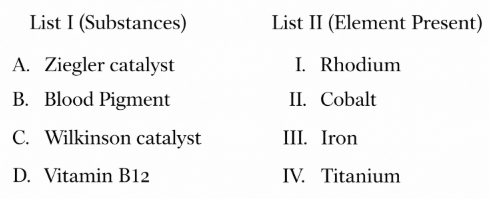
Match List - I with List-II
Consider the oxides of group 14 elements $$SiO_2, GeO_2, SnO_2, PbO_2, CO$$ and $$GeO$$. The amphoteric oxides are
Given below are two statements : one is labelled as Assertion (A) and the other is labelled as Reason (R).
Assertion (A) : Melting point of Boron (2453 K) is unusually high in group 13 elements.
Reason (R) : Solid Boron has very strong crystalline lattice.
In the light of the above statements, choose the most appropriate answer from the options given below:
Assertion (A): Melting point of Boron (2453 K) is unusually high in group 13 elements. This is true - Boron has the highest melting point among group 13 elements.
Reason (R): Solid Boron has very strong crystalline lattice. This is true - Boron exists in an icosahedral crystalline structure with very strong covalent bonds, giving it a very high melting point.
The reason correctly explains the assertion - the strong crystalline lattice of boron is why it has an unusually high melting point.
Both (A) and (R) are correct and (R) is the correct explanation of (A). The answer corresponds to Option (2).
Given below are two statements :
Statement I : The electronegativity of group 14 elements from Si to Pb gradually decreases.
Statement II : Group 14 contains non-metallic, metallic, as well as metalloid elements.
In the light of the above statements, choose the most appropriate from the options given below :
We need to evaluate two statements about Group 14 elements.
Analysis of Statement I: "The electronegativity of Group 14 elements from Si to Pb gradually decreases."
This is FALSE. While there is a general decreasing trend in electronegativity going down the group, it is NOT a gradual or monotonic decrease. The electronegativity values (Pauling scale) are approximately: C (2.5), Si (1.8), Ge (2.0), Sn (1.8), Pb (1.9). Notice that germanium has a higher electronegativity than silicon, and lead has a higher electronegativity than tin. This irregularity is attributed to the poor shielding effect of d-electrons (for Ge) and f-electrons (for Pb), known as the d-block contraction and lanthanide contraction respectively.
Analysis of Statement II: "Group 14 contains non-metallic, metallic, as well as metalloid elements."
This is TRUE. Group 14 shows a clear transition from non-metal to metal:
- Carbon: Non-metal
- Silicon and Germanium: Metalloids (semi-metals with intermediate properties)
- Tin and Lead: Metals
This is a characteristic feature of p-block groups, where metallic character increases down the group.
The correct answer is Option (1): Statement I is false but Statement II is true.
The correct statements from the following are : (A) The decreasing order of atomic radii of group 13 elements is $$Tl > In > Ga > Al > B$$. (B) Down the group 13 electronegativity decreases from top to bottom. (C) Al dissolves in dil. HCl and liberates $$H_2$$ but conc. $$HNO_3$$ renders Al passive by forming a protective oxide layer on the surface. (D) All elements of group 13 exhibits highly stable +1 oxidation state. (E) Hybridisation of Al in $$[Al(H_2O)_6]^{3+}$$ ion is $$sp^3d^2$$. Choose the correct answer from the options given below :
We need to evaluate each statement about Group 13 elements.
Statement (A) claims that the decreasing order of atomic radii is $$Tl > In > Ga > Al > B$$, but the actual order in Group 13 is $$Tl > In > Al > Ga > B$$. Due to the d-block contraction, Ga has a smaller atomic radius than Al, so statement (A) is incorrect.
Statement (B) asserts that electronegativity decreases down Group 13, but the trend is not monotonically decreasing because of poor shielding effects. Although B has the highest electronegativity, the values do not uniformly decrease from top to bottom, hence statement (B) is incorrect.
Statement (C) states that Al dissolves in dilute HCl to liberate $$H_2$$ but concentrated $$HNO_3$$ renders Al passive by forming a protective oxide layer. Indeed, aluminum reacts with dilute hydrochloric acid according to the equation $$2Al + 6HCl \rightarrow 2AlCl_3 + 3H_2 \uparrow$$, and concentrated nitric acid creates a thin $$Al_2O_3$$ layer that passivates the metal. Therefore statement (C) is correct.
Statement (D) claims that all elements of Group 13 exhibit a highly stable +1 oxidation state. In reality, B and Al do not show a stable +1 oxidation state and the +1 state only becomes more stable down the group due to the inert pair effect. Thus statement (D) is incorrect.
Statement (E) proposes that the hybridisation of Al in $$[Al(H_2O)_6]^{3+}$$ is $$sp^3d^2$$. In this hexaaqua complex, $$Al^{3+}$$ is octahedrally coordinated by six water molecules, which corresponds to $$sp^3d^2$$ hybridisation. Therefore statement (E) is correct.
The correct statements are (C) and (E) only. The correct answer is Option (3): (C) and (E) only.
Given below are two statements:
Statement I: Group 13 trivalent halides get easily hydrolysed by water due to their covalent nature.
Statement II: AlCl$$_3$$ upon hydrolysis in acidified aqueous solution forms octahedral $$[Al(H_2O)_6]^{3+}$$ ion.
In the light of the above statements, choose the correct answer from the options given below:
We need to evaluate two statements about Group 13 halides and AlCl$$_3$$ hydrolysis.
Analysis of Statement I: "Group 13 trivalent halides get easily hydrolysed by water due to their covalent nature."
This is TRUE. Group 13 trihalides (like BCl$$_3$$, AlCl$$_3$$, GaCl$$_3$$, etc.) are predominantly covalent compounds. They are electron-deficient — the central atom has only 6 electrons in its valence shell (incomplete octet). This makes them strong Lewis acids. When they come in contact with water, the lone pair on the oxygen atom of water coordinates with the electron-deficient metal atom, leading to easy hydrolysis. The covalent nature facilitates this process because ionic compounds typically dissociate rather than hydrolyse.
Analysis of Statement II: "AlCl$$_3$$ upon hydrolysis in acidified aqueous solution forms octahedral $$[Al(H_2O)_6]^{3+}$$ ion."
This is TRUE. When AlCl$$_3$$ dissolves in water (especially acidified solution), the Al$$^{3+}$$ ion is surrounded by six water molecules in an octahedral arrangement, forming the hexaaquaaluminium(III) ion $$[Al(H_2O)_6]^{3+}$$. This is because Al$$^{3+}$$ is a small, highly charged ion that can coordinate with six water molecules. The octahedral geometry is consistent with $$sp^3d^2$$ hybridization of the aluminium ion.
The correct answer is Option (4): Both Statement I and Statement II are true.
Given below are two statements:
Statement (I): $$SiO_2$$ and $$GeO_2$$ are acidic while SnO and PbO are amphoteric in nature.
Statement (II): Allotropic forms of carbon are due to property of catenation and $$p\pi - d\pi$$ bond formation.
In the light of the above statements, choose the most appropriate answer from the options given below:
We analyze two statements about Group 14 elements.
Statement I: $$SiO_2$$ and $$GeO_2$$ are acidic while $$SnO$$ and $$PbO$$ are amphoteric in nature.
$$SiO_2$$ and $$GeO_2$$ are indeed acidic oxides (they react with bases to form silicates and germanates). $$SnO$$ and $$PbO$$ are amphoteric (they react with both acids and bases). Statement I is TRUE.
Statement II: Allotropic forms of carbon are due to property of catenation and $$p\pi - d\pi$$ bond formation.
Carbon has allotropes (diamond, graphite, fullerenes) due to its excellent catenation ability and $$p\pi - p\pi$$ bonding (not $$p\pi - d\pi$$). Carbon does not have accessible d-orbitals for $$p\pi - d\pi$$ bonding. The ability to form multiple bonds via $$p\pi - p\pi$$ overlap is what gives carbon its diverse allotropes. Statement II is FALSE.
The answer is Option C) Statement I is true but Statement II is false.
Anomalous behaviour of oxygen is due to its
Oxygen shows anomalous behaviour compared to other members of Group 16 (S, Se, Te, Po). This is primarily due to two factors:
1. Small size:
Oxygen is the first element in Group 16 and has a very small atomic radius. Due to its small size:
- It has a high ionization enthalpy
- It has strong interelectronic repulsion in its compact orbitals
- It cannot expand its octet (no d-orbitals available in the second shell)
- Its maximum covalency is limited to 4 (unlike S which can show covalency of 6)
2. High electronegativity:
Oxygen is the second most electronegative element (after fluorine). Due to its high electronegativity:
- It forms strong hydrogen bonds
- It primarily shows a $$-2$$ oxidation state (unlike S, Se which show $$+2, +4, +6$$ as well)
- It tends to form $$p\pi - p\pi$$ multiple bonds with itself and with other small atoms like C and N
These two properties together make oxygen's behaviour significantly different from the rest of its group members.
The correct answer is Option 3: Small size and high electronegativity.
Given below are two statements:
Statement (I) : Oxygen being the first member of group 16 exhibits only -2 oxidation state.
Statement (II) : Down the group 16 stability of +4 oxidation state decreases and +6 oxidation state increases.
In the light of the above statements, choose the most appropriate answer from the options given below:
Statement I: "Oxygen being the first member of group 16 exhibits only -2 oxidation state."
This is incorrect. Oxygen can also show -1 (in peroxides like $$H_2O_2$$), 0 (in $$O_2$$), and +2 (in $$OF_2$$).
Statement II: "Down the group 16 stability of +4 oxidation state decreases and +6 oxidation state increases."
This is incorrect. Actually, down the group, due to the inert pair effect, the stability of +6 oxidation state decreases and +4 oxidation state becomes more stable (e.g., Po prefers +4 over +6).
Both statements are incorrect. The answer corresponds to Option (3).
Choose the correct statements about the hydrides of group 15 elements.
A. The stability of the hydrides decreases in the order $$NH_3 > PH_3 > AsH_3 > SbH_3 > BiH_3$$
B. The reducing ability of the hydrides increases in the order $$NH_3 < PH_3 < AsH_3 < SbH_3 < BiH_3$$
C. Among the hydrides, $$NH_3$$ is strong reducing agent while $$BiH_3$$ is mild reducing agent.
D. The basicity of the hydrides increases in the order $$NH_3 < PH_3 < AsH_3 < SbH_3 < BiH_3$$
Choose the most appropriate from the options given below:
We need to evaluate the statements about hydrides of Group 15 elements ($$NH_3, PH_3, AsH_3, SbH_3, BiH_3$$).
Statement A: The stability of hydrides decreases in the order $$NH_3 > PH_3 > AsH_3 > SbH_3 > BiH_3$$.
As we go down the group, the bond length between the central atom and hydrogen increases (N-H < P-H < As-H < Sb-H < Bi-H). Longer bonds are weaker, so the thermal stability decreases down the group. This statement is correct. ✓
Statement B: The reducing ability of hydrides increases in the order $$NH_3 < PH_3 < AsH_3 < SbH_3 < BiH_3$$.
Reducing ability is the tendency to donate electrons or get oxidized. As the stability decreases down the group, the hydride is more easily decomposed and more readily donates its electron pair. Therefore, reducing character increases from $$NH_3$$ to $$BiH_3$$. This statement is correct. ✓
Statement C: Among the hydrides, $$NH_3$$ is a strong reducing agent while $$BiH_3$$ is a mild reducing agent.
This is the opposite of what is true. $$NH_3$$ is the weakest reducing agent (most stable hydride), while $$BiH_3$$ is the strongest reducing agent (least stable). This statement is incorrect. ✗
Statement D: The basicity of hydrides increases in the order $$NH_3 < PH_3 < AsH_3 < SbH_3 < BiH_3$$.
Basicity depends on the availability of the lone pair. As the size of the central atom increases down the group, the electron density on the lone pair decreases (spread over a larger orbital), making it less available for donation. Therefore, basicity decreases down the group: $$NH_3 > PH_3 > AsH_3 > SbH_3 > BiH_3$$. This statement claims the opposite, so it is incorrect. ✗
The correct statements are A and B only.
The correct answer is Option (3): A and B only.
Choose the correct statements from the following:
A. All group 16 elements form oxides of general formula $$EO_2$$ and $$EO_3$$ where $$E = S, Se, Te$$ and $$Po$$. Both the types of oxides are acidic in nature.
B. $$TeO_2$$ is an oxidising agent while $$SO_2$$ is reducing in nature.
C. The reducing property decreases from $$H_2S$$ to $$H_2Te$$ down the group.
D. The ozone molecule contains five lone pairs of electrons.
Choose the correct answer from the options given below:
Element not showing variable oxidation state is :
Among the halogens:
- Chlorine shows oxidation states: -1, 0, +1, +3, +5, +7 (variable)
- Bromine shows oxidation states: -1, 0, +1, +3, +5, +7 (variable)
- Iodine shows oxidation states: -1, 0, +1, +3, +5, +7 (variable)
- Fluorine shows only oxidation state: -1 (and 0 in $$F_2$$). Since fluorine is the most electronegative element, it cannot show positive oxidation states.
Fluorine does not show variable oxidation state. The answer corresponds to Option (4).
The strongest reducing agent among the following is:
The hydrides of group 15 elements are ammonia ($$NH_3$$), phosphine ($$PH_3$$), arsine ($$AsH_3$$), stibine ($$SbH_3$$), and bismuthine ($$BiH_3$$).
The reducing power of these hydrides increases down the group. This is because the stability of the hydrides decreases down the group due to the decrease in bond strength of the E-H bond (where E is the group 15 element). As the size of the central atom increases down the group, the bond length increases and the bond strength decreases, making it easier to break the E-H bond and release hydrogen gas, which acts as a reducing agent.
The order of reducing power is: $$NH_3 < PH_3 < AsH_3 < SbH_3 < BiH_3$$
Among the given options:
Therefore, the strongest reducing agent is $$BiH_3$$, which corresponds to option C.
The correct answer is C. $$BiH_3$$.
Give below are two statements:
Statement-I: Noble gases have very high boiling points.
Statement-II: Noble gases are monoatomic gases. They are held together by strong dispersion forces. Because of this they are liquefied at very low temperature. Hence, they have very high boiling points.
In the light of the above statements, choose the correct answer from the options given below:
We need to evaluate two statements about noble gases.
Analysis of Statement I: "Noble gases have very high boiling points."
This is FALSE. Noble gases have very low boiling points. For example: He boils at 4.2 K (-269°C), Ne at 27.1 K, Ar at 87.3 K, Kr at 119.9 K, and Xe at 165.1 K. These are among the lowest boiling points of all elements because noble gases exist as monoatomic species with only weak London dispersion forces between atoms.
Analysis of Statement II: "Noble gases are monoatomic gases. They are held together by strong dispersion forces. Because of this they are liquefied at very low temperature. Hence, they have very high boiling points."
This statement contains internal contradictions and is FALSE. While it correctly states that noble gases are monoatomic, the claim that they have "strong dispersion forces" is incorrect — they have very weak dispersion forces (London forces), which is why they must be cooled to very low temperatures to be liquefied. Furthermore, the conclusion "they have very high boiling points" contradicts the fact that they liquefy at very low temperatures — low liquefaction temperature means low boiling points.
Since both statements are false, the correct answer is Option (4): Both Statement I and Statement II are false.
Identify the incorrect pair from the following :
We need to identify the incorrect pair of mineral name and chemical formula.
Check each pair.
Option (1): Fluorspar - $$BF_3$$
This is INCORRECT. Fluorspar (also called fluorite) is $$CaF_2$$ (calcium fluoride), NOT $$BF_3$$ (boron trifluoride). $$BF_3$$ is a gaseous compound, not a mineral. Fluorspar is a naturally occurring mineral and is the principal source of fluorine and hydrofluoric acid.
Option (2): Cryolite - $$Na_3AlF_6$$
This is correct. Cryolite is sodium hexafluoroaluminate, used as a flux in the electrolytic extraction of aluminium (Hall-Heroult process).
Option (3): Fluoroapatite - $$3Ca_3(PO_4)_2 \cdot CaF_2$$
This is correct. Fluoroapatite is a phosphate mineral containing fluoride, found in teeth and bones.
Option (4): Carnallite - $$KCl \cdot MgCl_2 \cdot 6H_2O$$
This is correct. Carnallite is a hydrated potassium magnesium chloride mineral, an important source of potassium.
The incorrect pair is Option (1): Fluorspar - $$BF_3$$.
When $$MnO_2$$ and $$H_2SO_4$$ is added to a salt (A), the greenish yellow gas liberated as salt (A) is:
When $$MnO_2$$ and $$H_2SO_4$$ are added to salt A, a greenish-yellow gas is liberated. Identify salt A.
Greenish-yellow gas is chlorine ($$Cl_2$$).
$$MnO_2$$ acts as an oxidizing agent in the presence of $$H_2SO_4$$. When a chloride salt is present:
$$MnO_2 + 2H_2SO_4 + 2Cl^- \rightarrow Mn^{2+} + 2SO_4^{2-} + 2H_2O + Cl_2 \uparrow$$
The chloride ions are oxidized to chlorine gas.
The salt must contain $$Cl^-$$ ions. Among the options: $$CaI_2$$ (iodide), $$NaBr$$ (bromide), $$KNO_3$$ (nitrate), $$NH_4Cl$$ (chloride).
Only $$NH_4Cl$$ contains chloride ions.
The correct answer is Option (4): $$NH_4Cl$$.
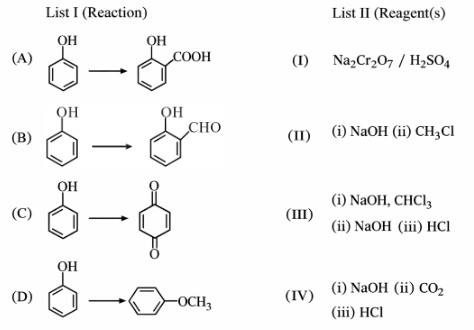
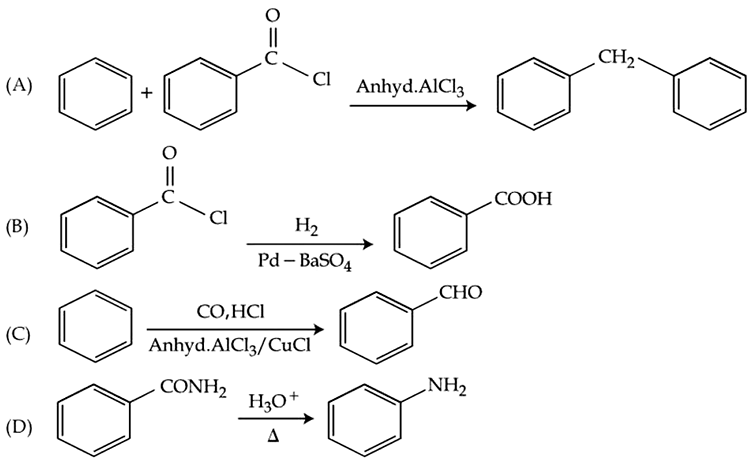
Match List-I with List-II.
Choose the correct answer from the options given below:
Reaction (A): Conversion of Phenol to Salicylic acid (2-hydroxybenzoic acid). This transformation is achieved via the Kolbe-Schmitt reaction. When phenol is treated with sodium hydroxide ($$NaOH$$) to form a phenoxide ion, followed by reaction with carbon dioxide ($$CO_2$$) under pressure and subsequent acidification with $$HCl$$, salicylic acid is produced. This matches with reagent (IV). Thus, (A) matches with (IV).
Reaction (B): Conversion of Phenol to Salicylaldehyde (2-hydroxybenzaldehyde). This is the Reimer-Tiemann reaction. Phenol reacts with chloroform ($$CHCl_3$$) in the presence of aqueous sodium hydroxide ($$NaOH$$), introducing a formyl group ($$\text{-}CHO$$) at the ortho-position, followed by hydrolysis and acidification ($$HCl$$). This matches with reagent (III). Thus, (B) matches with (III).
Reaction (C): Conversion of Phenol to p-Benzoquinone. Phenol undergoes oxidation when treated with a strong oxidizing agent like acidified sodium dichromate ($$Na_2Cr_2O_7 / H_2SO_4$$) to yield para-benzoquinone. This matches with reagent (I). Thus, (C) matches with (I).
Reaction (D): Conversion of Phenol to Anisole (Methoxybenzene). This is an etherification process (Williamson ether synthesis). Phenol is first converted into sodium phenoxide using $$NaOH$$, which then performs a nucleophilic substitution reaction with methyl chloride ($$CH_3Cl$$) to introduce a methoxy group ($$\text{-}OCH_3$$). This matches with reagent (II). Thus, (D) matches with (II).
Combining all the pairs, the correct matching sequence is: (A)-(IV), (B)-(III), (C)-(I), (D)-(II).
Answer: Option D — (A)-(IV), (B)-(III), (C)-(I), (D)-(II)
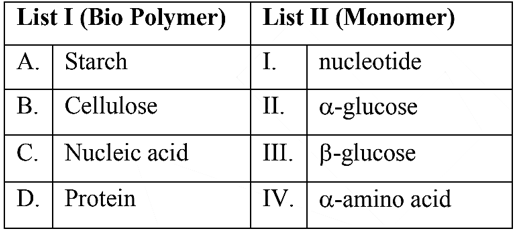
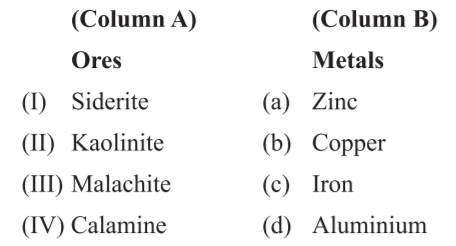
Match List I with List II
Choose the correct answer from the options given below:
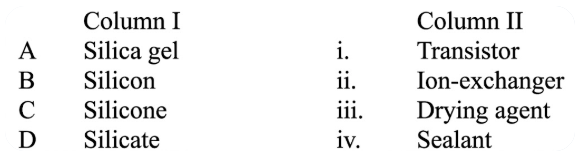
Match List I with List II
Choose the correct answer from the options given below:
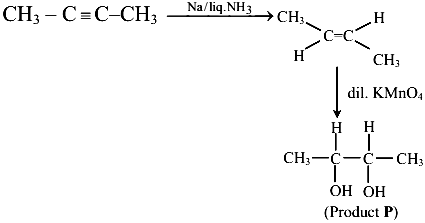
The major product of the following reaction is $$P$$. $$CH_3C \equiv C-CH_3 \xrightarrow[\text{(ii) dil. KMnO}_4, 273\text{ K}]{\text{(i) Na/liq. NH}_3} P$$. Number of oxygen atoms present in product '$$P$$' is _______ (nearest integer)
CH₃C≡C-CH₃ with Na/liq. NH₃ gives trans-2-butene (Birch reduction gives trans alkene).
Then dil. KMnO₄ at 273 K (cold) gives a diol: trans-but-2-ene-2,3-diol (syn addition giving glycol).
The product has 2 oxygen atoms (two OH groups).
The answer is 2.
Among the following oxides of p-block elements: $$Cl_2O_7$$, $$CO$$, $$PbO_2$$, $$N_2O$$, $$NO$$, $$Al_2O_3$$, $$SiO_2$$, $$N_2O_5$$, $$SnO_2$$, the number of amphoteric oxides is:
We need to identify the amphoteric oxides among: $$Cl_2O_7$$, $$CO$$, $$PbO_2$$, $$N_2O$$, $$NO$$, $$Al_2O_3$$, $$SiO_2$$, $$N_2O_5$$, $$SnO_2$$.
An amphoteric oxide reacts with both acids and bases.
$$Cl_2O_7$$: Acidic oxide (anhydride of $$HClO_4$$). Not amphoteric.
$$CO$$: Neutral oxide. Not amphoteric.
$$PbO_2$$: Amphoteric oxide. Lead(IV) oxide reacts with acids (e.g., $$PbO_2 + 4HCl \rightarrow PbCl_4 + 2H_2O$$) and with bases (e.g., forming plumbates). Yes, amphoteric.
$$N_2O$$: Neutral oxide. Not amphoteric.
$$NO$$: Neutral oxide. Not amphoteric.
$$Al_2O_3$$: Amphoteric oxide. Reacts with acids to form aluminum salts and with bases to form aluminates. Yes, amphoteric.
$$SiO_2$$: Acidic oxide. Not amphoteric.
$$N_2O_5$$: Acidic oxide (anhydride of $$HNO_3$$). Not amphoteric.
$$SnO_2$$: Amphoteric oxide. Tin(IV) oxide reacts with acids and bases. Yes, amphoteric.
The amphoteric oxides are: $$PbO_2$$, $$Al_2O_3$$, and $$SnO_2$$. That gives us 3.
The answer is 3.
The number of the correct reaction(s) among the following is ______
Molar mass of the salt from $$NaBr, NaNO_3, KI$$ and $$CaF_2$$ which does not evolve coloured vapours on heating with concentrated $$H_2SO_4$$ is ____ g mol$$^{-1}$$. (Molar mass in g mol$$^{-1}$$: Na: 23, N: 14, K: 39, O: 16, Br: 80, I: 127, F: 19, Ca: 40)
NaBr gives brown/orange vapors (Br₂) with conc H₂SO₄. KI gives violet vapors (I₂). NaNO₃ gives brown NO₂ fumes. CaF₂ does not give colored vapors (HF is colorless).
Molar mass of CaF₂ = 40 + 38 = 78 g/mol.
The answer is $$\boxed{78}$$.
Group-13 elements react with O$$_2$$ in amorphous form to form oxides of type M$$_2$$O$$_3$$ (M = element). Which among the following is the most basic oxide?
We need to identify the most basic oxide among the Group 13 oxides of type M$$_2$$O$$_3$$.
To begin,
Group 13 elements are: B, Al, Ga, In, Tl. As we move down the group, the metallic character increases progressively. Boron is a non-metal/metalloid, aluminum is a metal with some non-metallic properties, and by the time we reach thallium, the element is strongly metallic.
Next,
There is a fundamental relationship in chemistry:
- Oxides of non-metals are typically acidic (e.g., B$$_2$$O$$_3$$ is acidic)
- Oxides of metals are typically basic (e.g., Tl$$_2$$O$$_3$$ is basic)
- Oxides of elements with intermediate character are amphoteric (e.g., Al$$_2$$O$$_3$$, Ga$$_2$$O$$_3$$)
From this,
Going down Group 13, as metallic character increases, the basicity of the oxides also increases:
$$ \text{B}_2\text{O}_3 \;(\text{acidic}) < \text{Al}_2\text{O}_3 \;(\text{amphoteric}) < \text{Ga}_2\text{O}_3 \;(\text{amphoteric}) < \text{In}_2\text{O}_3 \;(\text{basic}) < \text{Tl}_2\text{O}_3 \;(\text{most basic}) $$
Tl$$_2$$O$$_3$$ is the most basic oxide because thallium is the most metallic element in Group 13. Its oxide is predominantly ionic in character, and it reacts with acids to form salts -- a characteristic property of basic oxides.
The most basic oxide is Tl$$_2$$O$$_3$$.
The correct answer is Option 3: Tl$$_2$$O$$_3$$.
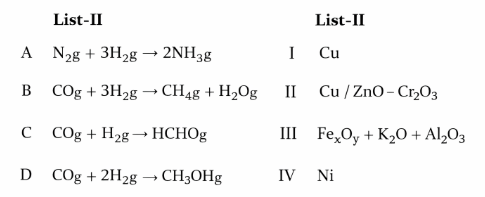
Match List I with List II
A. Cobalt catalyst I. (H$$_2$$ + Cl$$_2$$) production
B. Syngas II. Water gas production
C. Nickel catalyst III. Coal gasification
D. Brine solution IV. Methanol production
Choose the correct answer from the options given below:-
Given below are two statements:
Statement I: Lithium and Magnesium do not form superoxide
Statement II: The ionic radius of Li$$^+$$ is larger than ionic radius of Mg$$^{2+}$$
In the light of the above statements, choose the most appropriate answer from the questions given below:
Statement I: Lithium and Magnesium do not form superoxide.
Statement II: The ionic radius of Li⁺ is larger than ionic radius of Mg²⁺.
Analysis of Statement I:
Lithium, due to its small size and high charge density, strongly polarizes the larger superoxide ion (O₂⁻), destabilizing it. Li forms oxide (Li₂O) and peroxide (Li₂O₂) but not a stable superoxide. Similarly, Mg forms MgO but not a stable superoxide.
Statement I is correct.
Analysis of Statement II:
According to NCERT data:
Li⁺ ionic radius ≈ 76 pm, Mg²⁺ ionic radius ≈ 72 pm (Shannon radii)
However, using the values commonly cited in NCERT textbooks: Li⁺ ≈ 60 pm, Mg²⁺ ≈ 65 pm.
Using NCERT values, Li⁺ is actually smaller than Mg²⁺.
Statement II is incorrect (in the NCERT context).
Since Statement I is correct and Statement II is incorrect, the answer is Option B: Statement I is correct but Statement II is incorrect.
Given below are two statements:
Statement I: SbCl$$_5$$ is more covalent than SbCl$$_3$$
Statement II: The higher oxides of halogens also tend to be more stable than the lower ones.
In the light of the above statements, choose the most appropriate answer from the options given below.
According to Fajans' Rules, covalent character increases with an increase in the charge of the cation. In SbCl5, Antimony is in a +5 oxidation state, whereas in SbCl3, it is in a +3 oxidation state.
The higher positive charge (+5) creates a higher charge density, leading to greater polarizing power to distort the electron cloud of the chloride anions. Therefore, SbCl5 is significantly more covalent than SbCl3.
Status: Correct
According to standard periodic trends (specifically outlined in NCERT p-block chemistry), the higher oxides of halogens (where the halogen is in a higher oxidation state) are generally more stable than those in lower oxidation states.
For example, in the case of chlorine, higher oxides like Cl2O7 (where Cl is +7) are much more stable and less prone to violent decomposition compared to lower oxides like Cl2O or ClO2, due to kinetic factors and multiple bond stabilization characters.
Status: Correct
The alkaline earth metal sulphate(s) which are readily soluble in water is/are:
(A) BeSO$$_4$$
(B) MgSO$$_4$$
(C) CaSO$$_4$$
(D) SrSO$$_4$$
(E) BaSO$$_4$$
Choose the correct answer from the options below:
We need to identify which alkaline earth metal sulphates are readily soluble in water.
Solubility trend of alkaline earth metal sulphates:
The solubility of sulphates of alkaline earth metals decreases down the group due to the decrease in hydration enthalpy being more significant than the decrease in lattice enthalpy.
Solubility order: BeSO$$_4$$ > MgSO$$_4$$ > CaSO$$_4$$ > SrSO$$_4$$ > BaSO$$_4$$
Analysis:
(A) BeSO$$_4$$ — Readily soluble ✓
(B) MgSO$$_4$$ — Readily soluble ✓
(C) CaSO$$_4$$ — Slightly soluble (sparingly soluble)
(D) SrSO$$_4$$ — Insoluble
(E) BaSO$$_4$$ — Insoluble
Only BeSO$$_4$$ and MgSO$$_4$$ are readily soluble in water.
The correct answer is Option 3: A and B.
Which of the given compounds can enhance the efficiency of hydrogen storage tank?
We need to identify which compound can enhance the efficiency of a hydrogen storage tank.
For Option A, Li/P$$_4$$ is lithium with white phosphorus and is not a hydrogen storage material.
Option B, SiH$$_4$$ (silane or silicon tetrahydride), contains hydrogen and has been studied as a hydrogen storage material. Silicon-based hydrides can store hydrogen at high weight percentages and release it upon decomposition.
Option C, NaNi$$_5$$, is not a standard hydrogen storage alloy; the well-known alloy is LaNi$$_5$$, not NaNi$$_5$$.
Option D, di-isobutylaluminium hydride (DIBAL-H), is a reducing agent used in organic synthesis rather than a hydrogen storage material.
Among the given options, SiH$$_4$$ is the compound that can enhance hydrogen storage efficiency, as metal hydrides and silicon-based hydrides are important classes of hydrogen storage materials. The correct answer is Option B.
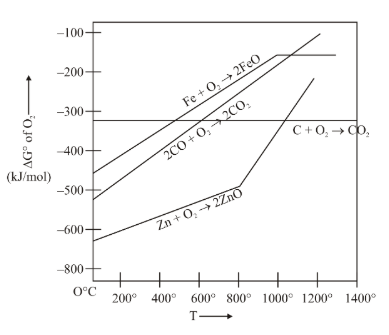
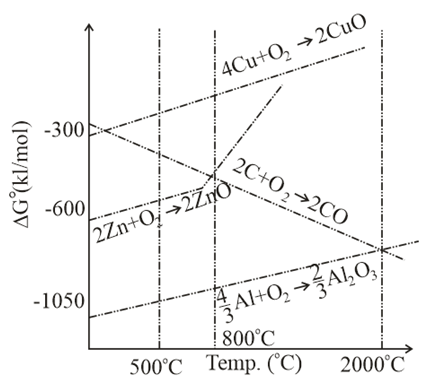
Gibbs energy vs T plot for the formation of oxides is given below. For the given diagram, the correct statement is-
Reason: At 600°C, the carbon monoxide oxidation curve ($2\text{CO} + \text{O}_2 \rightarrow 2\text{CO}_2$) lies lower than the iron oxide line ($2\text{Fe} + \text{O}_2 \rightarrow 2\text{FeO}$). This indicates that CO is thermodynamically capable of reducing FeO at this temperature, making the statement false.
Reason: The zinc oxide curve ($\text{Zn} + \text{O}_2 \rightarrow 2\text{ZnO}$) sits exceptionally low on the diagram (highly negative $\Delta G^\circ$ near −650 kJ/mol). Since the CO line is well above it at 600°C, CO cannot reduce ZnO.
Reason: The reduction of ZnO by solid carbon ($2\text{C} + \text{O}_2 \rightarrow 2\text{CO}$) only becomes favorable above the intersection point, which happens at temperatures well exceeding 900°C. At 600°C, the carbon line is far above the zinc line.
Reason: Based on the standard configuration of this problem in pyrometallurgy, at 600°C, the combined free energy change ($\Delta G^\circ$) for the coupled reduction reaction yields a negative value, confirming that elemental carbon functions as an effective reducing agent for iron oxide.
Given below are two statements: One is labelled as Assertion A and the other is labelled as Reason R:
Assertion (A) : BeCl$$_2$$ and MgCl$$_2$$ produce characteristic flame
Reason (R) : The excitation energy is high in BeCl$$_2$$ and MgCl$$_2$$
In the light of the above statements, choose the correct answer from the options given below:
Assertion A: BeCl₂ and MgCl₂ produce characteristic flame.
This is false. Be compounds do not produce a characteristic flame color because the excitation energy is too high for the flame to provide. MgCl₂ also does not produce a characteristic flame for the same reason (though Mg metal burns with bright white light).
Reason R: The excitation energy is high in BeCl₂ and MgCl₂.
This is true. Due to the small size and high ionization energy of Be and Mg, their excitation energies are high, which means the flame cannot provide enough energy to excite the electrons.
A is false but R is true.
This matches option 4.
Given below are two statements:
Statement I: Nickel is being used as the catalyst for producing syn gas and edible fats.
Statement II: Silicon forms both electron rich and electron deficient hydrides.
In the light of the above statements, choose the most appropriate answer from the options given below:
We need to evaluate two statements about nickel and silicon.
Analyze Statement I.
Statement I: Nickel is being used as the catalyst for producing syn gas and edible fats.
Syn gas (CO + H$$_2$$) is produced by steam reforming of methane: CH$$_4$$ + H$$_2$$O $$\xrightarrow{\text{Ni}}$$ CO + 3H$$_2$$. Nickel is indeed the catalyst used.
Edible fats are produced by hydrogenation of vegetable oils using finely divided nickel as catalyst.
Statement I is correct.
Analyze Statement II.
Statement II: Silicon forms both electron rich and electron deficient hydrides.
Silicon forms silanes (SiH$$_4$$, Si$$_2$$H$$_6$$, etc.), which are electron-precise hydrides — each Si forms 4 bonds using all valence electrons. Silicon does not form electron-rich hydrides (like PH$$_3$$, H$$_2$$S with lone pairs that dominate chemistry) or electron-deficient hydrides (like B$$_2$$H$$_6$$ with 3-centre 2-electron bonds).
Statement II is incorrect.
Conclusion.
Statement I is correct but Statement II is incorrect.
The correct answer is Option D: Statement I is correct but statement II is incorrect.
Lithium aluminium hydride can be prepared from the reaction of
We need to identify the reactants used to prepare Lithium Aluminium Hydride (LiAlH$$_4$$).
The preparation reaction is:
$$8\text{LiH} + \text{Al}_2\text{Cl}_6 \to 2\text{LiAlH}_4 + 6\text{LiCl}$$
This reaction involves lithium hydride (LiH) reacting with aluminium chloride (Al$$_2$$Cl$$_6$$) in ether solvent to produce LiAlH$$_4$$.
Therefore, LiAlH$$_4$$ is prepared from LiH and Al$$_2$$Cl$$_6$$.
The correct answer is Option 2.
The magnetic behaviour of Li$$_2$$O, Na$$_2$$O$$_2$$ and KO$$_2$$, respectively, are
We need to determine the magnetic behaviour of Li$$_2$$O, Na$$_2$$O$$_2$$, and KO$$_2$$.
Li$$_2$$O (Lithium oxide):
Contains Li$$^+$$ (1s$$^2$$, i.e., [He] configuration) and O$$^{2-}$$ (1s$$^2$$2s$$^2$$2p$$^6$$, i.e., [Ne] configuration). Both ions have all electrons paired. Li$$_2$$O is diamagnetic.
Na$$_2$$O$$_2$$ (Sodium peroxide):
Contains Na$$^+$$ ([Ne]) and the peroxide ion O$$_2^{2-}$$. The peroxide ion has a bond order of 1 with electronic configuration: $$(\sigma_{1s})^2(\sigma^*_{1s})^2(\sigma_{2s})^2(\sigma^*_{2s})^2(\sigma_{2p})^2(\pi_{2p})^4(\pi^*_{2p})^4$$. All electrons are paired. Na$$_2$$O$$_2$$ is diamagnetic.
KO$$_2$$ (Potassium superoxide):
Contains K$$^+$$ ([Ar]) and the superoxide ion O$$_2^-$$. The superoxide ion has electronic configuration: $$(\sigma_{1s})^2(\sigma^*_{1s})^2(\sigma_{2s})^2(\sigma^*_{2s})^2(\sigma_{2p})^2(\pi_{2p})^4(\pi^*_{2p})^3$$. There is one unpaired electron in the $$\pi^*_{2p}$$ orbital. KO$$_2$$ is paramagnetic.
Therefore, the magnetic behaviours are: diamagnetic, diamagnetic, and paramagnetic.
The correct answer is Option D.
Given below are two reactions, involved in the commercial production of dihydrogen H$$_2$$. The two reactions are carried out at temperature "T$$_1$$" and "T$$_2$$", respectively
$$C(s) + H_2O(g) \xrightarrow{T_1} CO(g) + H_2(g)$$
$$CO(g) + H_2O(g) \xrightarrow{T_2, Catalyst} CO_2(g) + H_2(g)$$
The temperatures T$$_1$$ and T$$_2$$ are correctly related as
We need to compare the temperatures $$T_1$$ and $$T_2$$ for two reactions in commercial H$$_2$$ production.
Reaction 1 (Water-gas reaction).
$$ C(s) + H_2O(g) \xrightarrow{T_1} CO(g) + H_2(g) $$
This is a highly endothermic reaction ($$\Delta H \approx +131$$ kJ/mol). It requires breaking the strong O-H bond in water and the C-C bonds in solid carbon. This reaction requires a very high temperature, typically around $$T_1 \approx 1270$$ K (about 1000 degrees C), to proceed at an appreciable rate.
Reaction 2 (Water-gas shift reaction).
$$ CO(g) + H_2O(g) \xrightarrow{T_2, \text{catalyst}} CO_2(g) + H_2(g) $$
This is a mildly exothermic reaction ($$\Delta H \approx -41$$ kJ/mol). It is carried out at a much lower temperature, typically $$T_2 \approx 673$$ K (about 400 degrees C), using an iron-chromate catalyst. The catalyst lowers the activation energy, allowing the reaction to proceed efficiently at this lower temperature.
Comparison:
$$ T_1 (\sim 1270\;\text{K}) > T_2 (\sim 673\;\text{K}) $$
The correct answer is Option 4: $$T_1 > T_2$$.
How can photochemical smog be controlled?
Photochemical smog is formed by the reaction of nitrogen oxides (NO$$_x$$) and volatile organic compounds (VOCs) in the presence of sunlight. The key pollutants include ozone (O$$_3$$), PAN (peroxyacetyl nitrate), and formaldehyde.
The most effective method to control photochemical smog is the use of catalytic converters in automobiles and industries. These converters transform harmful exhaust gases into less harmful products:
$$2CO + O_2 \xrightarrow{\text{catalyst}} 2CO_2$$
$$2NO_x \xrightarrow{\text{catalyst}} xO_2 + N_2$$
Unburnt hydrocarbons are also converted to CO$$_2$$ and H$$_2$$O. By reducing the emission of NO$$_x$$ and hydrocarbons at the source, catalytic converters prevent the formation of photochemical smog.
So, the answer is that photochemical smog can be controlled by using catalytic converters in automobiles and industry.
In the given reaction cycle

X, Y and Z respectively are
Match List I with List II
List-I (Species) List-2 (Maximum allowed concentration in ppm in drinking water)
A. F$$^-$$ I. < 50 ppm
B. SO$$_4^{2-}$$ II. < 5 ppm
C. NO$$_3^-$$ III. < 2 ppm
D. Zn IV. < 500 ppm
Choose the correct answer from the options given below.
Maximum allowed concentration in ppm for F− ,So4 -2, NO3-, and zn are 2, 5,50,200 respectively.
The correct order of hydration enthalpies is
(A) K$$^+$$
(B) Rb$$^+$$
(C) Mg$$^{2+}$$
(D) Cs$$^+$$
(E) Ca$$^{2+}$$
Choose the correct answer from the options below:
Hydration enthalpy depends on the charge density of the ion: higher charge and smaller ionic radius lead to greater (more negative) hydration enthalpy.
The ions given are (A) K$$^+$$ (charge = +1, ionic radius = 138 pm), (B) Rb$$^+$$ (charge = +1, ionic radius = 152 pm), (C) Mg$$^{2+}$$ (charge = +2, ionic radius = 72 pm), (D) Cs$$^+$$ (charge = +1, ionic radius = 167 pm) and (E) Ca$$^{2+}$$ (charge = +2, ionic radius = 100 pm).
Divalent cations have much higher hydration enthalpies than monovalent cations due to their greater charge density.
Between the divalent ions, Mg$$^{2+}$$ is smaller than Ca$$^{2+}$$, so Mg$$^{2+}$$ has greater hydration enthalpy: C > E.
Among the monovalent ions, smaller size means greater hydration enthalpy: K$$^+$$ > Rb$$^+$$ > Cs$$^+$$, i.e., A > B > D.
The complete order is:
$$\text{Mg}^{2+} > \text{Ca}^{2+} > \text{K}^+ > \text{Rb}^+ > \text{Cs}^+$$
That is: C > E > A > B > D.
The correct answer is Option D.
Given below are two statements: one is labelled as Assertion (A) and the other is labelled as Reason (R).
Assertion (A): Gypsum is used for making fireproof wall boards.
Reason (R): Gypsum is unstable at high temperatures.
In the light of the above statements, choose the correct answer from the options given below:
Assertion (A): Gypsum is used for making fireproof wall boards.
This is CORRECT. Gypsum ($$CaSO_4 \cdot 2H_2O$$) is widely used in making fireproof wall boards (drywall/gypsum board) because of its fire-resistant properties.
Reason (R): Gypsum is unstable at high temperatures.
This is CORRECT. When exposed to high temperatures, gypsum undergoes dehydration:
$$ CaSO_4 \cdot 2H_2O \xrightarrow{\Delta} CaSO_4 \cdot \frac{1}{2}H_2O + \frac{3}{2}H_2O $$This endothermic dehydration process absorbs heat, which slows down the spread of fire. The water released as steam also helps in fire suppression.
R is the correct explanation of A because it is precisely the instability of gypsum at high temperatures (releasing water endothermically) that makes it effective as a fireproof material.
Therefore, both (A) and (R) are correct and (R) is the correct explanation of (A).
Given below are two statements,one is labelled as Assertion A and the other is labelled as Reason R
Assertion A: Carbon forms two important oxides CO and CO$$_2$$. CO is neutral whereas CO$$_2$$ is acidic in nature.
Reason R: CO$$_2$$ can combine with water in a limited way to form carbonic acid, while CO is sparingly soluble in water.
In the light of the above statements, choose the most appropriate answer from the options given below :-
Some reactions of NO$$_2$$ relevant to photochemical smog formation are

Identify A, B, X and Y
The density of alkali metals is in the order
Density depends on both atomic mass and atomic volume according to the relation:
Density = Mass / Volume
As we move down the alkali metal group (Group 1):
There is a well-known exception between Potassium (K) and Sodium (Na). When moving from Na to K, there is a large, sudden increase in atomic volume due to the filling of empty 3d orbitals in the shell layer.
As a result, the volume increase outpaces the mass increase, making Potassium less dense than Sodium.
| Alkali Metal | Density (g/cm³) |
|---|---|
| Lithium (Li) | 0.53 |
| Potassium (K) | 0.86 |
| Sodium (Na) | 0.97 |
| Rubidium (Rb) | 1.53 |
| Cesium (Cs) | 1.93 |
Arranging them from lowest to highest density based on empirical values:
The possibility of photochemical smog formation is more at
Photochemical smog is formed when nitrogen oxides (NO₂) and volatile organic compounds (hydrocarbons) react in the presence of sunlight to produce secondary pollutants like ozone, PAN (peroxyacetyl nitrate), and other irritants.
The key requirements for photochemical smog formation are:
1. Nitrogen oxides (from automobile exhaust and industrial emissions)
2. Hydrocarbons (from incomplete combustion of fuels)
3. Sunlight (for photochemical reactions)
4. Warm, stagnant air conditions
Industrial areas have high concentrations of both nitrogen oxides and hydrocarbons from factories, vehicles, and other sources. Combined with sunlight, these areas have the highest possibility of photochemical smog formation.
The correct answer is Industrial areas.
Given below are two statements:
Statement I: Boron is extremely hard indicating its high lattice energy.
Statement II: Boron has highest melting and boiling point compared to its other group members.
In the light of the above statements, choose the most appropriate answer from the options given below
Statement I: Boron is extremely hard indicating high lattice energy — Incorrect. Boron's hardness is due to its covalent network structure, not ionic lattice energy. The term "lattice energy" applies to ionic compounds.
Statement II: Boron has the highest melting and boiling point among Group 13 elements — Correct. Boron (MP ≈ 2076°C) has the highest values due to its strong covalent network structure.
Statement I is incorrect but Statement II is correct.
The correct order of bond enthalpy (kJ mol$$^{-1}$$) is:
We need to determine the correct order of single bond enthalpies for Group 14 elements.
Known single bond enthalpies (kJ mol$$^{-1}$$):
C$$-$$C: 348 kJ/mol
Si$$-$$Si: 226 kJ/mol
Ge$$-$$Ge: 188 kJ/mol
Sn$$-$$Sn: 151 kJ/mol
Explanation:
Carbon has the strongest single bond due to effective overlap of its small 2p orbitals. As we move down Group 14, the atomic size increases, orbital overlap becomes less effective, and bond enthalpy decreases monotonically.
The correct order is:
$$ \text{C}-\text{C} > \text{Si}-\text{Si} > \text{Ge}-\text{Ge} > \text{Sn}-\text{Sn} $$The correct answer is Option D.
Given below are two statements:
Assertion A: In an Ellingham diagram, the oxidation of carbon to carbon monoxide shows a negative slope with respect to temperature.
Reason R: CO tends to get decomposed at higher temperature.
In the Ellingham diagram, the reaction $$2C(s) + O_2(g) \to 2CO(g)$$ has $$\Delta n_g = 2 - 1 = +1$$ (an increase in gas moles). By the relation $$\Delta G = \Delta H - T\Delta S$$, an increase in gaseous moles means $$\Delta S > 0$$, so the $$-T\Delta S$$ term becomes more negative with increasing temperature. This causes $$\Delta G$$ to decrease (become more negative) as temperature rises, giving the line a negative slope. Therefore, Assertion A is correct.
Reason R claims that CO tends to get decomposed at higher temperature. This is incorrect — in fact, the negative slope of the Ellingham line for CO formation means that CO becomes more thermodynamically stable at higher temperatures, not less. CO does not decompose at higher temperatures; rather, it is favoured as a reducing agent at elevated temperatures precisely because of this trend.
Since A is correct but R is not correct, the answer is Option D.
The methods NOT involved in concentration of ore are
(A) Liquation
(B) Leaching
(C) Electrolysis
(D) Hydraulic washing
(E) Froth floatation
Choose the correct answer from the options given below:
Concentration of ore involves separating the ore from gangue (impurities). The common methods include:
- Hydraulic washing (gravity separation) ✔
- Froth flotation ✔
- Leaching (chemical method of concentration) ✔
- Magnetic separation ✔
Methods NOT used for concentration of ore:
(A) Liquation: This is a refining technique (used to purify metals with low melting points like tin, bismuth, lead). It is NOT a concentration method. ✘
(C) Electrolysis: This is a refining technique (electrolytic refining). It is NOT a concentration method. ✘
Therefore, the methods NOT involved in concentration of ore are A and C only.
Which one of the following reactions does not occur during extraction of copper?
Four reactions are listed. We need to identify which one does NOT occur during the extraction of copper from copper pyrites (CuFeS$$_2$$). Copper is extracted through the following steps:
Roasting: The ore is heated in air to convert iron sulfide to iron oxide: $$2\text{FeS} + 3\text{O}_2 \to 2\text{FeO} + 2\text{SO}_2$$ This is Option B — it occurs during copper extraction.
Slag formation: SiO$$_2$$ is added as a flux and reacts with FeO to form slag: $$\text{FeO} + \text{SiO}_2 \to \text{FeSiO}_3$$ This is Option D — it occurs during copper extraction.
Partial roasting of Cu$$_2$$S: $$2\text{Cu}_2\text{S} + 3\text{O}_2 \to 2\text{Cu}_2\text{O} + 2\text{SO}_2$$ This is Option A — it occurs during copper extraction.
Option C states: CaO + SiO$$_2$$ $$\to$$ CaSiO$$_3$$. In copper extraction, the flux used is SiO$$_2$$, which reacts with FeO (not CaO). CaO is not involved in copper extraction. The reaction CaO + SiO$$_2$$ $$\to$$ CaSiO$$_3$$ occurs in iron extraction (blast furnace), not copper extraction.
Answer: Option C
Given below are two statements:
Statement I: Chlorine can easily combine with oxygen to from oxides; and the product has a tendency to explode.
Statement II: Chemical reactivity of an element can be determined by its reaction with oxygen and halogens.
Statement I: Chlorine can easily combine with oxygen to form oxides; and the product has a tendency to explode.
This is TRUE. Chlorine forms several oxides such as $$Cl_2O$$, $$ClO_2$$, $$Cl_2O_6$$, and $$Cl_2O_7$$. These chlorine oxides are highly unstable and have a strong tendency to explode. They are powerful oxidizing agents.
Statement II: Chemical reactivity of an element can be determined by its reaction with oxygen and halogens.
This is TRUE. The chemical reactivity of elements is commonly assessed by studying their reactions with oxygen (to form oxides) and halogens (to form halides). These reactions help determine the oxidation states, bond energies, and overall reactivity patterns of elements.
Therefore, both Statement I and Statement II are true.
Reaction of thionyl chloride with white phosphorus forms a compound [A], which on hydrolysis gives [B], a dibasic acid. [A] and [B] are respectively
Thionyl chloride ($$SOCl_2$$) reacts with white phosphorus ($$P_4$$).
When $$SOCl_2$$ reacts with $$P_4$$, it chlorinates the phosphorus. The reaction produces phosphorus trichloride ($$PCl_3$$) as compound [A]:
$$P_4 + 8SOCl_2 \rightarrow 4PCl_3 + 4SO_2 + 2S_2Cl_2$$
On hydrolysis, $$PCl_3$$ gives phosphorous acid ($$H_3PO_3$$) as compound [B]:
$$PCl_3 + 3H_2O \rightarrow H_3PO_3 + 3HCl$$
$$H_3PO_3$$ (phosphorous acid) is a dibasic acid because it has only two ionizable O-H bonds (the third hydrogen is directly bonded to phosphorus as a P-H bond and is not ionizable).
Therefore [A] = $$PCl_3$$ and [B] = $$H_3PO_3$$.
The answer is Option B.
The group of chemicals used as pesticide is
We need to identify which group of chemicals are all used as pesticides. Pesticides is a broad term that includes insecticides (kill insects), herbicides (kill weeds), fungicides (kill fungi), and rodenticides (kill rodents).
Analyzing each chemical mentioned in the options:
Aldrin: Aldrin is a chlorinated hydrocarbon compound that was widely used as an insecticide, particularly for soil-dwelling pests. It is a pesticide. (Present in Options 1 and 2)
Sodium Chlorate ($$NaClO_3$$): Sodium chlorate is a powerful oxidizing agent that is used as a non-selective herbicide (weed killer). It kills plants by disrupting their cellular processes. It is a pesticide. (Present in Options 1 and 3)
Sodium Arsenite ($$Na_3AsO_3$$ or $$NaAsO_2$$): Sodium arsenite is a highly toxic arsenic compound used as a pesticide (insecticide and herbicide). It has been used to control various pests and weeds. It is a pesticide. (Present in Options 1 and 4)
DDT (Dichlorodiphenyltrichloroethane): DDT is a well-known chlorinated insecticide. It is a pesticide. (Present in Options 2 and 3)
PAN (Peroxyacetyl nitrate): PAN is a secondary air pollutant formed in photochemical smog. It is NOT a pesticide - it is an atmospheric pollutant. (Present in Option 3)
Dieldrin: Dieldrin is a chlorinated hydrocarbon insecticide, related to aldrin (aldrin converts to dieldrin in the environment). It is a pesticide. (Present in Option 4)
Tetrachloroethene ($$C_2Cl_4$$): Tetrachloroethene (also called perchloroethylene or PCE) is primarily used as a dry cleaning solvent and degreasing agent. It is NOT classified as a pesticide. (Present in Option 4)
Evaluating the options:
Option 1: Aldrin (pesticide), Sodium Chlorate (pesticide), Sodium Arsenite (pesticide) - ALL are pesticides.
Option 2: DDT (pesticide), Aldrin (pesticide) - both are pesticides, but this is an incomplete group (only two).
Option 3: Sodium chlorate (pesticide), DDT (pesticide), PAN (NOT a pesticide) - incorrect.
Option 4: Dieldrin (pesticide), Sodium arsenite (pesticide), Tetrachloroethene (NOT a pesticide) - incorrect.
The correct answer is Option 1: Aldrin, Sodium Chlorate, Sodium Arsenite. All three are pesticides used for different purposes (insecticide, herbicide, and general pesticide respectively).
The metal which is extracted by oxidation and subsequent reduction from its ore is:
Given below are two statements:-
Statement I: In froth floatation method a rotating paddle agitates the mixture to drive air out of it.
Statement II: Iron pyrites are generally avoided for extraction of iron due to environmental reasons.
In the light of the above statements, choose the correct answer:
Statement I: In froth floatation method, a rotating paddle agitates the mixture to drive air out of it.
This is false. The rotating paddle agitates the mixture to draw air INTO it (not out of it), creating froth to which the mineral particles attach.
Statement II: Iron pyrites are generally avoided for extraction of iron due to environmental reasons.
This is true. Iron pyrites (FeS₂) produce SO₂ on roasting, which causes air pollution. Hence, oxide ores are preferred for iron extraction.
The correct answer is Option 2: Statement I is false but Statement II is true.
Given below are two statements:
Statement I: In the metallurgy process, sulphide ore is converted to oxide before reduction.
Statement II: Oxide ores in general are easier to reduce.
In the light of the above statements, choose the most appropriate answer from the options below:
We need to evaluate two statements about metallurgy.
Statement I: In the metallurgy process, sulphide ore is converted to oxide before reduction.
This is correct. The process of converting sulphide ores to oxides is called roasting. For example:
$$ 2ZnS + 3O_2 \xrightarrow{\Delta} 2ZnO + 2SO_2 $$
$$ 2PbS + 3O_2 \xrightarrow{\Delta} 2PbO + 2SO_2 $$
After roasting, the metal oxide is then reduced to the metal using a suitable reducing agent (carbon, CO, or another metal).
Statement II: Oxide ores in general are easier to reduce.
This is correct. Metal oxides are thermodynamically easier to reduce than metal sulphides for several reasons:
1. Carbon and CO are readily available, cheap reducing agents that can reduce most metal oxides at reasonable temperatures.
2. On the Ellingham diagram, the line for $$2C + O_2 \to 2CO$$ has a negative slope, meaning carbon becomes a better reducing agent at higher temperatures, and it falls below most metal oxide lines.
3. Direct reduction of sulphides is difficult because the corresponding reactions are less thermodynamically favourable.
Both statements are correct, and Statement II provides the reason for the practice described in Statement I.
The correct answer is Option 4: Both Statement I and Statement II are correct.
In the extraction process of copper, the product obtained after carrying out the reactions
(i) $$2Cu_2S + 3O_2 \to 2Cu_2O + 2SO_2$$
(ii) $$2Cu_2O + Cu_2S \to 6Cu + SO_2$$ is called
In the extraction of copper from copper pyrites (CuFeS$$_2$$), the ore first undergoes partial roasting:
$$2\text{Cu}_2\text{S} + 3\text{O}_2 \rightarrow 2\text{Cu}_2\text{O} + 2\text{SO}_2$$
This is followed by self-reduction (Bessemerisation):
$$2\text{Cu}_2\text{O} + \text{Cu}_2\text{S} \rightarrow 6\text{Cu} + \text{SO}_2$$
In this process, Cu$$_2$$S acts as both a reducing agent and is itself oxidised. The copper obtained contains blisters (bubbles) on the surface due to the evolution of SO$$_2$$ gas during solidification. This product is called blister copper, which is about 98-99% pure copper. It is further refined by electrolysis to obtain 99.9% pure copper.
So, the answer is blister copper.
Which of the following is used as a stabilizer during the concentration of sulphide ores?
In froth floatation process for concentration of sulphide ores:
- Collectors (like pine oils, fatty acids, xanthates) enhance the non-wettability of the mineral particles.
- Frothers help in forming a stable froth.
- Stabilizers stabilize the froth. Cresols are used as stabilizers.
Pine oils and xanthates are collectors, not stabilizers.
The correct answer is Option 4: Cresols.
Given below are two statements:
Statement-I: Methane and steam passed over a heated Ni catalyst produces hydrogen gas.
Statement-II: Sodium nitrite reacts with NH$$_4$$Cl to give H$$_2$$O, N$$_2$$ and NaCl.
In the light of the above statements, choose the most appropriate answer from the options below:
Statement I: Methane and steam passed over heated Ni catalyst produces hydrogen gas.
This is the steam reforming reaction:
$$\text{CH}_4 + \text{H}_2\text{O} \xrightarrow{\text{Ni, } 1270 \text{ K}} \text{CO} + 3\text{H}_2$$
This is indeed used commercially to produce hydrogen gas (syngas). Statement I is correct.
Statement II: Sodium nitrite reacts with NH$$_4$$Cl to give H$$_2$$O, N$$_2$$ and NaCl.
The reaction is:
$$\text{NaNO}_2 + \text{NH}_4\text{Cl} \xrightarrow{\Delta} \text{NaCl} + \text{N}_2 + 2\text{H}_2\text{O}$$
This reaction is a well-known method to prepare dinitrogen gas in the laboratory. Statement II is correct.
Both statements I and II are correct.
Which of the Phosphorus oxoacid can create silver mirror from $$AgNO_3$$ solution?
Reducing ability comes when there is a scope of oxidising the acid. For example: presence of P-H bonds. Which is only applicable in option B.
One mole of P$$_4$$ reacts with 8 moles of SOCl$$_2$$ to give 4 moles of A, x mole of SO$$_2$$ and 2 moles of B. A, B and x respectively are
$$\text{P}_4 + 8\text{SOCl}_2 \rightarrow 4\text{PCl}_3 + 4\text{SO}_2 + 2\text{S}_2\text{Cl}_2$$
Verifying: P: 4=4 ✓, S: 8=4+4 ✓, O: 8=8 ✓, Cl: 16=12+4 ✓
A = PCl$$_3$$, B = S$$_2$$Cl$$_2$$, x = 4.
The number of P $$-$$ O $$-$$ P bonds in H$$_4$$P$$_2$$O$$_7$$, (HPO$$_3$$)$$_3$$, and P$$_4$$O$$_{10}$$ are respectively
"A" obtained by Ostwald's method involving air oxidation of NH$$_3$$, upon further air oxidation produces "B". "B" on hydration forms an oxoacid of Nitrogen along with evolution of "A". The oxoacid also produces "A" and gives positive brown ring test
Which of these reactions is not a part of breakdown of ozone in stratosphere?
In the stratosphere, ultraviolet (UV) radiation breaks down chlorofluorocarbons (like Freons, e.g., CF2Cl2), releasing highly reactive chlorine free radicals (C•l). These radicals act as catalysts that continuously break down ozone molecules (O3) into oxygen (O2).
This step correctly shows UV light cleaving a C-Cl bond to generate the initial reactive chlorine free radical.
The chlorine radical attacks an ozone molecule, destroying it and producing a chlorine monoxide radical (Cl•O).
The chlorine monoxide radical reacts with a free oxygen atom, regenerating the catalytic chlorine radical to continue the cycle.
This hypothetical step does not occur in any atmosphere layer because it is energetically unfavorable and unstable.
In Hall-Heroult process, the following is used for reducing Al$$_2$$O$$_3$$:-
In the Hall-Heroult process for the extraction of aluminium, $$Al_2O_3$$ is dissolved in a molten mixture and electrolyzed.
We have the following setup in the Hall-Heroult process:
- $$Al_2O_3$$ (alumina) is dissolved in molten cryolite ($$Na_3AlF_6$$)
- $$CaF_2$$ (fluorspar) is added to lower the melting point of the mixture
- Graphite electrodes are used (carbon anodes)
- Electrolysis reduces $$Al^{3+}$$ to Al at the cathode
Now, at the cathode: $$Al^{3+} + 3e^- \to Al$$
At the anode: $$C + O^{2-} \to CO_2 + 4e^-$$
So the carbon (graphite) anode acts as the reducing agent in the overall reaction, while $$CaF_2$$ serves as a flux to lower the melting point.
Hence, the correct answer is Option D: $$CaF_2$$.
On heating, LiNO$$_3$$ gives how many compounds among the following?
Li$$_2$$O, N$$_2$$, O$$_2$$, LiNO$$_2$$, NO$$_2$$
We need to determine how many compounds from the given list are produced when LiNO$$_3$$ is heated.
Thermal decomposition of LiNO$$_3$$.
Lithium nitrate behaves differently from other alkali metal nitrates upon heating. Unlike NaNO$$_3$$, KNO$$_3$$, etc., which decompose to give the corresponding nitrite and O$$_2$$, lithium nitrate decomposes similar to alkaline earth metal nitrates due to the small size and high polarizing power of Li$$^+$$.
Write the decomposition reaction.
$$4\text{LiNO}_3 \xrightarrow{\Delta} 2\text{Li}_2\text{O} + 4\text{NO}_2 + \text{O}_2$$
Identify the products from the given list.
The products are:
Li$$_2$$O — Yes, it is a product.
N$$_2$$ — No, nitrogen gas is not produced.
O$$_2$$ — Yes, it is a product.
LiNO$$_2$$ — No, lithium nitrite is not formed (unlike other alkali metal nitrates).
NO$$_2$$ — Yes, it is a product.
Three compounds from the list are produced: Li$$_2$$O, O$$_2$$, and NO$$_2$$.
The correct answer is 3.
Total number of acidic oxides among N$$_2$$O$$_3$$, NO$$_2$$, N$$_2$$O, Cl$$_2$$O$$_7$$, SO$$_2$$, CO, CaO, Na$$_2$$O and NO is ______.
We need to count the number of acidic oxides from the given list.
An acidic oxide reacts with water to form an acid, or reacts with a base to form a salt.
Analyzing each oxide:
N$$_2$$O$$_3$$: Acidic oxide (forms HNO$$_2$$ with water). ✓
NO$$_2$$: Acidic oxide (forms a mixture of HNO$$_3$$ and HNO$$_2$$ with water). ✓
N$$_2$$O: Neutral oxide. ✗
Cl$$_2$$O$$_7$$: Acidic oxide (anhydride of HClO$$_4$$). ✓
SO$$_2$$: Acidic oxide (forms H$$_2$$SO$$_3$$ with water). ✓
CO: Neutral oxide. ✗
CaO: Basic oxide. ✗
Na$$_2$$O: Basic oxide. ✗
NO: Neutral oxide. ✗
Total number of acidic oxides = $$\boxed{4}$$
The difference in the oxidation state of Xe between the oxidised product of Xe formed on complete hydrolysis of XeF$$_4$$ and XeF$$_4$$ is _______
We need to find the difference in oxidation state of Xe between the oxidized product formed on complete hydrolysis of $$XeF_4$$ and $$XeF_4$$ itself.
The complete hydrolysis of $$XeF_4$$ is a disproportionation reaction:
$$6XeF_4 + 12H_2O \rightarrow 4Xe + 2XeO_3 + 24HF + 3O_2$$In this reaction, $$XeF_4$$ undergoes disproportionation - some Xe is reduced to elemental form (Xe) and some is oxidized to $$XeO_3$$.
In $$XeF_4$$: F has oxidation state $$-1$$. So $$x + 4(-1) = 0$$, giving $$x = +4$$.
In $$XeO_3$$ (oxidized product): O has oxidation state $$-2$$. So $$x + 3(-2) = 0$$, giving $$x = +6$$.
In Xe (reduced product): Oxidation state = 0.
The oxidized product is $$XeO_3$$ (Xe in +6 state). The oxidation state of Xe in $$XeF_4$$ is +4.
$$\text{Difference} = (+6) - (+4) = 2$$The difference in the oxidation state is 2.
The oxide which contains an odd electron at the nitrogen atom is
We need to identify which nitrogen oxide contains an odd electron at the nitrogen atom.
Key Concept: An odd-electron molecule has an odd total number of valence electrons, which means at least one electron must remain unpaired.
Option A: $$N_2O$$ (Nitrous oxide)
Total valence electrons = $$2 \times 5 + 6 = 16$$ (even).
Lewis structure: $$:N=N=O:$$ (linear, with resonance structures $$:\!N \equiv N - O\!:$$ and $$:N - N \equiv O:$$). All 16 electrons are paired. No unpaired electron on nitrogen.
Option B: $$NO_2$$ (Nitrogen dioxide)
Total valence electrons = $$5 + 2 \times 6 = 17$$ (odd).
Since 17 is odd, one electron must remain unpaired. The Lewis structure of $$NO_2$$ is drawn as follows:
Nitrogen is the central atom bonded to two oxygen atoms. One N=O double bond uses 4 electrons, one N-O single bond uses 2 electrons. Each oxygen gets lone pairs to complete its octet: the double-bonded O has 2 lone pairs (4 electrons), the single-bonded O has 3 lone pairs (6 electrons). This accounts for $$4 + 2 + 4 + 6 = 16$$ electrons. The remaining 1 electron (the 17th) sits on the nitrogen atom as an unpaired electron.
This unpaired electron makes $$NO_2$$ paramagnetic and gives it a bent geometry with a bond angle of about $$134°$$.
Option C: $$N_2O_3$$ (Dinitrogen trioxide)
Total valence electrons = $$2 \times 5 + 3 \times 6 = 28$$ (even).
$$N_2O_3$$ can be viewed as $$NO + NO_2$$ combined through an N-N bond: $$O=N-N(=O)-O$$. All 28 electrons are paired in the bonding and lone pair positions. No unpaired electron.
Option D: $$N_2O_5$$ (Dinitrogen pentoxide)
Total valence electrons = $$2 \times 5 + 5 \times 6 = 40$$ (even).
Structure: $$O_2N-O-NO_2$$. All 40 electrons are paired. No unpaired electron.
Among all the given oxides, only $$NO_2$$ has an odd number of valence electrons (17). The single unpaired electron resides on the nitrogen atom, making it an odd-electron species.
The correct answer is Option B: $$NO_2$$.
Reaction of $$BeCl_2$$ with $$LiAlH_4$$ gives:
(A) $$AlCl_3$$
(B) $$BeH_2$$
(C) $$LiH$$
(D) $$LiCl$$
(E) $$BeAlH_4$$
Choose the correct answer from options given below
We need to find the products of the reaction between BeCl₂ and LiAlH₄.
We start by writing the balanced reaction since LiAlH₄ is a strong reducing agent that acts as a source of hydride ions (H⁻). The reaction is:
$$2BeCl_2 + LiAlH_4 \rightarrow 2BeH_2 + LiCl + AlCl_3$$
Next, the products formed are (A) AlCl₃, (B) BeH₂, and (D) LiCl. Aluminium chloride is formed when Al³⁺ combines with Cl⁻ ions; beryllium hydride is formed when Be²⁺ receives hydride ions from LiAlH₄; and lithium chloride is formed as a by-product.
In this reaction, the hydride (H⁻) from LiAlH₄ replaces the chloride in BeCl₂, forming BeH₂. The displaced chloride ions combine with Li⁺ and Al³⁺ to form LiCl and AlCl₃. Note that BeAlH₄ (Option E) is not formed in this reaction, and neither is LiH (Option C).
Therefore, the correct answer is Option B.
The reaction of zinc with excess of aqueous alkali, evolves hydrogen gas and gives
We are given the reaction of zinc with excess aqueous alkali. Zinc is an amphoteric metal, meaning it can react with both acids and bases.
When zinc reacts with excess aqueous NaOH (alkali), the reaction proceeds as:
$$Zn + 2NaOH \rightarrow Na_2ZnO_2 + H_2 \uparrow$$
Here, zinc dissolves in the excess alkali solution and reduces water to liberate hydrogen gas. The sodium zincate $$Na_2ZnO_2$$ formed dissociates in solution to give the zincate ion $$[ZnO_2]^{2-}$$.
Now, one might wonder why the product is $$[ZnO_2]^{2-}$$ rather than $$Zn(OH)_2$$ or $$[Zn(OH)_4]^{2-}$$. When the alkali is in excess, any $$Zn(OH)_2$$ initially formed further reacts with NaOH:
$$Zn(OH)_2 + 2NaOH \rightarrow Na_2ZnO_2 + 2H_2O$$
This converts the hydroxide completely into the zincate ion $$[ZnO_2]^{2-}$$. The species $$ZnO$$ and $$Zn(OH)_2$$ are only intermediate products and do not persist when alkali is in excess.
Hence, the correct answer is Option D: $$[ZnO_2]^{2-}$$.
Borazine, also known as inorganic benzene, can be prepared by the reaction of 3-equivalents of "X" with 6-equivalents of "Y". "X" and "Y", respectively are
Borazine (B₃N₃H₆), also known as "inorganic benzene" due to its structural similarity to benzene, can be prepared from diborane and ammonia.
We start by writing the reaction for the standard preparation of borazine by heating diborane (B₂H₆) with ammonia (NH₃):
$$3B_2H_6 + 6NH_3 \rightarrow 2B_3N_3H_6 + 12H_2$$
The question states that borazine is prepared from 3 equivalents of "X" and 6 equivalents of "Y". From the balanced equation, 3 equivalents of $$B_2H_6$$ (diborane) correspond to X and 6 equivalents of $$NH_3$$ (ammonia) correspond to Y, which matches perfectly with the stoichiometry of the reaction.
Next, we consider why the other options do not apply. Option A, $$B(OH)_3 + NH_3$$, is not the standard method and does not match the stoichiometry.
Option C, $$B_2H_6 + HN_3$$, involves hydrazoic acid (HN₃), which is not used in borazine synthesis.
Option D, $$NH_3 + B_2O_3$$, while B₂O₃ can be used in some preparations, does not match the required stoichiometry of 3 equivalents.
Therefore, X = B₂H₆ and Y = NH₃, which corresponds to Option B.
Given below are two statements.
Statement I: Stannane is an example of a molecular hydride.
Statement II: Stannane is a planar molecule.
In the light of the above statement, choose the most appropriate answer from the options given below
Stannane is $$SnH_4$$, the hydride of tin (Sn). Since tin is a Group 14 element in the p-block, $$SnH_4$$ is formed by covalent bonding between Sn and H atoms, making it a molecular hydride. Hence, Statement I is true.
Now, tin in $$SnH_4$$ has four bonding pairs and no lone pairs on the central atom (Sn uses $$sp^3$$ hybridisation). According to VSEPR theory, four bonding pairs with no lone pairs adopt a tetrahedral geometry, not a planar geometry. Hence, Statement II is false.
Hence, the correct answer is Option C.
Identify the correct statement for $$B_2H_6$$ from those given below.
(A) In $$B_2H_6$$, all B $$-$$ H bonds are equivalent.
(B) In $$B_2H_6$$, there are four 3-centre-2-electron bonds.
(C) $$B_2H_6$$ is a Lewis acid.
(D) $$B_2H_6$$ can be synthesized from both $$BF_3$$ and $$NaBH_4$$.
(E) $$B_2H_6$$ is a planar molecule.
Choose the most appropriate answer from the options given below :
We need to identify the correct statements about $$B_2H_6$$ (diborane).
Analyzing each statement:
Statement (A): "All B-H bonds are equivalent" - This is incorrect. In $$B_2H_6$$, there are two types of B-H bonds:
- 4 terminal B-H bonds (2-centre-2-electron bonds, shorter, ~1.19 Å)
- 2 bridging B-H-B bonds (3-centre-2-electron bonds, longer, ~1.33 Å)
Statement (B): "There are four 3-centre-2-electron bonds" - This is incorrect. There are only two 3-centre-2-electron (3c-2e) bonds in $$B_2H_6$$, corresponding to the two bridging B-H-B bonds.
Statement (C): "$$B_2H_6$$ is a Lewis acid" - This is correct. Boron in $$B_2H_6$$ is electron-deficient (has an incomplete octet). It readily accepts electron pairs from Lewis bases like $$NH_3$$, $$CO$$, etc.
Statement (D): "$$B_2H_6$$ can be synthesized from both $$BF_3$$ and $$NaBH_4$$" - This is correct.
$$3NaBH_4 + 4BF_3 \rightarrow 2B_2H_6 + 3NaBF_4$$
This is a standard industrial synthesis of diborane.
Statement (E): "$$B_2H_6$$ is a planar molecule" - This is incorrect. $$B_2H_6$$ has a non-planar structure. The four terminal H atoms and the two B atoms are in one plane, while the two bridging H atoms lie above and below this plane.
Therefore, only statements (C) and (D) are correct.
The correct answer is Option C: (C) and (D) only.
Match List - I with List - II.
| List-I (Si-Compounds) | List-II (Si-Polymeric/Other Products) |
|---|---|
| A $$(CH_3)_4Si$$ | I Chain Silicone |
| B $$(CH_3)Si(OH)_3$$ | II Dimeric Silicone |
| C $$(CH_3)_2Si(OH)_2$$ | III Silane |
| D $$(CH_3)_3Si(OH)$$ | IV 2D-Silicone |
Choose the correct answer from the options given below
We need to match each silicon compound with its corresponding product based on the number of hydrolysable groups (OH or Cl groups that can condense).
A. $$(CH_3)_4Si$$ — This compound has no hydroxyl group and no hydrolysable group. It has 4 methyl groups attached to Si. This is simply a silane (tetramethylsilane). So A matches with III (Silane).
B. $$(CH_3)Si(OH)_3$$ — This compound has one methyl group and three $$-OH$$ groups on Si. With three functional groups available for condensation, it can cross-link in multiple directions to form a 2D sheet-like silicone polymer. So B matches with IV (2D-Silicone).
C. $$(CH_3)_2Si(OH)_2$$ — This compound has two methyl groups and two $$-OH$$ groups on Si. Two hydroxyl groups allow condensation in two directions, forming a long chain silicone polymer. So C matches with I (Chain Silicone).
D. $$(CH_3)_3Si(OH)$$ — This compound has three methyl groups and only one $$-OH$$ group on Si. With only one hydroxyl group, two such molecules can condense to form a dimer. So D matches with II (Dimeric Silicone).
The correct matching is: A-(III), B-(IV), C-(I), D-(II)
Hence, the correct answer is Option D.
The number of bridged oxygen atoms present in compound B formed from the following reactions is
$$PbNO_{3_2} \xrightarrow{673 K} A + PbO + O_2$$
$$A \xrightarrow{Dimerise} B$$
When lead nitrate is heated at 673 K:
$$2Pb(NO_3)_2 \xrightarrow{673K} 4NO_2 + 2PbO + O_2$$
So compound A is $$NO_2$$ (nitrogen dioxide).
When $$NO_2$$ dimerizes:
$$2NO_2 \xrightarrow{Dimerise} N_2O_4$$
Compound B is $$N_2O_4$$ (dinitrogen tetroxide).
The structure of $$N_2O_4$$ consists of two $$NO_2$$ units connected by an N-N bond:
$$O_2N - NO_2$$
Each nitrogen atom is bonded to two oxygen atoms and to the other nitrogen atom. There are no bridged (bridging) oxygen atoms in this structure. All oxygen atoms are terminal, bonded to only one nitrogen atom each.
The number of bridged oxygen atoms = 0
Hence, the correct answer is Option A.
Given below are two statements
Statement I: The chlorides of Be and Al have Cl-bridged structure. Both are soluble in organic solvents and act as Lewis bases.
Statement II: Hydroxides of Be and Al dissolve in excess alkali to give beryllate and aluminate ions.
In the light of the above statements. Choose the correct answer from the options
We need to evaluate both statements about the diagonal relationship between Be and Al.
Statement I: "The chlorides of Be and Al have Cl-bridged structure. Both are soluble in organic solvents and act as Lewis bases."
Analysis of Statement I:
It is true that $$BeCl_2$$ and $$AlCl_3$$ both have chlorine-bridged structures. $$BeCl_2$$ has a polymeric chain with Cl bridges, and $$Al_2Cl_6$$ has a dimeric structure with Cl bridges.
It is also true that both are soluble in organic solvents due to their covalent character.
However, the statement says they act as Lewis bases. This is incorrect. Both $$BeCl_2$$ and $$AlCl_3$$ are electron-deficient species and act as Lewis acids (electron pair acceptors), not Lewis bases.
Therefore, Statement I is false.
Statement II: "Hydroxides of Be and Al dissolve in excess alkali to give beryllate and aluminate ions."
Analysis of Statement II:
Both $$Be(OH)_2$$ and $$Al(OH)_3$$ are amphoteric hydroxides. They dissolve in excess alkali (NaOH):
$$ Be(OH)_2 + 2NaOH \rightarrow Na_2[Be(OH)_4] \text{ (sodium beryllate)} $$
$$ Al(OH)_3 + NaOH \rightarrow Na[Al(OH)_4] \text{ (sodium aluminate)} $$
Therefore, Statement II is true.
Conclusion: Statement I is false but Statement II is true.
The correct answer is Option D: Statement I is false but Statement II is true.
Given below are two statements:one is labelled as Assertion A and the other is labelled as Reason R.
Assertion A: Boric acid is a weak acid.
Reason R: Boric acid is not able to release $$H^+$$ ion on its own. It receives $$OH^-$$ ion from water and releases $$H^+$$ ion.
In the light of the above statements, choose the most appropriate answer from the options given below.
We need to evaluate the assertion that boric acid ($$H_3BO_3$$) is a weak acid. Since its acid dissociation constant is $$K_a = 5.8 \times 10^{-10}$$, the assertion is correct.
Reason R states that boric acid cannot release $$H^+$$ directly; instead, it accepts $$OH^-$$ from water and releases $$H^+$$ ion. This is also correct because boric acid acts as a Lewis acid rather than a Bronsted acid.
Next, boric acid reacts with water as follows:
$$B(OH)_3 + H_2O \rightarrow [B(OH)_4]^- + H^+$$
From this reaction, the boron atom in $$B(OH)_3$$, having an empty p-orbital, accepts $$OH^-$$ from water, releasing $$H^+$$ into solution. This indirect mechanism explains why boric acid is weak.
Is R the correct explanation of A?
Yes. The reason that boric acid is weak (Assertion A) is exactly because it cannot release $$H^+$$ on its own and must accept $$OH^-$$ from water (Reason R). This indirect mechanism makes it a weak acid.
Therefore, the correct answer is Option A: Both A and R are correct and R is the correct explanation of A.
Match List - I with List - II

Choose the correct answer from the options given below
Let us match each reaction with its industrial catalyst:
(A) $$N_2(g) + 3H_2(g) \rightarrow 2NH_3(g)$$
This is the Haber process for ammonia synthesis. The catalyst used is finely divided iron with promoters potassium oxide and aluminium oxide:
$$\text{Catalyst: } Fe_xO_y + K_2O + Al_2O_3 \rightarrow \textbf{(III)}$$
(B) $$CO(g) + 3H_2(g) \rightarrow CH_4(g) + H_2O(g)$$
This is the methanation reaction (Sabatier reaction). The catalyst used is nickel:
$$\text{Catalyst: Ni} \rightarrow \textbf{(IV)}$$
(C) $$CO(g) + H_2(g) \rightarrow HCHO(g)$$
The synthesis of formaldehyde from synthesis gas uses a copper catalyst:
$$\text{Catalyst: Cu} \rightarrow \textbf{(I)}$$
(D) $$CO(g) + 2H_2(g) \rightarrow CH_3OH(g)$$
This is methanol synthesis. The catalyst used is a mixture of copper, zinc oxide, and chromium oxide:
$$\text{Catalyst: Cu/ZnO-Cr}_2\text{O}_3 \rightarrow \textbf{(II)}$$
The correct matching is: A - III, B - IV, C - I, D - II.
Therefore, the correct answer is Option C.
Aqueous solution of which of the following boron compounds will be strongly basic in nature?
We need to identify which boron compound gives a strongly basic aqueous solution.
Analyzing each compound shows that sodium borohydride (NaBH₄) hydrolyzes slowly in water and, although a strong reducing agent, does not produce a strongly basic solution, while lithium borohydride (LiBH₄) behaves similarly without imparting strong basicity. Diborane (B₂H₆) reacts with water to form boric acid (H₃BO₃), which is weakly acidic rather than basic. Borax (Na₂B₄O₇), when dissolved in water:
$$\text{Na}_2\text{B}_4\text{O}_7 + 7\text{H}_2\text{O} \rightarrow 2\text{NaOH} + 4\text{H}_3\text{BO}_3$$
is the salt of a strong base (NaOH) and a weak acid (H₃BO₃), so its aqueous solution is strongly basic. Therefore, Na₂B₄O₇ (borax) gives a strongly basic aqueous solution. The answer is Option D: Na₂B₄O₇.
When borax is heated with CoO on a platinum loop, blue coloured bead formed is largely due to
We are asked to identify the compound responsible for the blue coloured bead when borax is heated with CoO on a platinum loop.
The borax bead test is a classic qualitative analysis technique. When borax ($$Na_2B_4O_7 \cdot 10H_2O$$) is heated, it first loses water and swells up, then melts into a transparent glassy bead. The key reaction during heating is:
$$Na_2B_4O_7 \xrightarrow{\Delta} 2NaBO_2 + B_2O_3$$
The $$B_2O_3$$ (boron trioxide) produced is a Lewis acid and reacts with metal oxides to form metaborates. When CoO is introduced into the hot borax bead, the following reaction occurs:
$$CoO + B_2O_3 \rightarrow Co(BO_2)_2$$
The product $$Co(BO_2)_2$$ is cobalt(II) metaborate, which imparts the characteristic deep blue colour to the bead. This blue colour is so distinctive that the borax bead test is considered a reliable confirmatory test for cobalt.
Among the given options, $$B_2O_3$$ (Option A) is colourless and merely serves as the acidic flux. Options C and D represent other possible boron-cobalt compounds, but the standard product formed in the borax bead test is the metaborate $$Co(BO_2)_2$$.
Hence, the correct answer is Option B.
Nitrogen gas is obtained by thermal decomposition of:
We need to identify which compound gives nitrogen gas ($$N_2$$) on thermal decomposition. Option A: $$NaNO_2$$ (Sodium nitrite) decomposes on heating but does not produce $$N_2$$ gas directly; it can decompose to give $$Na_2O$$, $$NO$$, and $$NO_2$$.
Option B: $$NaNO_3$$ (Sodium nitrate) decomposes on heating as:
$$2NaNO_3 \xrightarrow{\Delta} 2NaNO_2 + O_2$$
This gives oxygen gas, not nitrogen gas.
Option C: $$Ba(N_3)_2$$ (Barium azide) decomposes on heating as:
$$Ba(N_3)_2 \xrightarrow{\Delta} Ba + 3N_2$$
This gives pure nitrogen gas ($$N_2$$).
Option D: $$Ba(NO_3)_2$$ (Barium nitrate) decomposes on heating as:
$$2Ba(NO_3)_2 \xrightarrow{\Delta} 2BaO + 4NO_2 + O_2$$
This gives $$NO_2$$ and $$O_2$$, not $$N_2$$.
Azides ($$N_3^-$$) are compounds that contain three nitrogen atoms bonded together; on thermal decomposition, they readily release nitrogen gas ($$N_2$$). Barium azide is a well-known source of pure nitrogen gas upon heating. The correct answer is Option C: $$Ba(N_3)_2$$.
Given below are two statements :
Statement I: The pentavalent oxide of group-15 element, $$E_2O_5$$, is less acidic than trivalent oxide, $$E_2O_3$$, of the same element.
Statement II : The acidic character of trivalent oxide of group 15 elements, $$E_2O_3$$, decreases down the group.
We need to evaluate both statements about oxides of Group 15 elements.
Statement I: The pentavalent oxide $$E_2O_5$$ is less acidic than the trivalent oxide $$E_2O_3$$ of the same element.
In general, the higher the oxidation state of the central atom, the more acidic the oxide. This is because a higher oxidation state means a greater positive charge on the central atom, which makes it attract electron density from the O-H bond more strongly, facilitating the release of $$H^+$$ ions.
For Group 15 elements:
- In $$E_2O_5$$, the oxidation state of E is +5
- In $$E_2O_3$$, the oxidation state of E is +3
Since higher oxidation state leads to more acidic character, $$E_2O_5$$ is more acidic than $$E_2O_3$$, not less.
Therefore, Statement I is FALSE.
Statement II: The acidic character of trivalent oxide $$E_2O_3$$ decreases down the group.
As we go down Group 15 (N → P → As → Sb → Bi):
- The electronegativity of the element decreases
- The metallic character increases
- The oxides change from acidic → amphoteric → basic
For trivalent oxides specifically:
- $$N_2O_3$$ — acidic
- $$P_2O_3$$ — acidic
- $$As_2O_3$$ — amphoteric
- $$Sb_2O_3$$ — amphoteric
- $$Bi_2O_3$$ — basic
The acidic character clearly decreases down the group.
Therefore, Statement II is TRUE.
The correct answer is Option C: Statement I is false but Statement II is true.
The gas produced by treating an aqueous solution of ammonium chloride with sodium nitrite is
When an aqueous solution of ammonium chloride ($$NH_4Cl$$) is treated with sodium nitrite ($$NaNO_2$$), the following reaction takes place:
$$NH_4Cl + NaNO_2 \rightarrow NaCl + N_2 + 2H_2O$$
This is a well-known reaction used in the laboratory for the preparation of pure nitrogen gas ($$N_2$$). The ammonium ion ($$NH_4^+$$) acts as a mild reducing agent and the nitrite ion ($$NO_2^-$$) acts as a mild oxidizing agent. The nitrogen in $$NH_4^+$$ (oxidation state -3) and the nitrogen in $$NO_2^-$$ (oxidation state +3) combine to form $$N_2$$ (oxidation state 0). This is a comproportionation (disproportionation) reaction where nitrogen in two different oxidation states combines to form nitrogen in an intermediate oxidation state.
The gas produced is $$N_2$$, which matches Option B.
The answer is $$\boxed{\text{Option B: } N_2}$$.
White phosphorus reacts with thionyl chloride to give
We need to find the products when white phosphorus ($$P_4$$) reacts with thionyl chloride ($$SOCl_2$$).
Thionyl chloride ($$SOCl_2$$) is a chlorinating agent. When it reacts with white phosphorus, it converts phosphorus into a phosphorus chloride and undergoes reduction itself.
The balanced reaction is:
$$P_4 + 8SOCl_2 \rightarrow 4PCl_3 + 4SO_2 + 2S_2Cl_2$$
Let us verify this by analyzing the reaction. White phosphorus ($$P_4$$) has phosphorus in the 0 oxidation state. Thionyl chloride provides chlorine atoms to phosphorus. Each phosphorus atom accepts three chlorine atoms to form $$PCl_3$$ (phosphorus trichloride), where phosphorus goes to the +3 oxidation state.
Now, the sulfur in $$SOCl_2$$ is in the +4 oxidation state (since O is $$-2$$ and each Cl is $$-1$$, giving $$S + (-2) + 2(-1) = 0$$, so $$S = +4$$). In the products, sulfur appears in $$SO_2$$ (oxidation state +4) and $$S_2Cl_2$$ (oxidation state +1). The sulfur in $$S_2Cl_2$$ has been reduced from +4 to +1, while phosphorus has been oxidized from 0 to +3.
So the products of the reaction are $$PCl_3$$, $$SO_2$$, and $$S_2Cl_2$$.
Hence, the correct answer is Option B.
Concentrated $$HNO_3$$ reacts with Iodine to give
We need to determine the products formed when concentrated $$HNO_3$$ reacts with iodine ($$I_2$$).
Concentrated nitric acid is a strong oxidizing agent. When it reacts with iodine, it oxidizes iodine to its highest common oxide acid form. Iodine (oxidation state 0) gets oxidized to iodic acid $$HIO_3$$ (where iodine has an oxidation state of +5).
The balanced chemical equation for this reaction is:
$$I_2 + 10HNO_3 \text{(conc.)} \rightarrow 2HIO_3 + 10NO_2 + 4H_2O$$
Let us verify the balance. On the left side: 2 iodine atoms, 10 nitrogen atoms, 10 hydrogen atoms, and 30 oxygen atoms. On the right side: 2 iodine atoms (in $$2HIO_3$$), 10 nitrogen atoms (in $$10NO_2$$), 10 hydrogen atoms (2 in $$2HIO_3$$ and 8 in $$4H_2O$$), and oxygen: 6 (in $$2HIO_3$$) + 20 (in $$10NO_2$$) + 4 (in $$4H_2O$$) = 30 oxygen atoms. The equation is balanced.
The nitrogen in $$HNO_3$$ (oxidation state +5) is reduced to $$NO_2$$ (oxidation state +4), confirming that $$HNO_3$$ acts as the oxidizing agent while $$I_2$$ is oxidized.
So the products are $$HIO_3$$, $$NO_2$$, and $$H_2O$$.
Hence, the correct answer is Option C.
Given below are the oxides :
$$Na_2O, As_2O_3, N_2O, NO$$ and $$Cl_2O_7$$
Number of amphoteric oxides is :
We need to determine how many of the given oxides are amphoteric.
The given oxides are: $$Na_2O$$, $$As_2O_3$$, $$N_2O$$, $$NO$$, and $$Cl_2O_7$$.
1. $$Na_2O$$ (Sodium oxide): Na is a strongly electropositive alkali metal. $$Na_2O$$ is a basic oxide. It reacts with water to form NaOH and reacts with acids but not with bases.
2. $$As_2O_3$$ (Arsenic trioxide): Arsenic is a metalloid. $$As_2O_3$$ is an amphoteric oxide. It reacts with both acids and bases:
$$As_2O_3 + 6HCl \rightarrow 2AsCl_3 + 3H_2O$$ (reacts with acid)
$$As_2O_3 + 6NaOH \rightarrow 2Na_3AsO_3 + 3H_2O$$ (reacts with base)
3. $$N_2O$$ (Nitrous oxide): This is a neutral oxide. It does not react with either acids or bases.
4. $$NO$$ (Nitric oxide): This is a neutral oxide. It does not react with either acids or bases.
5. $$Cl_2O_7$$ (Dichlorine heptoxide): This is the anhydride of perchloric acid ($$HClO_4$$). It is a strongly acidic oxide.
Therefore, only $$As_2O_3$$ is amphoteric. The number of amphoteric oxides = 1.
The correct answer is Option B: 1.
Given below are two statements: one is labelled as Assertion and the other is labelled as Reason.
Assertion: Flourine forms one oxoacid.
Reason: Flourine has smallest size amongst all halogens and is highly electronegative.
In the light of the above statements, choose the most appropriate answer from the Question: options given
below.
Fluorine forms one oxoacid. It forms only one oxoacid, which is hypofluorous acid ($$HOF$$, also called fluoric(I) acid). All other halogens (Cl, Br, I) form multiple oxoacids (e.g., $$HOCl, HClO_2, HClO_3, HClO_4$$). The assertion is correct.
Fluorine has the smallest size amongst all halogens and is highly electronegative. Fluorine is the smallest halogen (atomic radius ~ 64 pm) and has the highest electronegativity (3.98 on the Pauling scale). This is factually correct.
Fluorine forms only one oxoacid because:
1. Due to its very small size, fluorine cannot accommodate multiple oxygen atoms around it.
2. Due to its high electronegativity (higher than oxygen), fluorine cannot exhibit positive oxidation states. In oxoacids of other halogens, the halogen shows positive oxidation states (+1, +3, +5, +7), but fluorine cannot do this because it is more electronegative than oxygen.
3. Fluorine lacks d-orbitals, so it cannot expand its octet to form higher oxoacids.
Therefore, both the small size and high electronegativity of fluorine directly explain why it forms only one oxoacid. The reason is the correct explanation of the assertion.
The answer is $$\boxed{\text{Option A}}$$.
Among the given oxides of nitrogen; N$$_2$$O, N$$_2$$O$$_3$$, N$$_2$$O$$_4$$ and N$$_2$$O$$_5$$, the number of compound/(s) having N - N bond is
We need to determine how many of the given nitrogen oxides — N$$_2$$O, N$$_2$$O$$_3$$, N$$_2$$O$$_4$$, and N$$_2$$O$$_5$$ — contain an N-N bond. N$$_2$$O has the structure N=N=O (linear), so it contains an N-N bond.
N$$_2$$O$$_3$$ has the structure O=N-N=O with an additional oxygen on one nitrogen: ON-NO$$_2$$, so it also contains an N-N bond. N$$_2$$O$$_4$$ is the dimer of NO$$_2$$, with structure O$$_2$$N-NO$$_2$$, and it too contains an N-N bond.
N$$_2$$O$$_5$$ has the structure O$$_2$$N-O-NO$$_2$$, where the two nitrogen atoms are connected through an oxygen bridge; there is no direct N-N bond.
N$$_2$$O, N$$_2$$O$$_3$$, and N$$_2$$O$$_4$$ have N-N bonds, which makes three compounds. Hence, the correct answer is Option C.
Dinitrogen and dioxygen the main constituents of air do not react with each other in atmosphere to form oxides of nitrogen because
We need to explain why dinitrogen ($$N_2$$) and dioxygen ($$O_2$$), despite being the main constituents of the atmosphere, do not react with each other under normal atmospheric conditions to form oxides of nitrogen.
The reaction between $$N_2$$ and $$O_2$$ to form nitric oxide is:
$$N_2(g) + O_2(g) \rightarrow 2NO(g)$$
This reaction is highly endothermic ($$\Delta H \approx +180 \text{ kJ/mol}$$). The reason is that the $$N \equiv N$$ triple bond is extremely strong (bond dissociation energy $$\approx 941 \text{ kJ/mol}$$), and breaking it requires a very large amount of energy. Similarly, the $$O = O$$ bond energy is about 498 kJ/mol. The energy released in forming the N-O bonds in NO is not sufficient to compensate for the energy required to break both the $$N \equiv N$$ and $$O = O$$ bonds.
Because the reaction is endothermic and has a very high activation energy, it requires extremely high temperatures (above 2000°C) to proceed at a significant rate. Such high temperatures occur in lightning strikes and in internal combustion engines, which is why small amounts of NO are produced under those conditions, but not under normal atmospheric conditions.
Let us examine the other options:
Option A states that $$N_2$$ is unreactive under atmospheric conditions — while $$N_2$$ is relatively inert, the fundamental reason is the thermodynamics of the reaction (endothermic nature), not just the inertness of nitrogen alone.
Option B states that oxides of nitrogen are unstable — this is not correct in general; $$NO_2$$ and other nitrogen oxides do exist stably.
Option C states the reaction can occur with a catalyst — while catalysts can lower activation energy, the key reason they don't react is the high temperature requirement due to the endothermic nature.
Hence, the correct answer is Option D.
Heating white phosphorus with conc. NaOH solution gives mainly
When white phosphorus ($$P_4$$) is heated with concentrated NaOH solution, it undergoes disproportionation.
The reaction of white phosphorus with concentrated NaOH solution is:
$$P_4 + 3NaOH + 3H_2O \rightarrow PH_3 + 3NaH_2PO_2$$
In this reaction:
- Phosphorus in $$P_4$$ has an oxidation state of 0.
- In $$PH_3$$ (phosphine), phosphorus has an oxidation state of $$-3$$ (reduction).
- In $$NaH_2PO_2$$ (sodium hypophosphite), phosphorus has an oxidation state of $$+1$$ (oxidation).
This is a disproportionation reaction where phosphorus is simultaneously oxidised and reduced.
The main products are phosphine ($$PH_3$$) and sodium hypophosphite ($$NaH_2PO_2$$).
Hence, the correct answer is Option D.
The most stable trihalide of nitrogen is :
We need to determine the most stable trihalide of nitrogen among $$NF_3$$, $$NCl_3$$, $$NBr_3$$, and $$NI_3$$.
Key factors affecting stability of nitrogen trihalides:
1. Bond strength: The N-X bond strength decreases as the size of the halogen increases:
$$N-F > N-Cl > N-Br > N-I$$
This is because nitrogen is a small atom, and it forms the strongest bond with the smallest halogen (fluorine) due to effective orbital overlap.
2. Bond energy values:
N-F bond energy $$\approx$$ 272 kJ/mol
N-Cl bond energy $$\approx$$ 200 kJ/mol
N-Br bond energy $$\approx$$ 160 kJ/mol
N-I bond energy $$\approx$$ 140 kJ/mol
3. Electronegativity effect: Fluorine is the most electronegative element. The high electronegativity of F stabilizes the N-F bond by making it strongly polar. This prevents the lone pairs on F from causing significant repulsion.
4. Trend in stability:
$$NF_3 > NCl_3 > NBr_3 > NI_3$$
In fact, $$NI_3$$ is so unstable that it is explosively sensitive when dry.
The correct answer is Option A: $$NF_3$$.
Dinitrogen is a robust compound, but reacts at high altitude to form oxides. The oxide of nitrogen that can damage plant leaves and retard photosynthesis is
We are asked to identify the oxide of nitrogen that damages plant leaves and retards photosynthesis.
At high altitudes, the high temperature from lightning or combustion causes nitrogen and oxygen to combine, forming various nitrogen oxides. Among these, nitrogen dioxide ($$NO_2$$) is a reddish-brown, pungent gas that is a major air pollutant.
$$NO_2$$ is particularly harmful to vegetation because it dissolves in the moisture on leaf surfaces to form nitric acid ($$HNO_3$$) and nitrous acid ($$HNO_2$$). These acids damage the leaf tissue, destroy chlorophyll, and thereby retard the process of photosynthesis. This leads to visible symptoms such as leaf bleaching and necrosis.
Now, NO (nitric oxide, Option A) is a colourless gas that is less directly toxic to plants compared to $$NO_2$$; it is primarily a precursor that gets oxidised to $$NO_2$$ in the atmosphere. $$NO_3^-$$ (Option B) is the nitrate ion, which is actually a plant nutrient, not a pollutant that damages leaves. $$NO_2^-$$ (Option D) is the nitrite ion, which exists in solution form and is not an atmospheric pollutant that directly damages plant leaves.
Hence, the correct answer is Option C.
The interhalogen compound formed from the reaction of bromine with excess of fluorine is a
We need to find what type of interhalogen compound is formed when bromine reacts with excess fluorine, and classify it by its analogous halate type.
When bromine reacts with excess fluorine, it undergoes the reaction $$Br_2 + 5F_2 \rightarrow 2BrF_5$$ resulting in the formation of $$BrF_5$$ (bromine pentafluoride), where bromine is in the +5 oxidation state.
Interhalogen compounds are classified analogous to oxoacid salts based on the oxidation state of the central halogen:
- Hypohalite: +1 oxidation state (like $$XY$$, e.g., $$ClF$$)
- Halite: +3 oxidation state (like $$XY_3$$, e.g., $$ClF_3$$)
- Halate: +5 oxidation state (like $$XY_5$$, e.g., $$BrF_5$$)
- Perhalate: +7 oxidation state (like $$XY_7$$, e.g., $$IF_7$$)
Since $$BrF_5$$ has bromine in the +5 oxidation state, it is classified as a halate.
Hence, the correct answer is Option B.
Which of the following oxoacids of sulphur contains "S" in two different oxidation states?
We need to find which oxoacid of sulphur has sulphur in two different oxidation states.
In H$$_2$$S$$_2$$O$$_3$$ (thiosulphuric acid), the structure is derived from H$$_2$$SO$$_4$$ by replacing one oxygen with a sulphur atom. The two sulphur atoms are not equivalent — one is in the central position bonded to oxygen atoms, and the other is the terminal sulphur replacing oxygen. For the central sulphur, it is bonded to 3 oxygen atoms and 1 sulphur atom, giving it an oxidation state of +5. For the terminal sulphur, it replaces an oxygen atom (O$$^{2-}$$), so its oxidation state is −1. Verification: (+1)$$\times$$2 + (+5) + (−1) + (−2)$$\times$$3 = 2 + 5 − 1 − 6 = 0 $$\checkmark$$. Sulphur exists in two different oxidation states (+5 and −1).
In H$$_2$$S$$_2$$O$$_6$$ (dithionic acid), the structure is HO$$_3$$S-SO$$_3$$H and both sulphur atoms are in identical environments. Using the formula: 2(+1) + 2x + 6(−2) = 0 $$\Rightarrow$$ 2 + 2x − 12 = 0 $$\Rightarrow$$ x = +5, so both sulphur atoms have oxidation state +5 and only one oxidation state.
In H$$_2$$S$$_2$$O$$_7$$ (pyrosulphuric/disulphuric acid), the structure is HO-SO$$_2$$-O-SO$$_2$$-OH and both sulphur atoms are in identical environments. Using the formula: 2(+1) + 2x + 7(−2) = 0 $$\Rightarrow$$ 2 + 2x − 14 = 0 $$\Rightarrow$$ x = +6, so both sulphur atoms have oxidation state +6 and only one oxidation state.
In H$$_2$$S$$_2$$O$$_8$$ (peroxodisulphuric acid/Marshall's acid), the structure is HO-SO$$_2$$-O-O-SO$$_2$$-OH and it contains a peroxide (O-O) linkage. Accounting for the peroxide oxygen atoms (each −1): 2(+1) + 2x + 6(−2) + 2(−1) = 0 $$\Rightarrow$$ 2 + 2x − 12 − 2 = 0 $$\Rightarrow$$ x = +6, so both sulphur atoms have oxidation state +6 and only one oxidation state.
Only H$$_2$$S$$_2$$O$$_3$$ has sulphur in two different oxidation states (+5 and −1). Hence, the correct answer is Option A.
Which one of the following elemental forms is not present in the enamel of the teeth?
We need to identify which elemental form is NOT present in the enamel of teeth.
Composition of tooth enamel:
Tooth enamel is primarily composed of hydroxyapatite, which has the formula:
$$Ca_5(PO_4)_3OH$$ or equivalently $$Ca_{10}(PO_4)_6(OH)_2$$
In fluoridated enamel, some hydroxyl groups are replaced by fluoride ions, forming fluorapatite:
$$Ca_5(PO_4)_3F$$
Analyzing each option:
Option A: $$Ca^{2+}$$ - Calcium is present as $$Ca^{2+}$$ ions in hydroxyapatite. This IS present in enamel.
Option B: $$P^{3+}$$ - In the phosphate group $$PO_4^{3-}$$, phosphorus is in the +5 oxidation state, not +3. $$P^{3+}$$ is NOT present in tooth enamel.
Option C: $$F^{-}$$ - Fluoride ions are present in fluorapatite, which strengthens the enamel. This IS present in enamel.
Option D: $$P^{5+}$$ - Phosphorus exists in the +5 oxidation state in the phosphate ion $$PO_4^{3-}$$. This IS present in enamel.
The correct answer is Option B: $$P^{3+}$$.
Which oxoacid of phosphorous has the highest number of oxygen atoms present in its chemical formula?
We need to find which oxoacid of phosphorus has the highest number of oxygen atoms in its chemical formula.
Writing the chemical formulae of each oxoacid yields the following:
Option A - Pyrophosphorous acid: $$H_4P_2O_5$$ — contains 5 oxygen atoms.
Option B - Hypophosphoric acid: $$H_4P_2O_6$$ — contains 6 oxygen atoms.
Option C - Phosphoric acid: $$H_3PO_4$$ — contains 4 oxygen atoms.
Option D - Pyrophosphoric acid: $$H_4P_2O_7$$ — contains 7 oxygen atoms.
| Oxoacid | Formula | Number of O atoms |
|---|---|---|
| Pyrophosphorous acid | $$H_4P_2O_5$$ | 5 |
| Hypophosphoric acid | $$H_4P_2O_6$$ | 6 |
| Phosphoric acid | $$H_3PO_4$$ | 4 |
| Pyrophosphoric acid | $$H_4P_2O_7$$ | 7 |
Comparing the number of oxygen atoms confirms that Pyrophosphoric acid ($$H_4P_2O_7$$) has the highest number of oxygen atoms (7). It is formed by the condensation of two molecules of phosphoric acid with loss of one water molecule:
$$ 2H_3PO_4 \xrightarrow{\Delta} H_4P_2O_7 + H_2O $$
The correct answer is Option D: Pyrophosphoric acid.
$$PCl_5$$ is well known but $$NCl_5$$ is not. Because,
We need to explain why $$PCl_5$$ exists but $$NCl_5$$ does not.
To form five bonds (as in $$PCl_5$$), the central atom needs five orbitals for bonding, which requires $$sp^3d$$ hybridization. This hybridization uses one d-orbital.
Phosphorus (P): Electronic configuration is $$[Ne]\, 3s^2\, 3p^3$$. Phosphorus is in the third period and has access to vacant 3d orbitals. It can undergo $$sp^3d$$ hybridization to form 5 bonds, giving $$PCl_5$$ a trigonal bipyramidal structure.
Nitrogen (N): Electronic configuration is $$[He]\, 2s^2\, 2p^3$$. Nitrogen is in the second period and has only 2s and 2p orbitals in its valence shell. There are no 2d orbitals available (d-orbitals start from the 3rd shell). Therefore, nitrogen cannot expand its octet and cannot form 5 bonds.
Since nitrogen lacks vacant d-orbitals, it can form a maximum of 4 bonds and cannot accommodate 5 chlorine atoms.
The correct answer is Option A: N does not have vacant d-orbital.
The total number of acidic oxides from the following list is:
$$NO$$, $$N_2O$$, $$B_2O_3$$, $$N_2O_5$$, $$CO$$, $$SO_3$$, $$P_4O_{10}$$
We need to count the number of acidic oxides from the given list: $$NO$$, $$N_2O$$, $$B_2O_3$$, $$N_2O_5$$, $$CO$$, $$SO_3$$, $$P_4O_{10}$$.
To begin with, $$NO$$ (Nitric oxide) behaves as a neutral oxide since it does not react with water to form an acid or a base.
Likewise, $$N_2O$$ (Nitrous oxide) is also a neutral oxide and remains unreactive with water in terms of acid or base formation.
On the other hand, $$B_2O_3$$ (Boron trioxide) is an acidic oxide and reacts with water to produce boric acid according to $$B_2O_3 + 3H_2O \rightarrow 2H_3BO_3$$.
Similarly, $$N_2O_5$$ (Dinitrogen pentoxide) is acidic and yields nitric acid when combined with water: $$N_2O_5 + H_2O \rightarrow 2HNO_3$$.
In contrast, $$CO$$ (Carbon monoxide) is a neutral oxide and does not form an acid upon reaction with water.
Meanwhile, $$SO_3$$ (Sulphur trioxide) is an acidic oxide that produces sulphuric acid in water: $$SO_3 + H_2O \rightarrow H_2SO_4$$.
Finally, $$P_4O_{10}$$ (Phosphorus pentoxide) also exhibits acidic behavior by forming phosphoric acid: $$P_4O_{10} + 6H_2O \rightarrow 4H_3PO_4$$.
From these classifications, the acidic oxides are $$B_2O_3$$, $$N_2O_5$$, $$SO_3$$, and $$P_4O_{10}$$, which gives a total of 4 acidic oxides.
Therefore, the correct answer is Option B.
Match List-I with List-II, match the gas evolved during each reaction.
| List-I | List-II |
|---|---|
| A. $$(NH_4)_2Cr_2O_7 \xrightarrow{\Delta}$$ | I. $$H_2$$ |
| B. $$KMnO_4 + HCl \to$$ | II. $$N_2$$ |
| C. $$Al + NaOH + H_2O \to$$ | III. $$O_2$$ |
| D. $$NaNO_3 \xrightarrow{\Delta}$$ | IV. $$Cl_2$$ |
Choose the correct answer from the options given below
We need to identify the gas evolved in each reaction.
A. $$(NH_4)_2Cr_2O_7 \xrightarrow{\Delta}$$
Ammonium dichromate decomposes on heating:
$$(NH_4)_2Cr_2O_7 \xrightarrow{\Delta} Cr_2O_3 + N_2 + 4H_2O$$
Gas evolved: $$N_2$$
$$\Rightarrow$$ A matches with II
B. $$KMnO_4 + HCl \to$$
Potassium permanganate reacts with concentrated HCl:
$$2KMnO_4 + 16HCl \to 2KCl + 2MnCl_2 + 5Cl_2 + 8H_2O$$
Gas evolved: $$Cl_2$$
$$\Rightarrow$$ B matches with IV
C. $$Al + NaOH + H_2O \to$$
Aluminium dissolves in aqueous NaOH:
$$2Al + 2NaOH + 2H_2O \to 2NaAlO_2 + 3H_2$$
Gas evolved: $$H_2$$
$$\Rightarrow$$ C matches with I
D. $$NaNO_3 \xrightarrow{\Delta}$$
Sodium nitrate decomposes on strong heating:
$$2NaNO_3 \xrightarrow{\Delta} 2NaNO_2 + O_2$$
Gas evolved: $$O_2$$
$$\Rightarrow$$ D matches with III
The correct matching is: A-II, B-IV, C-I, D-III
Therefore, the correct answer is Option C.
The number of non-ionisable protons present in the product B obtained from the following reaction is ______
$$C_2H_5OH + PCl_3 \rightarrow C_2H_5Cl + A$$
$$A + PCl_3 \rightarrow B$$
We need to find the number of non-ionisable protons in product B.
When ethanol reacts with phosphorus trichloride, $$3C_2H_5OH + PCl_3 \rightarrow 3C_2H_5Cl + H_3PO_3$$. Therefore, product A is phosphorous acid ($$H_3PO_3$$).
Since phosphorous acid exists in its tautomeric form $$HP(O)(OH)_2$$, it contains:
- One $$P=O$$ double bond
- Two $$P-OH$$ bonds (ionisable protons)
- One $$P-H$$ bond (non-ionisable proton)
Subsequently, when $$H_3PO_3$$ reacts with $$PCl_3$$, the hydroxyl groups undergo condensation with chloride atoms, releasing HCl and forming a P-O-P linkage. The product is pyrophosphorous acid ($$H_4P_2O_5$$).
Pyrophosphorous acid consists of two phosphorus atoms joined by a bridging oxygen (P-O-P). Each phosphorus atom has:
- One $$P=O$$ bond
- One $$P-OH$$ bond (ionisable proton)
- One $$P-H$$ bond (non-ionisable proton)
- Shared bridging oxygen connecting to the other P
The molecular formula $$H_4P_2O_5$$ accounts for 2 OH protons (ionisable) and 2 P-H protons (non-ionisable), giving 4 total hydrogen atoms.
Therefore, the number of non-ionisable protons in product B is $$\boxed{2}$$.
Consider the following sulphur based oxoacids. $$H_2SO_3, H_2SO_4, H_2S_2O_8$$ and $$H_2S_2O_7$$. Amongst these oxoacids, the number of those with peroxo (O-O) bond is
We are asked to determine how many of the given sulphur-based oxoacids — $$H_2SO_3$$, $$H_2SO_4$$, $$H_2S_2O_8$$, and $$H_2S_2O_7$$ — contain a peroxo (O-O) bond.
A peroxo bond is a direct oxygen-oxygen single bond (-O-O-). Let us examine the structure of each acid:
$$H_2SO_3$$ (Sulphurous acid): The structure has sulphur bonded to three oxygen atoms — two OH groups and one S=O double bond. There is no O-O bond present.
$$H_2SO_4$$ (Sulphuric acid): Sulphur is at the centre, bonded to two OH groups and two S=O double bonds. All oxygen atoms are bonded to sulphur only. There is no O-O bond.
$$H_2S_2O_8$$ (Peroxodisulphuric acid / Marshall's acid): This acid is formed by joining two $$HSO_4$$ units through a peroxo linkage. Its structure is $$HO_3S-O-O-SO_3H$$. The two sulphate-like halves are connected by a direct O-O bond. This is the peroxo bond. So $$H_2S_2O_8$$ contains a peroxo bond.
$$H_2S_2O_7$$ (Pyrosulphuric acid / Oleum acid): This acid is formed by the condensation of two molecules of $$H_2SO_4$$ with loss of water. Its structure is $$HO_3S-O-SO_3H$$, where the two sulphur atoms are connected through a single bridging oxygen atom (S-O-S). There is no O-O bond.
Among the four acids, only $$H_2S_2O_8$$ (peroxodisulphuric acid) contains a peroxo (O-O) bond. The count is therefore 1.
Hence, the correct answer is 1.
$$PCl_5 + H_2O \to A + HCl$$
$$A + H_2O \to B + HCl$$
Find number of ionisable hydrogen in B
We need to find the number of ionisable hydrogens in the final product B.
$$PCl_5 + H_2O \to POCl_3 + 2HCl$$
Product A is phosphorus oxychloride ($$POCl_3$$).
$$POCl_3 + 3H_2O \to H_3PO_4 + 3HCl$$
Product B is phosphoric acid ($$H_3PO_4$$).
Phosphoric acid ($$H_3PO_4$$) is a triprotic acid with 3 ionisable hydrogen atoms, all bonded to oxygen atoms as O-H groups:
$$H_3PO_4 \rightleftharpoons H^+ + H_2PO_4^-$$
$$H_2PO_4^- \rightleftharpoons H^+ + HPO_4^{2-}$$
$$HPO_4^{2-} \rightleftharpoons H^+ + PO_4^{3-}$$
The number of ionisable hydrogens in B is 3.
The number of inter halogens from the following having square pyramidal structure is
$$ClF_3, IF_7, BrF_5, BrF_3, I_2Cl_6, IF_5, ClF, ClF_5$$
We need to identify which interhalogens from the given list have a square pyramidal structure.
A square pyramidal structure arises when a molecule has the general formula AX$$_5$$E$$_1$$ (5 bonding pairs and 1 lone pair), with sp$$^3$$d$$^2$$ hybridization.
First, consider ClF$$_3$$. Chlorine has 7 valence electrons, forming 3 bond pairs and retaining 2 lone pairs, which gives 5 electron pairs overall. Since the resulting AX$$_3$$E$$_2$$ arrangement corresponds to a T-shaped geometry, ClF$$_3$$ does not adopt a square pyramidal structure.
Next, IF$$_7$$ involves iodine having 7 valence electrons forming 7 bond pairs with no lone pairs, for a total of 7 electron pairs. The AX$$_7$$ arrangement corresponds to a pentagonal bipyramidal shape, so IF$$_7$$ is not square pyramidal.
Turning to BrF$$_5$$, bromine contributes 7 valence electrons, yielding 5 bond pairs and 1 lone pair to make 6 electron pairs. This matches the AX$$_5$$E$$_1$$ pattern and sp$$^3$$d$$^2$$ hybridization, resulting in a square pyramidal structure, so BrF$$_5$$ qualifies.
In contrast, BrF$$_3$$ has bromine with 7 valence electrons but forms only 3 bond pairs and 2 lone pairs—5 electron pairs in total—leading to an AX$$_3$$E$$_2$$ T-shaped geometry and thus not square pyramidal.
Considering the dimer I$$_2$$Cl$$_6$$, each iodine is bonded to four bridging chlorine atoms and retains one lone pair, producing a square planar arrangement around each iodine and giving rise to an edge-shared bioctahedral framework. Consequently, I$$_2$$Cl$$_6$$ is not square pyramidal.
For IF$$_5$$, iodine’s 7 valence electrons form 5 bond pairs plus 1 lone pair, totaling 6 electron pairs. The resulting AX$$_5$$E$$_1$$ configuration with sp$$^3$$d$$^2$$ hybridization yields a square pyramidal structure, so IF$$_5$$ is included.
As for ClF, the simple diatomic molecule has a linear geometry and obviously does not have a square pyramidal shape.
Finally, ClF$$_5$$ involves chlorine with 7 valence electrons forming 5 bond pairs and 1 lone pair, for 6 electron pairs in an AX$$_5$$E$$_1$$ arrangement. Therefore, ClF$$_5$$ also adopts a square pyramidal structure.
From the above analysis, the interhalogens with square pyramidal structures are BrF$$_5$$, IF$$_5$$, and ClF$$_5$$. Therefore, the number of interhalogens with square pyramidal structure = 3.
An inorganic Compound 'X' on treatment with concentrated H$$_2$$SO$$_4$$ produces brown fumes and gives dark brown ring with FeSO$$_4$$ in presence of concentrated H$$_2$$SO$$_4$$. Also Compound 'X' gives precipitate 'Y', when its solution in dilute HCl is treated with H$$_2$$S gas. The precipitate 'Y' on treatment with concentrated HNO$$_3$$ followed by excess of NH$$_4$$OH further gives deep blue coloured solution, Compound 'X' is:
We are given an inorganic compound 'X' that satisfies several chemical tests. First, it produces brown fumes with concentrated H$$_2$$SO$$_4$$, which indicates the presence of nitrate ions (NO$$_3^-$$) — concentrated H$$_2$$SO$$_4$$ reacts with nitrates to release brown NO$$_2$$ gas. Second, the dark brown ring test with FeSO$$_4$$ and concentrated H$$_2$$SO$$_4$$ is the classic brown ring test confirming the presence of nitrate ions.
These two tests confirm compound X is a nitrate salt. The options remaining are Cu(NO$$_3$$)$$_2$$, Co(NO$$_3$$)$$_2$$, and Pb(NO$$_3$$)$$_2$$.
Third, when a solution of X in dilute HCl is treated with H$$_2$$S gas, a precipitate Y forms. In the presence of dilute HCl (acidic conditions), only group II ions precipitate as sulfides with H$$_2$$S. Cu$$^{2+}$$ forms black CuS, Pb$$^{2+}$$ forms black PbS, while Co$$^{2+}$$ precipitates only in ammoniacal medium (group IV). This rules out Co(NO$$_3$$)$$_2$$.
Fourth, precipitate Y treated with concentrated HNO$$_3$$ followed by excess NH$$_4$$OH gives a deep blue coloured solution. The deep blue colour with excess ammonia is the characteristic reaction of the tetraamminecopper(II) complex, $$[\text{Cu(NH}_3)_4]^{2+}$$. Lead sulfide treated with concentrated HNO$$_3$$ gives Pb$$^{2+}$$, which does not form a deep blue complex with ammonia.
Therefore, the precipitate Y is CuS, and compound X is $$\text{Cu(NO}_3)_2$$, which is option 3.
The set in which compounds have different nature is:
We need to identify the set in which the compounds have different chemical natures from each other.
Option 1: B(OH)$$_3$$ (boric acid) is a Lewis acid (acidic), and H$$_3$$PO$$_3$$ (phosphorous acid) is also acidic. Both are acids, so they have the same nature.
Option 2: B(OH)$$_3$$ is acidic (it acts as a Lewis acid, accepting electron pairs from water). Al(OH)$$_3$$ is amphoteric — it can act as both an acid and a base. Since B(OH)$$_3$$ is purely acidic and Al(OH)$$_3$$ is amphoteric, they have different natures.
Option 3: NaOH is a strong base and Ca(OH)$$_2$$ is also a base (though slightly less soluble). Both are basic in nature, so they have the same nature.
Option 4: Be(OH)$$_2$$ is amphoteric and Al(OH)$$_3$$ is also amphoteric. Both have the same nature.
The set where the compounds have different natures is option 2: B(OH)$$_3$$ (acidic) and Al(OH)$$_3$$ (amphoteric).
A group 15 element, which is a metal and forms a hydride with strongest reducing power among group 15 hydrides. The element is:
In Group 15, the elements are N, P, As, Sb, and Bi. Among these, the metallic character increases as we go down the group. Bismuth (Bi) is the most metallic element in Group 15.
The hydrides of Group 15 elements are $$NH_3$$, $$PH_3$$, $$AsH_3$$, $$SbH_3$$, and $$BiH_3$$. The reducing power of these hydrides increases down the group because the bond strength between the central atom and hydrogen decreases as the size of the central atom increases. Since $$BiH_3$$ (bismuthine) has the weakest Bi-H bond, it is the most easily decomposed and hence the strongest reducing agent among all Group 15 hydrides.
Therefore, the element that is a metal and forms the hydride with the strongest reducing power is Bi (Bismuth). The correct answer is Option (4): Bi.
Given below are two statements: one is labelled as Assertion A and the other is labelled as Reason R.
Assertion A: In $$TlI_3$$, isomorphous to $$CsI_3$$, the metal is present in +1 oxidation state.
Reason R: Tl metal has fourteen f electrons in its electronic configuration.
In the light of the above statements, choose the most appropriate answer from the options given below:
We need to evaluate both the Assertion and the Reason.
Assertion A states that in $$TlI_3$$, which is isomorphous to $$CsI_3$$, the metal is present in the +1 oxidation state. In $$CsI_3$$, cesium is in the +1 state as $$Cs^+$$ with $$I_3^-$$ (triiodide ion). Since $$TlI_3$$ is isomorphous to $$CsI_3$$, it has the same crystal structure, meaning thallium is also in the +1 state as $$Tl^+$$ with $$I_3^-$$. This is consistent with the inert pair effect, where the 6s electrons of Tl are reluctant to participate in bonding. So Assertion A is correct.
Reason R states that Tl has fourteen f electrons in its electronic configuration. The electronic configuration of Tl (Z = 81) is $$[Xe] \, 4f^{14} \, 5d^{10} \, 6s^2 \, 6p^1$$. Indeed, Tl has 14 f electrons. So Reason R is also correct.
However, the fact that Tl has 14 f electrons is not the direct reason for Tl existing in the +1 state in $$TlI_3$$. The +1 state is due to the inert pair effect. While the poor shielding by f electrons does contribute to the enhanced inert pair effect, the Reason as stated merely notes the presence of f electrons without explaining the mechanism. Therefore, R is not the correct explanation of A.
The correct answer is Option (4): Both A and R are correct but R is NOT the correct explanation of A.
The oxide that gives H$$_2$$O$$_2$$ most readily on treatment with H$$_2$$O is:
We begin by recalling the simple laboratory reaction that actually produces hydrogen peroxide from an oxide and water. The well-known reaction is with sodium peroxide. The balanced chemical equation is
$$\mathrm{Na_2O_2 + 2\,H_2O \;\longrightarrow\; 2\,NaOH + H_2O_2}$$
Here we can see dissociation and recombination step by step. First, water hydrates the peroxide ion, and because the peroxide ion $$\mathrm{O_2^{2-}}$$ is present in $$\mathrm{Na_2O_2}$$, one of its oxygen atoms combines with two hydrogen atoms drawn from two water molecules to form the $$\mathrm{OOH^-}$$ (hydroperoxide) intermediate; two such intermediates then couple to give one complete $$\mathrm{H_2O_2}$$ molecule, while the sodium cations are simultaneously balanced by hydroxide ions. Writing every ionic detail, we have
$$\mathrm{Na_2O_2 \; \xrightarrow{\;H_2O\;} \; 2\,Na^+ + O_2^{2-}}$$
$$\mathrm{O_2^{2-} + 2\,H_2O \;\longrightarrow\; 2\,OH^- + H_2O_2}$$
Now summing the ionic expressions, we arrive again at
$$\mathrm{Na_2O_2 + 2\,H_2O \;\longrightarrow\; 2\,NaOH + H_2O_2}$$
This reaction proceeds smoothly at room temperature, illustrating that $$\mathrm{Na_2O_2}$$ “gives” $$\mathrm{H_2O_2}$$ most readily simply by contact with water.
Let us briefly compare the other oxides mentioned:
$$\mathrm{BaO_2\cdot 8H_2O}$$ liberates $$\mathrm{H_2O_2}$$ only when treated with dilute acids, not merely with water, because the peroxide anion needs to be protonated while the barium ion must be converted to a soluble salt to shift the equilibrium.
$$\mathrm{SnO_2}$$ and $$\mathrm{PbO_2}$$ are higher oxides of tin and lead respectively. They do not contain the peroxide linkage $$\mathrm{-O-O-}$$, so when they encounter water they undergo hydrolysis to other oxides or hydroxides rather than forming $$\mathrm{H_2O_2}$$.
Since only $$\mathrm{Na_2O_2}$$ forms $$\mathrm{H_2O_2}$$ directly, it is the oxide that “gives $$\mathrm{H_2O_2}$$ most readily on treatment with $$\mathrm{H_2O}$$.”
Hence, the correct answer is Option A.
The species given below that does NOT show disproportionation reaction is:
Disproportionation is a redox reaction in which the same element is simultaneously oxidised and reduced, giving two different products with different oxidation states.
For a species to undergo disproportionation, the element must be in an intermediate oxidation state that can go both to a higher and a lower oxidation state.
BrO$$^-$$ has Br in $$+1$$ oxidation state: it can disproportionate as $$3\text{BrO}^- \rightarrow \text{BrO}_3^- + 2\text{Br}^-$$, where Br goes to $$+5$$ and $$-1$$.
BrO$$_2^-$$ has Br in $$+3$$ oxidation state: it can disproportionate as $$2\text{BrO}_2^- \rightarrow \text{BrO}_3^- + \text{BrO}^-$$, with Br going to $$+5$$ and $$+1$$.
BrO$$_3^-$$ has Br in $$+5$$ oxidation state: it can disproportionate as $$4\text{BrO}_3^- \rightarrow 3\text{BrO}_4^- + \text{Br}^-$$, with some Br going up to $$+7$$ and one Br going down to $$-1$$.
BrO$$_4^-$$ has Br in $$+7$$ oxidation state, which is the maximum possible oxidation state for bromine. Since there is no higher oxidation state available for Br, BrO$$_4^-$$ cannot be oxidised further and therefore cannot undergo disproportionation.
The species that does NOT show disproportionation is BrO$$_4^-$$, which is option 1.
$$Al_2O_3$$ was leached with alkali to get X. The solution of X on passing of gas Y, forms Z. X, Y and Z respectively are
We are told that $$Al_2O_3$$ is leached with alkali (NaOH). This is the Bayer's process for extraction of aluminium.
When $$Al_2O_3$$ is treated with NaOH solution, it dissolves to form sodium aluminate: $$Al_2O_3 + 2NaOH + 3H_2O \to 2NaAl(OH)_4$$. So X is $$NaAl(OH)_4$$ (sodium aluminate).
Now, when $$CO_2$$ gas is passed through the sodium aluminate solution, the weakly acidic $$CO_2$$ neutralises the solution and precipitates aluminium hydroxide: $$NaAl(OH)_4 + CO_2 \to Al(OH)_3 + NaHCO_3$$. So Y is $$CO_2$$.
The precipitate $$Al(OH)_3$$ is the hydrated form of alumina, written as $$Al_2O_3 \cdot xH_2O$$. So Z is $$Al_2O_3 \cdot xH_2O$$.
Hence, X = $$NaAl(OH)_4$$, Y = $$CO_2$$, Z = $$Al_2O_3 \cdot xH_2O$$.
Hence, the correct answer is Option 4.
Choose the correct statement from the following:
First we recall that the ease with which an ionic solid dissolves in water is governed by the thermodynamic relation
$$\Delta H_{\text{solution}} \;=\; \Delta H_{\text{lattice}} \;+\; \Delta H_{\text{hydration}},$$
where
$$\Delta H_{\text{lattice}} > 0 \quad (\text{energy required to break the crystal}),$$
and
$$\Delta H_{\text{hydration}} < 0 \quad (\text{energy released when ions are hydrated}).$$
A salt dissolves readily when the magnitude of the exothermic hydration enthalpy outweighs the endothermic lattice enthalpy, giving a small or negative $$\Delta H_{\text{solution}}$$. Conversely, very large positive lattice enthalpy or very small (less negative) hydration enthalpy will make the solid sparingly soluble.
For an alkali metal halide $$\text{M}^+\text{X}^-$$ both ions may vary in size. The lattice enthalpy is inversely proportional to the distance between the ion centres, stated qualitatively by
$$\Delta H_{\text{lattice}} \;\propto\; \dfrac{z_+\,z_-}{r_+ + r_-},$$
where $$z_+$$ and $$z_-$$ are the ionic charges (both unity in the present case) and $$r_+$$, $$r_-$$ are the ionic radii. Hence, smaller ions give larger (more positive) lattice enthalpies.
Within the alkali metal ions the order of size is
$$\text{Li}^+ \lt \text{Na}^+ \lt \text{K}^+ \lt \text{Rb}^+ \lt \text{Cs}^+,$$
while within the halide ions
$$\text{F}^- \lt \text{Cl}^- \lt \text{Br}^- \lt \text{I}^-.$$
Therefore for the fluoride series $$\text{LiF},\,\text{NaF},\,\text{KF},\,\dots$$ the compound $$\text{LiF}$$ contains the smallest cation and the smallest anion, so $$r_+ + r_-$$ is minimum and
$$\Delta H_{\text{lattice}}(\text{LiF})$$
is the largest (most positive) among all alkali metal fluorides. A very large positive lattice term requires a large negative hydration term before the salt can dissolve. Although $$\text{Li}^+$$ is indeed strongly hydrated, the extreme lattice enthalpy still dominates, giving a very small (and actually positive) value of $$\Delta H_{\text{solution}}$$. Hence $$\text{LiF}$$ is sparingly soluble in water.
Now we examine each assertion:
Option A claims that $$\text{LiF}$$ has the least negative standard enthalpy of formation among the fluorides. Because of its very high lattice enthalpy, the enthalpy of formation of $$\text{LiF}$$ is, in fact, the most negative; therefore the statement is false.
Option B says that the enthalpy of formation of alkali metal bromides becomes less negative down the group. In reality the trend is irregular; lattice enthalpy decreases, but other terms in the Born-Haber cycle change as well, so the statement cannot be generalised as written. Thus the option is incorrect.
Option C attributes the low solubility of $$\text{CsI}$$ to a high lattice enthalpy. Here both $$\text{Cs}^+$$ and $$\text{I}^-$$ are large; consequently $$r_+ + r_-$$ is large and $$\Delta H_{\text{lattice}}$$ is comparatively small. The real reason for poor solubility is the very low (less negative) hydration enthalpy of these large ions. Hence this statement is also false.
Option D states that, among the alkali metal halides, $$\text{LiF}$$ is least soluble in water. We have already reasoned that its extraordinarily high lattice enthalpy overrides the hydration energy advantage, giving the smallest solubility. This statement is true.
Therefore the only correct choice is the fourth one.
Hence, the correct answer is Option 4.
Given below are the statements about diborane
(a) Diborane is prepared by the oxidation of NaBH$$_4$$ with I$$_2$$
(b) Each boron atom is in sp$$^2$$ hybridized state
(c) Diborane has one bridged 3 centre-2-electron bond
(d) Diborane is a planar molecule
The option with correct statement(s) is
We need to evaluate each statement about diborane ($$\text{B}_2\text{H}_6$$).
Statement (a): Diborane is prepared by the oxidation of $$\text{NaBH}_4$$ with $$\text{I}_2$$. The reaction is $$2\text{NaBH}_4 + \text{I}_2 \to \text{B}_2\text{H}_6 + 2\text{NaI} + \text{H}_2$$. Here iodine acts as the oxidising agent and $$\text{NaBH}_4$$ is oxidised to produce diborane. This statement is correct.
Statement (b): Each boron atom in diborane is $$sp^3$$ hybridised (not $$sp^2$$), since each boron forms four bonds — two terminal B-H bonds and two bridging 3-centre-2-electron bonds. This statement is incorrect.
Statement (c): Diborane has two banana-shaped 3-centre-2-electron (3c-2e) bridging bonds, not one. This statement is incorrect.
Statement (d): Diborane is not planar. The four terminal hydrogen atoms and the two boron atoms lie in one plane, but the two bridging hydrogen atoms lie above and below this plane, giving the molecule a non-planar structure. This statement is incorrect.
Since only statement (a) is correct, the answer is option (2): (a) only.
Given below are two statements : one is labelled as Assertion (A) and the other is labelled as Reason (R).
Assertion (A): Lithium salts are hydrated.
Reason (R): Lithium has higher polarising power than other alkali metal group members.
In the light of the above statements, choose the most appropriate answer from the options given below:
We have to judge the truth of both statements and also decide whether the Reason really explains the Assertion. Let us examine them one by one, carrying every algebraic and conceptual step along.
First, consider the Assertion (A): “Lithium salts are hydrated.”
The lithium ion is $$\text{Li}^+$$. Its ionic radius $$r_{\text{Li}^+}$$ is the smallest in the entire alkali-metal group. Hydration depends upon the interaction between an ion and water dipoles, and the energy released is called hydration enthalpy $$\Delta H_{\text{hyd}}$$. A standard qualitative rule is
$$\Delta H_{\text{hyd}}\propto \dfrac{z^{+}}{r^{2}}$$
where $$z^{+}$$ is the charge on the cation and $$r$$ is its radius. Because $$r_{\text{Li}^+}$$ is minimum while $$z^{+}=1$$ for all alkali-metal ions, the term $$\dfrac{z^{+}}{r^{2}}$$ is maximum for $$\text{Li}^+$$. Hence $$\Delta H_{\text{hyd}}(\text{Li}^+)$$ is largest, water molecules are strongly attracted, and solid lithium salts often crystallise with molecules of water, i.e. they are hydrated. So the Assertion is correct.
Now consider the Reason (R): “Lithium has higher polarising power than other alkali metal group members.”
Polarising power is the ability of a cation to distort the electron cloud of an anion. The classical expression is
$$\text{Polarising power}\propto\dfrac{z^{+}}{r^{2}}$$
The numerator $$z^{+}$$ again equals 1 for all these monovalent cations, while the denominator $$r^{2}$$ is smallest for $$\text{Li}^+$$. Therefore $$\dfrac{1}{r^{2}}$$ is largest for lithium, making its polarising power the greatest among the alkali metals. Hence the Reason is also correct.
We must now decide whether the Reason truly explains the Assertion. Hydration stems from strong ion-dipole attraction, quantified by hydration enthalpy, which again involves the same $$\dfrac{z^{+}}{r^{2}}$$ factor. Polarising power, however, describes distortion of an anion’s electron cloud and leads chiefly to increased covalent character of the salt (e.g. LiI is more covalent than KI). While both high hydration enthalpy and high polarising power arise from the small size of $$\text{Li}^+$$, polarising power itself is not the direct cause of water of crystallisation. In other words, the Reason is a correct statement in its own right but it does not logically account for why lithium salts are hydrated.
Therefore, both (A) and (R) are correct, yet (R) is not the correct explanation of (A).
Hence, the correct answer is Option C.
Given below are two statements:
Statement I: Both $$CaCl_2 \cdot 6H_2O$$ and $$MgCl_2 \cdot 8H_2O$$ undergo dehydration on heating.
Statement II: BeO is amphoteric, whereas the oxides of other elements in the same group are acidic.
In the light of the above statements, choose the correct answer from the options given below:
We need to evaluate both statements about Group 2 (alkaline earth metal) compounds.
Consider Statement I: Both $$CaCl_2 \cdot 6H_2O$$ and $$MgCl_2 \cdot 8H_2O$$ undergo dehydration on heating. First, the standard hydrate of magnesium chloride is $$MgCl_2 \cdot 6H_2O$$, not $$MgCl_2 \cdot 8H_2O$$, so the formula given in the statement itself is incorrect. Moreover, when $$CaCl_2 \cdot 6H_2O$$ is heated, it does not undergo simple dehydration to give anhydrous $$CaCl_2$$. Instead, upon heating it first partially dehydrates but at higher temperatures it undergoes hydrolysis, releasing HCl gas and forming calcium oxychloride or $$CaO$$. Similarly, $$MgCl_2 \cdot 6H_2O$$ on heating undergoes hydrolysis: $$MgCl_2 \cdot 6H_2O \xrightarrow{\Delta} MgO + 2HCl + 5H_2O$$, rather than simple dehydration to anhydrous $$MgCl_2$$. To obtain anhydrous $$MgCl_2$$, the hydrate must be heated in a stream of dry HCl gas to prevent hydrolysis. Therefore, Statement I is false.
Consider Statement II: BeO is amphoteric, whereas the oxides of other elements in the same group are acidic. It is true that BeO is amphoteric — it reacts with both acids and bases. However, the oxides of other Group 2 elements (MgO, CaO, SrO, BaO) are basic in nature, not acidic. In fact, their basic character increases going down the group, with BaO being strongly basic. Therefore, Statement II is also false because it incorrectly states that other Group 2 oxides are acidic.
Since both statements are false, the correct answer is Option (2): Both statement I and statement II are false.
The exact volumes of 1 M NaOH solution required to neutralise 50 mL of 1 M $$H_3PO_3$$ solution and 100 mL of 2 M $$H_3PO_2$$ solution, respectively, are:
First, consider $$H_3PO_3$$ (phosphorous acid). This is a diprotic acid with the structure $$HP(O)(OH)_2$$. It has two ionizable $$O-H$$ groups and one non-ionizable $$P-H$$ bond. So 1 mole of $$H_3PO_3$$ reacts with 2 moles of NaOH.
For 50 mL of 1 M $$H_3PO_3$$: moles of $$H_3PO_3 = 0.05$$ mol. Moles of NaOH required $$= 2 \times 0.05 = 0.1$$ mol. Volume of 1 M NaOH $$= \frac{0.1}{1} = 0.1$$ L $$= 100$$ mL.
Next, consider $$H_3PO_2$$ (hypophosphorous acid). This is a monoprotic acid with the structure $$H_2P(O)(OH)$$. It has only one ionizable $$O-H$$ group and two non-ionizable $$P-H$$ bonds. So 1 mole of $$H_3PO_2$$ reacts with 1 mole of NaOH.
For 100 mL of 2 M $$H_3PO_2$$: moles of $$H_3PO_2 = 0.2$$ mol. Moles of NaOH required $$= 1 \times 0.2 = 0.2$$ mol. Volume of 1 M NaOH $$= \frac{0.2}{1} = 0.2$$ L $$= 200$$ mL.
The volumes required are 100 mL and 200 mL, which corresponds to option (3).
The number of water molecules in gypsum, dead burnt plaster and plaster of Paris, respectively are:
First, we recall the chemical names and formulae of the three calcium sulphate materials mentioned:
We have $$\text{gypsum} = \mathrm{CaSO_4\cdot 2H_2O}.$$
Now, the coefficient of $$\mathrm{H_2O}$$ in the formula tells us exactly how many molecules of water are present in one formula unit. Here the coefficient is $$2$$, so gypsum contains $$2$$ molecules of water of crystallisation.
When gypsum is heated strongly enough to drive out all its water, the product is called dead-burnt plaster. The formula becomes simply $$\mathrm{CaSO_4}$$ with no attached water. So the number of water molecules in dead-burnt plaster is $$0$$.
If, however, gypsum is only partially dehydrated—specifically, if one and a half molecules of water are removed from every two molecules originally present—we obtain plaster of Paris. The well-known formula for plaster of Paris is written as
$$\mathrm{CaSO_4\cdot\frac{1}{2}H_2O}.$$
Here the fraction $$\dfrac{1}{2}$$ in front of $$\mathrm{H_2O}$$ means that in the average crystal lattice there is half a molecule of water per formula unit. Thus plaster of Paris contains $$0.5$$ molecule of water.
Collecting these results together, we have:
$$ \begin{aligned} \text{Gypsum} &:& 2 \text{ water molecules},\\ \text{Dead-burnt plaster} &:& 0 \text{ water molecules},\\ \text{Plaster of Paris} &:& 0.5 \text{ water molecule}. \end{aligned} $$
Looking at the options, the sequence $$2,\;0,\;0.5$$ appears in Option A.
Hence, the correct answer is Option A.
Which one of the following compounds of Group-14 elements is not known?
First, we recall that the Group-14 elements are $$\text{C, Si, Ge, Sn, Pb}$$. In these elements the common higher oxidation state is $$+4$$, and many of their complex anions can be viewed as having the general formula $$[\text{E}X_6]^{2-}$$ where every ligand $$X$$ carries a charge $$-1$$.
To see whether a particular hexacoordinate ion is possible, we examine two points:
(i) the oxidation state balance We write the usual charge-balance equation $$6(-1) + (\text{oxidation state of E}) = -2.$$ Solving, we have $$\text{oxidation state of E} = +4.$$ So for every choice of central atom $$\text{E}$$ the required oxidation state is indeed the normal $$+4$$, which is accessible to $$\text{Si, Ge}$$ and $$\text{Sn}$$. Hence charge balance causes no difficulty for any of the listed species.
(ii) the steric (size) requirement for an octahedral arrangement In an octahedral $$[\text{E}X_6]^{2-}$$ ion all six ligands must crowd around the central atom. The larger the ligands, the more space they demand; the larger the central atom, the more easily it can accommodate them. Fluoride $$F^-$$ is the smallest normal monodentate ligand, chloride $$Cl^-$$ is appreciably larger, and hydroxide $$OH^-$$ lies in between. Among the central atoms, the size trend is $$r(\text{Si}) \lt r(\text{Ge}) \lt r(\text{Sn}).$$
Now we check each option in turn.
Option A : $$[\text{GeCl}_6]^{2-}$$. Germanium is larger than silicon, so six chloride ions can fit around it. Indeed, hexachlorogermanate(IV) salts such as $$\text{K}_2[\text{GeCl}_6]$$ are known. Therefore this ion exists.
Option B : $$[\text{Sn(OH)}_6]^{2-}$$. Tin(IV) is the largest central atom among the ones listed, and hydroxide is smaller than chloride. The well-known stannate ion $$[\text{Sn(OH)}_6]^{2-}$$ (or its oxide form $$\text{SnO}_3^{2-}$$ after dehydration) is easily formed in alkali. Thus this species also exists.
Option C : $$[\text{SiCl}_6]^{2-}$$. Here the problem is spatial. Silicon is the smallest of the three possible centres, while chloride is relatively bulky. Trying to pack six $$Cl^-$$ ions around the small $$\text{Si}^{4+}$$ produces prohibitive ligand-ligand repulsion, so the octahedral complex cannot be stabilised. No salts of the “hexachlorosilicate(IV)” ion are known.
Option D : $$[\text{SiF}_6]^{2-}$$. Although silicon is small, fluoride is even smaller, allowing the required octahedral arrangement. The ion $$[\text{SiF}_6]^{2-}$$ is perfectly stable; commercial compounds such as $$\text{Na}_2[\text{SiF}_6]$$ (sodium hexafluorosilicate) are common.
Therefore, among the four species, the only one that cannot exist is $$[\text{SiCl}_6]^{2-}$$.
Hence, the correct answer is Option C.
Calgon is used for water treatment. Which of the following statement is NOT true about Calgon?
Calgon is sodium hexametaphosphate with the formula $$Na_6P_6O_{18}$$ (also written as $$(NaPO_3)_6$$). Let us examine each statement.
Option (1): Calgon is a polymeric compound and is water soluble. This is true — sodium hexametaphosphate is a polymeric phosphate that dissolves readily in water.
Option (2): Calgon contains the 2nd most abundant element by weight in the Earth's crust. The most abundant element in Earth's crust by weight is oxygen, and the second most abundant is silicon. Calgon contains sodium (Na), phosphorus (P), and oxygen (O), but does not contain silicon. Therefore, this statement is NOT true.
Option (3): It is also known as Graham's salt. This is true — sodium hexametaphosphate is indeed known as Graham's salt.
Option (4): It does not remove $$Ca^{2+}$$ ion by precipitation. This is true — Calgon sequesters $$Ca^{2+}$$ ions by forming a soluble complex $$[Ca_2(PO_3)_6]^{2-}$$, not by precipitation.
The statement that is NOT true is Option (2).
In which one of the following molecules strongest back donation of an electron pair from halide to boron is expected?
We have four boron trihalides: $$\text{BF}_3,\; \text{BCl}_3,\; \text{BBr}_3,\; \text{BI}_3$$. In every one of these molecules the central boron atom possesses only six valence electrons, so it is electron-deficient and can accept electron density. Each halogen atom, on the other hand, has three lone pairs and can donate one of those lone pairs into the empty $$2p$$ orbital of boron. This donation of a filled orbital on the halogen into an empty orbital on boron is called back bonding (or $$p\;(\pi)\!-\!p\;(\pi)$$ back donation when both orbitals are $$p$$ orbitals).
The strength of such back donation depends primarily on the efficiency of orbital overlap. The guiding principle is:
$$\text{Better size and energy match } \Longrightarrow \text{stronger overlap } \Longrightarrow \text{stronger back bonding}.$$
For boron, the relevant empty orbital is the $$2p$$ orbital. Therefore the ideal donor would also have a $$2p$$ orbital, because orbitals of the same principal quantum number $$n$$ (and therefore similar size and energy) overlap most effectively. Let us compare each halogen:
• In $$\text{F}$$ the lone pair resides in a $$2p$$ orbital (same principal quantum number as boron’s $$2p$$).
• In $$\text{Cl}$$ the lone pair is in a $$3p$$ orbital (larger and higher in energy than $$2p$$).
• In $$\text{Br}$$ the lone pair is in a $$4p$$ orbital (even larger and higher in energy).
• In $$\text{I}$$ the lone pair is in a $$5p$$ orbital (largest mismatch of all).
Because the radial size and energy separation between $$2p$$ and $$2p$$ orbitals are minimal, the overlap in $$\text{BF}_3$$ is far superior to that in the other trihalides. As the halogen becomes heavier (from F to I) the difference in size and energy between its lone-pair orbital and boron’s empty $$2p$$ orbital keeps increasing, so the overlap - and hence the back donation - keeps weakening.
Therefore the order of back-bond strength is
$$\text{BF}_3 \; > \; \text{BCl}_3 \; > \; \text{BBr}_3 \; > \; \text{BI}_3.$$
So the molecule with the strongest halide → boron back donation is $$\text{BF}_3$$, which corresponds to option 4.
Hence, the correct answer is Option 4.
One of the by-products formed during the recovery of NH$$_3$$ from Solvay process is:
In the Solvay process, ammonia is recovered by treating the ammonium chloride ($$\text{NH}_4\text{Cl}$$) by-product with calcium hydroxide ($$\text{Ca(OH)}_2$$, obtained from slaking quicklime). The reaction is: $$2\text{NH}_4\text{Cl} + \text{Ca(OH)}_2 \to 2\text{NH}_3 + \text{CaCl}_2 + 2\text{H}_2\text{O}$$.
From this reaction, when ammonia is recovered, calcium chloride ($$\text{CaCl}_2$$) is formed as a by-product. Therefore, one of the by-products formed during the recovery of $$\text{NH}_3$$ from the Solvay process is $$\text{CaCl}_2$$.
The INCORRECT statement regarding the structure of $$C_{60}$$ is:
$$C_{60}$$ (Buckminsterfullerene) has the structure of a truncated icosahedron, resembling a soccer ball. Let us evaluate each statement:
(1) The six-membered rings are fused to both six and five-membered rings. This is correct. In $$C_{60}$$, each hexagonal ring is surrounded by alternating pentagons and hexagons.
(2) Each carbon atom forms three sigma bonds. This is correct. Every carbon atom in $$C_{60}$$ is $$sp^2$$ hybridised and bonded to three other carbon atoms through sigma bonds.
(3) The five-membered rings are fused only to six-membered rings. This is correct. By the isolated pentagon rule, no two pentagons share an edge in $$C_{60}$$. Each pentagonal ring is completely surrounded by hexagonal rings.
(4) It contains 12 six-membered rings and 24 five-membered rings. This is incorrect. The actual composition of $$C_{60}$$ is 12 pentagonal (five-membered) rings and 20 hexagonal (six-membered) rings. This can be verified using Euler's formula for polyhedra. The statement reverses and incorrectly states the numbers.
The incorrect statement is option (4).
The single largest industrial application of dihydrogen is:
Dihydrogen ($$\text{H}_2$$) has several industrial applications including the synthesis of ammonia, production of metal hydrides, as rocket fuel, and in the synthesis of various chemicals. However, the single largest industrial application needs to be identified.
The Haber-Bosch process for the synthesis of ammonia consumes the largest quantity of dihydrogen industrially. In this process, nitrogen and hydrogen react at high temperature and pressure in the presence of an iron catalyst: $$\text{N}_2 + 3\text{H}_2 \xrightarrow{\text{Fe catalyst}} 2\text{NH}_3$$.
Ammonia production is one of the most important industrial chemical processes in the world, as ammonia is the starting material for fertilisers, which feed a large fraction of the global population. The scale of ammonia production far exceeds any other use of dihydrogen, making it the single largest industrial application.
The correct answer is option (3): in the synthesis of ammonia.
Match List-I with List-II.
| List-I | List-II |
|---|---|
| (a) Sodium Carbonate | (i) Deacon |
| (b) Titanium | (ii) Castner-Kellner |
| (c) Chlorine | (iii) van-Arkel |
| (d) Sodium hydroxide | (iv) Solvay |
We need to match each substance with the correct industrial process.
(a) Sodium Carbonate is manufactured by the Solvay process (also called the ammonia soda process), which involves the reaction of sodium chloride, ammonia, and carbon dioxide. This matches (iv).
(b) Titanium of high purity is obtained by the van-Arkel method (also known as the crystal bar process), where crude titanium is converted to volatile $$TiI_4$$ which is then decomposed on a hot tungsten filament. This matches (iii).
(c) Chlorine is manufactured by the Deacon process, which involves the catalytic oxidation of HCl by atmospheric oxygen in the presence of $$CuCl_2$$ catalyst: $$4HCl + O_2 \xrightarrow{CuCl_2} 2Cl_2 + 2H_2O$$. This matches (i).
(d) Sodium hydroxide is produced by the Castner-Kellner process, which is an electrolytic process using a mercury cathode cell for the electrolysis of brine. This matches (ii).
The correct matching is (a)$$\to$$(iv), (b)$$\to$$(iii), (c)$$\to$$(i), (d)$$\to$$(ii), which is Option (4).
Which one of the following is formed (mainly) when red phosphorus is heated in a sealed tube at 803 K?
First, recall the well-established experimental facts about the allotropes of phosphorus.
Black phosphorus exists in two crystalline modifications that chemists name $$\alpha$$-black and $$\beta$$-black. We have the following preparation conditions:
$$\alpha\text{-black P} : \text{obtained by heating red phosphorus in a sealed (evacuated) tube at } T \approx 803\ \text{K}$$
$$\beta\text{-black P} : \text{obtained by heating white or }\alpha\text{-black phosphorus at a lower temperature }(473\text{-}523\ \text{K})\text{ BUT under very high pressure (}\gtrsim 1.2\times10^{4}\text{ atm)}.$$
Now, the question specifies red phosphorus heated in a sealed tube at 803 K. There is no mention of any externally applied high pressure. So the experimental conditions exactly match the first line written above.
Therefore red phosphorus rearranges into the layered, lustrous form called $$\alpha$$-black phosphorus under these conditions.
Hence, the correct answer is Option A.
Which of the following ore is concentrated using group 1 cyanide salt?
We need to identify the ore that is concentrated using a Group 1 cyanide salt (such as NaCN or KCN).
In metallurgy, NaCN is used as a depressant in the froth flotation process. Specifically, when separating a mixture of ZnS (sphalerite) and PbS (galena), NaCN is added to selectively depress ZnS.
NaCN reacts with ZnS on the surface to form $$Na_2[Zn(CN)_4]$$, a soluble complex. This prevents ZnS from being wetted by the collector (xanthate), so ZnS sinks while PbS floats with the froth.
Among the given options: Malachite is a copper carbonate ore, Calamine is a zinc carbonate ore, Siderite is an iron carbonate ore, and Sphalerite is zinc sulphide (ZnS).
Sphalerite (ZnS) is the ore that is concentrated using NaCN in the froth flotation process.
Hence, the correct answer is Option 4.
Match List - I with List - II.
| List-I (Metal) | List-II (Ores) |
|---|---|
| (a) Aluminium | (i) Siderite |
| (b) Iron | (ii) Calamine |
| (c) Copper | (iii) Kaolinite |
| (d) Zinc | (iv) Malachite |
We need to match each metal with its correct ore.
Aluminium is found in Kaolinite, which is a clay mineral with the formula $$Al_2Si_2O_5(OH)_4$$. So (a) matches with (iii).
Iron is found in Siderite, which has the formula $$FeCO_3$$. So (b) matches with (i).
Copper is found in Malachite, which has the formula $$Cu_2(OH)_2CO_3$$ (basic copper carbonate). So (c) matches with (iv).
Zinc is found in Calamine, which is $$ZnCO_3$$ (zinc carbonate). So (d) matches with (ii).
Therefore, the correct matching is: (a)-(iii), (b)-(i), (c)-(iv), (d)-(ii).
The correct answer is Option (4).
The method used for the purification of Indium is:
Indium is a semiconductor-grade metal that requires very high purity. The method used for its purification is zone refining.
Zone refining is based on the principle that impurities are more soluble in the molten state (melt) than in the solid state. A narrow zone of the metal is melted using a circular heater, and this molten zone is slowly moved along the length of the rod. As the molten zone advances, impurities preferentially remain in the melt and are swept to one end of the rod. The process is repeated several times to achieve ultra-high purity.
This method is particularly suited for elements like indium, germanium, silicon, and gallium that are used in semiconductor applications where extremely high purity (99.9999%) is required.
Therefore, the correct answer is option (3): zone refining.
The number of S = O bonds present in sulphurous acid, peroxodisulphuric acid and pyrosulphuric acid, respectively are:
First, we recall that an S = O bond is a double bond between a sulphur atom and an oxygen atom. We must examine the accepted structures of each of the three oxo-acids and then simply count how many such double bonds are present.
We begin with sulphurous acid whose molecular formula is $$\mathrm{H_2SO_3}.$$ The usual Lewis structure is obtained by giving sulphur an expanded octet (which sulphur can do because it is a third-period element). We write one S = O double bond and attach the remaining two oxygen atoms by single bonds, converting each of those oxygens into an $$\mathrm{-OH}$$ group by adding a hydrogen. Symbolically,
$$\mathrm{HO\!-\!S(=O)-OH}.$$
There is only one S = O bond visible in this structure.
Next, we consider peroxodisulphuric acid, whose molecular formula is $$\mathrm{H_2S_2O_8}.$$ The name already suggests the presence of a peroxide linkage. Accordingly, we connect the two sulphur atoms through an $$\mathrm{-O-O-}$$ bridge and complete the octets around each sulphur by adding the necessary oxygen atoms and hydrogens. Each sulphur ends up being bonded
• by a single bond to the peroxy oxygen,
• by a single bond to an $$\mathrm{-OH}$$ group,
• and by two S = O double bonds in order to satisfy the overall count of eight oxygens.
Thus every sulphur carries $$2$$ S = O bonds. Since there are two sulphur atoms, the total number of S = O bonds is
$$2$$ bonds per S $$\times 2$$ S atoms $$=4.$$
Finally, pyrosulphuric acid—also called oleum—has the formula $$\mathrm{H_2S_2O_7}.$$ This acid is derived formally by condensing two molecules of sulphuric acid and removing one molecule of water, leaving a single $$\mathrm{-O-}$$ bridge between the sulphur atoms. The accepted structure is therefore
$$\mathrm{HO\!-\!S(=O)_2-O-S(=O)_2-OH}.$$
Each sulphur is joined
• by a single bond to the bridging oxygen,
• by a single bond to an $$\mathrm{-OH}$$ group,
• and by two S = O double bonds.
Hence, for pyrosulphuric acid as well, we count
$$2$$ bonds per S $$\times 2$$ S atoms $$=4$$
S = O bonds.
We can now summarise our findings:
$$\begin{aligned} \text{Sulphurous acid }(\mathrm{H_2SO_3}) &:&\;1\;S{=}\!O\;\text{bond},\\ \text{Peroxodisulphuric acid }(\mathrm{H_2S_2O_8}) &:&\;4\;S{=}\!O\;\text{bonds},\\ \text{Pyrosulphuric acid }(\mathrm{H_2S_2O_7}) &:&\;4\;S{=}\!O\;\text{bonds}. \end{aligned}$$
The ordered triple of counts is therefore $$1,\,4,\,4$$ which is exactly what is listed in Option B.
Hence, the correct answer is Option B.
The oxide without nitrogen-nitrogen bond is:
First, let us recall what we mean by a nitrogen-nitrogen bond. A nitrogen-nitrogen bond is a direct covalent linkage $$\text{N-N}$$ or $$\text{N}\equiv\text{N}$$ between two nitrogen atoms, with no other atom in between. If the two nitrogen atoms are connected only through some other atom (for example $$\text{N-O-N}$$), then there is no direct nitrogen-nitrogen bond.
Now we shall examine the molecular structures of each given oxide one by one.
We have option A, $$\text{N}_2\text{O}_4$$. In the gas phase it exists as a dimer of nitrogen dioxide, and its accepted Lewis structure is $$\text{O}_2\text{N-N}\text{O}_2.$$ Here we can clearly see the direct single bond $$\text{N-N}$$ joining the two nitrogens. Hence $$\text{N}_2\text{O}_4$$ contains a nitrogen-nitrogen bond.
Next, option B, $$\text{N}_2\text{O}$$ (laughing gas). The commonly written resonance form is $$\text{N}\equiv\text{N}^+-\text{O}^-.$$ There is an unambiguous $$\text{N≡N}$$ triple bond between the two nitrogen atoms. Therefore $$\text{N}_2\text{O}$$ also possesses a nitrogen-nitrogen bond.
Moving to option C, $$\text{N}_2\text{O}_5$$. In the gaseous state its structure is best described as $$\text{O}_2\text{N-O-NO}_2.$$ Note the important point: the two nitrogen atoms are not directly bonded. They are connected through an oxygen bridge. The connectivity can be written as $$\text{N}\,-\,\text{O}\,-\,\text{N},$$ which clearly shows that an oxygen atom sits between the two nitrogens. Since no direct $$\text{N-N}$$ or $$\text{N≡N}$$ linkage exists, $$\text{N}_2\text{O}_5$$ lacks a nitrogen-nitrogen bond.
Finally, option D, $$\text{N}_2\text{O}_3$$. This molecule is the dimer of nitric oxide and is usually written as $$\text{O}_2\text{N-N}\text{O},$$ again displaying an explicit single bond $$\text{N-N}$$ between the two nitrogens. So $$\text{N}_2\text{O}_3$$ contains a nitrogen-nitrogen bond.
Summarising the observations:
• $$\text{N}_2\text{O}_4$$ → has $$\text{N-N}$$ bond.
• $$\text{N}_2\text{O}$$ → has $$\text{N≡N}$$ bond.
• $$\text{N}_2\text{O}_5$$ → no direct $$\text{N-N}$$ bond.
• $$\text{N}_2\text{O}_3$$ → has $$\text{N-N}$$ bond.
Hence, the only oxide in the list that does not contain a nitrogen-nitrogen bond is $$\text{N}_2\text{O}_5$$, which corresponds to Option C.
Hence, the correct answer is Option C.
Which one of the following is used to remove most of plutonium from spent nuclear fuel?
The removal of plutonium from spent nuclear fuel is achieved by converting insoluble plutonium dioxide, $$PuO_2, into a volatile hexafluoride, PuF_6. This allows gas-solid separation since PuF_6$$ sublimes at low temperatures.
Thus we require a reagent capable of strong fluorination at cryogenic temperature.
BrO$$_3^- (Option A) and I_2O_5 (Option B) are oxygen-containing oxidizers but contain no fluorine, so they cannot form PuF_6.
Chlorine trifluoride, ClF_3 (Option C), is a strong fluorinating agent but requires relatively high temperature and is less effective at -196\,^\circ\text{C}$$.
Dioxygen difluoride, $$O_2F_2$$ (Option D), is an extremely powerful oxidizing and fluorinating agent. It can convert $$PuO_2 to PuF_6 even at -196\,^\circ\text{C}. The balanced fluorination reaction is:
PuO_2 + 3\,O_2F_2 \rightarrow PuF_6 + 4\,O_2 Therefore, the reagent used to remove most of plutonium from spent nuclear fuel is Option D: O_2F_2.
Chemical nature of the nitrogen oxide compound obtained from a reaction of concentrated nitric acid and P$$_4$$O$$_{10}$$ (in 4 : 1 ratio) is:
When concentrated nitric acid (HNO$$_3$$) reacts with P$$_4$$O$$_{10}$$ in a 4:1 molar ratio, P$$_4$$O$$_{10}$$ acts as a powerful dehydrating agent (it is one of the strongest desiccants known). P$$_4$$O$$_{10}$$ abstracts water from concentrated HNO$$_3$$:
$$\text{P}_4\text{O}_{10} + 4\text{HNO}_3 \rightarrow 4\text{HPO}_3 + 2\text{N}_2\text{O}_5$$The nitrogen oxide compound produced is dinitrogen pentoxide (N$$_2$$O$$_5$$). The ratio of 4 molecules of HNO$$_3$$ per P$$_4$$O$$_{10}$$ (i.e., 4:1) is consistent with this reaction, as P$$_4$$O$$_{10}$$ removes four water molecules to form metaphosphoric acid HPO$$_3$$ while dehydrating HNO$$_3$$ to N$$_2$$O$$_5$$.
N$$_2$$O$$_5$$ (dinitrogen pentoxide) is the anhydride of nitric acid — it reacts with water to form HNO$$_3$$: $$\text{N}_2\text{O}_5 + \text{H}_2\text{O} \rightarrow 2\text{HNO}_3$$. As an acid anhydride, N$$_2$$O$$_5$$ is acidic in chemical nature.
Therefore, the chemical nature of the nitrogen oxide compound obtained is acidic, which is option 1.
Match List-I with List-II:

Choose the correct answer from the options given below:
Let us match each industrial process with its correct application.
(a) Haber's process is used for the synthesis of ammonia ($$NH_3$$) from nitrogen and hydrogen: $$N_2 + 3H_2 \rightleftharpoons 2NH_3$$. This matches with (iii).
(b) Ostwald's process is used for the synthesis of nitric acid ($$HNO_3$$). In this process, ammonia is catalytically oxidised to nitric oxide, which is further oxidised and dissolved in water to produce $$HNO_3$$. This matches with (i).
(c) The Contact process is used for the synthesis of sulphuric acid ($$H_2SO_4$$). Sulphur dioxide is oxidised to sulphur trioxide using a $$V_2O_5$$ catalyst, and $$SO_3$$ is then absorbed in concentrated $$H_2SO_4$$ to form oleum, which is diluted to give $$H_2SO_4$$. This matches with (iv).
(d) The Hall-Heroult process is used for the extraction of aluminium by electrolysis of alumina ($$Al_2O_3$$) dissolved in molten cryolite ($$Na_3AlF_6$$). This matches with (ii).
The correct matching is (a)-(iii), (b)-(i), (c)-(iv), (d)-(ii), which corresponds to Option (3).
The correct order of bond dissociation enthalpy of halogens is:
The bond dissociation enthalpy of halogens depends on the size of the atoms and the effectiveness of orbital overlap.
For $$F_2$$, despite its small size, the bond dissociation enthalpy is anomalously low (159 kJ/mol) because the lone pairs on the two small fluorine atoms are very close together, leading to strong electron-electron repulsion that weakens the bond.
$$Cl_2$$ has the highest bond dissociation enthalpy (242 kJ/mol) among the halogens because chlorine atoms are large enough to avoid significant lone pair repulsion while still being small enough for effective orbital overlap.
$$Br_2$$ has a bond dissociation enthalpy of 193 kJ/mol, lower than $$Cl_2$$ because of the larger atomic size leading to less effective overlap.
$$I_2$$ has the lowest bond dissociation enthalpy (151 kJ/mol) due to its very large atomic size and poor orbital overlap.
So the order is: $$Cl_2 (242) > Br_2 (193) > F_2 (159) > I_2 (151)$$, which corresponds to option (4).
Therefore, the correct answer is option (4): $$Cl_2 > Br_2 > F_2 > I_2$$.
The number of non-ionisable hydrogen atoms present in the final product obtained from the hydrolysis of PCl$$_5$$ is:
We need to find the number of non-ionisable hydrogen atoms in the final product obtained from the hydrolysis of $$PCl_5$$.
The hydrolysis of $$PCl_5$$ proceeds in steps. First, partial hydrolysis gives phosphoryl chloride:
$$PCl_5 + H_2O \rightarrow POCl_3 + 2HCl$$
Then, $$POCl_3$$ undergoes further hydrolysis with excess water:
$$POCl_3 + 3H_2O \rightarrow H_3PO_4 + 3HCl$$
The overall reaction for complete hydrolysis is:
$$PCl_5 + 4H_2O \rightarrow H_3PO_4 + 5HCl$$
The final product is orthophosphoric acid ($$H_3PO_4$$).
The structure of $$H_3PO_4$$ has a central phosphorus atom bonded to one $$P=O$$ double bond and three $$P-OH$$ groups. All three hydrogen atoms are attached to oxygen atoms through $$O-H$$ bonds.
Since all three $$O-H$$ bonds are ionisable (each can release an $$H^+$$ ion), $$H_3PO_4$$ is a triprotic acid:
$$H_3PO_4 \rightarrow H^+ + H_2PO_4^-$$
$$H_2PO_4^- \rightarrow H^+ + HPO_4^{2-}$$
$$HPO_4^{2-} \rightarrow H^+ + PO_4^{3-}$$
There are no non-ionisable hydrogen atoms in $$H_3PO_4$$. All three hydrogen atoms are ionisable because they are all bonded to highly electronegative oxygen atoms via $$O-H$$ bonds.
Note: In contrast, phosphorous acid ($$H_3PO_3$$) has one $$P-H$$ bond which is non-ionisable, but $$H_3PO_4$$ has no such $$P-H$$ bond.
The number of non-ionisable hydrogen atoms = 0.
The correct answer is Option A.
Which one of the following correctly represents the order of stability of oxides, X$$_2$$O; (X = halogen)?
We have to compare the relative stability of the monoxides $$\mathrm{X_2O}$$ in which the halogen atom X is present in the $$+1$$ oxidation state. The factors that mainly decide the stability are
1. The ease with which the halogen can exist in a positive oxidation state.
2. The strength of the X-O bond that actually holds the molecule together.
First, let us examine the ease of attaining the $$+1$$ state. For a halogen the tendency to show positive oxidation states increases as its electronegativity decreases, because a less-electronegative atom can more readily part with electron density to oxygen. The Pauling electronegativities are
$$\chi(\mathrm{Cl}) = 3.0,\; \chi(\mathrm{Br}) = 2.8,\; \chi(\mathrm{I}) = 2.5.$$
Thus the stability arising only from the oxidation state follows
$$\mathrm{I} > \mathrm{Br} > \mathrm{Cl}.$$
Now we must consider the second factor, X-O bond strength. The X-O bond is formed by the lateral overlap of the $$p$$ orbitals of X and O. A larger atomic radius leads to poorer overlap and therefore a weaker bond. The atomic radii increase down the group, so the bond strength order is
$$\text{X-O bond energy:}\;\; \mathrm{Cl-O} > \mathrm{Br-O} > \mathrm{I-O}.$$
A stronger bond clearly enhances stability; hence, by this factor alone, the order would be
$$\mathrm{Cl} > \mathrm{Br} > \mathrm{I}.$$
To obtain the overall trend we combine both arguments. For iodine, although the I-O bond is somewhat weaker, the very large gain in stability obtained by having iodine comfortably in the $$+1$$ state more than compensates for the weaker bond. For bromine the I-O advantage does not exist, yet its Br-O bond is weaker than the Cl-O bond, making dibromine monoxide the least stable among the three. Hence the net order becomes
$$\boxed{\mathrm{I}_2\mathrm{O}\; >\; \mathrm{Cl}_2\mathrm{O}\; >\; \mathrm{Br}_2\mathrm{O}}.$$
So iodine monoxide is the most stable, chlorine monoxide comes next, and bromine monoxide is the least stable.
Hence, the correct answer is Option C.
Chalcogen group elements are:
The periodic table is arranged in vertical columns known as groups. Group $$16$$ is traditionally called the chalcogen or oxygen family. By definition, every element lying in group $$16$$ is called a chalcogen.
Listing the members of group $$16$$ in order of increasing atomic number, we have
$$\text{O}\;(Z = 8),\;\text{S}\;(Z = 16),\;\text{Se}\;(Z = 34),\;\text{Te}\;(Z = 52),\;\text{Po}\;(Z = 84),\;\text{and}\;\text{Lv}\;(Z = 116).$$
Now we compare each option with this authentic list:
Option A: $$\text{Se},\;\text{Te},\;\text{Po}$$ All three—selenium, tellurium and polonium—are present in the list above, so every element in this option is indeed a chalcogen.
Option B: $$\text{O},\;\text{Ti},\;\text{Po}$$ While $$\text{O}$$ and $$\text{Po}$$ are chalcogens, $$\text{Ti}$$ (titanium) belongs to group $$4$$, not group $$16$$, so this set is not exclusively chalcogenic.
Option C: $$\text{Se},\;\text{Tb},\;\text{Pu}$$ Here, $$\text{Se}$$ is a chalcogen, but $$\text{Tb}$$ (terbium) is a lanthanide and $$\text{Pu}$$ (plutonium) is an actinide. Hence this option fails the requirement.
Option D: $$\text{S},\;\text{Te},\;\text{Pm}$$ Although $$\text{S}$$ and $$\text{Te}$$ are chalcogens, $$\text{Pm}$$ (promethium) is again a lanthanide, not a group $$16$$ element. Therefore the set is invalid.
Only Option A contains elements exclusively from group $$16$$ without exception.
Hence, the correct answer is Option A.
Given below are two statements:
Statement I: $$\alpha$$ and $$\beta$$ forms of sulphur can change reversibly between themselves with slow heating or slow cooling.
Statement II: At room temperature the stable crystalline form of sulphur is monoclinic sulphur.
In the light of the above statements, choose the correct answer from the options given below:
We need to evaluate both statements about sulphur allotropes.
Statement I says that the $$\alpha$$ (rhombic) and $$\beta$$ (monoclinic) forms of sulphur can change reversibly between themselves with slow heating or slow cooling. This is correct. At the transition temperature of 95.6°C, rhombic sulphur slowly converts to monoclinic sulphur on heating, and monoclinic sulphur converts back to rhombic sulphur on slow cooling. This reversible interconversion is a well-known example of allotropy.
Statement II says that at room temperature the stable crystalline form of sulphur is monoclinic sulphur. This is false. At room temperature (below 95.6°C), the thermodynamically stable form of sulphur is rhombic sulphur ($$\alpha$$-sulphur), not monoclinic sulphur. Monoclinic sulphur is stable only between 95.6°C and 119°C.
Therefore, Statement I is true but Statement II is false, which corresponds to option (2).
Match List-I with List-II:

Choose the correct answer from the options given below:
We need to determine the oxidation state of phosphorus in each oxo acid.
(a) Hypophosphorous acid ($$H_3PO_2$$): The formula has 3 hydrogen atoms, 1 phosphorus atom, and 2 oxygen atoms. However, only 1 hydrogen is ionisable (acidic), and the other 2 are bonded directly to P. Using the oxidation state calculation: let the oxidation state of P be $$x$$. Since there is 1 acidic H (as $$H^+$$) and 2 P-H bonds, we have $$x + 2(+1) + 1(+1) + 2(-2) = 0$$, giving $$x + 3 - 4 = 0$$, so $$x = +1$$. This matches (v).
(b) Orthophosphoric acid ($$H_3PO_4$$): All three hydrogens are acidic. The oxidation state of P: $$3(+1) + x + 4(-2) = 0$$, giving $$3 + x - 8 = 0$$, so $$x = +5$$. This matches (i).
(c) Hypophosphoric acid ($$H_4P_2O_6$$): This contains two P atoms. The oxidation state: $$4(+1) + 2x + 6(-2) = 0$$, giving $$4 + 2x - 12 = 0$$, so $$2x = 8$$ and $$x = +4$$. This matches (ii).
(d) Orthophosphorous acid ($$H_3PO_3$$): This has 2 ionisable hydrogens and 1 P-H bond. The oxidation state: $$2(+1) + 1(+1) + x + 3(-2) = 0$$, giving $$3 + x - 6 = 0$$, so $$x = +3$$. This matches (iii).
The correct matching is (a)-(v), (b)-(i), (c)-(ii), (d)-(iii), which corresponds to Option (1).
The incorrect statement is:
The set that represents the pair of neutral oxides of nitrogen is:
A neutral oxide is one that is neither acidic nor basic — it does not react with either acids or bases to form salts.
Among the oxides of nitrogen: $$\text{N}_2\text{O}$$ (nitrous oxide) is a neutral oxide as it does not react with water, acids, or bases under normal conditions. $$\text{NO}$$ (nitric oxide) is also a neutral oxide as it does not form any acid or base when dissolved in water.
On the other hand, $$\text{N}_2\text{O}_3$$ is the anhydride of nitrous acid ($$\text{HNO}_2$$) and is acidic. $$\text{NO}_2$$ is also acidic, as it reacts with water to form a mixture of nitric acid and nitrous acid.
Therefore, the pair of neutral oxides of nitrogen is $$\text{NO}$$ and $$\text{N}_2\text{O}$$.
Which one of the following group-15 hydride is the strongest reducing agent?
BiH3 is the strongest reducing agent amongst all the hydrides in group 15 (as per NCERT).
Given below are two statements:
Statement I: Colourless cupric metaborate is reduced to cuprous metaborate in a luminous flame.
Statement II: Cuprous metaborate is obtained by heating boric anhydride and copper sulphate in a non-luminous flame.
In the light of the above statements, choose the most appropriate answer from the options given below.
We need to evaluate both statements about the borax bead test involving cupric and cuprous metaborate.
Statement I: "Colourless cupric metaborate is reduced to cuprous metaborate in a luminous flame." This statement is false. Cupric metaborate $$Cu(BO_2)_2$$ is not colourless — it is blue in colour when formed in the oxidising (non-luminous) flame. In the borax bead test, the cupric compound gives a blue-coloured bead.
Statement II: "Cuprous metaborate is obtained by heating boric anhydride and copper sulphate in a non-luminous flame." This statement is also false. In the non-luminous (oxidising) flame, cupric metaborate $$Cu(BO_2)_2$$ is formed, not cuprous metaborate. Cuprous metaborate $$CuBO_2$$ is formed in the luminous (reducing) flame where $$Cu^{2+}$$ is reduced to $$Cu^{+}$$.
Since both statements are false, the correct answer is Option B.
Hence, the correct answer is Option B.
Consider the sulphides HgS, PbS, CuS, Sb$$_2$$S$$_3$$, As$$_2$$S$$_3$$ and CdS. Number of these sulphides soluble in 50% HNO$$_3$$ is _________.
We have to see, one by one, whether each of the six given sulphides is attacked by $$50\%$$ (that is, roughly one-to-one $$HNO_3 : H_2O$$) nitric acid. In such a medium the acid acts simultaneously as a strong proton source and as an oxidising agent, so a sulphide will dissolve if the metal can pass into an oxidised, soluble species while the sulphur is converted to elemental sulphur or to sulphuric acid. Whenever this happens we say that the sulphide is “soluble” in the acid.
For a simple metallic sulphide $$MS$$, the typical oxidation-dissolution pattern is
$$3\,MS\;+\;8\,HNO_3 \;\longrightarrow\; 3\,M(NO_3)_2 \;+\;2\,NO \;+\;3\,S \;+\;4\,H_2O$$
(If the metal goes to a higher oxidation state the stoichiometry changes, but the guiding idea is the same: the nitrate of the metal is formed and remains in solution.) Using this idea we now examine every sulphide in the list.
1. $$\underline{HgS}$$ - Mercury(II) sulphide (cinnabar) has an extremely compact crystal lattice. Even concentrated $$HNO_3$$ cannot oxidise it; only aqua regia or a cyanide solution succeeds. So
$$HgS\;+\;HNO_3\;(50\%) \;\nrightarrow\; \text{soluble products}$$
Hence $$HgS$$ does not dissolve.
2. $$\underline{PbS}$$ - Lead(II) sulphide is readily oxidised. With $$50\%$$ nitric acid we obtain
$$3\,PbS + 8\,HNO_3 \;\longrightarrow\; 3\,Pb(NO_3)_2 + 2\,NO + 3\,S + 4\,H_2O$$
The salt $$Pb(NO_3)_2$$ is soluble, so the sulphide disappears from the solid phase. Therefore $$PbS$$ is soluble in the medium.
3. $$\underline{CuS}$$ - Copper(II) sulphide behaves exactly like lead sulphide:
$$3\,CuS + 8\,HNO_3 \;\longrightarrow\; 3\,Cu(NO_3)_2 + 2\,NO + 3\,S + 4\,H_2O$$
The nitrate $$Cu(NO_3)_2$$ is freely soluble, so $$CuS$$ dissolves.
4. $$\underline{Sb_2S_3}$$ - When antimony(III) sulphide is treated with $$HNO_3$$ an oxidation sets in, but the antimony produced is not a soluble nitrate; instead an insoluble hydrated oxide, commonly written $$HSbO_3$$, precipitates:
$$Sb_2S_3 + 6\,HNO_3 + 3\,H_2O \;\longrightarrow\; 2\,HSbO_3 \downarrow + 3\,H_2SO_4 + 6\,NO$$
Because the newly formed oxide remains as a solid, the original sulphide has not really passed into solution. Hence $$Sb_2S_3$$ is regarded as insoluble in $$50\%$$ nitric acid.
5. $$\underline{As_2S_3}$$ - Arsenic(III) sulphide, unlike the antimony compound, is completely oxidised to the soluble acid $$H_3AsO_4$$ (arsenic(V) acid). A convenient balanced equation is
$$As_2S_3 + 10\,HNO_3 + 4\,H_2O \;\longrightarrow\; 2\,H_3AsO_4 + 10\,NO_2 + 3\,H_2SO_4$$
Both $$H_3AsO_4$$ and $$H_2SO_4$$ stay in solution, so the solid sulphide disappears completely. Therefore $$As_2S_3$$ is soluble in $$50\%$$ nitric acid.
6. $$\underline{CdS}$$ - Cadmium(II) sulphide is oxidised in exactly the same manner as lead and copper sulphides:
$$3\,CdS + 8\,HNO_3 \;\longrightarrow\; 3\,Cd(NO_3)_2 + 2\,NO + 3\,S + 4\,H_2O$$
The nitrate $$Cd(NO_3)_2$$ is soluble, so $$CdS$$ dissolves.
Collecting the results:
• Insoluble: $$HgS,\; Sb_2S_3$$ (2 compounds)
• Soluble: $$PbS,\; CuS,\; As_2S_3,\; CdS$$ (4 compounds)
So in total, $$4$$ of the listed sulphides dissolve in $$50\%$$ nitric acid.
So, the answer is $$4$$.
A xenon compound A upon partial hydrolysis gives XeO$$_2$$F$$_2$$. The number of lone pair of electrons present in compound A is ___ (Round off to the Nearest integer)
The compound A undergoes partial hydrolysis to give $$\text{XeO}_2\text{F}_2$$. The xenon compound that gives $$\text{XeO}_2\text{F}_2$$ on partial hydrolysis is $$\text{XeF}_6$$, since $$\text{XeF}_6 + 2\text{H}_2\text{O} \to \text{XeO}_2\text{F}_2 + 4\text{HF}$$. So compound A is $$\text{XeF}_6$$.
Now we count the total number of lone pairs in $$\text{XeF}_6$$. Each fluorine atom has 7 valence electrons; one is used in bonding to Xe, leaving 6 non-bonding electrons, i.e., 3 lone pairs per F atom. With 6 fluorine atoms, that gives $$6 \times 3 = 18$$ lone pairs from fluorine.
For the central xenon atom in $$\text{XeF}_6$$: Xe has 8 valence electrons, 6 are used in bonding with the six F atoms, leaving 2 non-bonding electrons, which is 1 lone pair on Xe.
The total number of lone pairs in $$\text{XeF}_6$$ is $$18 + 1 = 19$$.
Among the following allotropic forms of sulphur, the number of allotropic forms, which will show paramagnetism is ______.
(A) $$\alpha$$-sulphur
(B) $$\beta$$-sulphur
(C) $$S_2$$-form
We need to determine which allotropic forms of sulphur are paramagnetic. Paramagnetism arises from the presence of unpaired electrons.
$$\alpha$$-sulphur exists as $$S_8$$ molecules (crown-shaped ring). All electrons in $$S_8$$ are paired, making it diamagnetic.
$$\beta$$-sulphur also exists as $$S_8$$ molecules (with a different crystal packing). Since the molecular structure is the same $$S_8$$ ring, all electrons are paired and it is diamagnetic.
The $$S_2$$ form of sulphur is analogous to $$O_2$$. Like molecular oxygen, $$S_2$$ has two unpaired electrons in its antibonding $$\pi^*$$ molecular orbitals based on molecular orbital theory. This makes $$S_2$$ paramagnetic.
Therefore, among the given allotropes, only $$S_2$$ is paramagnetic.
The number of allotropic forms showing paramagnetism is $$\textbf{1}$$.
The number of halogen/(s) forming halic (V) acid is _________.
First, we recall that for any oxo-acid of a halogen the oxidation state of the halogen is obtained from the general expression
Oxidation state of X $$= \frac{\text{(Total charge of the acid)}-\sum \text{(known oxidation states of other atoms)}}{\text{Number of X atoms}}.$$
Now, a halic (V) acid is defined as an oxo-acid of the type $$\mathrm{HXO_3}$$ in which the halogen $$\mathrm{X}$$ possesses an oxidation state of $$+5 \, (\text{Roman numeral V}).$$
We examine each halogen one by one to check whether it can exhibit the $$+5$$ oxidation state and hence form $$\mathrm{HXO_3}.$$
1. Fluorine ($$\mathrm{F}$$):
Fluorine is the most electronegative element and never exhibits a positive oxidation state. Thus it cannot attain $$+5$$ oxidation state. Therefore no compound of the form $$\mathrm{HFO_3}$$ exists.
2. Chlorine ($$\mathrm{Cl}$$):
Using the formula for oxidation state in $$\mathrm{HClO_3}$$ we have
$$x + 3(-2) + 1(+1) = 0,$$
which simplifies step by step as
$$x - 6 + 1 = 0,$$
$$x - 5 = 0,$$
$$x = +5.$$
Since chlorine attains $$+5,$$ $$\mathrm{HClO_3}$$ is a genuine halic (V) acid.
3. Bromine ($$\mathrm{Br}$$):
For $$\mathrm{HBrO_3}$$ the same calculation gives
$$x + 3(-2) + 1(+1) = 0,$$
$$x - 6 + 1 = 0,$$
$$x - 5 = 0,$$
$$x = +5.$$
Hence bromine forms $$\mathrm{HBrO_3},$$ another halic (V) acid.
4. Iodine ($$\mathrm{I}$$):
For $$\mathrm{HIO_3}$$ we again obtain
$$x + 3(-2) + 1(+1) = 0,$$
$$x - 6 + 1 = 0,$$
$$x - 5 = 0,$$
$$x = +5.$$
Thus iodine also forms a stable halic (V) acid $$\mathrm{HIO_3}.$$
Summarising our findings, the halogens that can form halic (V) acids are $$\mathrm{Cl}, \mathrm{Br},$$ and $$\mathrm{I}.$$ Fluorine is excluded. Therefore the count of such halogens is
$$3.$$
Hence, the correct answer is Option C.
Among the following, the number of halide(s) which is/are inert to hydrolysis is ______
(A) $$BF_3$$
(B) $$SiCl_4$$
(C) $$PCl_5$$
(D) $$SF_6$$
We need to determine which of the given halides is/are inert (resistant) to hydrolysis.
(A) $$BF_3$$: Boron trifluoride is readily hydrolysed by water. Boron, being electron-deficient, acts as a Lewis acid and reacts with water. So $$BF_3$$ is not inert to hydrolysis.
(B) $$SiCl_4$$: Silicon tetrachloride is easily hydrolysed because silicon has vacant 3d orbitals that can accommodate the lone pair from water, facilitating the hydrolysis reaction. So $$SiCl_4$$ is not inert to hydrolysis.
(C) $$PCl_5$$: Phosphorus pentachloride is vigorously hydrolysed by water. Phosphorus has vacant d-orbitals and the molecule reacts readily with water. So $$PCl_5$$ is not inert to hydrolysis.
(D) $$SF_6$$: Sulfur hexafluoride is kinetically inert to hydrolysis despite the thermodynamic feasibility of the reaction. This is because the six fluorine atoms sterically shield the sulfur atom so completely that water molecules cannot access it. The compact size of fluorine atoms and the octahedral arrangement create an effective steric barrier. So $$SF_6$$ is inert to hydrolysis.
Therefore, the number of halides inert to hydrolysis is $$\mathbf{1}$$ (only $$SF_6$$).
The reaction of white phosphorus on boiling with alkali in inert atmosphere resulted in the formation of product A. The reaction 1 mol of A with excess of AgNO$$_3$$ in aqueous medium gives ________ mole(s) of Ag. (Round off to the Nearest Integer).
When white phosphorus ($$P_4$$) is boiled with concentrated NaOH solution in an inert atmosphere, it undergoes disproportionation: $$P_4 + 3NaOH + 3H_2O \to PH_3 + 3NaH_2PO_2$$. Two products are formed — phosphine gas ($$PH_3$$) and sodium hypophosphite ($$NaH_2PO_2$$). The product A referred to in the question is the hypophosphite salt $$NaH_2PO_2$$, which remains in the aqueous solution.
In $$NaH_2PO_2$$, phosphorus is in the +1 oxidation state. Hypophosphite is a powerful reducing agent. When 1 mol of $$NaH_2PO_2$$ reacts with excess $$AgNO_3$$ in aqueous medium, the phosphorus gets oxidized from the +1 state to the +5 state (as phosphate), losing 4 electrons per P atom. Each $$Ag^+$$ gains 1 electron to form metallic Ag. Therefore, the balanced reaction is: $$NaH_2PO_2 + 4AgNO_3 + 2H_2O \to NaH_2PO_4 + 4Ag + 4HNO_3$$.
Hence, 1 mol of $$NaH_2PO_2$$ gives 4 moles of Ag. The answer is 4.
Among statements (a) - (d), the correct ones are:
(a) Decomposition of hydrogen peroxide gives di-oxygen.
(b) Like hydrogen peroxide, compounds, such as KClO$$_3$$, Pb(NO$$_3$$) and NaNO$$_3$$ when heated liberate di-oxygen.
(c) 2-Ethylanthraquinone is useful for the industrial preparation of hydrogen peroxide.
(d) Hydrogen peroxide is used for the manufacture of sodium perborate.
We have four independent statements (a) to (d). We shall examine each one carefully, deriving or recalling the required chemical equations so that every algebraic-type manipulation is clear.
First, consider statement (a): “Decomposition of hydrogen peroxide gives di-oxygen.” The well-known disproportionation reaction of hydrogen peroxide can be written as
$$2\,\mathrm{H_2O_2}\;\longrightarrow\;2\,\mathrm{H_2O} \;+\; \mathrm{O_2}.$$
Every coefficient is an integer and both sides contain four hydrogen atoms and four oxygen atoms, so the equation is perfectly balanced. Because the product on the right contains molecular oxygen $$\mathrm{O_2},$$ the statement that the decomposition “gives di-oxygen” is absolutely correct. Hence, statement (a) is true.
Now we move to statement (b): “Like hydrogen peroxide, compounds such as $$\mathrm{KClO_3},\; \mathrm{Pb(NO_3)}$$ and $$\mathrm{NaNO_3}$$ when heated liberate di-oxygen.” We verify this one compound at a time.
For potassium chlorate we have the thermal decomposition formula (taught in school as the preparation of oxygen gas):
$$2\,\mathrm{KClO_3}\;\xrightarrow{\;\Delta\;}\;2\,\mathrm{KCl}\;+\;3\,\mathrm{O_2}.$$
Again, $$\mathrm{O_2}$$ appears on the product side, so $$\mathrm{KClO_3}$$ does indeed release di-oxygen.
For lead(II) nitrate—the correct formula is $$\mathrm{Pb(NO_3)_2}$$ but the idea is the same—the decomposition is written as
$$2\,\mathrm{Pb(NO_3)_2}\;\xrightarrow{\;\Delta\;}\;2\,\mathrm{PbO}\;+\;4\,\mathrm{NO_2}\;+\;\mathrm{O_2}.$$
Here also, gaseous $$\mathrm{O_2}$$ is liberated. Even if the original statement omitted one nitrate group and wrote $$\mathrm{Pb(NO_3)},$$ the intent was clearly the common laboratory salt that does evolve oxygen. Thus the spirit of the statement is correct.
For sodium nitrate we recall the heating equation
$$2\,\mathrm{NaNO_3}\;\xrightarrow{\;\Delta\;}\;2\,\mathrm{NaNO_2}\;+\;\mathrm{O_2}.$$
The coefficient “2” is chosen so that nitrogen and sodium atoms balance properly, and, crucially, $$\mathrm{O_2}$$ again appears. Therefore each of the cited salts behaves “like hydrogen peroxide” in the sense that they all give off molecular oxygen on heating. Consequently, statement (b) is true.
Next comes statement (c): “2-Ethylanthraquinone is useful for the industrial preparation of hydrogen peroxide.” The commercial anthraquinone process begins with 2-ethylanthraquinone (often abbreviated $$\mathrm{EAQ}$$). The molecule is first hydrogenated to the corresponding anthrahydroquinone and is then oxidized by air to regenerate the quinone and simultaneously produce $$\mathrm{H_2O_2}$$ in the working solution. Because this compound functions as a reversible carrier of hydrogen, it is indeed the cornerstone of modern large-scale $$\mathrm{H_2O_2}$$ manufacture. So statement (c) is unquestionably true.
Finally, consider statement (d): “Hydrogen peroxide is used for the manufacture of sodium perborate.” In industry sodium perborate is obtained by reacting hydrogen peroxide with sodium borate (or, more specifically, sodium metaborate) under suitable alkaline conditions. A simplified stoichiometric representation is
$$\mathrm{Na_2B_4O_7}\;+\;2\,\mathrm{NaOH}\;+\;4\,\mathrm{H_2O_2}\;\longrightarrow\;2\,\mathrm{NaBO_3\!\cdot\!4H_2O}\;+\;2\,\mathrm{H_2O}.$$
Because $$\mathrm{H_2O_2}$$ is consumed to introduce the peroxo linkage in the borate lattice, its use in the manufacture is genuine. Therefore statement (d) is also true.
We have now shown that statements (a), (b), (c) and (d) are all correct. Among the listed options, only Option A includes every one of these four statements.
Hence, the correct answer is Option A.
Among the statements (a) - (d), the correct ones are:
(a) Lithium has the highest hydration enthalpy among the alkali metals.
(b) Lithium chloride is insoluble in pyridine.
(c) Lithium cannot form ethynide upon its reaction with ethyne.
(d) Both lithium and magnesium react slowly with $$H_2O$$.
We examine every statement one by one and compare it with the standard properties of lithium, the other alkali metals and magnesium.
For statement (a) we recall the relation between hydration enthalpy and ionic radius. Hydration enthalpy $$\Delta H_{\text{hyd}}$$ is inversely proportional to the ionic radius, i.e. $$\Delta H_{\text{hyd}}\propto\dfrac{1}{r_{\text{ion}}}.$$ Among the alkali-metal ions $$\text{Li}^+,\; \text{Na}^+,\; \text{K}^+,\; \text{Rb}^+,\; \text{Cs}^+$$ the radius order is $$r_{\text{Li}^+}<r_{\text{Na}^+}<r_{\text{K}^+}<r_{\text{Rb}^+}<r_{\text{Cs}^+}.$$ Because lithium ion is the smallest, its hydration enthalpy is the highest. So statement (a) is correct.
For statement (b) we use Fajans’ rule: the smaller the cation and the larger the anion, the greater the covalent character of the salt. $$\text{LiCl}$$ therefore possesses considerable covalent character and, like many covalent chlorides, it dissolves in organic solvents such as ethanol, acetone and pyridine. Hence lithium chloride is actually soluble in pyridine, not insoluble. Therefore statement (b) is false.
For statement (c) we look at the direct reaction of metals with ethyne (acetylene). For sodium and the heavier alkali metals the equation is
$$2M + C_2H_2 \longrightarrow M_2C_2 + H_2,$$
where $$M = \text{Na},\,\text{K},\,\text{Rb},\,\text{Cs}.$$ Because of the exceptionally high lattice energy of the small $$\text{Li}^+$$ ion, lithium metal itself does not follow this route; it does not give lithium ethynide directly with ethyne. (Laboratory preparations of lithium acetylide are done via lithium amide or other routes, not by the direct metal-ethyne reaction.) Thus lithium cannot form ethynide upon its direct reaction with ethyne, so statement (c) is correct.
For statement (d) we compare the speed of reaction with water.
• Lithium reacts with water, but very sluggishly compared with the other alkali metals because of its higher ionisation enthalpy and the formation of a protective layer of $$\text{LiOH}$$ on the surface: $$2\text{Li} + 2H_2O \rightarrow 2\text{LiOH} + H_2.$$
• Magnesium also reacts only slowly with cold water; it forms a thin film of $$\text{Mg(OH)}_2$$ that limits further attack: $$\text{Mg} + 2H_2O \rightarrow \text{Mg(OH)}_2 + H_2.$$ In hot water or steam the reaction is faster, but with cold water both metals are indeed slow. Hence statement (d) is correct.
We now collect the true statements: (a), (c) and (d). This set corresponds to Option B.
Hence, the correct answer is Option B.
On heating, lead (II) nitrate gives a brown gas (A). The gas (A) on cooling changes to a colourless solid/liquid (B). (B) on heating with NO changes to a blue solid (C). The oxidation number of nitrogen in solid (C) is:
We have lead(II) nitrate $$\text{Pb(NO}_3)_2$$. A well-known rule for the thermal decomposition of the nitrate of any divalent metal (except the very light alkali metals) is
$$2\,M(NO_3)_2 \;\longrightarrow\; 2\,MO \;+\; 4\,NO_2 \;+\; O_2$$
where $$M$$ represents the divalent metal. Substituting $$M = \text{Pb}$$ gives
$$2\,\text{Pb(NO}_3)_2 \;\longrightarrow\; 2\,\text{PbO} \;+\; 4\,NO_2 \;+\; O_2$$
The gas set free is $$NO_2$$, which is brown in colour, so
$$(A) = NO_2$$.
When this brown gas is cooled, the well-known equilibrium
$$2\,NO_2 \;\rightleftharpoons\; N_2O_4$$
shifts to the right (because lowering the temperature favours the dimer), producing colourless liquid/solid $$N_2O_4$$. Hence
$$(B) = N_2O_4$$.
Now $$(B)$$ is heated in the presence of nitric oxide $$NO$$. The reaction that takes place is
$$N_2O_4 + NO \;\longrightarrow\; N_2O_3$$
The product $$N_2O_3$$ is a blue solid at sufficiently low temperatures, so
$$(C) = N_2O_3$$.
We must now find the oxidation number of nitrogen in $$N_2O_3$$. Let the oxidation number of a single nitrogen atom be $$x$$. Using the rule “the sum of oxidation numbers in a neutral molecule is zero”, we write
$$2x + 3(-2) = 0$$
because oxygen has the fixed oxidation number $$-2$$. Simplifying step by step,
$$2x - 6 = 0$$
$$2x = +6$$
$$x = +3$$.
So, in the blue solid $$N_2O_3$$, each nitrogen atom is in the $$+3$$ oxidation state.
Hence, the correct answer is Option C.
When gypsum is heated to 393K, it forms:
We begin by recalling the composition of the mineral gypsum. Gypsum is chemically written as $$\text{CaSO}_{4}\,.\,2\text{H}_{2}\text{O}$$, that is, calcium sulphate containing two molecules of water of crystallisation.
Now, when gypsum is gently heated, a part of this water is driven off. The temperature at which such partial dehydration is carried out is about $$393\ \text{K}$$ (approximately $$120^{\circ}\text{C}$$). This temperature is deliberately kept below the point at which the entire water is lost, because our goal is to remove only a specific fraction of the water.
The chemical change can be written step by step. Starting with the full formula, we have
$$\text{CaSO}_{4}\,.\,2\text{H}_{2}\text{O} \xrightarrow[393\ \text{K}]{} \text{CaSO}_{4}\,.\,0.5\text{H}_{2}\text{O} + 1.5\text{H}_{2}\text{O}\uparrow$$
In words, one and a half molecules of water escape as vapour, and only half a molecule of water per formula unit remains within the crystal lattice. The resulting product $$\text{CaSO}_{4}\,.\,0.5\text{H}_{2}\text{O}$$ is known in everyday language as Plaster of Paris.
Thus, heating gypsum to $$393\ \text{K}$$ does not give anhydrous $$\text{CaSO}_{4}$$ (that would require complete dehydration at a higher temperature), nor does it leave the original dihydrate or form “dead-burnt” plaster. Instead, it produces the hemihydrate $$\text{CaSO}_{4}\,.\,0.5\text{H}_{2}\text{O}$$.
Hence, the correct answer is Option C.
The reaction of $$H_3N_3B_3Cl_3(A)$$ with $$LiBH_4$$ in tetrahydrofuran gives inorganic benzene (B). Further, the reaction of (A) with (C) leads to $$H_3N_3B_3(Me)_3$$. Compounds (B) and (C) respectively, are:
We are told that compound $$A$$ has the molecular formula $$H_3N_3B_3Cl_3$$. In this six-membered $$B_3N_3$$ ring each boron atom is bonded to one chlorine atom, so the structure can be written as $$\left( BN\,BN\,BN \right)$$ with $$3$$ peripheral $$Cl$$ atoms.
First we let $$A$$ react with $$LiBH_4$$ in tetrahydrofuran (THF). A well-known property of $$BH_4^-$$ is that it acts as a hydride donor; whenever it encounters a $$B\!-\!Cl$$ bond it delivers a hydride ion $$H^-$$ which replaces the chlorine. The purely ionic picture is
$$H_3N_3B_3Cl_3 + 3\,LiBH_4 \;\longrightarrow\; H_3N_3B_3H_3 + 3\,LiCl + 3\,BH_3.$$
All three chlorines are therefore substituted by hydrogens, giving $$H_3N_3B_3H_3$$. The compound $$H_3N_3B_3H_3$$ possesses an alternation of $$B$$ and $$N$$ atoms in a planar six-membered ring with delocalised $$\pi$$ bonding, exactly analogous to the $$\pi$$ system of benzene. Because of this analogy it is popularly called inorganic benzene, the systematic name being borazine.
Hence
$$B = \text{borazine} \; (\text{inorganic benzene}).$$
Next, compound $$A$$ is treated with another reagent $$C$$ to give $$H_3N_3B_3(Me)_3$$. We observe that every $$Cl$$ attached to boron has been replaced by a methyl group $$Me$$. To convert a $$B\!-\!Cl$$ bond into a $$B\!-\!Me$$ bond we need a reagent that can supply the carbanion fragment $$Me^-$$. The most common laboratory source of $$Me^-$$ is a Grignard reagent, specifically methylmagnesium bromide:
$$MeMgBr + B\!-\!Cl \;\longrightarrow\; B\!-\!Me + MgBrCl.$$
Applying this three times around the ring we have
$$H_3N_3B_3Cl_3 + 3\,MeMgBr \;\longrightarrow\; H_3N_3B_3(Me)_3 + 3\,MgBrCl.$$
Therefore
$$C = MeMgBr \;(\text{methylmagnesium bromide}).$$
Putting the two identifications together, compound $$B$$ is borazine and compound $$C$$ is methylmagnesium bromide. Examining the options, the pair (borazine, MeMgBr) corresponds to Option 4.
Hence, the correct answer is Option 4.
On heating compound (A) gives a gas (B) which is constituent of air. This gas when treated with $$H_2$$ in the presence of a catalyst gives another gas (C) which is basic in nature. (A) should not be:
We begin by interpreting the information given. Compound (A) is said to liberate a gas (B) when heated. Gas (B) is further described as “a constituent of air”. The principal constituents of air are $$N_2 \;( \text{about }78\% )$$ and $$O_2 \;( \text{about }21\% ).$$ The next statement tells us that when this gas (B) is treated with hydrogen in the presence of a catalyst, another gas (C) is obtained and that gas (C) is basic in nature.
Now we recall a well-known catalytic reaction involving one of the major air gases:
Stated formula (Haber-Bosch process): $$N_2 + 3H_2 \xrightarrow{\text{Fe catalyst, high }T,P} 2NH_3$$
Here the reactant gas $$N_2$$ comes from air, and the product $$NH_3$$ is a basic gas. Oxygen, on the other hand, reacts with hydrogen to form water $$ \bigl( O_2 + 2H_2 \to 2H_2O \bigr)$$ which is not a basic gas. Therefore, the only air constituent that satisfies the second condition is
$$\boxed{N_2 \;\text{(gas B)}}$$
Consequently gas (C) must be
$$\boxed{NH_3 \;\text{(basic gas)}}$$
Hence, compound (A) must be one that evolves $$N_2$$ on heating. Let us test every option by writing its thermal decomposition step by step:
Option A : $$NaN_3$$
On heating, sodium azide decomposes as
$$2NaN_3 \;\xrightarrow{\Delta}\; 2Na + 3N_2$$
Clearly, $$N_2$$ is produced.
Option B : $$Pb(NO_3)_2$$
Lead(II) nitrate decomposes as
$$2Pb(NO_3)_2 \;\xrightarrow{\Delta}\; 2PbO + 4NO_2 + O_2$$
The gaseous products are $$NO_2$$ and $$O_2$$, not $$N_2$$. Therefore this option does not give $$N_2$$.
Option C : $$(NH_4)_2Cr_2O_7$$
On heating, ammonium dichromate undergoes the well-known “volcano” decomposition:
$$(NH_4)_2Cr_2O_7 \;\xrightarrow{\Delta}\; Cr_2O_3 + N_2 + 4H_2O$$
Again, $$N_2$$ is evolved.
Option D : $$NH_4NO_2$$
Ammonium nitrite is thermally unstable and decomposes as
$$NH_4NO_2 \;\xrightarrow{\Delta}\; N_2 + 2H_2O$$
This also yields $$N_2$$.
From the above step-by-step analysis we see that every option except Option B produces $$N_2$$ on heating. Since compound (A) must evolve $$N_2$$, the compound that should not be chosen is the one that fails to do so, namely $$Pb(NO_3)_2$$.
Hence, the correct answer is Option 2.
The reaction of NO with $$\text{N}_2\text{O}_4$$ at 250 K gives:
We are given that nitric oxide is reacting with dinitrogen tetroxide at a low temperature of about 250 K. At this temperature dinitrogen tetroxide exists mainly as the dimer of nitrogen dioxide, but it is in equilibrium with a small amount of $$\text{NO}_2$$ according to
$$\text{N}_2\text{O}_4 \;\rightleftharpoons\; 2\,\text{NO}_2 \qquad (1)$$
Next we recall the well-known combination reaction between nitric oxide and nitrogen dioxide. First we state the equation and then use it:
Formula used: “One mole of $$\text{NO}$$ combines with one mole of $$\text{NO}_2$$ to give one mole of dinitrogen trioxide $$\text{N}_2\text{O}_3$$.”
$$\text{NO} \;+\; \text{NO}_2 \;\longrightarrow\; \text{N}_2\text{O}_3 \qquad (2)$$
Now we supply nitric oxide to the equilibrium mixture (1). The moment $$\text{NO}$$ appears, it finds $$\text{NO}_2$$ (generated from the slight dissociation of $$\text{N}_2\text{O}_4$$) and reacts via equation (2) to give $$\text{N}_2\text{O}_3$$. Because $$\text{NO}_2$$ is being removed, Le Châtelier’s principle makes reaction (1) shift to the right, furnishing still more $$\text{NO}_2$$, which in turn keeps combining with more $$\text{NO}$$. Combining equations (1) and (2) algebraically gives us the overall stoichiometry.
First write twice equation (2) so that $$2\,\text{NO}_2$$ are used:
$$2\,\text{NO} + 2\,\text{NO}_2 \;\longrightarrow\; 2\,\text{N}_2\text{O}_3 \qquad (2')$$
Now add equation (1) and equation (2') term by term.
Left-hand side: $$\text{N}_2\text{O}_4 + 2\,\text{NO}$$
Right-hand side: $$2\,\text{NO}_2 + 2\,\text{N}_2\text{O}_3$$
Because $$2\,\text{NO}_2$$ appears on both sides, it cancels out, leaving the net equation
$$\boxed{\,2\,\text{NO} \;+\; \text{N}_2\text{O}_4 \;\longrightarrow\; 2\,\text{N}_2\text{O}_3\,} \qquad (3)$$
This overall reaction tells us unambiguously that the species obtained is dinitrogen trioxide, $$\text{N}_2\text{O}_3$$.
Hence, the correct answer is Option C.
In the following reactions, products (A) and (B), respectively, are:
NaOH + Cl$$_2$$ $$\rightarrow$$ (A) + side products (hot and conc.)
Ca(OH)$$_2$$ + Cl$$_2$$ $$\rightarrow$$ (B) + side products (dry)
We begin with the behaviour of chlorine in alkaline medium. Chlorine is an element whose atoms are in oxidation state $$0$$. In alkaline solution it can simultaneously undergo reduction (to chloride, $$\text{Cl}^{-}$$, oxidation state $$-1$$) and oxidation (to higher oxy-anions such as hypochlorite $$\text{ClO}^{-}$$, oxidation state $$+1$$, or chlorate $$\text{ClO}_{3}^{-}$$, oxidation state $$+5$$). Such a simultaneous oxidation-reduction process is called disproportionation.
Whether hypochlorite or chlorate is formed depends on the temperature and concentration of the alkali:
• Cold, dilute alkali gives hypochlorite.
• Hot, concentrated alkali gives chlorate.
Now we treat each reaction one by one.
First reaction (hot and concentrated $$\text{NaOH}$$):
As stated above, hot and conc. alkali drives chlorine all the way to the chlorate ion. The balanced equation is obtained by equating the number of electrons lost and gained:
Reduction half-reaction (chlorine to chloride): $$\text{Cl}_{2} + 2e^{-} \rightarrow 2\text{Cl}^{-}$$
Oxidation half-reaction (chlorine to chlorate in basic medium): $$\text{Cl}_{2} + 6\text{OH}^{-} \rightarrow \text{ClO}_{3}^{-} + 5\text{Cl}^{-} + 3\text{H}_{2}\text{O} + 6e^{-}$$
Multiplying the reduction half by $$3$$ so that $$6e^{-}$$ are exchanged and then adding gives
$$6\text{Cl}^{-} + 3\text{Cl}_{2} + 6\text{OH}^{-} \rightarrow \text{ClO}_{3}^{-} + 5\text{Cl}^{-} + 3\text{H}_{2}\text{O}$$
Cancelling $$5\text{Cl}^{-}$$ from both sides we obtain
$$\text{Cl}^{-} + 3\text{Cl}_{2} + 6\text{OH}^{-} \rightarrow \text{ClO}_{3}^{-} + 3\text{H}_{2}\text{O}$$
Re-introducing sodium ions (because the base used is $$\text{NaOH}$$) and rewriting in molecular form gives
$$6\text{NaOH} + 3\text{Cl}_{2} \rightarrow 5\text{NaCl} + \text{NaClO}_{3} + 3\text{H}_{2}\text{O}$$
We see that the new chlorine-containing product other than common salt is $$\text{NaClO}_{3}$$, sodium chlorate. Therefore
$$(A) = \text{NaClO}_{3}$$.
Second reaction (dry $$\text{Ca(OH)}_{2}$$):
When absolutely dry chlorine is passed over absolutely dry slaked lime at ordinary temperature, chlorine again disproportionates, but now the medium is only mildly basic (solid state) and the product stops at the hypochlorite stage. A convenient experimentally observed stoichiometric equation is
$$2\text{Ca(OH)}_{2} + 2\text{Cl}_{2} \rightarrow \text{Ca(OCl)}_{2} + \text{CaCl}_{2} + 2\text{H}_{2}\text{O}$$
Here $$\text{Ca(OCl)}_{2}$$ is calcium hypochlorite. It is the active ingredient in modern commercial “bleaching powder”. Hence
$$(B) = \text{Ca(OCl)}_{2}$$.
Collecting the two results:
$$\begin{aligned} (A) &= \text{NaClO}_{3},\\ (B) &= \text{Ca(OCl)}_{2}. \end{aligned}$$
Among the given choices, Option A lists exactly these two compounds.
Hence, the correct answer is Option A.
Reaction of an inorganic sulphite X with dilute $$\text{H}_2\text{SO}_4$$ generated compound Y. Reaction of Y with NaOH gives X. Further, the reaction of X with Y and water affords compound Z. Y and X, respectively, are:
The inorganic sulphite is denoted by $$\text{X}$$. First we treat it with dilute sulphuric acid.
Whenever any sulphite or hydrogen-sulphite salt is treated with a dilute mineral acid, the following general reaction takes place
$$\text{SO}_3^{2-}+2\,\text{H}^+\;\longrightarrow\;\text{SO}_2\uparrow+\text{H}_2\text{O}$$
That is, sulphur dioxide gas is set free. Hence, in the present case
$$\text{X}+\,\text{dil.}\;\text{H}_2\text{SO}_4\;\longrightarrow\;\text{SO}_2\uparrow+\text{(other\;products)}$$
So the compound $$\textbf{Y}$$ produced in the first step is definitely
$$\boxed{\text{SO}_2}$$
Next we are told that the same compound $$\textbf{Y}$$ reacts with aqueous NaOH to regenerate $$\textbf{X}$$. Sulphur dioxide dissolves in alkali according to two possible stoichiometries:
With just one mole of base (limited alkali)
$$\text{SO}_2+\text{NaOH}\;\longrightarrow\;\text{NaHSO}_3$$
With two moles of base (excess alkali)
$$\text{SO}_2+2\,\text{NaOH}\;\longrightarrow\;\text{Na}_2\text{SO}_3+\text{H}_2\text{O}$$
The statement of the problem merely says “with NaOH”, it does not say “with excess NaOH”. In ordinary laboratory practice the product obtained from the 1 : 1 reaction is the acid (or hydrogen) sulphite, $$\text{NaHSO}_3$$. Therefore the species that is re-formed must be
$$\boxed{\text{X}=\text{NaHSO}_3}$$
We still have to check the third piece of information: “Reaction of X with Y and water affords compound Z”. Passing more $$\text{SO}_2$$ through an aqueous solution of sodium hydrogen-sulphite brings about the well-known condensation that gives sodium metabisulphite:
First write the bisulphite ion explicitly:
$$\text{HSO}_3^-+\text{SO}_2\;\rightleftharpoons\;[\text{SO}_2\cdot\text{SO}_3\text{H}]^-$$
Two such species then eliminate water to give the pyrosulphite (metabisulphite) ion, $$\text{S}_2\text{O}_5^{2-}$$. Combining the ionic steps and adding the sodium ions gives the overall equation in aqueous medium:
$$2\,\text{NaHSO}_3+\text{SO}_2\;\xrightarrow[\text{(aq.)}]{\text{presence of H}_2\text{O}}\;\text{Na}_2\text{S}_2\text{O}_5+\text{H}_2\text{O}$$
This is exactly of the form “X + Y + water → Z”, and it fits perfectly with $$\text{X}=\text{NaHSO}_3$$ and $$\text{Y}=\text{SO}_2$$.
Thus all three experimental facts are simultaneously satisfied only when
$$\boxed{\text{Y}=\text{SO}_2,\qquad\text{X}=\text{NaHSO}_3}$$
Looking at the given options, this pair corresponds to Option C.
Hence, the correct answer is Option C.
The correct statement with respect to dinitrogen is:
First, let us recall the electronic configuration of a nitrogen atom. A single N atom has the ground-state configuration $$1s^2\,2s^2\,2p^3$$.
When two nitrogen atoms combine to give the dinitrogen molecule $$N_2$$, we construct its molecular orbital (MO) diagram. For homonuclear diatomic molecules up to atomic number 14, the order of MOs is
$$\sigma(1s),\; \sigma^*(1s),\; \sigma(2s),\; \sigma^*(2s),\; \pi(2p_x)=\pi(2p_y),\; \sigma(2p_z),\; \pi^*(2p_x)=\pi^*(2p_y),\; \sigma^*(2p_z).$$
Each nitrogen contributes 7 electrons, so $$N_2$$ has $$2 \times 7 = 14$$ electrons in total. We now fill the MOs in the order above:
$$\sigma(1s)^2,\; \sigma^*(1s)^2,\; \sigma(2s)^2,\; \sigma^*(2s)^2,\; \pi(2p_x)^2,\; \pi(2p_y)^2,\; \sigma(2p_z)^2.$$
There are no electrons left for any antibonding $$\pi^*$$ or $$\sigma^*$$ orbitals. Hence all electrons are paired.
According to MO theory, a molecule with all paired electrons is diamagnetic, not paramagnetic. Therefore the statement “$$N_2$$ is paramagnetic in nature” is wrong, making Option A incorrect.
Next, we look at the reactivity toward dioxygen $$O_2$$. At ordinary temperature ($$25^\circ\text{C}$$) the reaction
$$N_2 + O_2 \rightarrow 2\,NO$$
does not occur to any measurable extent because the triple bond in $$N_2$$ (bond order 3) is very strong (bond dissociation energy ≈ $$941\ \text{kJ mol}^{-1}$$). Notice that appreciable formation of $$NO$$ requires an electric spark or very high temperature (≈ $$2000-3000^\circ\text{C}$$). Hence the claim that $$N_2$$ “can combine with dioxygen at $$25^\circ\text{C}$$” is false. So Option B is wrong.
Liquid dinitrogen (commonly called liquid nitrogen) boils at $$77\ \text{K}$$. Owing to this very low temperature it is widely used for cryosurgery, cryopreservation, and instant tissue freezing. The given sentence “liquid dinitrogen is not used in cryosurgery” contradicts actual medical practice, so Option C is also incorrect.
Finally, consider whether $$N_2$$ can be used as an inert diluent. Because $$N_2$$ is chemically inert under normal conditions, it is frequently employed to blanket or dilute reactive gases and volatile chemicals, preventing unwanted oxidation or combustion. Common laboratory and industrial procedures (e.g., handling of pyrophoric organometallics) often replace air with a stream of dry nitrogen precisely for this reason. Therefore the statement “it can be used as an inert diluent for reactive chemicals” is correct.
We have examined every option: only Option D withstands scrutiny.
Hence, the correct answer is Option 4.
Aqua regia is used for dissolving noble metals (Au, Pt, etc.). The gas evolved in this process is
First, recall that aqua regia is a freshly prepared mixture of concentrated hydrochloric acid and concentrated nitric acid in the volume ratio $$3:1$$. Because both acids are present together, they react among themselves even before any metal is added.
We write the acid-acid reaction first. One molecule of $$\mathrm{HNO_3}$$ oxidises three molecules of $$\mathrm{HCl}$$:
$$$\mathrm{HNO_3 + 3\,HCl \;\longrightarrow\; NOCl + Cl_2 + 2\,H_2O}$$$
In this equation $$\mathrm{NOCl}$$ (nitrosyl chloride) and $$\mathrm{Cl_2}$$ are produced. The chlorine is in the nascent (freshly liberated) state and acts as a very strong oxidising as well as complex-forming species, which is why even noble metals get dissolved.
Now we bring a noble metal, say gold, into the mixture. Gold is oxidised by the nascent chlorine while chloride ions simultaneously form a complex with gold. The corresponding half-reactions are written below.
Oxidation (gold gives electrons):
$$\mathrm{Au \;\longrightarrow\; Au^{3+} + 3e^-}$$
Complex formation (gold(III) combines with chloride):
$$\mathrm{Au^{3+} + 4\,Cl^- \;\longrightarrow\; [AuCl_4]^-}$$
Nitrate from $$\mathrm{HNO_3}$$ is the species that accepts the electrons. We write its reduction half-reaction in acidic medium:
$$$\mathrm{NO_3^- + 4\,H^+ + 3e^- \;\longrightarrow\; NO + 2\,H_2O}$$$
Next, we add the two half-reactions, making sure the electrons cancel:
$$$\begin{aligned} \mathrm{Au} &\;\longrightarrow\; \mathrm{Au^{3+} + 3e^-} \\ \mathrm{NO_3^- + 4\,H^+ + 3e^-} &\;\longrightarrow\; \mathrm{NO + 2\,H_2O} \\ \hline \mathrm{Au + NO_3^- + 4\,H^+} &\;\longrightarrow\; \mathrm{Au^{3+} + NO + 2\,H_2O} \end{aligned}$$$
Now we incorporate the chloride ions that were already present in large excess from the $$3$$ parts of $$\mathrm{HCl}$$:
$$\mathrm{Au^{3+} + 4\,Cl^- \;\longrightarrow\; [AuCl_4]^-}$$
Adding this step gives the overall equation that chemists usually quote for the dissolution of gold in aqua regia:
$$$\mathrm{Au + NO_3^- + 4\,H^+ + 4\,Cl^- \;\longrightarrow\; [AuCl_4]^- + NO + 2\,H_2O}$$$
The single gaseous product appearing on the right-hand side of the balanced equation is $$\mathrm{NO}$$, nitric oxide. Although this $$\mathrm{NO}$$ quickly reacts with atmospheric oxygen to give brown fumes of $$\mathrm{NO_2}$$, the gas actually evolved at the instant of reaction from the solution is still $$\mathrm{NO}$$.
Therefore, among the four options given, the gas evolved when aqua regia dissolves noble metals is nitric oxide, symbolised as $$\mathrm{NO}$$.
Hence, the correct answer is Option A.
The number of bonds between sulphur and oxygen atoms in S$$_2$$O$$_8^{2-}$$ and the number of bonds between sulphur and sulphur atoms in rhombic sulphur, respectively are:
First, let us consider the peroxodisulphate ion, whose formula is $$\mathrm{S_2O_8^{2-}}$$. The name itself tells us that two sulphur atoms are present and the total number of oxygen atoms is eight.
Each sulphur atom in $$\mathrm{S_2O_8^{2-}}$$ is in the $$+6$$ oxidation state. When sulphur shows $$+6$$ oxidation state, its usual geometry is tetrahedral, meaning every sulphur is bonded to four oxygen atoms.
To write its actual structure we start with two separate $$\mathrm{SO_4^{2-}}$$ units and then join them through a peroxide ($$\mathrm{-O-O-}$$) bridge. Symbolically, the structure may be written as
$$\mathrm{O_3S-O-O-SO_3^{2-}}$$
Reading the formula from left to right we see:
• The left sulphur is bonded to two terminal doubly-bonded oxygens ($$\mathrm{S\!=\!O}$$) and to one oxygen of the $$\mathrm{-O-O-}$$ bridge by a single bond.
• Analogously, the right sulphur is also bonded to two terminal $$\mathrm{S\!=\!O}$$ oxygens and to the second oxygen of the $$\mathrm{-O-O-}$$ bridge.
Because each sulphur is attached to exactly four oxygens, the total number of sulphur-oxygen bonds is obtained by simple multiplication:
$$\text{Number of S-O bonds} \;=\; (4\;\text{bonds per S}) \times (2\;\text{S atoms}) \;=\; 8.$$
Hence, in $$\mathrm{S_2O_8^{2-}}$$ there are eight $$\mathrm{S-O}$$ bonds.
Now we examine rhombic sulphur. Rhombic sulphur consists of puckered eight-membered rings, each written as $$\mathrm{S_8}$$. In this ring every sulphur atom is bonded to its two neighbouring sulphur atoms by single covalent bonds, so each sulphur contributes two $$\mathrm{S-S}$$ bonds. Because the ring is closed, the total number of S-S bonds in one $$\mathrm{S_8}$$ molecule is equal to the number of atoms:
$$\text{Number of S-S bonds in } \mathrm{S_8} \;=\; 8.$$
Combining both results we obtain:
$$\begin{aligned} \text{S-O bonds in }\mathrm{S_2O_8^{2-}} &= 8,\\ \text{S-S bonds in rhombic sulphur} &= 8. \end{aligned}$$
These counts correspond to Option B, which states “8 and 8”.
Hence, the correct answer is Option B.
The presence of soluble fluoride ion upto 1 ppm concentration in drinking water, is:
We begin by recalling the meaning of the unit “ppm”. The abbreviation “ppm” stands for “parts per million”. Quantitatively, $$1\ \text{ppm} = \frac{1\ \text{part of solute}}{10^{6}\ \text{parts of solution}}.$$ When applied to water, this means $$1\ \text{ppm} = 1\ \text{mg of solute per litre of water},$$ because one litre of water has a mass very close to $$10^{6}\ \text{mg}$$.
Now we consider fluoride ions $$\mathrm{F^-}$$ in drinking water. A very small amount of fluoride is known to interact with the surface of tooth enamel. Enamel is primarily composed of the mineral hydroxy-apatite, whose chemical formula is $$\mathrm{Ca_5(PO_4)_3OH}.$$ Fluoride ions can replace the hydroxide ion $$\mathrm{OH^-}$$ in this lattice to produce fluoro-apatite, $$\mathrm{Ca_5(PO_4)_3F}.$$
Fluoro-apatite is chemically less soluble in acids than hydroxy-apatite. Therefore, when a limited quantity of fluoride (about $$1\ \text{ppm}$$) is present in water, it strengthens the enamel and makes teeth more resistant to decay caused by bacterial acids. This phenomenon is the scientific basis of community water fluoridation programmes carried out around the world.
We must also remember that only a narrow range of fluoride concentration is beneficial. If the concentration rises significantly above $$1\ \text{ppm}$$ (for example, to $$3\text{-}4\ \text{ppm}$$ or higher), chronic consumption can lead to dental fluorosis (mottling and discolouration of teeth) and at still higher levels to skeletal fluorosis, which affects bones. However, the question specifically states “up to $$1\ \text{ppm}$$”, i.e. at or below the optimal protective level.
Therefore, within the given limit of $$1\ \text{ppm}$$, the presence of soluble fluoride ion is not harmful; on the contrary, it is beneficial because it protects teeth from decay.
Among the options, the statement that matches this conclusion is “safe for teeth”.
Hence, the correct answer is Option D.
White phosphorus on reaction with concentrated NaOH solution in an inert atmosphere of CO$$_2$$ gives phosphine and compound (X). (X) on acidification with HCl gives compound (Y). The basicity of compound (Y) is:
We have the well-known disproportionation of white phosphorus in strong alkali. When $$\mathrm{P_4}$$ is boiled with concentrated $$\mathrm{NaOH}$$ solution in an atmosphere of $$\mathrm{CO_2}$$ (so that no air oxidation takes place), phosphorus undergoes simultaneous oxidation and reduction. The balanced chemical equation is
$$\mathrm{P_4 + 3\,NaOH + 3\,H_2O \;\longrightarrow\; 3\,NaH_2PO_2 + PH_3}$$
Thus the side product $$\mathrm{PH_3}$$ (phosphine) is obtained together with compound $$(X)=\; \mathrm{NaH_2PO_2}$$, which is called sodium hypophosphite.
Now the statement says that compound $$(X)$$ is acidified with dilute $$\mathrm{HCl}$$. Whenever a salt of an oxy-acid is treated with a strong acid, the corresponding free oxy-acid is liberated. Therefore,
$$\mathrm{NaH_2PO_2 + HCl \;\longrightarrow\; H_3PO_2 + NaCl}$$
So compound $$(Y)$$ formed after acidification is $$\mathbf{H_3PO_2}$$, hypophosphorous acid.
To find its basicity we must look at its actual structure. The valence-bond formula of $$\mathrm{H_3PO_2}$$ is
$$\mathrm{H\!-\!P(=O)(OH)H}$$
Here we notice two different kinds of hydrogen atoms:
• Two hydrogens (shown on the P—H bonds) are attached directly to phosphorus. These hydrogens are not ionisable; they cannot be replaced by metal ions in aqueous solution.
• Only one hydrogen is attached to oxygen in the O-H group. This particular hydrogen is protonic (acidic) and can be given off as $$\mathrm{H^+}$$. Hence just one hydrogen per molecule can be neutralised by base.
By definition, the basicity of an acid is the number of replaceable (ionisable) hydrogens present in one molecule. Since only the single O-H hydrogen is replaceable,
$$\text{Basicity of } \mathrm{H_3PO_2}=1$$
Therefore compound $$(Y)$$ is monobasic.
Comparing with the options, the value $$1$$ corresponds to Option B.
Hence, the correct answer is Option B.
Boron and silicon of very high purity can be obtained through:
In a molecule of pyrophosphoric acid, the number of P - O - H, P = O and P - O - P bonds/moiety(ies) respectively are:
First, we recall that the molecular formula of pyrophosphoric acid is $$\mathrm{H_4P_2O_7}$$. This molecule is produced by the condensation of two molecules of orthophosphoric acid $$\bigl(\mathrm{H_3PO_4}\bigr)$$ with the elimination of one molecule of water:
$$2\,\mathrm{H_3PO_4}\;\longrightarrow\;\mathrm{H_4P_2O_7}+ \mathrm{H_2O}$$
This dehydration joins the two $$\mathrm{PO_4^{3-}}$$ tetrahedra through one common oxygen atom. Hence, in the final structure each phosphorus atom remains tetra-coordinated, exactly as in orthophosphoric acid, but now one of the single bonds on each phosphorus is to the same bridging oxygen. We can sketch the connectivity as
$$\mathrm{HO\!-\!P(=O)(OH)\!-\!O\!-\!P(=O)(OH)\!-\!OH}$$
Now we simply count the different kinds of linkages present in this expanded formula.
Counting the $$\mathbf{P-O-H}$$ (hydroxyl) bonds: We see four separate “OH” groups: the two on the left phosphorus and the two on the right phosphorus. So,
$$\text{Number of }P-O-H \text{ bonds}=4$$
Counting the $$\mathbf{P = O}$$ (doubly bonded oxygen) bonds: Each phosphorus is still double-bonded to one oxygen atom, just as in orthophosphoric acid. Since there are two phosphorus atoms, we get
$$\text{Number of }P = O \text{ bonds}=2$$
Counting the $$\mathbf{P-O-P}$$ (bridging oxygen) linkage: There is exactly one oxygen that is shared between the two phosphorus atoms, giving exactly one $$P-O-P$$ bridge.
$$\text{Number of }P-O-P \text{ bonds}=1$$
Collecting these results, the set of numbers is $$4,\,2,\,1$$ in the order asked. This matches Option D.
Hence, the correct answer is Option D.
A metal (A) on heating in nitrogen gas gives compound B. B on treatment with H$$_2$$O gives a colourless gas which when passed through CuSO$$_4$$ solution gives a dark blue-violet coloured solution. A and B respectively, are:
We begin with the information that a metal, called $$A$$, is heated in a stream of nitrogen gas and gives a new substance $$B$$. The most common change that occurs when a reactive metal is treated with nitrogen at high temperature is the direct formation of a metal nitride. Symbolically we can write the general reaction first:
$$\text{Metal}\;(A) + N_2 \;\overset{\text{heat}}{\rightarrow}\; \text{Metal nitride}\;(B).$$
Now we look at the four options for $$A$$ and $$B$$:
Option A: $$A = \text{Na},\; B = \text{NaNO}_3$$ Option B: $$A = \text{Na},\; B = \text{Mg}_3N_2$$ Option C: $$A = \text{Mg},\; B = \text{Mg}_3N_2$$ Option D: $$A = \text{Mg},\; B = \text{Mg(NO}_3)_2$$
Sodium metal does not readily combine with nitrogen at ordinary or even moderately high temperatures; instead, it burns in air to give oxides or peroxides. Magnesium, on the other hand, is well known to react directly with nitrogen at red heat to give magnesium nitride. Hence the only chemically reasonable nitride among the four possibilities is the pair
$$A = \text{Mg}, \quad B = \text{Mg}_3N_2.$$
So at this stage we favour Option C, but we must verify the rest of the data. Let us pursue the subsequent steps.
The problem states that compound $$B$$ is treated with water and produces a colourless gas. We write the stoichiometric equation for the hydrolysis of magnesium nitride:
$$\text{(Formula)} \qquad Mg_3N_2 + 6H_2O \;\longrightarrow\; 3Mg(OH)_2 + 2NH_3.$$
In words, magnesium nitride reacts with water to give magnesium hydroxide and ammonia. Ammonia $$(NH_3)$$ is indeed a colourless gas with a pungent smell.
Next, the produced gas is bubbled through an aqueous copper(II) sulfate solution. We recall a standard qualitative test: ammonia forms a deep blue-violet (often simply called “deep blue”) complex with $${Cu}^{2+}$$ ions, namely the tetrammine copper(II) ion $$[Cu(NH_3)_4]^{2+}$$. The formation of this soluble complex causes the light blue $$CuSO_4$$ solution to change to a characteristic dark blue-violet colour. In equation form, the key step is
$$Cu^{2+}_{(aq)} + 4NH_{3\,(aq)} \;\longrightarrow\; [Cu(NH_3)_4]^{2+}_{(aq)}$$
with the accompanying colour change exactly as described in the question. Therefore the colour test fully supports that the evolved gas is indeed ammonia.
Because ammonia is only produced when a nitride such as $$Mg_3N_2$$ is hydrolysed, and because magnesium is the metal that combines with nitrogen to give that nitride, the only self-consistent pair among the choices is
$$A = Mg, \qquad B = Mg_3N_2.$$
Hence, the correct answer is Option C.
Reaction of ammonia with excess $$Cl_2$$ gives:
We start with the observation that ammonia, $$\text{NH}_3$$, can behave either as a reducing agent or as a nucleophile, and its products with chlorine depend strongly on the relative amounts of the two reactants present.
First, let us recall the two extreme cases (we shall soon focus on the one that involves excess chlorine):
1. When chlorine is taken in limited quantity, the redox reaction dominates. The textbook equation is
$$8\,\text{NH}_3 + 3\,\text{Cl}_2 \;\longrightarrow\; \text{N}_2 + 6\,\text{NH}_4\text{Cl}.$$
This gives molecular nitrogen and ammonium chloride.
2. When chlorine is taken in excess, the substitution reaction goes all the way; each hydrogen atom on the nitrogen of ammonia can be replaced by a chlorine atom. The product of full substitution is nitrogen trichloride $$\text{NCl}_3$$. The three displaced hydrogens combine with three more chlorine atoms (from the excess chlorine) to give hydrochloric acid $$\text{HCl}$$. The corresponding balanced equation is
$$\text{NH}_3 + 3\,\text{Cl}_2 \;\longrightarrow\; \text{NCl}_3 + 3\,\text{HCl}.$$
Let us verify each stoichiometric step explicitly:
• One molecule of $$\text{NH}_3$$ contains one nitrogen and three hydrogens.
• Replacing one hydrogen by chlorine requires one molecule of $$\text{Cl}_2$$ (because each $$\text{Cl}_2$$ supplies two chlorine atoms; one atom substitutes at nitrogen, the other atom pairs up with the ejected hydrogen to form $$\text{HCl}$$). Since there are three hydrogens on ammonia, full substitution needs three such $$\text{Cl}_2$$ molecules.
• After three substitutions, all three H atoms are displaced, giving $$\text{NCl}_3$$. The three displaced hydrogens each pair with a leftover chlorine atom to furnish three molecules of hydrochloric acid. Symbolically, for each hydrogen removed:
$$\text{H}^{\;(\text{from NH}_3)} + \text{Cl}^{\;(\text{from Cl}_2)} \;\longrightarrow\; \text{HCl}.$$
• Collecting these three identical steps yields the overall reaction already written.
Thus, with excess chlorine we exclusively obtain nitrogen trichloride and hydrochloric acid.
Now we compare with the given options:
A. $$\text{NH}_4\text{Cl}$$ and $$\text{N}_2$$ - those are the products for limited chlorine, not excess.
B. $$\text{NH}_4\text{Cl}$$ and $$\text{HCl}$$ - ammonium chloride is absent when chlorine is in excess.
C. $$\text{NCl}_3$$ and $$\text{NH}_4\text{Cl}$$ - ammonium chloride again appears only in the limited-chlorine route.
D. $$\text{NCl}_3$$ and $$\text{HCl}$$ - exactly matches the products we have just derived for excess chlorine.
Hence, the correct answer is Option D.
Aluminium is usually found in +3 oxidation state. In contrast, thallium exists in +1 and +3 oxidation states. This is due to:
We first recall the electronic configuration of the relevant elements. For aluminium, which has atomic number 13, the ground-state configuration is $$\mathrm{[Ne]\;3s^{2}\,3p^{1}}.$$ For thallium, atomic number 81, the configuration can be written in a short form as $$\mathrm{[Xe]\;4f^{14}\,5d^{10}\,6s^{2}\,6p^{1}}.$$
Both elements are members of group 13, so each possesses three electrons outside the noble-gas core. Ordinarily, all three outer electrons would be available for bonding, leading to the oxidation state $$+3.$$ This is indeed what we observe for aluminium: the two $$3s$$ electrons and the one $$3p$$ electron are all ionised or shared, giving compounds such as $$\mathrm{Al^{3+}}$$ or $$\mathrm{AlCl_{3}}.$$
Now we look at thallium. Thallium’s outer electrons are $$6s^{2}\,6p^{1}.$$ Experimentally we find that thallium forms many compounds in the $$+1$$ state, for example $$\mathrm{Tl^{+}}, \; TlCl,$$ etc., as well as some in the $$+3$$ state like $$\mathrm{TlCl_{3}}.$$ The key point is that, in thallium, the pair of $$6s$$ electrons tends to remain non-bonding or “inert,” while only the single $$6p$$ electron participates in bonding, giving the oxidation state $$+1.$$
The tendency of the outermost $$ns^{2}$$ electron pair to resist participation in bonding as we move down a group in the p-block is known as the inert pair effect. This effect increases with atomic number because:
Greater nuclear charge $$\;+\;$$ poor shielding by intervening $$d \text{ and } f$$ electrons $$\;\Longrightarrow\;$$ stronger attraction of the $$ns^{2}$$ pair to the nucleus $$.$$
Hence, the $$6s^{2}$$ pair in thallium is held more tightly and is less easily ionised than the $$3s^{2}$$ pair in aluminium. As a consequence, aluminium shows almost exclusively the $$+3$$ state, whereas thallium comfortably exhibits both $$+1$$ (with the inert pair remaining) and $$+3$$ (when all three electrons are removed).
Among the options given, this explanation corresponds to the inert pair effect and not to diagonal relationship, lattice effect, or lanthanoid contraction.
Hence, the correct answer is Option D.
The element that does not show catenation is
First, let us recall the meaning of the term “catenation”. Catenation is the self-linking property of an element through covalent bonds, resulting in chains or rings of identical atoms. Its extent depends mainly on the strength (bond enthalpy) of the element-element single bond. The higher the $$E\_{X-X}$$ bond enthalpy, the greater is the tendency toward catenation.
Now, we focus on the elements given in the options. All of them—$$\text{Si},\; \text{Ge},\; \text{Sn},\; \text{Pb}$$—belong to group $$14$$ of the periodic table, lying below carbon. Down a group, the atomic size increases and the $$X\!-\!X$$ bond enthalpy decreases. Mathematically, we can summarise the trend:
$$E_{\text{C-C}} \; > \; E_{\text{Si-Si}} \; > \; E_{\text{Ge-Ge}} \; > \; E_{\text{Sn-Sn}} \; > \; E_{\text{Pb-Pb}}$$
The loss in bond strength arises because larger, more diffused orbitals overlap less efficiently, making the bond weaker and longer. As a consequence, the ability of the atoms to form stable chains falls sharply down the group.
Let us compare the approximate single-bond enthalpies (kJ mol−1) for clarity:
$$\begin{aligned} E_{\text{Si-Si}} &\approx 226,\\ E_{\text{Ge-Ge}} &\approx 188,\\ E_{\text{Sn-Sn}} &\approx 155,\\ E_{\text{Pb-Pb}} &\approx 110. \end{aligned}$$
Because the $$\text{Pb-Pb}$$ bond is the weakest among these, two adjoining lead atoms cannot sustain a long chain. Therefore $$\text{Pb}$$ hardly exhibits catenation in ordinary chemical conditions. In contrast, silicon, germanium and even tin still possess sufficiently strong $$X\!-\!X$$ bonds to show at least limited catenation: polysilanes ($$\text{Si}_n\text{H}_{2n+2}$$-type), polygermanes and stannanes ($$\text{Sn}_n\text{H}_{2n+2}$$-type) are all known.
Hence, among the given choices, lead is the element that does not show catenation.
Hence, the correct answer is Option D.
The element that shows greater ability to form $$p\pi - p\pi$$ multiple bonds is:
First, let us list the four elements once again: C (carbon), Si (silicon), Ge (germanium), Sn (tin). All of them belong to Group 14 of the periodic table and each possesses the general outer-shell configuration $$ns^2np^2.$$
Now, the ability to create a $$p\pi - p\pi$$ multiple bond (for example $$C=C$$ or $$C{\#}C$$) depends mainly on two related factors: the effective sideways (lateral) overlap between two $$p$$ orbitals, and the matching in energy of those $$p$$ orbitals. For good overlap, the orbitals must be (i) sufficiently small and (ii) held close to the nucleus so that their lobes meet accurately in space.
Moving down the group from $$\text{C}$$ to $$\text{Sn},$$ we have an increase in principal quantum number $$n$$: the $$p$$ orbitals change successively from $$2p$$ to $$3p$$ to $$4p$$ to $$5p.$$ A higher $$n$$ means:
$$\text{Larger orbital radius} \;\; \Longrightarrow \;\; \text{more diffuse lobes}.$$
Diffuse lobes overlap less efficiently sideways, making the formation of strong $$p\pi - p\pi$$ bonds increasingly difficult. Therefore the multiple-bond strength trend strictly decreases as we descend the group.
We can reinforce this idea by recalling observed chemistry:
$$\begin{aligned} \text{C} &\;\; \text{readily forms}\; C=C,\; C{\#}C,\; C=O,\; C=N, \text{etc.} \\ \text{Si} &\;\; \text{rarely forms}\; Si=Si\; (\text{few compounds exist}). \\ \text{Ge} &\;\; \text{forms Ge=Ge only under special conditions}. \\ \text{Sn} &\;\; \text{virtually never shows Sn=Sn double bonds in simple molecules}. \\ \end{aligned}$$
Hence, among the four, carbon’s $$2p$$ orbitals provide by far the best lateral overlap, giving it the greatest propensity toward multiple bonding via $$p\pi - p\pi$$ interaction.
Thus the order of ability is
$$\text{C} \gt \text{Si} \gt \text{Ge} \gt \text{Sn}.$$
Since the question asks for the element that shows greater ability (i.e., the greatest among those listed), the choice must be carbon.
Hence, the correct answer is Option B.
Match the following items in column I with the corresponding items in column II.
The metal that forms nitride by reacting directly with $$N_2$$ of air is:
We begin by recalling the special reactivity of the lightest alkali metal, lithium. Because of its small atomic and ionic size as well as its comparatively high lattice-energy contribution, lithium alone among the alkali metals can combine directly with the nitrogen present in air to give a stable ionic nitride.
We express this reaction in a balanced chemical equation. First we write the skeletal form:
$$Li + N_2 \longrightarrow Li_3N$$
Now we balance the atoms. One molecule of $$N_2$$ contains two nitrogen atoms, while each formula unit of lithium nitride, $$Li_3N$$, contains only one nitrogen atom. Therefore, to accommodate both nitrogen atoms we require two formula units of $$Li_3N$$ on the right-hand side:
$$Li + N_2 \longrightarrow 2\,Li_3N$$
Each unit of $$Li_3N$$ contains three lithium atoms, so two units will need six lithium atoms in total. Hence we place the coefficient 6 before $$Li$$ on the left-hand side to balance lithium:
$$6\,Li + N_2 \longrightarrow 2\,Li_3N$$
Now both lithium and nitrogen atoms are balanced, so the final balanced chemical equation is
$$6\,Li + N_2 \rightarrow 2\,Li_3N$$
This shows clearly that lithium reacts directly with molecular nitrogen to form lithium nitride.
For comparison, the heavier alkali metals such as potassium, rubidium and caesium do not form nitrides directly with $$N_2$$ under ordinary conditions; instead, when they interact with substances containing nitrogen (for example liquid ammonia) they preferentially form amides like $$MNH_2$$. Consequently, only lithium exhibits the direct nitride-forming behavior described in the question statement.
Therefore, among the given options, the metal that reacts directly with $$N_2$$ of air to give its nitride is lithium.
Hence, the correct answer is Option A.
The temporary hardness of a water sample is due to compound X. Boiling this sample converts X to compound Y. X and Y, respectively, are:
We begin by recalling that the temporary hardness of natural water is produced exclusively by the presence of soluble bicarbonates of calcium and magnesium. In symbols, the offending ions are $$\mathrm{Ca^{2+},\ Mg^{2+}}$$ present as their bicarbonate salts $$\mathrm{Ca(HCO_3)_2}$$ and $$\mathrm{Mg(HCO_3)_2}$$.
When such a water sample is boiled, these bicarbonates decompose. The standard thermal‐decomposition equations are:
$$\mathrm{Ca(HCO_3)_2 \ \overset{\Delta}{\rightarrow}\ CaCO_3\downarrow\ +\ H_2O\ +\ CO_2\uparrow}$$
$$\mathrm{Mg(HCO_3)_2 \ \overset{\Delta}{\rightarrow}\ Mg(OH)_2\downarrow\ +\ 2\,CO_2\uparrow}$$
In each reaction the product on the right is an insoluble solid (indicated by the ↓ symbol). Because the solid precipitates out of the water, the hardness originally produced by the bicarbonate (compound X) is removed. The insoluble solid formed on boiling is the new compound Y.
From the magnesium equation we see clearly that:
$$\text{X} = \mathrm{Mg(HCO_3)_2}, \qquad \text{Y} = \mathrm{Mg(OH)_2}$$
Now we compare this pair (X, Y) with the options given:
A. $$\mathrm{Mg(HCO_3)_2 \; and \; MgCO_3}$$ - Y is incorrect (should be Mg(OH)$$_2$$).
B. $$\mathrm{Ca(HCO_3)_2 \; and \; Ca(OH)_2}$$ - both X and Y are incorrect for the magnesium case.
C. $$\mathrm{Mg(HCO_3)_2 \; and \; Mg(OH)_2}$$ - exactly matches the equations above.
D. $$\mathrm{Ca(HCO_3)_2 \; and \; CaO}$$ - Y is incorrect (should be CaCO$$_3$$).
The only option reproducing the correct decomposition product is Option C.
Hence, the correct answer is Option C.
C$$_{60}$$, an allotrope of carbon contains:
We are asked to find how many pentagonal and hexagonal rings are present in the molecule C60, also called buckminsterfullerene. Let us treat the molecule as a closed polyhedron whose vertices are the 60 carbon atoms and whose faces are only pentagons or hexagons.
First, we recall a well-known fact about the geometry of a truncated icosahedron (the shape of a soccer ball): every vertex is the meeting point of exactly three polygons, namely one pentagon and two hexagons. We shall now translate this verbal information into algebra.
Let $$P$$ be the number of pentagons and $$H$$ the number of hexagons on the surface. The total number of faces is then $$F = P + H.$$
Because each pentagon has 5 vertices and each vertex belongs to exactly one pentagon, we have
$$5P = 60 \; \Longrightarrow \; P = \frac{60}{5} = 12.$$
Next, we need a second relation that links $$H$$ with the known quantities. For any convex polyhedron, we can use Euler’s famous formula
$$V - E + F = 2,$$
where $$V$$ is the number of vertices, $$E$$ the number of edges, and $$F$$ the number of faces. We already know $$V = 60$$ and have just obtained $$P = 12$$, so $$F = P + H = 12 + H.$$
To express $$E$$ in terms of $$P$$ and $$H$$, observe that each pentagon contributes 5 edges and each hexagon contributes 6 edges, but every edge is shared by exactly two faces. Therefore
$$E = \frac{5P + 6H}{2}.$$
We now substitute all these expressions into Euler’s relation:
$$V - E + F = 2$$
$$\Longrightarrow 60 - \frac{5P + 6H}{2} + (P + H) = 2.$$
Substituting $$P = 12$$ gives
$$60 - \frac{5 \times 12 + 6H}{2} + (12 + H) = 2.$$
First compute the numerator in the fraction:
$$5 \times 12 = 60,$$
so $$5 \times 12 + 6H = 60 + 6H.$$
Hence
$$\frac{60 + 6H}{2} = 30 + 3H.$$
Substituting back, we have
$$60 - (30 + 3H) + (12 + H) = 2.$$
Now perform the subtractions and additions step by step:
$$60 - 30 - 3H + 12 + H = 2,$$
$$42 - 2H = 2,$$
$$-2H = 2 - 42 = -40,$$
$$H = \frac{-40}{-2} = 20.$$
We have finally obtained
$$P = 12, \qquad H = 20.$$
That is, C60 contains exactly 12 pentagons and 20 hexagons.
Hence, the correct answer is Option D.
The correct statements among a to d are:
a. Saline hydrides produce H$$_2$$ gas when reacted with H$$_2$$O.
b. Reaction of LiAlH$$_4$$ with BF$$_3$$ leads to B$$_2$$H$$_6$$.
c. PH$$_3$$ and CH$$_4$$ are electron-rich and electron-precise hydrides, respectively.
d. HF and CH$$_4$$ are called as molecular hydrides.
First, we recall that saline (or ionic) hydrides are compounds of hydrogen with highly electropositive metals such as $$\text{Na},\ \text{K},\ \text{Ca},\ \text{Ba}$$ etc. Because the $$\text{H}^-$$ ion is a very strong base, it abstracts a proton from water immediately. Using $$\text{NaH}$$ as a representative example, we write the reaction
$$\text{NaH}+ \text{H}_2\text{O} \;\longrightarrow\; \text{NaOH}+ \text{H}_2\uparrow$$
The arrow pointing upward indicates the liberation of hydrogen gas. Since every saline hydride behaves analogously, statement a is correct.
Now we turn to the behaviour of $$\text{LiAlH}_4$$, which is a powerful reducing agent. A well‐known reduction that it performs is upon $$\text{BF}_3$$, in which two $$\text{BH}_3$$ units generated in situ combine to give diborane $$\text{B}_2\text{H}_6$$. Stating the complete stoichiometric equation, we have
$$4\,\text{BF}_3 \;+\; 3\,\text{LiAlH}_4 \;\longrightarrow\; 2\,\text{B}_2\text{H}_6 \;+\; 3\,\text{LiF} \;+\; 3\,\text{AlF}_3$$
The appearance of $$\text{B}_2\text{H}_6$$ on the product side confirms that statement b is also correct.
Next, we classify hydrides on the basis of valence‐shell electron count. A hydride is called electron-precise when the total number of valence electrons exactly satisfies the octet (or duet) rule for every atom, with no surplus electrons left as lone pairs. Conversely, a hydride is termed electron-rich when one or more atoms possess lone pairs in addition to the bonding pairs.
• The molecule $$\text{CH}_4$$ contains carbon in the centre with four $$\sigma$$ bonds to hydrogen and no lone pair: total $$8$$ electrons around carbon, neither more nor less. Hence $$\text{CH}_4$$ is electron-precise.
• In $$\text{PH}_3$$, phosphorus forms three $$\sigma$$ bonds to hydrogen and still retains one lone pair. Thus the electron count exceeds that needed merely for bonding, placing $$\text{PH}_3$$ in the electron-rich category.
Therefore statement c saying “$$\text{PH}_3$$ is electron-rich and $$\text{CH}_4$$ is electron-precise” stands correct.
Finally, we discuss the nomenclature “molecular (or covalent) hydrides”. A molecular hydride is simply a compound in which hydrogen is linked to a non-metal by covalent bonds, the discrete molecules being held together in the solid or liquid state by comparatively weak intermolecular forces.
• Hydrofluoric acid, $$\text{HF}$$, has the covalent bond $$\text{H-F}$$ and exists as associated but distinct molecules.
• Methane, $$\text{CH}_4$$, is likewise a purely covalent molecule.
Since both $$\text{HF}$$ and $$\text{CH}_4$$ satisfy the definition, statement d is also correct.
Combining our assessments:
a: correct}, \quad \text{b: correct}, \quad \text{c: correct}, \quad \text{d: correct
All four statements are true. The only option that includes a, b, c and d together is Option D.
Hence, the correct answer is Option D.
The correct statements among I to III regarding group 13 element oxides are,
(I) Boron trioxide is acidic.
(II) Oxides of aluminum and gallium are amphoteric.
(III) Oxides of indium and thallium are basic.
In p-block chemistry, a very important periodic trend concerns the acidic-basic nature of the oxides. The general rule is that when we go across a period from left to right, the oxides change from basic to acidic, while when we go down a group, metallic character increases and therefore the oxides become progressively more basic.
Group 13 (also called the boron group) contains the elements $$B,\;Al,\;Ga,\;In,\;Tl$$. In this family, boron is a typical non-metal whereas the rest are metals of increasing metallic character as we proceed downward. Consequently, their oxides exhibit the following nature:
• For the top member, boron, the oxide is $$B_2O_3$$. Because boron is a non-metal, $$B_2O_3$$ shows non-metallic, i.e. acidic, behaviour. It dissolves in strong bases to give borates: $$B_2O_3\;+\;2\,OH^- \;\longrightarrow\;2\,BO_2^- \;+\;H_2O$$. Hence statement (I) is correct.
• Aluminium and gallium are positioned after boron and are much more metallic, yet they still possess some covalent character. Therefore their oxides $$Al_2O_3$$ and $$Ga_2O_3$$ can react both with acids and with bases. Oxides that behave like this are called amphoteric. Example reactions are
$$Al_2O_3 + 6\,HCl \;\longrightarrow\; 2\,AlCl_3 + 3\,H_2O$$
$$Al_2O_3 + 2\,NaOH + 3\,H_2O \;\longrightarrow\; 2\,Na[Al(OH)_4]$$
Thus statement (II) is also correct.
• Indium and thallium are even more metallic than aluminium and gallium. Their oxides $$In_2O_3$$ and $$Tl_2O_3$$ react almost exclusively with acids, showing a basic nature, for example
$$In_2O_3 + 6\,HCl \;\longrightarrow\; 2\,InCl_3 + 3\,H_2O$$
They do not readily dissolve in aqueous alkali, confirming that they are not amphoteric but predominantly basic. Hence statement (III) is correct as well.
Because all three statements I, II and III are correct, the set that lists all of them is Option C.
Hence, the correct answer is Option C.
The incorrect statement is:
We begin by recalling the thermal decomposition pattern of alkali-metal nitrates. For all Group-1 nitrates except lithium, the general reaction on heating is
$$MNO_3 \;\xrightarrow{\;\Delta\;}\; MNO_2 + \dfrac12\,O_2,$$
where $$M$$ represents Na, K, Rb or Cs. However, lithium behaves anomalously and follows the behaviour of Group-2 nitrates; its nitrate decomposes to the oxide, nitrogen dioxide and oxygen:
$$4\,LiNO_3 \;\xrightarrow{\;\Delta\;}\; 2\,Li_2O + 4\,NO_2 + O_2.$$
Thus the statement “$$LiNO_3$$ decomposes on heating to give $$LiNO_2$$ and $$O_2$$” is false because $$LiNO_2$$ is not formed at all.
Now let us examine the remaining options one by one.
For option B, lithium chloride does crystallise from aqueous solution as the dihydrate. The hydration reaction is
$$LiCl\;+\;2\,H_2O \;\longrightarrow\; LiCl\!\cdot\!2H_2O,$$
so the statement is correct.
For option C, the reducing power of an alkali metal in aqueous medium is governed by its hydration enthalpy as well as its ionisation energy. Because $$Li^+$$ is the smallest cation, its hydration enthalpy is the most negative, and therefore metallic lithium possesses the highest (most negative) standard reduction potential, $$E^\circ = -3.04\,V.$$ Hence lithium is indeed the strongest reducing agent in the group. The statement is correct.
For option D, reactivity with water increases steadily down the alkali-metal group. Lithium reacts gently, sodium reacts vigorously, potassium reacts violently, and rubidium and caesium react explosively. Therefore lithium is indeed the least reactive with water. The statement is correct.
We have found that the only false statement is option A. Hence, the correct answer is Option A.
The synonym for water gas when used in the production of methanol is:
We begin by recalling what “water gas” actually is. Water gas is the mixture produced when steam is passed over red-hot coke or coal; the principal constituents of this mixture are carbon monoxide and hydrogen. In symbolic form we can write the main components as $$\text{CO} + \text{H}_{2}\,.$$
Whenever water gas is employed for the industrial synthesis of methanol, chemists very often do not keep saying “water gas”; instead, they adopt a special name that highlights the fact that this gaseous mixture is an excellent source of the two fundamental synthesis gases, namely carbon monoxide and hydrogen. The frequently used synonym in this context is “synthesis gas,” which is almost always abbreviated to “syn gas” or “syngas.”
Let us examine each option in turn.
Option A gives the term “syn gas.” This matches directly with the widely accepted abbreviation for synthesis gas. Because methanol production needs precisely a synthesis mixture of $$\text{CO}$$ and $$\text{H}_{2},$$ the use of “syn gas” is perfectly appropriate.
Option B offers “laughing gas,” which is the common name for $$\text{N}_{2}\text{O}$$ (nitrous oxide). Clearly, nitrous oxide is unrelated to the water-gas mixture and is not used for methanol synthesis, so this option is incorrect.
Option C proposes “natural gas,” whose principal component is methane $$\left(\text{CH}_{4}\right).$$ Though natural gas can be reformed to generate synthesis gas, the term “natural gas” itself is never used interchangeably with water gas; therefore this option is also incorrect.
Option D lists “fuel gas,” a very general expression for any combustible gas mixture. While water gas can indeed act as a fuel, the phrase “fuel gas” is not the specific synonym preferred in the methanol context, so this is not the right choice either.
Consequently, only Option A, “syn gas,” serves as the correct synonym for water gas when it is used in methanol production.
Hence, the correct answer is Option A.
A hydrated solid X on heating initially gives a monohydrated compound Y. Y upon heating above 373 K leads to an anhydrous white powder Z. X and Z, respectively, are;
We start by translating the verbal information into chemical language. The solid $$X$$ is said to be a hydrated compound, i.e. it contains water of crystallisation. When $$X$$ is heated, it first loses water until only a monohydrate $$Y$$ remains. Mathematically:
$$X \;{\xrightarrow{\text{mild heat}}}\; Y + \text{water vapour}$$
Again heating $$Y$$ above $$373\ \text{K}$$ removes its last molecule of water and produces an anhydrous white powder $$Z$$:
$$Y \;{\xrightarrow{T > 373\ \text{K} }}\; Z +$$ water vapour
The two-step loss of water strongly hints at sodium carbonate, because:
Formula for washing soda (decahydrate): $$\mathrm{Na_2CO_3\cdot 10H_2O}$$.
When gently heated (just above room temperature but below $$373\ \text{K}$$), washing soda loses $$9$$ of its $$10$$ water molecules and becomes the monohydrate:
$$\mathrm{Na_2CO_3\cdot 10H_2O}\;\;{\xrightarrow{\text{heat}}}\;\;\mathrm{Na_2CO_3\cdot H_2O} + 9\mathrm{H_2O}$$
Further heating the monohydrate above $$373\ \text{K}$$ drives off the last water molecule, giving anhydrous sodium carbonate, commonly called soda ash:
$$\mathrm{Na_2CO_3\cdot H_2O}\;\;{\xrightarrow{T > 373\ \text{K}}}\;\;\mathrm{Na_2CO_3} + \mathrm{H_2O}$$
Thus we can match each species with the symbols used in the question:
$$X = \mathrm{Na_2CO_3\cdot 10H_2O}\quad(\text{washing soda})$$
$$Y = \mathrm{Na_2CO_3\cdot H_2O}\quad(\text{monohydrate})$$
$$Z = \mathrm{Na_2CO_3}\quad($$ soda ash, a white anhydrous powder $$)$$
Comparing with the options, only choice A lists washing soda for $$X$$ and soda ash for $$Z$$.
Hence, the correct answer is Option A.
The alkaline earth metal nitrate that does not crystallise with molecules is:
We are asked to select that alkaline-earth metal nitrate which does not form crystals containing water of crystallisation. We have the four possible nitrates $$Ba(NO_3)_2,\;Sr(NO_3)_2,\;Mg(NO_3)_2,\;Ca(NO_3)_2.$$
Whether a salt retains water molecules in its crystal lattice depends largely on two opposite energetic factors. First, there is the hydration enthalpy; a small, highly charged cation such as $$Mg^{2+}$$ possesses a strong ability to attract and hold water dipoles, leading to hydrated crystals. Second, there is the lattice enthalpy; a large cation such as $$Ba^{2+}$$ forms an extended ionic lattice of comparatively lower charge density, so the gain in stability on attaching water is insufficient to offset the lattice enthalpy that would be lost.
Let us arrange the cations of the group in order of increasing ionic radius:
$$Mg^{2+}\lt Ca^{2+}\lt Sr^{2+}\lt Ba^{2+}.$$
Because the charge is the same (+2) throughout the series, a smaller radius means a larger charge density and, hence, a stronger hydration enthalpy. Thus we expect
$$\Delta H_{\text{hydr}}(Mg^{2+})\gt \Delta H_{\text{hydr}}(Ca^{2+})\gt \Delta H_{\text{hydr}}(Sr^{2+})\gt \Delta H_{\text{hydr}}(Ba^{2+}).$$
Consequently, the nitrates of $$Mg^{2+},\;Ca^{2+},$$ and $$Sr^{2+}$$ tend to bind water molecules when they crystallise, forming hydrates such as $$Mg(NO_3)_2\!\cdot\!6H_2O,$$ $$Ca(NO_3)_2\!\cdot\!4H_2O,$$ and $$Sr(NO_3)_2\!\cdot\!4H_2O.$$
In contrast, $$Ba^{2+}$$ is the largest cation of the list. Its low charge density gives a hydration enthalpy too small to stabilise water within the lattice. So, when $$Ba(NO_3)_2$$ crystallises, it does so anhydrously:
$$Ba^{2+} + 2\,NO_3^- \longrightarrow Ba(NO_3)_2\;(s)$$ $$\text{(no water attached)}.$$
Thus among the four nitrates provided, only $$Ba(NO_3)_2$$ fails to incorporate any molecules of water in its crystalline form.
Hence, the correct answer is Option A.
The alloy used in the construction of aircrafts is:
First, let us recall a well-known fact from metallurgy. In the construction of aircrafts, engineers prefer alloys that are simultaneously very light in weight and sufficiently strong. A classical choice fulfilling these conditions is the magnesium-aluminium alloy. Because magnesium has a very low density and aluminium also combines low density with good tensile strength, their alloy inherits both advantages: high strength-to-weight ratio and good corrosion resistance. Therefore, an alloy of magnesium and aluminium is widely adopted in the aviation industry for making various structural components of aircrafts.
Now we examine the options given in the question one by one:
Option A gives the alloy $$\text{Mg-Al}$$, which matches the standard light alloy used in aircraft construction.
Option B lists $$\text{Mg-Mn}$$. Although manganese can be added in small amounts to improve corrosion resistance, an alloy of only magnesium and manganese is not the principal material for aircraft bodies.
Option C shows $$\text{Mg-Sn}$$. Tin does not impart the desired combination of lightness and mechanical strength needed for aircraft structures, so this alloy is not employed for that purpose.
Option D proposes $$\text{Mg-Zn}$$. Zinc may improve certain properties when alloyed in minor proportions, yet the primary aircraft alloy is not a simple binary magnesium-zinc mixture.
Since Option A alone corresponds to the recognized magnesium-aluminium alloy used in aircraft manufacturing, we select it.
Hence, the correct answer is Option A.
The amorphous form of silica is:
We begin by recalling that silica, denoted by the chemical formula $$\text{SiO}_2$$, can exist in many structural varieties. These varieties are broadly classified into two groups on the basis of the long-range order in the arrangement of $$\text{SiO}_4^{4-}$$ tetrahedra:
• Crystalline forms, where the tetrahedra are arranged in a regular, repeating three-dimensional pattern.
• Amorphous forms, where no such long-range periodicity is present and the tetrahedra are linked in a random network.
Now, let us examine each option and decide whether it is crystalline or amorphous.
We have quartz. Quartz is the most common naturally occurring crystal of $$\text{SiO}_2$$; its atoms are packed in a highly ordered trigonal lattice. Hence quartz is crystalline.
Next, we have kieselguhr (also called diatomaceous earth). It is formed from the microscopic skeletons of diatoms and possesses a porous, powdery structure with no long-range order. Therefore kieselguhr is amorphous.
Then comes tridymite. Tridymite is another polymorph of $$\text{SiO}_2$$ that appears at higher temperatures than quartz and has a distinct, ordered crystal lattice. Thus tridymite is crystalline.
Finally, we have cristobalite. Cristobalite is yet another high-temperature polymorph of silica with its own well-defined crystal system, so cristobalite is crystalline as well.
Out of the four names considered, only kieselguhr lacks a regular, periodic crystal lattice. All the remaining three are crystalline polymorphs of silica.
So the form of silica that is amorphous is kieselguhr, which corresponds to Option 2 in the given list.
Hence, the correct answer is Option 2.
The C - C bond length is maximum in:
We begin by recalling that the length of a C-C bond depends mainly on the type of hybridisation of the carbon atoms involved. The empirical rule is:
$$\text{Greater }\;s\text{-character} \;\Longrightarrow\; \text{shorter bond length}.$$
This rule comes from the basic idea that orbitals with more $$s$$-character are closer to the nucleus, so the bonded electrons are held more tightly, pulling the two nuclei closer together. Let us put this in mathematical form:
$$\text{Bond length} \propto \dfrac{1}{\%\,s\text{-character}}.$$
Now we list the hybridisations and the corresponding $$s$$-character for the carbon-carbon frameworks present in each option:
• In diamond, every carbon is $$sp^3$$ hybridised. From the definition of hybridisation
$$sp^3:\; 1\,s + 3\,p \;\Longrightarrow\; 4\text{ orbitals},$$
the percentage $$s$$-character is
$$\%s = \dfrac{1}{4}\times 100 = 25\%.$$
• In graphite, each carbon is $$sp^2$$ hybridised, so
$$sp^2:\; 1\,s + 2\,p \;\Longrightarrow\; 3\text{ orbitals},$$
hence
$$\%s = \dfrac{1}{3}\times 100 \approx 33.3\%.$$
• In fullerenes C$$_{60}$$ and C$$_{70}$$, the carbon framework is also largely $$sp^2$$ hybridised (with a small curvature‐induced deviation), giving them approximately the same $$s$$-character as graphite, i.e.
$$\%s \approx 33.3\%.$$
Because the bond length varies inversely with the $$s$$-character, we now compare the values:
• Diamond ⇒ $$25\%$$ $$s$$-character ⇒ longest C-C bond.
• Graphite/C$$_{60}$$/C$$_{70}$$ ⇒ $$33.3\%$$ $$s$$-character ⇒ shorter C-C bonds.
Indeed, experimentally measured bond lengths verify this prediction:
$$ \begin{aligned} \text{Diamond}& : \; 1.54 \text{ \AA}\\[4pt] \text{Fullerenes}& : \; 1.46 \text{ \AA (single)} \;\text{and}\; 1.40 \text{ \AA (double)}\\[4pt] \text{Graphite}& : \; 1.42 \text{ \AA} \end{aligned} $$
We see clearly that $$1.54 \text{ \AA}$$ in diamond is the greatest among all the listed structures. Therefore, the C-C bond length is maximum in diamond.
Hence, the correct answer is Option D.
The metal used for making X-ray tube window is:
In an X-ray tube, electrons strike a metal target and produce X-rays, which then have to pass out of the evacuated tube through a thin “window.” The window material must satisfy two crucial conditions: it must be mechanically strong enough to withstand the pressure difference, and it must absorb the least possible fraction of the emerging X-ray beam so that intensity losses are minimal.
To analyse the absorption of X-rays by a material, we recall the exponential attenuation law, stated as
$$I \;=\; I_0 \, e^{-\mu x},$$
where $$I_0$$ is the incident intensity, $$I$$ is the transmitted intensity after passing through a thickness $$x,$$ and $$\mu$$ is the linear absorption coefficient of the material. A smaller $$\mu$$ means smaller attenuation for the same thickness, hence a better window material.
Now, the absorption coefficient $$\mu$$ depends strongly on the atomic number $$Z$$ of the material; in general, $$\mu$$ increases rapidly with increasing $$Z$$ because heavier nuclei interact more strongly with X-rays. Therefore, to minimise absorption, we want a metal with the lowest possible atomic number among those that are mechanically suitable.
Let us list the atomic numbers:
$$\text{Mg: } Z = 12,\quad \text{Na: } Z = 11,\quad \text{Be: } Z = 4,\quad \text{Ca: } Z = 20.$$
Clearly, beryllium ($$Z = 4$$) has by far the lowest atomic number of the four. Owing to this low $$Z,$$ its absorption coefficient $$\mu$$ is correspondingly small, and the factor $$e^{-\mu x}$$ remains close to unity even for practical window thicknesses. Thus, beryllium allows most of the generated X-ray photons to exit the tube with minimal loss while still providing adequate mechanical strength because of its high stiffness-to-weight ratio.
All other listed metals (magnesium, sodium, calcium) have higher atomic numbers, resulting in significantly greater absorption of X-rays and therefore are not preferred for the window.
So, the only metal that meets the requirement of very low X-ray absorption while retaining mechanical integrity is beryllium.
Hence, the correct answer is Option C.
The relative stability of +1 oxidation state of group 13 elements follows the order
We begin by recalling that the common or “normal” oxidation state for the elements of group 13 is $$+3$$, because every atom in this group possesses the outer-shell configuration $$ns^{2}\,np^{1}$$, giving three valence electrons that can, in principle, be lost during oxidation.
However, as we descend the group, another important concept—the inert pair effect—becomes more and more significant. The inert pair effect can be stated as follows:
“For heavier p-block elements, the two $$ns$$ electrons (called the ‘inert pair’) tend to remain non-bonding due to relativistic contraction and poor shielding by intervening d and f orbitals, making oxidation states two units lower than the group oxidation state progressively more stable.”
Applying this statement, we see that for group 13 elements the oxidation state $$+1$$ (which is lower by two units from the normal $$+3$$) should become increasingly stable down the group, because the inert pair of $$ns^{2}$$ electrons is less readily removed.
In other words, the stability trend should be
$$\text{B} \; < \; \text{Al} \; < \; \text{Ga} \; < \; \text{In} \; < \; \text{Tl}$$
Since boron almost never exhibits $$+1$$ and is not included in the options, we restrict ourselves to Al, Ga, In and Tl. Removing B from the series gives
$$\text{Al} \; < \; \text{Ga} \; < \; \text{In} \; < \; \text{Tl}$$
Thus, the relative stability of the $$+1$$ oxidation state increases in precisely this order.
Comparing with the choices provided, this matches Option D.
Hence, the correct answer is Option D.
A metal on combustion in excess air forms X. X upon hydrolysis with water yields $$H_2O_2$$ and $$O_2$$ along with another product. The metal is:
First, we recall the general behaviour of alkali-metal oxides. The possible oxides obtained on burning an alkali metal $$M$$ in excess air are:
$$M_2O$$ (normal oxide), $$M_2O_2$$ (peroxide), $$MO_2$$ (superoxide).
The nature of the oxide depends on the size of the metal cation. As we move down the group from Li to Cs, the ionic radius increases, and the larger cations can stabilise the larger $$O_2^-$$ superoxide ion more easily. Hence:
$$\text{Li} \longrightarrow \text{oxide}\;(Li_2O),$$
$$\text{Na} \longrightarrow \text{peroxide}\;(Na_2O_2),$$
$$\text{K},\;\text{Rb},\;\text{Cs} \longrightarrow \text{superoxide}\;(KO_2,\;RbO_2,\;CsO_2).$$
Now, the question states that the oxide $$X$$ on hydrolysis with water gives $$H_2O_2$$ and $$O_2$$ along with another product. Let us write the general hydrolysis reaction for a superoxide:
$$2\,MO_2 + 2\,H_2O \;\longrightarrow\; 2\,MOH + H_2O_2 + O_2.$$
Here we clearly see both $$H_2O_2$$ and $$O_2$$ appearing simultaneously, exactly as described. Thus, $$X$$ must be a superoxide $$MO_2$$.
Among the given metals, the one that most readily forms a superoxide on combustion in excess air is rubidium (Rb). Lithium (Li) forms only the normal oxide, sodium (Na) forms mainly the peroxide, magnesium (Mg) is not an alkali metal at all, while rubidium, being large, stabilises the superoxide $$RbO_2$$.
Therefore the metal whose combustion product fits the data is rubidium.
Hence, the correct answer is Option D.
Diborane B$$_2$$H$$_6$$ reacts independently with O$$_2$$ and H$$_2$$O to produce, respectively:
Reactions given in NCERT
The correct order of catenation is:
First, let us recall what “catenation” means. Catenation is the ability of an element to form long chains (or rings) by making covalent bonds with atoms of the same element. In the p-block, particularly for Group 14 elements (C, Si, Ge, Sn, Pb), this property is very important.
The strength of catenation depends mainly on the bond dissociation energy of the element-element single bond, written generally as $$E\bigl(\text{X-X}\bigr).$$ The larger this energy, the more stable the X-X bond is, and the better the element can catenate.
Empirically, the $$\text{X-X}$$ bond energies for Group 14 fall as we go down the group. Symbolically we may write
$$E(\text{C-C}) \; > \; E(\text{Si-Si}) \; > \; E(\text{Ge-Ge}) \; > \; E(\text{Sn-Sn}) \; > \; E(\text{Pb-Pb}).$$
This fall happens because atomic size increases down the group, causing the overlap of orbitals in the M-M bond to weaken and hence lowering the bond energy.
The trend in bond energy directly translates to the trend in catenation ability. Therefore we can write the qualitative order of catenation as
$$\text{C} \; > \; \text{Si} \; > \; \text{Ge} \; > \; \text{Sn} \; \bigl(\text{and Pb still lower}\bigr).$$
Often in questions Pb is not included, and sometimes Ge and Sn are declared “nearly equal” because the difference between $$E(\text{Ge-Ge})$$ and $$E(\text{Sn-Sn})$$ is not as large as the earlier gaps. Thus many textbooks write
$$\text{C} \; > \; \text{Si} \; > \; \text{Ge} \approx \text{Sn}.$$
Now we match this theoretical order with the given options.
Option A: $$\text{Ge} > \text{Sn} > \text{Si} > \text{C}$$ — completely opposite; incorrect.
Option B: $$\text{C} > \text{Sn} > \text{Si} \approx \text{Ge}$$ — places Sn above Si; incorrect.
Option C: $$\text{C} > \text{Si} > \text{Ge} \approx \text{Sn}$$ — exactly matches the theoretical order; correct.
Option D: $$\text{Si} > \text{Sn} > \text{C} > \text{Ge}$$ — does not start with C; incorrect.
Since only Option C represents the proper descending trend of catenation, we select it.
Hence, the correct answer is Option C.
The correct sequence of thermal stability of the following carbonates is:
We wish to arrange the carbonates of the alkaline-earth metals Mg, Ca, Sr and Ba in the order of their thermal stability, that is, the ease with which they resist decomposition on heating:
$$\text{MCO}_3 \; \longrightarrow \; \text{MO} \;+\; \text{CO}_2$$
Higher thermal stability means a higher temperature is required for the above decomposition, whereas lower thermal stability means the salt breaks up more readily.
First, we recall the Fajan’s rule statement: “The smaller the cation and the larger its charge, the greater its polarising power, and hence the greater the covalent character of the compound.” Conversely, a larger cation possesses lower polarising power, thereby creating a more ionic lattice.
Now, for the alkaline-earth metals in the order
$$\text{Mg}^{2+},\; \text{Ca}^{2+},\; \text{Sr}^{2+},\; \text{Ba}^{2+}$$
we note that ionic radius increases as we move down the group. Because the charge $$+2$$ is the same for all of them, the polarising power depends only on the size. Hence
$$\text{polarising power:}\; \text{Mg}^{2+} \;>\; \text{Ca}^{2+} \;>\; \text{Sr}^{2+} \;>\; \text{Ba}^{2+}$$
Greater polarising power distorts the electron cloud of the carbonate ion $$\text{CO}_3^{2-}$$ more strongly, weakening the $$\text{C-O}$$ bonds and facilitating decomposition. Therefore, the carbonate with the smallest cation (MgCO$$_3$$) is the least thermally stable, while the carbonate with the largest cation (BaCO$$_3$$) is the most thermally stable.
Writing this out explicitly, we obtain
$$\text{thermal stability:}\; \text{MgCO}_3 \;<\; \text{CaCO}_3 \;<\; \text{SrCO}_3 \;<\; \text{BaCO}_3$$
We now simply match this derived sequence with the alternatives provided:
Option A states: $$\text{BaCO}_3 < \text{CaCO}_3 < \text{SrCO}_3 < \text{MgCO}_3$$ - this is the reverse of what we derived; it is incorrect.
Option B states: $$\text{MgCO}_3 < \text{CaCO}_3 < \text{SrCO}_3 < \text{BaCO}_3$$ - this exactly matches our result; it is correct.
Option C and Option D similarly disagree with the correct order.
Hence, the correct answer is Option B.
The number of pentagons in C$$_{60}$$ and trigons (triangles) in white phosphorus, are;
We begin with the fullerene molecule $$\mathrm{C}_{60}$$, commonly called buckminsterfullerene. Its carbon atoms occupy the vertices of a polyhedron that is topologically identical to a soccer ball, i.e. a truncated icosahedron. In such a solid we observe that two types of regular polygons are present: pentagons and hexagons. Let us let $$P$$ denote the number of pentagons, $$H$$ denote the number of hexagons, $$F$$ denote the total number of faces, $$E$$ the total number of edges and $$V$$ the total number of vertices.
First, the truncated icosahedron has $$V = 60$$ because there are sixty carbon atoms. Every carbon atom is bonded to three others, so every vertex is of degree $$3$$. Because each edge is shared by exactly two vertices, we have the relation
$$2E = 3V.$$
Substituting $$V = 60$$ gives
$$2E = 3 \times 60 = 180,$$
so
$$E = \frac{180}{2} = 90.$$
Next we write Euler’s polyhedral formula, which states
$$V - E + F = 2.$$
Placing the known values $$V = 60$$ and $$E = 90$$, we have
$$60 - 90 + F = 2,$$
so
$$F = 2 + 90 - 60 = 32.$$
Thus the truncated icosahedron has $$32$$ faces in total. These faces consist only of pentagons and hexagons, so
$$F = P + H.$$
Therefore
$$P + H = 32. \quad-(\text{1})$$
Now we examine the edge count in terms of faces. A pentagon possesses $$5$$ edges and a hexagon possesses $$6$$ edges. Because each edge belongs to exactly two faces, the following relation also holds:
$$5P + 6H = 2E.$$
We already calculated $$E = 90$$, hence
$$5P + 6H = 2 \times 90 = 180. \quad-(\text{2})$$
We now have two simultaneous linear equations, (1) and (2), in the unknowns $$P$$ and $$H$$:
$$\begin{aligned} P + H &= 32, \\ 5P + 6H &= 180. \end{aligned}$$
To solve them, we first express $$H$$ from the first equation:
$$H = 32 - P.$$
Substituting this into the second equation gives
$$5P + 6(32 - P) = 180.$$
Simplifying, we obtain
$$5P + 192 - 6P = 180,$$
which reduces to
$$(5P - 6P) + 192 = 180,$$
so
$$-P + 192 = 180.$$
Therefore
$$-P = 180 - 192 = -12,$$
and hence
$$P = 12.$$
Substituting $$P = 12$$ back into $$H = 32 - P$$ gives
$$H = 32 - 12 = 20.$$
Thus the fullerene $$\mathrm{C}_{60}$$ contains $$12$$ pentagonal faces.
Now we turn our attention to white phosphorus, whose molecular formula is $$\mathrm{P}_{4}$$. In white phosphorus, four phosphorus atoms occupy the corners of a regular tetrahedron. A tetrahedron is defined as the polyhedron possessing four triangular faces, six edges and four vertices. Therefore, the number of triangular faces, which the question calls trigons, equals the total count of faces of a tetrahedron, namely
$$\text{number of triangles} = 4.$$
So, for white phosphorus $$\mathrm{P}_{4}$$, there are exactly four triangular faces.
Combining the two parts, we have
$$\begin{aligned} \text{Pentagons in } \mathrm{C}_{60} &= 12,\\ \text{Triangles in white phosphorus} &= 4. \end{aligned}$$
Examining the options, we see that these values correspond to Option D, which lists “12 and 4”.
Hence, the correct answer is Option D.
The reaction that is not involved in the ozone layer depletion mechanism in the stratosphere is:
First, we recall what the ozone-depletion mechanism looks like in the stratosphere. The chain is initiated by highly reactive free radicals, most famously the chlorine radical $$Cl^{\bullet}$$ that comes from chlorofluorocarbons (CFCs). The key elementary steps are:
$$\text{(1) } Cl^{\bullet}(g) + O_3(g) \rightarrow ClO^{\bullet}(g) + O_2(g)$$
$$\text{(2) } ClO^{\bullet}(g) + O(g) \rightarrow Cl^{\bullet}(g) + O_2(g)$$
Adding the two reactions, the $$Cl^{\bullet}$$ cancels, giving the net destruction of ozone:
$$O_3(g) + O(g) \rightarrow 2O_2(g)$$
The radical is thus regenerated and can repeat the cycle many times, so even a trace amount of $$Cl^{\bullet}$$ can destroy a large amount of ozone. Because the radical must come from somewhere, we also need a photochemical source reaction, for example
$$\text{(3) } CF_2Cl_2(g) \xrightarrow{uv} Cl^{\bullet}(g) + CF_2Cl(g)$$
or
$$\text{(4) } HOCl(g) \xrightarrow{h\nu} OH^{\bullet}(g) + Cl^{\bullet}(g)$$
Both reactions (3) and (4) furnish the chain-propagating $$Cl^{\bullet}$$, so they are definitely parts of the overall ozone-depletion scheme.
Now, let us see whether each of the four options given in the problem participates in this mechanism.
Option B is reaction (2) exactly, so it is clearly on the list.
Option C is reaction (3), the photodissociation of a CFC, again essential.
Option D is reaction (4), another photolytic source of $$Cl^{\bullet}$$, hence also relevant.
Option A, however, is
$$CH_4 + 2O_2 \rightarrow CO_2 + 2H_2O$$
This is the ordinary combustion (oxidation) of methane. It involves no chlorine-containing species and generates no $$Cl^{\bullet}$$ or $$ClO^{\bullet}$$ radicals. Therefore it does not feed into the catalytic destruction cycle of ozone in the stratosphere. Combustion of methane takes place mainly in the troposphere and is unrelated to the specific free-radical chain we have just discussed.
So, among the four reactions, only Option A is not involved in the ozone-layer-depletion mechanism.
Hence, the correct answer is Option A.
The basic structural unit of feldspar, zeolites, mica, and asbestos is:
The one that is not a carbonate ore is:
We begin by recalling that a carbonate ore is one which contains the $$\mathrm{CO_3^{2-}}$$ ion as an essential part of its chemical composition. In simple words, the formula of a carbonate ore must show the carbonate group $$\mathrm{(CO_3)}$$ joined to a metal.
Now let us write the chemical formulas of all the four ores mentioned in the options so that we can clearly see whether the carbonate group is present or absent in each case.
For malachite (Option A) the chemical formula is $$\mathrm{CuCO_3 \cdot Cu(OH)_2}$$. We notice the separate unit $$\mathrm{CuCO_3}$$ inside this formula, and that obviously contains the carbonate ion $$\mathrm{CO_3^{2-}}$$. So malachite is a carbonate ore of copper.
For bauxite (Option B) the commonly accepted formula is $$\mathrm{Al_2O_3 \cdot 2H_2O}$$. There is no $$\mathrm{CO_3}$$ group in this formula; instead it is an oxide combined with water of hydration, making it an aluminium oxide ore, not a carbonate.
For calamine (Option C) the formula is $$\mathrm{ZnCO_3}$$. The carbonate group is directly attached to zinc, so calamine is definitely a carbonate ore of zinc.
For siderite (Option D) the formula is $$\mathrm{FeCO_3}$$, and once again the carbonate ion $$\mathrm{CO_3^{2-}}$$ is present, making siderite a carbonate ore of iron.
Comparing all four formulas, we see that malachite, calamine, and siderite each contain the $$\mathrm{CO_3}$$ group, while bauxite does not. Therefore bauxite is the only ore in the list that is not a carbonate ore.
Hence, the correct answer is Option B.
The noble gas that does not occur in the atmosphere is;
Fact based question
Among the following reactions of hydrogen with halogens, the one that requires a catalyst is:
We recall the general order of chemical reactivity of the halogens toward molecular hydrogen. Experimental data and bond-dissociation energies tell us that the ease with which the reactions
$$H_2 + X_2 \longrightarrow 2HX$$
proceed in the gas phase decreases in the sequence
$$F_2 \; > \; Cl_2 \; > \; Br_2 \; > \; I_2.$$
This trend can be justified by comparing the bond strengths of the covalent bonds $$X\!-\!X$$ and $$H\!-\!X$$ along the group. The lighter halogens form weaker $$X\!-\!X$$ bonds but stronger $$H\!-\!X$$ bonds, making the overall enthalpy change more negative (that is, more exothermic) and the activation energy lower. As we go down the group, the $$X\!-\!X$$ bond becomes stronger relative to the $$H\!-\!X$$ bond that is to be formed, so the reaction becomes less spontaneous and increasingly sluggish.
Let us examine each option in the light of this trend.
(i) For $$H_2 + F_2$$ we have a violent, practically instantaneous reaction even in the dark at low temperatures because the driving force is very large. Therefore no catalyst is required.
(ii) For $$H_2 + Cl_2$$ the reaction is also fast, although it usually needs initiation by light (photochemical initiation) rather than a chemical catalyst. Again, no catalyst is necessary; mere exposure to light is enough.
(iii) For $$H_2 + Br_2$$ the reaction rate drops significantly. Ordinarily, gentle heating or strong light is supplied to accelerate the process, but a separate chemical species acting as a catalyst is still not indispensable.
(iv) For $$H_2 + I_2$$ the reaction is the slowest of all because the enthalpy change is almost thermoneutral and the activation energy is high. To obtain an appreciable rate at moderate temperature one introduces a catalyst such as finely divided platinum, palladium or moist red phosphorus. The catalyst provides an alternate pathway of lower activation energy by adsorbing both $$H_2$$ and $$I_2$$ on its surface, dissociating them into atoms, and allowing them to recombine as $$HI$$. Without this catalytic assistance the direct homogeneous reaction is practically negligible under ordinary laboratory conditions.
Consequently, among the four reactions listed, only
$$H_2 + I_2 \longrightarrow 2HI$$
unequivocally requires a catalyst to proceed at a reasonable rate. The others may need light or heat but not a chemical catalyst.
Hence, the correct answer is Option 2.
Match the refining methods (Column I) with metals (Column II).
Column I Column II
(Refining methods) (Metals)
(I) Liquation (a) Zr
(II) Zone Refining (b) Ni
(III) Mond Process (c) Sn
(IV) Van Arkel Method (d) Ga
We start by recalling what each refining method is meant to do. Each method is suited to metals that possess particular physical or chemical properties. By matching those properties, we can decide which metal is refined by which method.
First we consider the Liquation process. In Liquation, the impure metal is heated just above its melting point so that the pure metal melts and flows away while the impurities, having higher melting points, remain solid. This method clearly demands a metal with a relatively low melting point. Among the metals listed—$$\text{Zr, Ni, Sn, Ga}$$—we note that $$\text{Sn (tin)}$$ melts at about $$232\ ^\circ\text{C}$$, which is far lower than the melting points of the others. Hence, Sn is refined by Liquation.
Now we look at Zone Refining. Zone Refining is based on the principle that when a molten zone is passed along a solid metal bar, impurities concentrate in the molten region. Repetition moves impurities to one end, leaving ultra-pure metal behind. This technique is wonderfully effective for semiconductors or metals needed in extremely pure form and possessing high tendency to form covalent bonds. Gallium, $$\text{Ga}$$, used in semiconductor devices, is famously purified by this method. So Zone Refining matches Ga.
Next we recall the Mond Process. The Mond Process involves the formation of a volatile metal carbonyl at moderate temperatures followed by its thermal decomposition at higher temperatures to yield pure metal. The key reaction is
$$\text{Ni} + 4\,\text{CO} \;\xrightarrow[50-60^\circ\text{C}]{}\; \text{Ni(CO)}_4$$
followed by
$$\text{Ni(CO)}_4 \;\xrightarrow[180-200^\circ\text{C}]{}\; \text{Ni} + 4\,\text{CO}.$$
This process is characteristic of nickel, $$\text{Ni}$$, because $$\text{Ni(CO)}_4$$ is volatile while the carbonyls of the other listed metals are not similarly convenient. Therefore, the Mond Process is used for Ni.
Finally, we turn to the Van Arkel Method (also called the Van Arkel-de Boer process or the iodide process). It relies on the reversible formation of a volatile metal iodide at moderate temperatures and its subsequent decomposition at a hot filament, depositing the pure metal. The reactions may be written as
$$\text{Zr (impure)} + 2\,\text{I}_2 \;\xrightarrow[500-700^\circ\text{C}]{}\; \text{ZrI}_4$$
and then
$$\text{ZrI}_4 \;\xrightarrow[\,\approx 1800^\circ\text{C}\,]{}\; \text{Zr (pure)} + 2\,\text{I}_2.$$
This technique is especially useful for very reactive transition metals such as zirconium, $$\text{Zr}$$, and titanium. None of the other three metals listed form such stable yet easily decomposed iodides suitable for this method. Thus, the Van Arkel Method corresponds to Zr.
Putting all our matches together, we have
$$\begin{aligned} \text{(I) Liquation} &\;\longrightarrow\; \text{Sn} \; (c),\\ \text{(II) Zone Refining} &\;\longrightarrow\; \text{Ga} \; (d),\\ \text{(III) Mond Process} &\;\longrightarrow\; \text{Ni} \; (b),\\ \text{(IV) Van Arkel Method} &\;\longrightarrow\; \text{Zr} \; (a). \end{aligned}$$
Comparing this sequence with the options provided, we observe that the mapping (I) - (c), (II) - (d), (III) - (b), (IV) - (a) is listed as Option C.
Hence, the correct answer is Option C.
The correct statement regarding the given Ellingham diagram is:
Basic of understanding Ellingham Diagram. Whatever is below will be able to reduce as it has more negative Gibbs-Free-Energy.
Good reducing nature of $$H_3PO_2$$ is attributed to the presence of:
More P-H bond means more room for oxidation.
In the Hall-Heroult process, aluminium is formed at the cathode. The cathode is made out of:
The extraction of aluminium by the Hall-Héroult process relies on the electrolytic reduction of molten $$\text{Al}_2\text{O}_3$$ dissolved in molten cryolite ($$\text{Na}_3\text{AlF}_6$$). In any electrolytic cell, we always require two electrodes: the anode (positive) where oxidation occurs and the cathode (negative) where reduction takes place.
In this commercial cell, both the anodes and the cathode are normally made of carbon (graphite). The anodes are large blocks that dip into the electrolyte from the top, while the entire inner lining of the steel container is packed with a thick layer of carbon; this carbon lining itself is connected to the negative terminal of the power supply and therefore serves as the cathode.
At the cathode, the desired reduction reaction is written as $$\text{Al}^{3+} + 3e^- \longrightarrow \text{Al(l)}.$$ We can see that nothing in this reaction would demand an expensive or noble-metal electrode. What is essential is a material that
Carbon (graphite) meets all these requirements: it is a good electronic conductor, it remains solid and stable at the working temperature, and it is far cheaper than metals like platinum or even copper. For this reason the industry uses carbon both for the cathode lining and for the anode blocks. Platinum or copper would be economically prohibitive and pure aluminium cannot serve as a cathode material because we are actually collecting liquid aluminium at the bottom of the cell.
Therefore, the cathode in the Hall-Héroult process is made of carbon.
Hence, the correct answer is Option B.
The ore that contains the metal in the form of fluoride is known as which of the following?
We are asked to identify the ore in which the metal is present as a fluoride. In other words, we need the option whose chemical composition clearly shows the presence of the fluoride ion $$\mathrm{F^-}$$ bound to a metal cation.
First, let us write the formulae of all the given ores:
• Cryolite $$\mathrm{Na_3AlF_6}$$
• Magnetite $$\mathrm{Fe_3O_4}$$
• Malachite $$\mathrm{CuCO_3\!\cdot\!Cu(OH)_2}$$
• Sphalerite $$\mathrm{ZnS}$$
Now, we inspect each formula:
• In $$\mathrm{Na_3AlF_6}$$ we clearly see the presence of six fluoride ions $$\mathrm{F^-}$$ combined with sodium and aluminium. So cryolite is a fluoride ore.
• In $$\mathrm{Fe_3O_4}$$ we only have the oxide ion $$\mathrm{O^{2-}}$$, hence magnetite is an oxide ore.
• In $$\mathrm{CuCO_3\!\cdot\!Cu(OH)_2}$$ we see carbonate $$\mathrm{CO_3^{2-}}$$ and hydroxide $$\mathrm{OH^-}$$ ions, so malachite is a basic copper carbonate, not a fluoride.
• In $$\mathrm{ZnS}$$ the anion present is sulfide $$\mathrm{S^{2-}}$$, therefore sphalerite is a sulfide ore.
Only cryolite satisfies the requirement of containing the metal in the form of a fluoride.
Hence, the correct answer is Option A.
The oxoacid of sulphur that does not contain bond between sulphur atom is:
We first note that in all oxo-acids of sulphur the presence or absence of a direct bond between two sulphur atoms can be inferred most easily from their accepted structural formulae. The four formulae that correspond to the given options are written below in conventional form.
For pyrosulphuric (also called disulphuric) acid the structure is
$$\mathrm{HO\!-\!S(=O)_2\!-\!O\!-\!S(=O)_2\!-\!OH}$$
Here the two sulphur atoms are not joined to each other directly; instead they are linked through an intervening oxygen atom. Thus there is an $$\mathrm{S\!-\!O\!-\!S}$$ bridge and no $$\mathrm{S\!-\!S}$$ bond.
For dithionous acid the accepted structure is
$$\mathrm{HO\!-\!S(=O)\!-\!S(=O)\!-\!OH}$$
In this case the two sulphur atoms are neighbours with no atom between them, giving a clear $$\mathrm{S\!-\!S}$$ single bond.
For tetrathionic acid the chain of atoms is longer:
$$\mathrm{HO\!-\!S(=O)_2\!-\!S\!-\!S\!-\!S(=O)_2\!-\!OH}$$
Inside this molecule consecutive sulphur atoms are directly connected, so more than one $$\mathrm{S\!-\!S}$$ bond is present.
For thiosulphurous acid the formula is
$$\mathrm{HO\!-\!S\!-\!S(=O)\!-\!OH}$$
Again the two sulphur atoms are adjacent, providing one $$\mathrm{S\!-\!S}$$ bond.
By simple inspection of each displayed structure we see that only the first compound, $$\mathrm{H_2S_2O_7}$$, completely lacks an $$\mathrm{S\!-\!S}$$ bond; the sulphur atoms are separated by oxygen. All the remaining three acids undeniably contain at least one direct sulphur-sulphur linkage.
Hence, the correct answer is Option A.
The pair that contains two $$P - H$$ bonds in each of the oxoacids is:
First we recall a very useful thumb-rule for oxo-acids of phosphorus: only those hydrogen atoms that are attached directly to the phosphorus atom constitute $$P-H$$ bonds; any hydrogen written as part of an $$OH$$ group is bonded to oxygen and does not give a $$P-H$$ bond.
With this idea fixed, we examine every acid mentioned in the options one after another, writing its accepted structural formula and then counting the $$P-H$$ links.
We begin with hypophosphorous acid $$H_3PO_2$$. A standard way of writing its structure is
$$H-P(=O)(OH)H$$
Here two hydrogens are attached directly to phosphorus and one hydrogen is on an oxygen. Therefore
$$H_3PO_2:\; \text{number of }P-H\text{ bonds}=2$$
Next comes phosphorous acid $$H_3PO_3$$. Its structure is
$$H-P(=O)(OH)_2$$
Now there is only one hydrogen directly on phosphorus; the other two hydrogens belong to $$OH$$ groups. Hence
$$H_3PO_3:\; \text{number of }P-H\text{ bonds}=1$$
We turn to hypodiphosphorous (pyrophosphorous) acid $$H_4P_2O_5$$. It is obtained by condensation of two $$H_3PO_2$$ units with loss of one water molecule, and its accepted structure is
$$HO-P(H)-P(H)-OH$$
Each phosphorus atom carries one hydrogen directly, so altogether there are two $$P-H$$ bonds:
$$H_4P_2O_5:\; \text{number of }P-H\text{ bonds}=2$$
Finally we look at $$H_4P_2O_6$$ (hypophosphoric acid). Its structure contains a $$P-O-P$$ linkage with every hydrogen attached to oxygen, for example
$$(HO)_2P-O-P(OH)_2$$
Consequently, there is no hydrogen directly attached to phosphorus, giving
$$H_4P_2O_6:\; \text{number of }P-H\text{ bonds}=0$$
Now we collect the counts:
$$H_3PO_2 \rightarrow 2,\;\; H_3PO_3 \rightarrow 1,\;\; H_4P_2O_5 \rightarrow 2,\;\; H_4P_2O_6 \rightarrow 0$$
We need a pair in which each acid possesses exactly two $$P-H$$ bonds. From the list we see that only $$H_3PO_2$$ and $$H_4P_2O_5$$ satisfy this requirement simultaneously.
Hence, the correct answer is Option D.
The pair that does not require calcination is
Calcination is a thermal treatment carried out in a limited or complete absence of air. During this process substances such as carbonates, bicarbonates, hydroxides and hydrated oxides lose volatile components like $$CO_2$$ or $$H_2O$$ and get converted into simple, anhydrous metal oxides.
An ore or compound that is already present as a simple, anhydrous oxide obviously cannot lose anything further; it is already in its most thermally stable oxide form. Consequently, such an oxide does not need calcination before subsequent metallurgical steps such as reduction or smelting.
Now let us examine each option carefully.
Option A: $$ZnO$$ and $$Fe_2O_3 \cdot xH_2O$$
• $$ZnO$$ is a simple oxide, so it does not require calcination.
• $$Fe_2O_3 \cdot xH_2O$$ is a hydrated oxide; the loosely bound water must be expelled. Heating (calcination) is therefore required to transform it into anhydrous $$Fe_2O_3$$.
Because one member of the pair does need calcination, the whole pair cannot be chosen.
Option B: $$ZnO$$ and $$MgO$$
• $$ZnO$$ is already an anhydrous oxide.
• $$MgO$$ is also an anhydrous oxide.
Neither substance contains water of hydration, hydroxide groups, carbonate groups, or any other volatile component. No liberation of $$CO_2$$ or $$H_2O$$ can occur; hence no calcination step is needed for either compound.
Option C: $$ZnCO_3$$ and $$CaO$$
• $$ZnCO_3$$ is a carbonate. It must be calcined to expel $$CO_2$$ and furnish $$ZnO$$.
• $$CaO$$ is a simple oxide and does not need calcination.
Because one member of this pair requires calcination, the pair as a whole is unsuitable.
Option D: $$Fe_2O_3$$ and $$CaCO_3 \cdot MgCO_3$$ (dolomite)
• $$Fe_2O_3$$ itself does not need calcination.
• The dolomite mixture $$CaCO_3 \cdot MgCO_3$$ is wholly carbonate in nature; it must be calcined to expel $$CO_2$$ and yield the mixed oxides $$CaO + MgO$$.
Thus the pair requires calcination.
Out of the four possibilities, only the second option presents a pair in which neither substance demands the removal of volatile components. Both compounds are already fully converted oxides.
Hence, the correct answer is Option 2.
The reaction that does NOT define calcination is:
First, let us recall the meaning of calcination. The definition we use in metallurgy is: “Calcination is the process of heating an ore in the absence or limited supply of air to remove volatile impurities such as water of crystallisation or carbon dioxide.” In contrast, roasting is the process of heating an ore in excess of air or oxygen so that sulphide ores are converted into their oxides with liberation of sulphur dioxide.
Now we examine each option one by one and compare it with the above definition.
Option A gives the chemical change $$Fe_2O_3 \cdot xH_2O \xrightarrow{\Delta} Fe_2O_3 + xH_2O.$$ We see that the hydrated ferric oxide ($$Fe_2O_3\cdot xH_2O$$) is only losing its water of crystallisation on heating. No oxygen from outside appears in the equation. This exactly matches the description of calcination.
Option B shows the reaction $$2Cu_2S + 3O_2 \xrightarrow{\Delta} 2Cu_2O + 2SO_2.$$ Here molecular oxygen $$O_2$$ is an explicit reactant. The sulphide ore $$Cu_2S$$ is being heated in the presence of excess air/oxygen to form an oxide and sulphur dioxide. This is the textbook example of roasting, not calcination.
Option C presents $$ZnCO_3 \xrightarrow{\Delta} ZnO + CO_2.$$ Zinc carbonate loses $$CO_2$$ on heating, with no external oxygen involved. This is again calcination.
Option D offers $$CaCO_3 \cdot MgCO_3 \xrightarrow{\Delta} CaO + MgO + 2CO_2.$$ Both carbonates give off $$CO_2$$ on heating in limited or no air. This is also a straightforward case of calcination.
Summarising the discussion, only the reaction in Option B employs free oxygen as a reactant and converts a sulphide to an oxide, satisfying the definition of roasting, not calcination. All the other reactions meet the criteria for calcination.
Hence, the correct answer is Option B.
Chlorine on reaction with hot and concentrated sodium hydroxide gives
Match the ores (column A) with the metals (column B):
Sodium metal on dissolution in liquid ammonia gives a deep blue solution due to the formation of:
We start by recalling a well-known property of alkali metals: when an alkali metal such as sodium ($$Na$$) is added to liquid ammonia ($$NH_3$$) at low temperature, the metal actually dissolves rather than merely dispersing. This dissolution is accompanied by an intense deep blue colour.
To understand the origin of this colour, we first write the qualitative representation of the species formed when sodium enters liquid ammonia. Metallic sodium contains free electrons. Upon dissolution, the metal atoms ionise according to the idea
$$Na \;\;\longrightarrow\;\; Na^{+} \;+\; e^{-}$$
Inside the liquid ammonia medium, both the sodium cations and the electrons become surrounded (solvated) by ammonia molecules. The solvated species can be expressed symbolically as
$$Na^{+}(NH_3)_x \quad\text{and}\quad e^{-}(NH_3)_y$$
where $$x$$ and $$y$$ denote the coordination numbers (often 4-6 for the cation and about 4 for the electron). These solvated electrons are popularly called “ammoniated electrons.”
The deep blue colour of the solution is due to these ammoniated electrons. Their presence introduces broad absorption bands in the visible region, leading to the characteristic blue appearance. Neither sodamide ($$NaNH_2$$) nor a simple sodium-ammonia complex alone can account for this colour; it is specifically the solvated (ammoniated) electrons that are responsible.
Hence, when the question asks for the species responsible for the deep blue solution, the correct choice must be the one that explicitly mentions these solvated electrons.
Hence, the correct answer is Option D.
The correct statement is:
We have to decide which one of the four given statements is factually true in the light of standard metallurgical principles. One by one we shall examine every option and compare it with the well-known facts of metallurgy, showing all the chemical equations wherever necessary.
First, look at option A:
“Pig iron is obtained from cast iron.”
The blast furnace reduction of haematite $$\text{Fe}_2\text{O}_3$$ with coke gives a crude iron melt containing about $$4\text{-}5\%$$ carbon. This first product that runs out of the furnace and solidifies in moulds is called pig iron. Cast iron, on the other hand, is produced later by melting pig iron again along with scrap iron and adding controlled amounts of carbon and silicon. Thus the chronological order is
$$\text{haematite}\;\longrightarrow\;\text{pig iron}\;\longrightarrow\;\text{cast iron}.$$
So pig iron is obtained before cast iron, not from it. Therefore option A is incorrect.
Now examine option B:
“The Hall-Héroult process is used for the production of aluminium and iron.”
The Hall-Héroult electrolytic cell contains a fused mixture of cryolite ($$\text{Na}_3\text{AlF}_6$$) and alumina ($$\text{Al}_2\text{O}_3$$). At about $$950^{\circ}\text{C}$$ the cell supplies aluminium metal at the cathode by the reaction
$$\text{Al}^{3+}+3e^{-}\;\longrightarrow\;\text{Al(l)}.$$
No iron species are present in the bath, and the process is never used for iron. The major industrial method for iron is the blast furnace. Hence option B is also incorrect.
Next consider option C:
“Leaching of bauxite using concentrated NaOH solution gives sodium aluminate and sodium silicate.”
During the Bayer (leaching) process, powdered bauxite is digested with hot concentrated $$\text{NaOH}$$ under pressure. The principal reactions are
$$\text{Al}_2\text{O}_3 + 2\,\text{NaOH} + 3\,\text{H}_2\text{O} \;\longrightarrow\; 2\,\text{Na[Al(OH)}_4]$$
$$\text{SiO}_2 + 2\,\text{NaOH} \;\longrightarrow\; \text{Na}_2\text{SiO}_3 + \text{H}_2\text{O}.$$
The first product $$\text{Na[Al(OH)}_4]$$ is called sodium aluminate, and the second product $$\text{Na}_2\text{SiO}_3$$ is sodium silicate, exactly as the statement claims. Therefore option C is correct.
Finally analyse option D:
“The blistered appearance of copper during metallurgical process is due to the evolution of CO$$_2$$.”
In the final roasting of the matte, impure molten copper absorbs dissolved $$\text{O}_2$$. When the metal solidifies, excess oxygen combines with dissolved sulphur to form $$\text{SO}_2$$ gas:
$$\text{Cu}_2\text{S} + \text{O}_2 \;\longrightarrow\; 2\,\text{Cu} + \text{SO}_2\uparrow.$$
The escaping $$\text{SO}_2$$ creates cavities that give the solid ingot a blistered or vesicular surface. Carbon dioxide $$\text{CO}_2$$ is not involved. Hence option D is incorrect.
Out of all four statements, only option C withstands critical scrutiny.
Hence, the correct answer is Option C.
Hall Heroult's process is given by:
First, let us recall what the Hall - Héroult process actually is. It is the industrial electrolytic method used worldwide for extracting aluminium metal from its oxide, alumina. During this process, molten alumina, $$\mathrm{Al_2O_3},$$ dissolved in molten cryolite, is electrolysed. The overall cell reaction that we finally observe is obtained by combining the anodic oxidation of carbon and the cathodic reduction of aluminium ions. Writing it explicitly, we have
$$2\,\mathrm{Al_2O_3\;(l)} + 3\,\mathrm{C\;(s)} \;\longrightarrow\; 4\,\mathrm{Al\;(l)} + 3\,\mathrm{CO_2\;(g)}.$$
This is the universally quoted net reaction for the Hall - Héroult electrolytic reduction of alumina. Hence, while analysing the options, we must look for an equation identical to or equivalent to the above expression.
Now we compare each option one by one.
Option A gives: $$\mathrm{Cr_2O_3 + 2\,Al \rightarrow Al_2O_3 + Cr}.$$ Here chromium(III) oxide is being reduced by aluminium; this is actually an example of the thermite (aluminothermic) process for extracting chromium, not the Hall - Héroult process. So, this option is ruled out.
Option B gives: $$2\,\mathrm{Al_2O_3} + 3\,\mathrm{C} \rightarrow 4\,\mathrm{Al} + 3\,\mathrm{CO_2}.$$ We see that this equation exactly matches the net reaction written above for the Hall - Héroult process. Therefore, this option is fully consistent.
Option C gives: $$\mathrm{Cu^{2+}(aq) + H_2(g) \rightarrow Cu(s) + 2\,H^+(aq)}.$$ This depicts a simple redox displacement of copper(II) ions by hydrogen and has nothing to do with aluminium extraction, so it is not relevant.
Option D gives: $$\mathrm{ZnO + C \xrightarrow{coke,\;1673\;K} Zn + CO}.$$ This equation describes the reduction of zinc oxide by coke in a blast furnace and pertains to zinc metallurgy, again unrelated to the Hall - Héroult process.
From the above detailed comparison, only Option B reproduces the definitive Hall - Héroult overall reaction. Therefore, we choose Option B, which corresponds to Option 2 in the given list.
Hence, the correct answer is Option 2.
The chloride that CANNOT get hydrolysed is:
We begin by recalling what is meant by “hydrolysis of a chloride”. Hydrolysis is a reaction with water in which the chloride $$MCl_n$$ is converted into an oxide, hydroxide or oxy-chloride of the element $$M$$ with simultaneous liberation of $$HCl$$.
For covalent chlorides, the key requirement for hydrolysis is the presence of vacant low-energy orbitals on the central atom that can accept lone-pair electrons donated by water’s oxygen. These vacant orbitals are usually the $$d$$-orbitals that first become available from the third period onward.
Let us examine each option one by one while stating explicitly whether such vacant $$d$$-orbitals exist.
Option A is $$PbCl_4$$. Lead lies in the sixth period and possesses accessible $$6d$$ orbitals. Water can donate an electron pair to these orbitals, so $$PbCl_4$$ readily undergoes hydrolysis.
Option C is $$SnCl_4$$. Tin is a fifth-period element with vacant $$5d$$ orbitals. Hence $$SnCl_4$$ is easily hydrolysed:
$$SnCl_4 + 2H_2O \; \longrightarrow \; SnO_2 + 4HCl$$
Option D is $$SiCl_4$$. Silicon belongs to the third period, and beginning with the third period the $$3d$$ subshell is available (though higher in energy than $$3s$$ and $$3p$$). These vacant $$3d$$ orbitals can still accept electron density from water, therefore $$SiCl_4$$ is also hydrolysed:
$$SiCl_4 + 2H_2O \; \longrightarrow \; SiO_2 + 4HCl$$
Option B is $$CCl_4$$. Carbon is a second-period element; its valence shell consists only of the $$2s$$ and $$2p$$ orbitals. There are no vacant $$d$$-orbitals in the second period. Because carbon cannot expand its octet to accommodate the lone-pair donation from water, the required coordinate bond formation cannot take place, and hydrolysis does not proceed. Consequently, $$CCl_4$$ remains completely unreactive toward water under ordinary conditions.
Thus, among the four chlorides listed, the only one that cannot get hydrolysed is $$CCl_4$$.
Hence, the correct answer is Option 2.
The correct order of the oxidation states of nitrogen in NO, N$$_2$$O, NO$$_2$$ and N$$_2$$O$$_3$$ is:
We recall the general rule that in almost every compound the oxidation state of oxygen is $$-2$$.
For nitric oxide, $$\mathrm{NO}$$: Let the oxidation state of the single nitrogen atom be $$x$$. We have
$$x + (-2) = 0$$
because the molecule is electrically neutral. Solving gives
$$x = +2$$.
For nitrous oxide, $$\mathrm{N_2O}$$: Let each nitrogen atom have the same oxidation state $$x$$. Now
$$2x + (-2) = 0 \quad\Longrightarrow\quad 2x = +2 \quad\Longrightarrow\quad x = +1.$$
For nitrogen dioxide, $$\mathrm{NO_2}$$: The single nitrogen atom has oxidation state $$x$$, so
$$x + 2(-2) = 0 \quad\Longrightarrow\quad x - 4 = 0 \quad\Longrightarrow\quad x = +4.$$
For dinitrogen trioxide, $$\mathrm{N_2O_3}$$: With each nitrogen at oxidation state $$x$$, we write
$$2x + 3(-2) = 0 \quad\Longrightarrow\quad 2x - 6 = 0 \quad\Longrightarrow\quad 2x = +6 \quad\Longrightarrow\quad x = +3.$$
Now we list the values obtained:
$$\mathrm{N_2O}: +1,\qquad \mathrm{NO}: +2,\qquad \mathrm{N_2O_3}: +3,\qquad \mathrm{NO_2}: +4.$$
Arranging them in increasing order we get
$$+1 < +2 < +3 < +4 \;\;\Longrightarrow\;\; \mathrm{N_2O} < \mathrm{NO} < \mathrm{N_2O_3} < \mathrm{NO_2}.$$
Hence, the correct answer is Option A.
The correct statement is:
We begin by reading all the four statements one by one and recalling the fundamental facts of metallurgy and surface chemistry that are needed to judge their correctness.
Statement (A) reads: “Aniline is a froth stabilizer.” In the froth-flotation process, collectors such as $$KCN$$, xanthates etc. adsorb on the mineral surface and make it hydrophobic, while froth stabilizers are substances that keep the bubbles from breaking too quickly. Text-book froth stabilizers include cresols and aniline. Therefore, Statement (A) is true.
Statement (B) says: “Zone refining process is used for the refining of titanium.” The zone-refining (or zone-melting) technique is based on the principle that impurities are more soluble in the melt than in the solid, so a narrow molten zone moved along a bar sweeps the impurities ahead of it. This method is employed for extremely high-purity elements of high electronic grade such as silicon, germanium and gallium. Titanium, however, is purified industrially by the van Arkel-de Boer (iodide) process, not by zone refining. Hence Statement (B) is false.
Statement (C) claims: “Zincite is a carbonate ore.” Zincite has the formula $$ZnO$$ and is therefore an oxide ore. Typical carbonate ores of zinc would be smithsonite $$ZnCO_{3}$$, not zincite. Thus Statement (C) is false.
Statement (D) declares: “Sodium cyanide cannot be used in the metallurgy of silver.” The well-known MacArthur-Forrest cyanide leaching process dissolves both gold and silver by forming the complex $$[Ag(CN)2]^-$$ in the presence of oxygen and water:
$$4\,Ag + 8\,NaCN + O_{2} + 2\,H_{2}O \;\longrightarrow\; 4\,Na[Ag(CN)2] + 4\,NaOH$$
Because $$NaCN$$ is actually the reagent used for extracting silver, Statement (D) is also false.
Out of the four statements, only Statement (A) is correct.
Hence, the correct answer is Option A.
The idea of froth flotation method came from a person X and this method is related to the process Y of ores. X and Y, respectively, are:
We first recall that the sequence of metallurgical operations carried out on an ore is: $$\text{(i) Concentration} \;\;\longrightarrow\;\; \text{(ii) Reduction} \;\;\longrightarrow\;\; \text{(iii) Refining}.$$
The froth-flotation technique is employed before reduction, because its sole purpose is to enrich or concentrate the ore by removing gangue. So, for the variable $$Y$$ we definitely obtain $$Y = \text{concentration}.$$
Next, we look at the historical origin of the idea. It is well recorded that an early observation, central to the development of froth-flotation, was made while clothes were being washed: wetting agents (soaps) caused dirt particles to preferentially attach to soap froth and rise to the surface. A washer woman noticed that the dirt floated away with bubbles, inspiring engineers to apply the same principle to sulphide ores in water containing collectors and frothers. Hence, for the variable $$X$$ we have $$X = \text{washer woman}.$$
Putting these two deductions together gives the ordered pair $$\bigl(X , Y \bigr) = \bigl(\text{washer woman},\; \text{concentration}\bigr).$$
Comparing with the given options, this corresponds to Option D.
Hence, the correct answer is Option D.
The ore that contains both iron and copper is:
We have to identify the ore which contains atoms of both iron and copper in its chemical formula.
First, let us recall the composition of each ore mentioned in the options.
Azurite has the formula $$\mathrm{Cu_3(CO_3)_2(OH)_2}$$. We can clearly see only copper, carbon, oxygen and hydrogen are present; iron is absent. So Azurite does not satisfy the required condition of containing iron as well as copper.
Malachite is written as $$\mathrm{Cu_2(OH)_2CO_3}$$. Once again the elements present are copper, carbon, oxygen and hydrogen; iron is not present. Hence Malachite is ruled out.
Dolomite possesses the formula $$\mathrm{CaCO_3 \cdot MgCO_3}$$ which can be rewritten as $$\mathrm{CaMg(CO_3)_2}$$. There is neither copper nor iron. Therefore Dolomite is also not the required ore.
Copper pyrites, also known as chalcopyrite, has the chemical formula $$\mathrm{CuFeS_2}$$. In this formula we can recognise one copper atom $$\mathrm{(Cu)}$$ and one iron atom $$\mathrm{(Fe)}$$ bonded with two sulphur atoms $$\mathrm{(S_2)}$$. Thus copper pyrites indeed contains both iron and copper simultaneously.
Among all four options, only copper pyrites satisfies the condition mentioned in the question.
Hence, the correct answer is Option D.
Lithium aluminium hydride reacts with silicon tetrachloride to form:
We have the reducing agent lithium aluminium hydride whose formula is written as $$\text{LiAlH}_4$$. In this salt the aluminium-centred anion $$\text{AlH}_4^-$$ supplies hydride ions $$\text{H}^-$$ very readily.
Silicon tetrachloride is $$\text{SiCl}_4$$. Whenever a covalent chloride such as $$\text{SiCl}_4$$ is treated with a strong hydride donor, each $$\text{Cl}$$ atom can in principle be replaced by a hydride ion, because the hydride has a very high affinity for the electropositive silicon centre.
First we state the general hydride-transfer idea:
$$\text{SiCl}_4 + 4\,\text{H}^- \longrightarrow \text{SiH}_4 + 4\,\text{Cl}^-$$
Those four chloride ions set free in the process cannot remain free in the reaction mixture; they immediately combine with the available metal cations. There are two different cations present after the hydride has been delivered:
The chloride ions distribute themselves between these two cations according to their charges. One chloride ion pairs with each lithium ion to give lithium chloride:
$$\text{Li}^+ + \text{Cl}^- \longrightarrow \text{LiCl}$$
and three chloride ions bind to each newly formed $$\text{Al}^{3+}$$ to give aluminium trichloride:
$$\text{Al}^{3+} + 3\,\text{Cl}^- \longrightarrow \text{AlCl}_3$$
Putting all the pieces together, a convenient schematic equation is
$$4\,\text{LiAlH}_4 + \text{SiCl}_4 \;\longrightarrow\; \text{SiH}_4 + 4\,\text{LiCl} + 4\,\text{AlCl}_3$$
(The exact stoichiometric coefficients are not asked in the problem; the essential point is simply the identity of the products.) We see clearly that the reaction gives three distinct substances: $$\text{LiCl}$$, $$\text{AlCl}_3$$ and $$\text{SiH}_4$$.
Comparing this product set with the choices provided, only Option B contains the trio $$\text{LiCl}$$, $$\text{AlCl}_3$$ and $$\text{SiH}_4$$.
Hence, the correct answer is Option B.
A group 13 element 'X' reacts with chlorine gas to produce a compound XCl$$_3$$. XCl$$_3$$ is electron deficient and easily reacts with NH$$_3$$ to form Cl$$_3$$X $$\leftarrow$$ NH$$_3$$ adduct; however, XCl$$_3$$ does not dimerize. X is:
We have element $$X$$ belonging to group 13, so the possible elements are $$\text{B, Al, Ga, In, Tl}$$. The question tells us that $$X$$ reacts with chlorine gas to give the trichloride $$\text{XCl}_3$$.
Now, the given properties of $$\text{XCl}_3$$ are:
(i) $$\text{XCl}_3$$ is electron-deficient. (ii) It readily accepts a lone pair from $$\text{NH}_3$$ to form the Lewis-acid-base adduct $$\text{Cl}_3X \leftarrow \text{NH}_3$$. (iii) It does not dimerize.
First recall the concept of electron deficiency. A molecule is electron deficient when the central atom has fewer than eight electrons in its valence shell. All group-13 trihalides $$\text{MX}_3$$ (where $$\text{M = B, Al, Ga, In, Tl}$$) possess only $$6$$ valence electrons around the metal, so they are potential Lewis acids. Thus condition (i) is satisfied by every $$\text{MCl}_3$$ in the list.
Next, we use the experimentally observed tendency toward dimerization. A larger central atom can expand its coordination number by employing vacant $$p$$ orbitals to accept electron density from chloride bridges, leading to the dimer:
$$2\,\text{MCl}_3 \;\; \longrightarrow \;\; \text{Cl}_3\text{M}\!-\!\!\!\;\:\,\text{Cl}\;\!-\!\!\!\;\:\,\text{MCl}_3$$
The accepted textbook facts are:
• $$\text{BCl}_3$$ remains monomeric in the vapour and in non-coordinating solvents because the boron atom is too small to accommodate two extra chloride bridges. • $$\text{AlCl}_3, \text{GaCl}_3,$$ and $$\text{InCl}_3$$ dimerize to $$\text{M}_2\text{Cl}_6$$ in the gaseous state or in solution unless a stronger base is present.
Therefore the information that $$\text{XCl}_3$$ does not dimerize singles out boron trichloride:
$$\text{BCl}_3 \; ( \text{monomeric} ) , \qquad \text{AlCl}_3 \to \text{(Al}_2\text{Cl}_6), \; \text{GaCl}_3 \to \text{(Ga}_2\text{Cl}_6), \; \text{InCl}_3 \to \text{(In}_2\text{Cl}_6)$$
Finally, statement (ii) about forming the adduct $$\text{Cl}_3X \leftarrow \text{NH}_3$$ is perfectly consistent with $$\text{BCl}_3$$, which is the classic Lewis acid that picks up the nitrogen lone pair:
$$\text{BCl}_3 + \text{NH}_3 \;\; \longrightarrow \;\; \text{Cl}_3\text{B} \leftarrow \text{NH}_3$$
So every given property matches $$X = \text{Boron (B)}$$ and none of the heavier group-13 elements satisfy the “no dimerization” condition.
Hence, the correct answer is Option A.
When metal M is treated with NaOH, a white gelatinous precipitate X is obtained, which is soluble in excess of NaOH. Compound X when heated strongly gives an oxide which is used in chromatography as an adsorbent. The metal M is:
We have a metal, denoted as $$M$$, which reacts with aqueous $$\text{NaOH}$$ to give a white gelatinous precipitate $$X$$. The information tells us that $$X$$ dissolves when an excess of $$\text{NaOH}$$ is added. Later, when $$X$$ is heated strongly, it produces an oxide that is employed in chromatography as an adsorbent.
First, let us recall what usually happens when different metal ions are treated with dilute $$\text{NaOH}$$:
1. Iron (Fe) gives green or reddish-brown precipitates (depending on its oxidation state) that are not white and do not dissolve in excess $$\text{NaOH}$$.
2. Zinc (Zn) forms a white precipitate of $$\text{Zn(OH)}_2$$, and this precipitate does dissolve in excess alkali, giving $$\text{[Zn(OH)}_4]^{2-}$$.
3. Calcium (Ca) generally gives a faint, sometimes milky precipitate of $$\text{Ca(OH)}_2$$ that does not dissolve appreciably in excess alkali.
4. Aluminium (Al) produces a white gelatinous precipitate of $$\text{Al(OH)}_3$$, and this precipitate does dissolve in excess alkali, forming the soluble aluminate ion $$\text{[Al(OH)}_4]^-$$.
So, on the basis of mere colour and solubility, both zinc and aluminium appear to fit. We therefore use the additional clue: “the precipitate $$X$$, on strong heating, yields an oxide that is used in chromatography as an adsorbent.”
The oxide obtained from zinc hydroxide is $$\text{ZnO}$$, zinc oxide. Zinc oxide is certainly industrially important, but it is not the standard stationary phase adsorbent used for column chromatography. Instead, the common adsorbent mentioned in basic chemistry laboratories for chromatography is activated alumina, i.e. $$\text{Al}_2\text{O}_3$$.
Let us write the sequence of reactions explicitly for aluminium to check consistency.
When aluminium metal (or an aluminium salt) is treated with aqueous sodium hydroxide, the initial precipitation step is
$$\text{Al}^{3+}_{(aq)} + 3\,\text{OH}^-_{(aq)} \rightarrow \text{Al(OH)}_3\, (s)$$
This $$\text{Al(OH)}_3$$ is a white, gelatinous solid. Now, because aluminium hydroxide is amphoteric, if we add an excess of $$\text{OH}^-$$ ions, it dissolves, giving
$$\text{Al(OH)}_3\, (s) + \text{OH}^-_{(aq)} \rightarrow \text{[Al(OH)}_4]^-_{(aq)}$$
This exactly matches the solubility behaviour described in the question.
Next, we heat the hydroxide strongly. The decomposition (or calcination) reaction is
$$2\,\text{Al(OH)}_3\, (s) \xrightarrow{\;\Delta\;} \text{Al}_2\text{O}_3\, (s) + 3\,\text{H}_2\text{O}\,(g)$$
The product $$\text{Al}_2\text{O}_3$$ is aluminium oxide, commonly called alumina. Activated alumina is widely used as an adsorbent in chromatography columns because of its high surface area and polar character. Therefore the oxide mentioned in the question is clearly alumina.
Since the only metal among the options whose hydroxide behaves in this precise way and whose oxide is the standard chromatographic adsorbent is aluminium, we conclude that
$$M = \text{Al}$$
Option D corresponds to aluminium.
Hence, the correct answer is Option D.
A white sodium salt dissolves readily in water to give a solution which is neutral to litmus. When silver nitrate solution is added to the aforementioned solution, a white precipitate is obtained which does not dissolve in dil. nitric acid. The anion is:
We are given a white sodium salt, so let us represent it in general as $$\mathrm{NaX}$$ where $$\mathrm{X^-}$$ is the unknown anion. Being a sodium salt it dissolves completely in water, producing an aqueous solution of $$\mathrm{Na^+}$$ and $$\mathrm{X^-}$$ ions. We are told that this solution is neutral to litmus, so it is neither appreciably acidic nor basic.
Into this neutral solution silver nitrate is added. According to the general ionic reaction
$$\mathrm{Ag^+ + X^- \rightarrow AgX \downarrow}$$
a precipitate of $$\mathrm{AgX}$$ will form if $$\mathrm{AgX}$$ is insoluble in water. Experimentally a white precipitate appears. We next note the behaviour of this white precipitate toward dilute nitric acid. The observation states that the precipitate does not dissolve in dilute $$\mathrm{HNO_3}$$.
Now we check each anion one by one, recalling the well-known solubility properties of the corresponding silver salts in the presence of dilute nitric acid:
1. For carbonate: $$\mathrm{CO_3^{2-}}$$ gives $$\mathrm{Ag_2CO_3}$$, also white, but the carbonate decomposes in dilute acids due to the reaction $$\mathrm{CO_3^{2-} + 2\,H^+ \rightarrow CO_2 \uparrow + H_2O}$$. Therefore $$\mathrm{Ag_2CO_3}$$ dissolves in dilute $$\mathrm{HNO_3}$$ with brisk effervescence of $$\mathrm{CO_2}$$. This does not match the observation.
2. For sulfate: $$\mathrm{SO_4^{2-}}$$ gives $$\mathrm{Ag_2SO_4}$$. Silver sulfate is sparingly soluble in water but becomes appreciably soluble in dilute nitric acid because $$\mathrm{Ag_2SO_4 + 2\,H^+ \rightarrow 2\,Ag^+ + H_2SO_4}$$. Hence the precipitate would disappear on adding dilute $$\mathrm{HNO_3}$$. Again, this contradicts the observation.
3. For sulfide: $$\mathrm{S^{2-}}$$ produces $$\mathrm{Ag_2S}$$, which is characteristically black or dark brown, not white. The colour alone rules this out.
4. For chloride: $$\mathrm{Cl^-}$$ yields $$\mathrm{AgCl}$$ by the reaction $$\mathrm{Ag^+ + Cl^- \rightarrow AgCl \downarrow}$$, and silver chloride is well known to be a curdy white precipitate insoluble in dilute nitric acid. This behaviour exactly matches the experimental facts.
Because only chloride produces a white precipitate that remains unaffected by dilute $$\mathrm{HNO_3}$$, the anion must be $$\mathrm{Cl^-}$$.
Hence, the correct answer is Option D.
The recommended concentration of fluoride ion in drinking water is up to 1 ppm as fluoride ion is required to make teeth enamel harder by converting [3Ca$$_3$$(PO$$_4$$)$$_2$$.Ca(OH)$$_2$$] to:
We begin by recalling the actual chemical composition of the chief mineral present in tooth-enamel. Enamel is mainly made of the crystalline substance called hydroxy-apatite, whose formula is
$$\text{Hydroxy-apatite} = 3\,\text{Ca}_3(\text{PO}_4)_2 \cdot \text{Ca(OH)}_2$$
This lattice, although quite hard, still allows a small amount of dissolution in acidic medium because the $$\text{OH}^-$$ ions can be leached out.
Fluoride ions $$\text{F}^-$$ help by replacing these labile hydroxide ions. The general ion-exchange step is stated first:
$$\text{Ca(OH)}_2 + 2\,\text{F}^- \;\longrightarrow\; \text{CaF}_2 + 2\,\text{OH}^-$$
When this exchange is carried out inside the hydroxy-apatite lattice, we simply substitute $$\text{Ca(OH)}_2$$ by $$\text{CaF}_2$$ in the overall crystal formula while keeping the phosphate part unchanged. Therefore
$$3\,\text{Ca}_3(\text{PO}_4)_2 \cdot \underbrace{\text{Ca(OH)}_2}_{\text{present originally}} \;\underset{\;\text{F}^-\,}{\rightarrow}\;\; 3\,\text{Ca}_3(\text{PO}_4)_2 \cdot \underbrace{\text{CaF}_2}_{\text{formed}}$$
The new crystal thus formed is called fluoro-apatite. Because $$\text{CaF}_2$$ is far less soluble than $$\text{Ca(OH)}_2$$, the enamel becomes harder and more resistant to acid attack.
Comparing this result with the options given, we look for the formula containing $$3\,\text{Ca}_3(\text{PO}_4)_2$$ followed by $$\text{CaF}_2$$. That exact expression appears in Option D:
$$[3\text{Ca}_3(\text{PO}_4)_2 \cdot \text{CaF}_2]$$
Hence, the correct answer is Option D.
In the extraction of copper from its sulphide ore, metal is finally obtained by the oxidation of cuprous sulphide with:
In the metallurgical process of copper extraction, the concentrated sulphide ore is first roasted and then smelted. After these operations we obtain a molten “matte”, which is chiefly a mixture of cuprous sulphide and ferrous sulphide:
$$\text{Matte} = \text{Cu}_2\text{S} + \text{FeS}$$
This matte is transferred to a Bessemer-type converter where a blast of hot air is blown through it. Let us examine, one by one, the chemical changes that occur in the converter.
1. First, the ferrous sulphide is oxidised to ferrous oxide:
$$\text{2FeS} + 3O_2 \;\longrightarrow\; 2\text{FeO} + 2\text{SO}_2 \uparrow$$
2. Silica is added, and ferrous oxide combines with it to form a slag which floats away. The reaction is:
$$\text{FeO} + \text{SiO}_2 \;\longrightarrow\; \text{FeSiO}_3 \;(\text{slag})$$
3. Simultaneously, part of the cuprous sulphide present in the matte is oxidised by the same air blast to cuprous oxide:
$$\text{Cu}_2\text{S} + O_2 \;\longrightarrow\; \text{Cu}_2\text{O} + \text{SO}_2 \uparrow$$
Now comes the pivotal step that actually produces metallic copper. The freshly formed cuprous oxide reacts with the remaining cuprous sulphide. We first state the general redox principle involved:
When an oxide of a metal reacts with a sulphide of the same metal, the oxide is reduced to the metal, while the sulphide is oxidised to sulphur dioxide.
Applying this principle, the reaction between $$\text{Cu}_2\text{O}$$ and $$\text{Cu}_2\text{S}$$ is:
$$\text{Cu}_2\text{O} + \text{Cu}_2\text{S} \;\longrightarrow\; 4\text{Cu} + \text{SO}_2 \uparrow$$
Algebraically balancing it in the more familiar six-copper form, we also write:
$$2\text{Cu}_2\text{O} + \text{Cu}_2\text{S} \;\longrightarrow\; 6\text{Cu} + \text{SO}_2 \uparrow$$
Observe the redox roles clearly:
• $$\text{Cu}_2\text{O}$$ is reduced to $$\text{Cu}$$ (its oxidation state goes from $$+1$$ in the oxide to $$0$$ in the metal).
• $$\text{Cu}_2\text{S}$$ is oxidised; the sulphur in it goes from $$-2$$ in the sulphide to $$+4$$ in $$\text{SO}_2$$.
Thus, in the very last step copper metal appears because cuprous sulphide is oxidised by cuprous oxide. Therefore, the reagent responsible for the final oxidation of $$\text{Cu}_2\text{S}$$, and consequently for the production of metallic copper, is $$\text{Cu}_2\text{O}$$.
The option list is:
A. $$\text{SO}_2$$ B. $$\text{Fe}_2\text{O}_3$$ C. $$\text{Cu}_2\text{O}$$ D. CO
We have just shown that the correct reagent is $$\text{Cu}_2\text{O}$$, which corresponds to Option C (Option 3 in the given numbering).
Hence, the correct answer is Option C.
Among the oxides of nitrogen: N$$_2$$O$$_3$$, N$$_2$$O$$_4$$ and N$$_2$$O$$_5$$; the molecule(s) having nitrogen-nitrogen bond is/are:
First, let us recall that the existence of a nitrogen-nitrogen bond can be confirmed only by looking at the actual Lewis or structural formula of the oxide. A mere count of the atoms in the molecular formula is not sufficient; we must see whether the two nitrogen atoms are directly joined to each other or whether they are separated by some other atom such as oxygen.
We examine the three oxides one by one.
For dinitrogen trioxide, $$\mathrm{N_2O_3}$$, the experimentally established structure is written as $$\mathrm{O_2N{-}NO}$$. Here the two nitrogen atoms are directly connected by a single bond, that is, there is an explicit $$\mathrm{N{-}N}$$ linkage. Thus $$\mathrm{N_2O_3}$$ definitely possesses a nitrogen-nitrogen bond.
Next we inspect dinitrogen tetroxide, $$\mathrm{N_2O_4}$$. This molecule is obtained by dimerisation of nitrogen dioxide $$\mathrm{NO_2}$$, and its structure is $$\mathrm{O_2N{-}NO_2}$$. Once again the two nitrogen centers are directly attached to each other, giving a clear $$\mathrm{N{-}N}$$ bond in the molecule. Therefore $$\mathrm{N_2O_4}$$ also contains a nitrogen-nitrogen bond.
Finally we look at dinitrogen pentoxide, $$\mathrm{N_2O_5}$$. The accepted Lewis structure for this oxide is $$\mathrm{O_2N{-}O{-}NO_2}$$. In this arrangement the two nitrogen atoms are not bonded to each other; instead, an oxygen atom sits between them, forming an $$\mathrm{N{-}O{-}N}$$ bridge. As a result there is no direct $$\mathrm{N{-}N}$$ bond in $$\mathrm{N_2O_5}$$.
Putting these observations together, we have found a direct nitrogen-nitrogen bond in $$\mathrm{N_2O_3}$$ and in $$\mathrm{N_2O_4}$$, but not in $$\mathrm{N_2O_5}$$.
Hence, the correct answer is Option A.
In the leaching method, bauxite ore is digested with a concentrated solution of NaOH that produces 'X'. When CO$$_2$$ gas is passed through the aqueous solution of 'X', a hydrated compound 'Y' is precipitated. 'X' and 'Y' respectively are:
We begin by recalling that bauxite, the principal aluminium ore, is essentially a hydrated oxide of aluminium and is conveniently written as $$\mathrm{Al_2O_3\cdot xH_2O}$$. In the Bayer leaching process this ore is digested with a concentrated solution of caustic soda.
First we need the chemical equation that describes what happens when bauxite meets hot concentrated NaOH. The aluminium oxide dissolves, forming a soluble complex called sodium aluminate while the iron and silica impurities remain undissolved.
$$\mathrm{Al_2O_3\cdot xH_2O + 2\,NaOH + (x\!-\!1)H_2O \longrightarrow 2\,Na[Al(OH)_4]}$$
All water molecules have been shown explicitly so that the balancing is perfectly clear. The product $$\mathrm{Na[Al(OH)_4]}$$ is the aqueous complex of aluminium; this is the substance labelled ‘X’ in the question.
Now the next operation in the Bayer cycle is to bubble carbon dioxide through the clear filtrate that contains ‘X’. The CO$$\_2$$ neutralises the alkaline solution, decomposing the aluminate ion and precipitating hydrated aluminium oxide (which you may also write as aluminium hydroxide, because the two notations represent the same solid).
$$\mathrm{2\,Na[Al(OH)_4] + CO_2 \longrightarrow 2\,Al(OH)_3\!\downarrow + Na_2CO_3 + H_2O}$$
The freshly precipitated gel $$\mathrm{Al(OH)_3}$$ always retains some water of hydration, so chemists very often prefer to write it in the compact form $$\mathrm{Al_2O_3\cdot xH_2O}$$. This hydrated oxide is the solid designated as ‘Y’ in the problem.
Summarising, we therefore identify
$$X = \mathrm{Na[Al(OH)_4]} \qquad\text{and}\qquad Y = \mathrm{Al_2O_3\cdot xH_2O}$$
Inspecting the given options, only Option D contains exactly these two formulas in the correct order.
Hence, the correct answer is Option 4.
The number of P - O bonds in P$$_4$$O$$_6$$ is:
We begin by examining the molecular formula $$\mathrm{P_4O_6}$$. This compound contains four phosphorus atoms and six oxygen atoms.
First, recall the usual valencies in such oxides. Phosphorus in its +3 oxidation state typically forms three single bonds, while oxygen in oxides forms two single bonds when it acts as a bridging atom. Hence, every phosphorus atom will try to connect itself to exactly three oxygen atoms through single $$\mathrm{P\!-\!O}$$ bonds.
With this idea in mind, picture the well-known “P4 tetrahedron” framework: the four phosphorus atoms occupy the corners of a regular tetrahedron. The six oxygen atoms sit on the six edges of that tetrahedron, each oxygen bridging the two phosphorus atoms that define that edge. Thus every edge $$\bigl(\text{there are }6\bigr)$$ carries one oxygen atom, and every such oxygen links the two adjacent phosphorus atoms.
Now let us count the actual $$\mathrm{P\!-\!O}$$ bonds one by one. Each bridging oxygen uses both of its valence positions, so it makes two single bonds—one to each of the two phosphorus atoms it bridges. We have $$6$$ such oxygen atoms, and every one of them supplies exactly $$2$$ $$\mathrm{P\!-\!O}$$ bonds. Therefore, the total number of $$\mathrm{P\!-\!O}$$ bonds is
$$\text{Number of P-O bonds}=6\times 2=12.$$
We can confirm this result by counting from the phosphorus side as well. There are $$4$$ phosphorus atoms, and each one is attached to precisely $$3$$ oxygens (valency of P in this oxide is $$3$$). Hence
$$\text{Number of P-O bonds}=4\times 3=12,$$
which is identical to the previous count, as expected.
So, $$\mathrm{P_4O_6}$$ contains exactly twelve $$\mathrm{P\!-\!O}$$ single bonds.
Hence, the correct answer is Option C.
Xenon hexafluoride on partial hydrolysis produces compounds 'X' and 'Y'. Compounds 'X' and 'Y' and the oxidation state of Xe are respectively:
We are asked what happens when xenon hexafluoride, $$\mathrm{XeF_6}$$, undergoes partial hydrolysis. “Partial” means that we add water step-by-step, not enough to carry the reaction all the way to the fully hydrolysed oxide $$\mathrm{XeO_3}$$.
First we let one mole of water react with $$\mathrm{XeF_6}$$. The experimentally known equation is
$$\mathrm{XeF_6 + H_2O \;\longrightarrow\; XeOF_4 + 2\,HF}$$
Thus the first product that appears is $$\mathrm{XeOF_4}$$. We call this compound ‘X’.
Now we add a second mole of water. The product $$\mathrm{XeOF_4}$$ reacts further but is still not hydrolysed completely. The next step is
$$\mathrm{XeOF_4 + H_2O \;\longrightarrow\; XeO_2F_2 + 2\,HF}$$
The new product that appears is $$\mathrm{XeO_2F_2}$$. We call this compound ‘Y’.
So, after two successive (but still partial) hydrolysis steps we obtain the pair
$$X = \mathrm{XeOF_4}, \qquad Y = \mathrm{XeO_2F_2}.$$
Next we calculate the oxidation state of xenon in each compound.
For $$\mathrm{XeOF_4}$$ we let the oxidation state of Xe be $$x$$. We use the rule “sum of oxidation numbers = overall charge (which is 0 here)”. Fluorine is always $$-1$$ and oxygen is $$-2$$. Hence
$$x + (-2) + 4(-1) = 0.$$
That is
$$x - 2 - 4 = 0 \;\Longrightarrow\; x - 6 = 0 \;\Longrightarrow\; x = +6.$$
For $$\mathrm{XeO_2F_2}$$ we again put xenon’s oxidation state as $$x$$. Now there are two oxygens and two fluorines, so
$$x + 2(-2) + 2(-1) = 0.$$
Simplifying we get
$$x - 4 - 2 = 0 \;\Longrightarrow\; x - 6 = 0 \;\Longrightarrow\; x = +6.$$
Therefore xenon is present in the $$+6$$ oxidation state in both ‘X’ and ‘Y’.
The pair of compounds and the common oxidation state correspond to Option C: $$\mathrm{XeOF_4(+6)}$$ and $$\mathrm{XeO_2F_2(+6)}.$$
Hence, the correct answer is Option C.
A metal M reacts with nitrogen gas to afford $$M_3N$$, $$M_3N$$ on heating at high temperature gives back M and on reaction with water produces a gas B. Gas B reacts with an aqueous solution of CuSO$$_4$$ to form a deep blue compound. M and B respectively are:
First we examine the information that the unknown metal $$M$$ reacts with nitrogen gas to give a nitride whose formula is written as $$M_3N$$.
Whenever we write an ionic nitride in the form $$M_3N$$ we are implying that the three atoms of the metal together supply the same total positive charge that the one nitride ion $$N^{3-}$$ carries as negative charge. Therefore each atom of the metal must provide a charge of $$+1$$ because
$$\text{Total positive charge} = 3 \times (+1) = +3$$
$$\text{Charge on }N^{3-} = -3$$
and the compound is electrically neutral. So the valency of the metal has to be $$+1$$. The only common main-group metal that fulfills two conditions - being monovalent and forming an isolable solid nitride of the stoichiometry $$M_3N$$ - is lithium. Sodium and the heavier alkali metals do not form a stable solid nitride under ordinary conditions, while group-2 metals would have formula $$M_3N_2$$ and not $$M_3N$$. Hence we are already strongly pointed toward
$$M = Li$$.
Let us write the preparative reaction explicitly:
$$6Li \;+\; N_2 \;\rightarrow\; 2Li_3N.$$
Now the question states that $$M_3N$$ on heating at high temperature “gives back” the metal $$M$$. For lithium nitride this decomposition can be represented as
$$2Li_3N \;\xrightarrow[\text{high }T]{}\; 6Li \;+\; N_2.$$
This step is perfectly consistent with the description.
The nitride is next allowed to react with water. The general hydrolysis of an ionic nitride is
$$M_3N \;+\; 3H_2O \;\rightarrow\; 3MOH \;+\; NH_3.$$
Substituting $$M = Li$$ we obtain
$$Li_3N \;+\; 3H_2O \;\rightarrow\; 3LiOH \;+\; NH_3.$$
The gas produced, designated in the problem statement as $$B$$, is therefore
$$B = NH_3 \;(\text{ammonia}).$$
The final piece of experimental evidence says that gas $$B$$ reacts with an aqueous solution of $$CuSO_4$$ to give a deep-blue compound. Ammonia is well known to form the tetraammine copper(II) complex, which has an intense deep-blue colour. The reaction may be written as
$$CuSO_4 \;+\; 4NH_3 \;\rightarrow\; [Cu(NH_3)_4]SO_4,$$
and the complex $$[Cu(NH_3)_4]^{2+}$$ in solution is responsible for the characteristic colour.
Because every piece of the description matches lithium and ammonia, the pair $$(M,\,B)$$ must be
$$M = Li,\qquad B = NH_3.$$
Looking at the options supplied, this corresponds to Option A.
Hence, the correct answer is Option A.
The products obtained when chlorine gas reacts with cold and dilute aqueous NaOH are
The reaction between elemental chlorine gas and an aqueous solution of sodium hydroxide at low temperature (cold, dilute NaOH) is an example of disproportionation, that is, the same element is simultaneously oxidised and reduced. First, let us assign oxidation numbers to understand what will happen.
In molecular chlorine $$Cl_2$$, the oxidation number of each chlorine atom is $$0$$. In chloride ion $$Cl^-$$, chlorine is at oxidation number $$-1$$, while in hypochlorite ion $$ClO^-$$ it is at oxidation number $$+1$$. Hence, during the reaction one Cl atom will be reduced from $$0$$ to $$-1$$ and another Cl atom will be oxidised from $$0$$ to $$+1$$.
We now write the two half-reactions separately.
Reduction half-reaction (gain of electrons):
$$Cl_2 + 2e^- \rightarrow 2Cl^-$$
Oxidation half-reaction (loss of electrons):
$$Cl_2 + 2H_2O \rightarrow 2ClO^- + 4H^+ + 2e^-$$
Both half-reactions involve the transfer of $$2e^-$$, so we can directly add them. Adding gives
$$\left(Cl_2 + 2e^- \rightarrow 2Cl^- \right) + \left(Cl_2 + 2H_2O \rightarrow 2ClO^- + 4H^+ + 2e^- \right)$$
Canceling the electrons on both sides we obtain
$$2Cl_2 + 2H_2O \rightarrow 2Cl^- + 2ClO^- + 4H^+$$
Because the actual medium is basic (aqueous NaOH provides $$OH^-$$ ions), we must remove the $$H^+$$ ions by adding the same number of $$OH^-$$ ions to both sides:
$$2Cl_2 + 2H_2O + 4OH^- \rightarrow 2Cl^- + 2ClO^- + 4H^+ + 4OH^-$$
Using the neutralisation relation $$H^+ + OH^- \rightarrow H_2O$$, the right-hand side contains $$4H^+ + 4OH^- = 4H_2O$$. Therefore we rewrite:
$$2Cl_2 + 2H_2O + 4OH^- \rightarrow 2Cl^- + 2ClO^- + 4H_2O$$
Cancel $$2H_2O$$ from both sides (because there are $$4H_2O$$ on the right and $$2H_2O$$ on the left), yielding
$$2Cl_2 + 4OH^- \rightarrow 2Cl^- + 2ClO^- + 2H_2O$$
Dividing the entire equation by $$2$$ gives the simplest stoichiometric form:
$$Cl_2 + 2OH^- \rightarrow Cl^- + ClO^- + H_2O$$
Re-inserting the spectator sodium cations that accompany the anions in solution, the overall molecular equation can be written as
$$Cl_2 + 2NaOH \rightarrow NaCl + NaClO + H_2O$$
Thus, the two ionic products formed are $$Cl^-$$ (chloride ion) and $$ClO^-$$ (hypochlorite ion). These correspond exactly to Option B.
Hence, the correct answer is Option 2.
The number of P $$-$$ OH bonds and the oxidation state of phosphorus atom in pyrophosphoric acid (H$$_4$$P$$_2$$O$$_7$$), respectively are:
We start by recalling that pyrophosphoric acid, whose molecular formula is $$H_4P_2O_7$$, is obtained by the condensation of two molecules of orthophosphoric acid $$H_3PO_4$$ with the elimination of one molecule of water:
$$2\,H_3PO_4 \;\rightarrow\; H_4P_2O_7 \;+\; H_2O$$
Each orthophosphoric acid molecule possesses a tetrahedral $$PO_4$$ unit in which the phosphorus is linked to one $$P=O$$ bond and three $$P\!-\!OH$$ bonds. When two such units condense, one $$OH$$ from the first unit and one $$H$$ from the second unit combine to give $$H_2O$$, and the remaining oxygen from the first unit forms a bridge between the two phosphorus atoms. After this condensation the structure of $$H_4P_2O_7$$ can be written schematically as
$$HO{-}P(=O)(OH){-}O{-}P(=O)(OH){-}OH$$
We see clearly that each phosphorus atom now carries two $$P\!-\!OH$$ groups. Because there are two phosphorus atoms, the total number of $$P\!-\!OH$$ bonds in one molecule of pyrophosphoric acid is
$$2 \text{ (from first }P) + 2 \text{ (from second }P) = 4$$
Now we determine the oxidation state of phosphorus in $$H_4P_2O_7$$. Let the oxidation state of each phosphorus atom be $$x$$. The rules we shall employ are:
• The oxidation number of hydrogen is $$+1$$.
• The oxidation number of oxygen is $$-2$$.
• The algebraic sum of oxidation numbers of all atoms in a neutral molecule is zero.
Applying these rules to $$H_4P_2O_7$$, we write
$$4(+1) + 2x + 7(-2) = 0$$
Simplifying step by step, we have
$$+4 + 2x - 14 = 0$$
$$2x - 10 = 0$$
$$2x = 10$$
$$x = +5$$
Thus each phosphorus atom is in the $$+5$$ oxidation state.
We have found that pyrophosphoric acid contains four $$P\!-\!OH$$ bonds and that the oxidation state of phosphorus is $$+5$$.
Hence, the correct answer is Option B.
The number of S = O and S - OH bonds present in peroxodisulphuric acid and pyrosulphuric acid respectively are:
First, we recall the molecular formulas of the two oxy-acids involved.
Peroxodisulphuric acid has the formula $$H_2S_2O_8$$, while pyrosulphuric acid has the formula $$H_2S_2O_7$$.
We now write the accepted structural formulae.
For peroxodisulphuric acid $$H_2S_2O_8$$, the two sulphur atoms are linked through a peroxide bridge. The complete formula is
$$HO{-}S(=O)_2{-}O{-}O{-}S(=O)_2{-}OH.$$
For pyrosulphuric acid $$H_2S_2O_7$$, the two sulphur atoms are linked through a single oxygen (there is no O-O bond). The complete formula is
$$HO{-}S(=O)_2{-}O{-}S(=O)_2{-}OH.$$
With the structures written, we can now count the individual bond types requested.
Counting in peroxodisulphuric acid
Each sulphur atom in $$HO{-}S(=O)_2{-}O{-}O{-}S(=O)_2{-}OH$$ shows:
Because there are two identical sulphur centres, we simply multiply the numbers obtained for one sulphur atom by two.
Number of $$S = O$$ bonds:
$$2 \text{ (bonds per S)} \times 2 \text{ (S atoms)} = 4.$$
Number of $$S - OH$$ bonds:
$$1 \text{ (bond per S)} \times 2 \text{ (S atoms)} = 2.$$
So, peroxodisulphuric acid contains four $$S = O$$ bonds and two $$S - OH$$ bonds.
Counting in pyrosulphuric acid
In $$HO{-}S(=O)_2{-}O{-}S(=O)_2{-}OH$$ each sulphur atom again displays:
Proceeding exactly as before, we multiply by two for the two sulphur atoms.
Number of $$S = O$$ bonds:
$$2 \times 2 = 4.$$
Number of $$S - OH$$ bonds:
$$1 \times 2 = 2.$$
Thus, pyrosulphuric acid also possesses four $$S = O$$ bonds and two $$S - OH$$ bonds.
Summarising our counts:
Peroxodisulphuric acid: $$(4,\,2).$$
Pyrosulphuric acid: $$(4,\,2).$$
Among the given choices, the ordered pair $$(4,\,2)$$ for each acid appears only in Option B.
Hence, the correct answer is Option B.
The correct sequence of decreasing number of $$\pi$$-bonds in the structure of $$H_2SO_3$$, $$H_2SO_4$$ and $$H_2S_2O_7$$ is:
We have to arrange the three oxo-acids of sulphur $$H_2SO_3$$, $$H_2SO_4$$ and $$H_2S_2O_7$$ in the order of decreasing number of $$\pi$$-bonds. In every covalent bond, one $$\sigma$$-bond is always present, and whenever a double bond is formed it contains, in addition to that single $$\sigma$$-bond, one extra $$\pi$$-bond. Hence, to count the total number of $$\pi$$-bonds in a molecule, we simply have to count how many double bonds are present in its most accepted Lewis structure, because each double bond contributes exactly one $$\pi$$-bond.
Now we write the accepted structures of the three acids and count their double bonds one by one.
For $$H_2SO_3$$ (sulphurous acid) the canonical structure is
$$HO{-}S(=O){-}OH$$
Here the sulphur atom is doubly bonded to only one oxygen atom. The two remaining oxygens are connected through $$S{-}O{-}H$$ single bonds. So the number of double bonds, and therefore the number of $$\pi$$-bonds, is
$$n_{\pi}(H_2SO_3)=1$$.
For $$H_2SO_4$$ (sulphuric acid) the commonly accepted structure is
$$HO{-}S(=O)_2{-}OH$$
That is, the sulphur atom carries two $$S=O$$ double bonds while the other two oxygens are present as $$OH$$ groups joined by single bonds. Thus the number of double bonds equals two, giving
$$n_{\pi}(H_2SO_4)=2$$.
For $$H_2S_2O_7$$ (pyrosulphuric acid or oleum) the structure can be written as
$$HO{-}S(=O)_2{-}O{-}S(=O)_2{-}OH$$
There are two sulphur atoms, and each sulphur is doubly bonded to two separate oxygen atoms. Consequently the total number of double bonds is
$$2 \text{ (double bonds per }S) \times 2 \text{ (number of }S)=4.$$
Hence,
$$n_{\pi}(H_2S_2O_7)=4$$.
Summarising the counts we obtained:
$$H_2S_2O_7 : 4\pi\text{-bonds}, \qquad H_2SO_4 : 2\pi\text{-bonds}, \qquad H_2SO_3 : 1\pi\text{-bond}.$$
To list them in decreasing order we start from the highest and move to the lowest:
$$H_2S_2O_7 \; > \; H_2SO_4 \; > \; H_2SO_3.$$
Comparing this with the options given, we see that it matches Option B.
Hence, the correct answer is Option B.
XeF$$_6$$ on partial hydrolysis with water, produces a compound X. The same compound X is formed when XeF$$_6$$ reacts with silica. The compound X is:
We start with the given xenon compound $$XeF_6$$. Whenever a fluoroxenon compound meets water, step-wise or “partial” hydrolysis can occur. The general idea is that every mole of water replaces two fluorine atoms by one oxygen atom, liberating two moles of $$HF$$ each time.
For the very first, most limited, stage of hydrolysis the reaction is
$$XeF_6 + H_2O \;\rightarrow\; XeOF_4 + 2\,HF$$
Thus, after the loss of only two fluorine atoms, the product obtained is $$XeOF_4$$. This compound still contains both xenon-oxygen and xenon-fluorine bonds, so we call it a mixed oxide-fluoride.
If more water were supplied, subsequent steps would be
$$XeF_6 + 2\,H_2O \;\rightarrow\; XeO_2F_2 + 4\,HF$$
$$XeF_6 + 3\,H_2O \;\rightarrow\; XeO_3 + 6\,HF$$
However, the question explicitly says “partial hydrolysis,” which stops after the very first step, giving $$XeOF_4$$.
Next, we examine the reaction with silica ($$SiO_2$$). Fluoride ions have a strong affinity for silicon; therefore $$XeF_6$$ reacts with silica according to
$$XeF_6 + SiO_2 \;\rightarrow\; XeOF_4 + SiF_4$$
We see that the very same product, $$XeOF_4$$, appears here as well. Because both routes—partial hydrolysis with water and reaction with silica—furnish the identical species, that species must be the compound X mentioned in the problem.
Looking at the options:
A. $$XeF_4$$ B. $$XeF_2$$ C. $$XeO_3$$ D. $$XeOF_4$$
The only choice matching our deduction is $$XeOF_4$$.
Hence, the correct answer is Option D.
What is the commercial name for calcium oxide?
We are asked to recall the commercial (trade) name of the compound calcium oxide, whose chemical formula is $$CaO$$.
First, let us remember how $$CaO$$ is obtained industrially. Limestone, which is nothing but calcium carbonate $$CaCO_3$$, is strongly heated in rotary kilns. During this calcination process the following reaction takes place:
$$CaCO_3 \rightarrow CaO + CO_2 \quad \text{(on heating)}$$
The freshly produced $$CaO$$ is a white, highly caustic solid that reacts vigorously with water. Because of the speed (quickness) with which it reacts and because it is obtained immediately after the decomposition of limestone, the material is popularly called “quick lime.”
Now, let us compare the given options with the above information:
A. “Quick lime” is the common name for $$CaO$$ as just discussed.
B. “Milk of lime” is not $$CaO$$; it is a milky suspension formed when $$Ca(OH)_2$$ (calcium hydroxide) is dispersed in water.
C. “Slaked lime” is the solid form of $$Ca(OH)_2$$ itself, obtained when water is added to quick lime: $$CaO + H_2O \rightarrow Ca(OH)_2$$. Hence slaked lime is calcium hydroxide, not calcium oxide.
D. “Limestone” is the mineral $$CaCO_3$$, the raw material from which $$CaO$$ is produced, so it is also different.
Only Option A matches $$CaO$$.
Hence, the correct answer is Option A.
Identify the reaction which does not liberate hydrogen
We first recall that molecular hydrogen, $$H_2,$$ is produced in a reaction only when two hydrogen atoms come together and are released as a gas. We shall test every option one by one, write the balanced equation, and look carefully whether $$H_2$$ appears on the product side.
Option A - Reaction of lithium hydride with diborane
Diborane, $$B_2H_6,$$ is an electron-deficient Lewis acid. Lithium hydride, $$LiH,$$ can supply a hydride ion $$H^-.$$ The accepted laboratory equation is
$$B_2H_6 + 2\,LiH \rightarrow 2\,LiBH_4$$
On the right-hand side we obtain lithium borohydride, $$LiBH_4,$$ and we notice that no extra $$H_2$$ is produced. All hydrogens remain bonded inside the borohydride ion $$BH_4^-.$$ Therefore, this reaction does not liberate hydrogen gas.
Option B - Electrolysis of acidified water using Pt electrodes
During electrolysis water splits. The cathode reaction is
$$2\,H_2O + 2\,e^- \rightarrow H_2 + 2\,OH^-$$
We clearly see $$H_2$$ appears; thus hydrogen is liberated here.
Option C - Reaction of zinc with aqueous alkali
In alkaline medium zinc forms sodium zincate (if the alkali is sodium hydroxide) and releases hydrogen:
$$Zn + 2\,NaOH \rightarrow Na_2ZnO_2 + H_2$$
Again $$H_2$$ is on the product side, so hydrogen is liberated.
Option D - Allowing a solution of sodium in liquid ammonia to stand
Freshly prepared blue solutions contain solvated electrons. On standing they disproportionate and yield sodium amide and hydrogen:
$$2\,Na + 2\,NH_3 \rightarrow 2\,NaNH_2 + H_2$$
Here too, $$H_2$$ gas is set free.
Comparing all four possibilities, only the first reaction produces no hydrogen gas. The others all have $$H_2$$ among their products.
Hence, the correct answer is Option A.
The main oxides formed on combustion of Li, Na and K in excess of air are respectively:
We begin by recalling a general qualitative rule of the periodic table: when alkali-metal cations $$M^+$$ are heated in excess oxygen, the nature of the anion of oxygen (oxide $$O^{2-}$$, peroxide $$O_2^{2-}$$ or superoxide $$O_2^-$$) that is stabilised depends strongly on the ionic radius of $$M^+$$.
The rule is:
Smaller $$M^+$$ – greater lattice energy with the small $$O^{2-}$$ ion ⇒ normal oxide is favoured.
Medium $$M^+$$ – lattice energy no longer sufficient to stabilise very highly charged $$O^{2-}$$, but still enough for $$O_2^{2-}$$ ⇒ peroxide is favoured.
Larger $$M^+$$ – still lower lattice energy; even $$O_2^{2-}$$ is not comfortably stabilised, but the larger, less-charged $$O_2^-$$ matches well ⇒ superoxide is favoured.
Let us apply this step by step to lithium, sodium and potassium.
1. Lithium has the smallest cation among the three. Because of its small radius, the lattice energy of $$Li_2O$$ (which contains $$O^{2-}$$) is very high and easily compensates for the high charge density of $$O^{2-}$$. Thus, in excess oxygen, the principal product is the normal oxide
$$2\,Li \;+\; \dfrac12\,O_2 \;\rightarrow\; Li_2O.$$
2. Sodium is larger than lithium. The lattice energy released on forming $$Na_2O$$ is now insufficient to offset the very high negative charge density of $$O^{2-}$$. However, the peroxide anion $$O_2^{2-}$$ has a lower charge density and a larger size, giving a better radius match with $$Na^+$$. Therefore sodium burns mainly to the peroxide:
$$2\,Na \;+\; O_2 \;\rightarrow\; Na_2O_2.$$
3. Potassium is still larger. For the even bigger $$K^+$$ the lattice energy becomes still smaller, so even the peroxide anion is not the best match. The superoxide anion $$O_2^-$$, which carries only a single negative charge and has the largest size among the three oxygen species, fits $$K^+$$ best. Consequently potassium gives the superoxide:
$$K \;+\; O_2 \;\rightarrow\; KO_2.$$
Collecting the three main oxides obtained in excess air, we have
$$Li \longrightarrow Li_2O, \quad Na \longrightarrow Na_2O_2, \quad K \longrightarrow KO_2.$$
Comparing this sequence with the options provided, we see that Option B lists exactly $$Li_2O$$, $$Na_2O_2$$ and $$KO_2$$ in that order.
Hence, the correct answer is Option B.
Match the items in Column I with its main use listed in Column II:
First, let us examine each substance given in Column I and recall its most common technological application. Then we can pair it logically with the descriptions in Column II.
We have $$\text{Silica gel}$$ written against item A. Silica gel is an amorphous, porous form of $$SiO_2$$ having a very high surface area. Because of this large surface area, it adsorbs water vapour readily. Therefore, it is routinely packed in small pouches that are kept in electronic boxes, leather goods, or medicine bottles to keep the contents dry. So its principal function is as a drying agent. In Column II the phrase “drying agent” corresponds to the Roman numeral $$\text{(iii)}$$. Hence we associate
$$A \;-\; \text{Silica gel} \;\longrightarrow\; \text{(iii) Drying agent}$$
Next we consider $$\text{Silicon}$$, item B. When the word “silicon” appears without any modifier, it usually denotes elemental silicon, which is a group-14 semiconductor. Pure or doped silicon wafers are the heart of diodes, transistors, integrated circuits and almost all modern microelectronic devices. Thus its most direct utility among the options listed is “transistor.” In Column II “transistor” carries the Roman numeral $$\text{(i)}$$. Therefore
$$B \;-\; \text{Silicon} \;\longrightarrow\; \text{(i) Transistor}$$
Now we analyse $$\text{Silicone}$$, item C. Silicones (also called polysiloxanes) have the general structural unit $$\big(-Si-O-Si-\big)_n$$ with various organic side groups. Because of their high thermal stability, water repellence and elasticity, silicones are formulated into greases, lubricants and, quite prominently, into sealants used in construction (for filling joints in glass fittings, bathroom tiles, aquaria, etc.). The expression “sealant” appears in Column II with the Roman numeral $$\text{(iv)}$$. Accordingly, we set
$$C \;-\; \text{Silicone} \;\longrightarrow\; \text{(iv) Sealant}$$
Lastly, we have $$\text{Silicate}$$ as item D. Silicates are salts of silicic acid and often exist as complex anionic frameworks such as $$[\;SiO_4^{4-}\;]$$ units. Some specially prepared sodium or hydrogen silicates possess a three-dimensional open-network structure containing exchangeable cations (for example, zeolites). These materials are widely employed in water-softening and as ion-exchange resins in chromatography. Thus the phrase “ion-exchanger” in Column II, labelled $$\text{(ii)}$$, is best matched with silicate. Hence
$$D \;-\; \text{Silicate} \;\longrightarrow\; \text{(ii) Ion-exchanger}$$
Collating all four correspondences we have
$$A \;-\; (iii), \qquad B \;-\; (i), \qquad C \;-\; (iv), \qquad D \;-\; (ii)$$
Looking at the given answer choices, the sequence A - iii, B - i, C - iv, D - ii appears exactly in Option A.
Hence, the correct answer is Option A.
Identify the incorrect statement:
First, we recall some essential structural facts about different allotropes of sulphur:
$$S_8$$ is the most common form of elemental sulphur. Each molecule contains a puckered eight-membered ring that looks like a “crown”. In this crown-shaped ring, the $$\displaystyle \angle S\!-\!S\!-\!S$$ bond angle is about $$108^{\circ}$$.
$$S_6$$ can also exist in a puckered ring. Because the ring is smaller, the bond angles are forced to contract slightly; the $$\displaystyle \angle S\!-\!S\!-\!S$$ value in $$S_6$$ is about $$105^{\circ}$$. Thus the two bond angles are not equal.
Now we examine each statement one by one.
Statement A says: “The $$S\!-\!S\!-\!S$$ bond angles in the $$S_8$$ and $$S_6$$ rings are the same.” From the numerical values just quoted—$$108^{\circ}$$ for $$S_8$$ versus $$105^{\circ}$$ for $$S_6$$—we see that the angles are different. Therefore Statement A is incorrect.
Statement B says: “Rhombic and monoclinic sulphur have $$S_8$$ molecules.” Both the rhombic (α-sulphur) and monoclinic (β-sulphur) crystalline forms consist of discrete puckered $$S_8$$ rings packed differently in the solid state. Hence Statement B is correct.
Statement C says: “$$S_2$$ is paramagnetic like oxygen.” The molecule $$S_2$$ has the electronic configuration $$\sigma_{g}^{2}\,\sigma_{u}^{2}\,\pi_{u}^{4}\,\pi_{g}^{2}$$, leaving two unpaired electrons in the degenerate $$\pi_{g}^{*}$$ orbitals, exactly as in $$O_2$$. Unpaired electrons give paramagnetism, so Statement C is correct.
Statement D says: “The $$S_8$$ ring has a crown shape.” The puckered eight-membered ring indeed resembles a crown; this is the textbook description of its conformation. Hence Statement D is correct.
Only Statement A fails. Therefore the option that contains the incorrect statement is Option A.
Hence, the correct answer is Option A.
The pair in which phosphorous atoms have a formal oxidation state of +3 is:
To decide which pair contains phosphorus atoms with a formal oxidation state of $$+3$$, we first recall the definition: the algebraic sum of oxidation states of all atoms in a neutral molecule is zero. Hydrogen in acids is taken as $$+1$$ and oxygen as $$-2$$. We now examine every acid that appears in the four options, writing and solving the oxidation-state equation each time.
We have orthophosphorous acid, whose molecular formula is $$H_3PO_3$$. Writing the oxidation-state balance,
$$3(+1) + (\,\text{O.S. of }P\,) + 3(-2) = 0.$$
So $$3 + x - 6 = 0 \Longrightarrow x = +3.$$ Hence in $$H_3PO_3$$ phosphorus is in the $$+3$$ state.
Next comes hypophosphoric (also written hypophospheric) acid, formula $$H_4P_2O_6$$. The balance is
$$4(+1) + 2x + 6(-2) = 0.$$
This gives $$4 + 2x - 12 = 0 \Longrightarrow 2x = 8 \Longrightarrow x = +4.$$ Therefore here phosphorus is $$+4$$; not $$+3$$.
Now consider pyrophosphorous acid, whose formula is $$H_4P_2O_5$$. Setting up the equation,
$$4(+1) + 2x + 5(-2) = 0.$$
We obtain $$4 + 2x - 10 = 0 \Longrightarrow 2x = 6 \Longrightarrow x = +3.$$ Each phosphorus atom in $$H_4P_2O_5$$ is therefore in the $$+3$$ state.
Pyrophosphoric acid has the formula $$H_4P_2O_7$$. Writing its balance,
$$4(+1) + 2x + 7(-2) = 0.$$
Thus $$4 + 2x - 14 = 0 \Longrightarrow 2x = 10 \Longrightarrow x = +5.$$ Phosphorus is $$+5$$ in this acid.
Summarising the results:
$$H_3PO_3$$ (orthophosphorous) $$\rightarrow$$ $$+3$$
$$H_4P_2O_5$$ (pyrophosphorous) $$\rightarrow$$ $$+3$$
$$H_4P_2O_6$$ (hypophosphoric) $$\rightarrow$$ $$+4$$
$$H_4P_2O_7$$ (pyrophosphoric) $$\rightarrow$$ $$+5$$
Only the pair “orthophosphorous acid and pyrophosphorous acid” gives phosphorus in the same oxidation state, namely $$+3$$.
Option C lists exactly this pair. Hence, the correct answer is Option C.
From the following statements, choose the incorrect statement regarding $$H_2O_2$$.
We are given four statements about hydrogen peroxide (H₂O₂) and need to identify the incorrect one. Let's evaluate each option step by step.
Starting with Option A: "It has to be kept away from dust." Hydrogen peroxide decomposes readily in the presence of catalysts like dust particles, which accelerate the breakdown into water and oxygen gas. The reaction is: $$2H_2O_2 \rightarrow 2H_2O + O_2$$. Therefore, keeping H₂O₂ away from dust is a necessary precaution, making this statement correct.
Now Option B: "It can act only as an oxidising agent." Hydrogen peroxide can act as both an oxidising agent and a reducing agent. As an oxidising agent, it accepts electrons (e.g., oxidizing I⁻ to I₂ in acidic medium): $$H_2O_2 + 2H^+ + 2e^- \rightarrow 2H_2O$$. As a reducing agent, it donates electrons (e.g., reducing acidified KMnO₄): $$H_2O_2 \rightarrow O_2 + 2H^+ + 2e^-$$. Since H₂O₂ exhibits dual behavior, the claim that it acts "only" as an oxidising agent is false.
Option C: "It decomposes on exposure to light." Light catalyzes the decomposition of H₂O₂. The reaction is: $$2H_2O_2 \rightarrow 2H_2O + O_2$$. Thus, storing H₂O₂ in dark bottles is standard practice, confirming this statement as correct.
Option D: "It has to be stored in plastic or wax-lined glass bottles in the dark." Alkaline glass can catalyze decomposition, so plastic or wax-lined glass prevents contact with reactive surfaces. Storing in the dark avoids photodecomposition, as explained in Option C. Hence, this storage method is valid, making the statement correct.
Only Option B is incorrect because H₂O₂ can act as both an oxidising and a reducing agent. Hence, the correct answer is Option B.
Which physical property of di-hydrogen is wrong?
We start by recalling the well-established physical properties of di-hydrogen, the molecular form of hydrogen written simply as $$H_2$$.
First, di-hydrogen is invisible to the human eye, so it is described as a colourless gas. This statement is found in every standard data table of gaseous properties.
Next, di-hydrogen possesses no characteristic smell that can be perceived at ordinary concentrations. Hence it is correctly called an odourless gas.
Similarly, when di-hydrogen is inhaled in small, safe laboratory quantities, it stimulates no taste receptors. Therefore it is properly labelled a tasteless gas.
The crucial property to examine is inflammability. A substance is said to be inflammable (sometimes also termed flammable or combustible) if it catches fire readily in the presence of an ignition source and oxygen.
It is a familiar laboratory demonstration that a mixture of $$H_2$$ and air explodes or burns with a pale-blue flame when ignited:
$$2H_2(g) + O_2(g) \rightarrow 2H_2O(g) + \text{energy}$$
This reaction releases a large amount of heat, showing that di-hydrogen is highly inflammable. In fact, its inflammability is so pronounced that the gas must be handled only in spark-free apparatus and well-ventilated areas.
Therefore, calling di-hydrogen a non-inflammable gas contradicts experimental fact. The statement is incorrect, whereas the other three statements are correct.
Hence, the correct answer is Option D.
In the context of the Hall-Heroult process for the extraction of Al, which of the following statements is false?
First, recall that in the Hall-Héroult electrolytic reduction of alumina, the electrolytic bath is not made of pure alumina. Pure $$Al_2O_3$$ has an extremely high melting point, close to $$2050^\circ{\rm C}$$, and also possesses very low electrical conductivity in the molten state. To overcome these difficulties, a molten mixture is prepared which can both dissolve alumina and conduct current at a much lower temperature (about $$950^\circ{\rm C}$$).
The principal constituent of this bath is molten cryolite, whose formula is $$Na_3AlF_6$$. Alumina is added to this cryolite. To further decrease the melting point and improve conductivity, small amounts of $$CaF_2$$ are also mixed in. Thus the real electrolyte is the molten solution of alumina in cryolite (often with added $$CaF_2$$), not cryolite by itself.
We now examine each option:
Option A states, “$$Na_3AlF_6$$ serves as the electrolyte.” Because the actual electrolyte is the mixture of $$Al_2O_3$$ dissolved in molten $$Na_3AlF_6$$ (sometimes with $$CaF_2$$), it is incorrect to say that cryolite alone is the electrolyte. Hence, this statement is false.
Option B claims that CO and $$CO_2$$ are produced. At the carbon anode, oxide ions released from alumina react as
$$\text{C (s) } + 2\,O^{2-} \rightarrow CO_2 \, + \, 4\,e^-$$
or, under slightly different conditions,
$$\text{C (s) } + O^{2-} \rightarrow CO \, + \, 2\,e^-$$
Thus both CO and $$CO_2$$ can indeed form, so Option B is true.
Option C says that $$Al_2O_3$$ is mixed with $$CaF_2$$ which lowers the melting point of the mixture and provides conductivity. This effect of $$CaF_2$$ is well documented, so the statement is true.
Option D asserts that $$Al^{3+}$$ ions are reduced at the cathode to metallic aluminium. At the cathode the reaction is
$$Al^{3+} \; + \; 3\,e^- \; \rightarrow \; Al$$
This is exactly what happens, so Option D is also true.
Only Option A is inconsistent with the detailed chemistry of the process.
Hence, the correct answer is Option A.
Which among the following is the most reactive?
The reactivity of halogens and their compounds is primarily governed by Bond Dissociation Enthalpy. In general, interhalogen compounds ($$XY$$) are more reactive than the corresponding elemental halogens ($$X_2$$), with the notable exception of fluorine ($$F_2$$).
Since $$ICl$$ is an interhalogen compound with a weaker, polar bond compared to the elemental halogens provided, it is the most reactive.
In the isolation of metals, calcination process usually results in:
In the isolation of metals, calcination is a process where the ore is heated strongly in the absence of air or in a limited supply of air. This step is crucial for removing volatile impurities and converting the ore into a more suitable form for reduction.
Let us consider common types of ores and what happens during calcination:
For carbonate ores, such as zinc carbonate (ZnCO₃) or limestone (CaCO₃), calcination causes decomposition. The reaction for zinc carbonate is:
$$ \text{ZnCO}_3 \rightarrow \text{ZnO} + \text{CO}_2 $$Here, zinc carbonate decomposes to zinc oxide (a metal oxide) and carbon dioxide gas.
For hydrated ores, like bauxite (Al₂O₃·2H₂O), calcination removes water of hydration:
$$ \text{Al}_2\text{O}_3 \cdot 2\text{H}_2\text{O} \rightarrow \text{Al}_2\text{O}_3 + 2\text{H}_2\text{O} $$This yields aluminium oxide (a metal oxide).
For hydroxide ores, such as iron(III) hydroxide, calcination leads to decomposition:
$$ 2\text{Fe(OH)}_3 \rightarrow \text{Fe}_2\text{O}_3 + 3\text{H}_2\text{O} $$This produces iron(III) oxide (a metal oxide).
Now, examining the options:
Option B: Metal carbonate - Calcination decomposes carbonates, so it does not result in a carbonate.
Option C: Metal sulphide - Sulphide ores are typically roasted (heated in excess air) to form oxides, not calcined to sulphides.
Option D: Metal hydroxide - Hydroxides decompose to oxides upon heating, so calcination does not yield hydroxides.
In all cases, calcination produces metal oxides. Hence, the correct answer is Option A.
Which one has the highest boiling point?
We are asked to compare the boiling points of the noble gases $$\text{He},\; \text{Ne},\; \text{Kr},\; \text{Xe}.$$
First, we recall a key fact about intermolecular forces. For atoms or non-polar molecules, the only significant attractive force is the London dispersion (van der Waals) force. The empirical observation and theoretical treatment both show that
$$\text{Magnitude of dispersion force} \;\;\propto\;\; \alpha \times N_e^2,$$
where $$\alpha$$ is the polarisability of the electron cloud and $$N_e$$ is the number of electrons. In simpler words, a heavier atom with more electrons has a more easily distortable (more polarisable) electron cloud, leading to stronger attractive forces between neighbouring atoms.
Now, the boiling point is the temperature at which intermolecular attractions are overcome and the substance changes from liquid to gas. Stronger attractions mean more energy (higher temperature) is required, so
$$\text{Stronger dispersion forces} \;\;\Longrightarrow\;\; \text{Higher boiling point}.$$
Next, we list the atomic masses and electron counts in increasing order:
$$ \text{He}: 4\;(\text{u}),\; 2\;e^- \\ \text{Ne}: 20\;(\text{u}),\; 10\;e^- \\ \text{Kr}: 84\;(\text{u}),\; 36\;e^- \\ \text{Xe}: 131\;(\text{u}),\; 54\;e^- $$
Clearly, polarisability increases in the same sequence:
$$\alpha(\text{He}) < \alpha(\text{Ne}) < \alpha(\text{Kr}) < \alpha(\text{Xe}).$$
Therefore the strength of London dispersion forces follows exactly this order, and consequently the boiling points follow the same ascending trend:
$$T_b(\text{He}) < T_b(\text{Ne}) < T_b(\text{Kr}) < T_b(\text{Xe}).$$
The largest of the given boiling points thus belongs to xenon.
Hence, the correct answer is Option A.
Calamine is an ore of:
First, let us recall what calamine actually is. In mineralogy, the term “calamine” traditionally refers to a naturally occurring zinc carbonate, whose chemical formula is written as $$ZnCO_3$$. In many deposits it is found mixed with small amounts of $$ZnO$$ and other impurities, but the essential metal present is zinc.
Now, when the question asks “Calamine is an ore of ______,” we must identify which metal can be commercially extracted from this mineral. Because the cation in $$ZnCO_3$$ is $$Zn^{2+}$$, the metal obtainable from calamine is zinc.
So, among the given options—Iron, Copper, Aluminium, and Zinc—the only correct match is Zinc.
Hence, the correct answer is Option D.
The least number of oxyacids are formed by:
We first recall that an oxyacid is an acid which contains the element hydrogen bonded to oxygen, and the oxygen in turn is bonded to some other central element. Therefore the ability of an element to form oxyacids depends on two factors: the element should be able to bond simultaneously with oxygen and also have available orbitals (generally d-orbitals) or lower electronegativity so that it can accommodate multiple bonding.
Now we examine, one by one, the four elements given in the options and count how many oxyacids each of them is known to form.
We have chlorine. Chlorine belongs to the same group as fluorine but it possesses empty 3d-orbitals and a moderate electronegativity. It is able to expand its octet and show variable oxidation states $$+1, +3, +5, +7$$. Hence chlorine forms the four well-known oxyacids: hypochlorous acid $$HOCl$$, chlorous acid $$HClO_2$$, chloric acid $$HClO_3$$ and perchloric acid $$HClO_4$$. So chlorine contributes a count of $$4$$ distinct oxyacids.
Next we consider fluorine. Fluorine is the most electronegative element ($$\chi_{F}=4.0$$ on the Pauling scale) and is restricted to the small $$2p$$ valence shell; it has no available d-orbitals. Being so electronegative, fluorine strongly withdraws electron density from oxygen, making the $$O-F$$ bond extremely unstable when hydrogen is also present. Consequently fluorine is unable to stabilise any compound that can be written in the general oxyacid form $$H-O-F$$ or $$F-O-(something)$$. In other words fluorine forms no oxyacids at all. The only common acid of fluorine is hydrofluoric acid $$HF$$, and that does not contain oxygen, so it is not an oxyacid. Therefore the tally for fluorine is $$0$$.
Now we look at sulphur. Sulphur lies in Period $$3$$, possesses empty $$3d$$ orbitals and shows a wide variety of oxidation states such as $$+2, +4, +6$$. Because of this versatility sulphur forms many oxyacids, for example sulphurous acid $$H_2SO_3$$ and sulphuric acid $$H_2SO_4$$ in the simple series, as well as peroxymonosulphuric acid $$H_2SO_5$$ (Caro’s acid), peroxydisulphuric acid $$H_2S_2O_8$$ (Marshall’s acid), thiosulphuric acid $$H_2S_2O_3$$ and several others. Even the most conservative list gives at least $$5$$ distinct sulphur oxyacids, obviously far more than chlorine and certainly more than fluorine.
Lastly we have nitrogen. Nitrogen has no d-orbitals but it still manages two very common oxyacids because of its moderate electronegativity and ability to form $$\pi$$-bonds with oxygen. These are nitrous acid $$HNO_2$$ with nitrogen in oxidation state $$+3$$ and nitric acid $$HNO_3$$ with nitrogen in oxidation state $$+5$$. Besides those, hyponitrous acid $$H_2N_2O_2$$ and peroxynitric acid $$HNO_4$$ are also known, so nitrogen’s count is at least $$3$$ or $$4$$, again larger than fluorine’s.
Collecting all these counts we have:
$$\begin{aligned} \text{Chlorine} & : 4 \text{ oxyacids} \\ \text{Fluorine} & : 0 \text{ oxyacids} \\ \text{Sulphur} & : \ge 5 \text{ oxyacids} \\ \text{Nitrogen} & : \ge 3 \text{ oxyacids} \end{aligned}$$
Clearly the smallest number is $$0$$, which belongs to fluorine. Thus, among the elements listed, fluorine forms the least number of oxyacids.
Hence, the correct answer is Option B.
Chlorine water on standing loses its color and forms:
Chlorine water is a solution of chlorine gas ($$Cl_2$$) in water. Chlorine gas has a pale yellow-green color, which gives chlorine water its characteristic color. When chlorine water stands, it undergoes a reaction with water.
The reaction between chlorine and water is:
$$ Cl_2 + H_2O \rightarrow HCl + HOCl $$Here, $$Cl_2$$ reacts with $$H_2O$$ to form hydrochloric acid (HCl) and hypochlorous acid (HOCl). Both HCl and HOCl are colorless. As the reaction proceeds, the yellow-green color of chlorine fades because $$Cl_2$$ is consumed, and the products are colorless. This explains why chlorine water loses its color on standing.
Now, examining the options:
Option A suggests HOCl and $$HOCl_2$$. However, $$HOCl_2$$ is not a stable compound and does not form in this reaction. Chlorine water does not produce $$HOCl_2$$.
Option B suggests HCl only. While HCl is formed, hypochlorous acid (HOCl) is also produced, so this option is incomplete.
Option C suggests HCl and $$HClO_2$$ (chlorous acid). Chlorous acid is not a product of chlorine water decomposition. It forms in other reactions, like with chlorine dioxide, not here.
Option D suggests HCl and HOCl. This matches the products of the reaction: hydrochloric acid and hypochlorous acid.
Although hypochlorous acid (HOCl) can decompose slowly over time, especially in light, to form HCl and oxygen ($$2HOCl \rightarrow 2HCl + O_2$$), the question specifies "on standing" without mentioning light. The initial and primary reaction responsible for the loss of color is the formation of HCl and HOCl. Under normal standing conditions, HOCl remains present for a significant period, and the solution contains both HCl and HOCl.
Hence, the correct answer is Option D.
Which of the following compounds has a P - P Bond?
To determine which compound has a phosphorus-phosphorus (P-P) bond, we need to examine the structure of each option. A P-P bond means a direct bond between two phosphorus atoms, not connected through an oxygen atom or any other bridge.
Starting with option A: $$(HPO_3)_3$$. This compound is metaphosphoric acid, which exists as a cyclic trimer. The structure consists of a ring where each phosphorus atom is bonded to three oxygen atoms: two bridging oxygen atoms (connecting to adjacent phosphorus atoms) and one terminal oxygen atom (which is part of an OH group). The phosphorus atoms are connected via P-O-P bridges, but there is no direct P-P bond. Therefore, option A does not have a P-P bond.
Moving to option B: $$H_4P_2O_6$$. This compound is hypophosphoric acid. First, let's verify the oxidation state of phosphorus. Assign oxidation states: hydrogen is +1, oxygen is -2. The molecule has four hydrogen atoms, two phosphorus atoms, and six oxygen atoms. Setting up the equation: $$4 \times (+1) + 2 \times \text{(oxidation state of P)} + 6 \times (-2) = 0$$. Solving: $$4 + 2x - 12 = 0 \rightarrow 2x - 8 = 0 \rightarrow 2x = 8 \rightarrow x = +4$$. Each phosphorus has an oxidation state of +4. The structure of hypophosphoric acid is $$H_2O_3P-PO_3H_2$$, where there is a direct P-P single bond. Each phosphorus atom is also bonded to three oxygen atoms: two are part of OH groups, and one has a double bond character (or is a terminal oxygen). Thus, there is a direct P-P bond in this compound. Therefore, option B has a P-P bond.
Now, option C: $$H_4P_2O_7$$. This compound is pyrophosphoric acid. Oxidation state calculation: $$4 \times (+1) + 2 \times \text{(oxidation state of P)} + 7 \times (-2) = 0$$. Solving: $$4 + 2x - 14 = 0 \rightarrow 2x - 10 = 0 \rightarrow 2x = 10 \rightarrow x = +5$$. Each phosphorus has an oxidation state of +5. The structure consists of two phosphate units connected by an oxygen bridge: $$(HO)_2OP-O-PO(OH)_2$$. This is a P-O-P linkage, with no direct P-P bond. Therefore, option C does not have a P-P bond.
Finally, option D: $$H_4P_2O_5$$. This compound is sometimes called pyrophosphorous acid or isohypophosphoric acid. Oxidation state calculation: $$4 \times (+1) + 2 \times \text{(oxidation state of P)} + 5 \times (-2) = 0$$. Solving: $$4 + 2x - 10 = 0 \rightarrow 2x - 6 = 0 \rightarrow 2x = 6 \rightarrow x = +3$$. Each phosphorus has an oxidation state of +3. The structure of this compound is often represented as having a P-O-P bridge, similar to pyrophosphoric acid, but with different bonding due to the lower oxidation state. Specifically, it is $$(HO)_2P-O-P(OH)_2$$, where the phosphorus atoms are connected by an oxygen atom. There is no direct P-P bond; instead, it has a P-O-P linkage. Therefore, option D does not have a P-P bond.
After evaluating all options, only option B ($$H_4P_2O_6$$) has a direct P-P bond. Hence, the correct answer is Option B.
Example of a three-dimensional silicate is:
First, let's understand what a three-dimensional silicate is. Silicates are minerals composed of silicon and oxygen atoms. The basic building block is the SiO₄ tetrahedron, where a silicon atom is surrounded by four oxygen atoms. These tetrahedra can link together in different ways to form various structures.
In three-dimensional silicates, the SiO₄ tetrahedra are connected in all three spatial directions, forming a continuous network. This type is also called tectosilicates or framework silicates. Each oxygen atom is shared between two silicon atoms, creating a rigid 3D structure.
Now, let's examine each option:
Option A: Ultramarines
Ultramarines are minerals like lapis lazuli. They are complex aluminosilicates with a sodalite cage structure. In this structure, SiO₄ and AlO₄ tetrahedra are interconnected in three dimensions, forming a framework. Therefore, ultramarines are three-dimensional silicates.
Option B: Feldspars
Feldspars are common rock-forming minerals (e.g., orthoclase, albite). They are aluminosilicates where SiO₄ and AlO₄ tetrahedra share all their oxygen atoms to build an extensive 3D network. This qualifies feldspars as three-dimensional silicates.
Option C: Zeolites
Zeolites are microporous aluminosilicates (e.g., natrolite). They have a honeycomb-like 3D framework where SiO₄ and AlO₄ tetrahedra are linked in all directions, creating channels and cavities. Thus, zeolites are also three-dimensional silicates.
Since ultramarines (A), feldspars (B), and zeolites (C) all exhibit three-dimensional silicate structures, the correct choice is "All of these."
Hence, the correct answer is Option D.
Which of these statements is not true?
We are given four statements and need to determine which one is not true. Let's examine each option step by step.
Starting with option A: "LiAlH$$_4$$ is versatile reducing agent in organic synthesis." Lithium aluminium hydride (LiAlH$$_4$$) is indeed a versatile reducing agent. It reduces a wide range of functional groups, such as carbonyl compounds (aldehydes, ketones, carboxylic acids, esters) to alcohols, and also reduces nitriles, amides, and other groups. This statement is true.
Now option B: "NO$$^+$$ is isoelectronic with O$$_2$$." Isoelectronic species have the same total number of electrons. Let's calculate the electrons in each. For NO$$^+$$: Nitrogen (atomic number 7) has 7 electrons, oxygen (atomic number 8) has 8 electrons. Since NO$$^+$$ is a cation formed by losing one electron from neutral NO, neutral NO would have 7 + 8 = 15 electrons. Therefore, NO$$^+$$ has 15 - 1 = 14 electrons. For O$$_2$$: Each oxygen atom has 8 electrons, so O$$_2$$ has 8 + 8 = 16 electrons. Since 14 ≠ 16, NO$$^+$$ and O$$_2$$ are not isoelectronic. This statement is false.
Moving to option C: "Boron is always covalent in its compounds." Boron is a metalloid with high ionization energy and small atomic size, which favors covalent bonding. Examples include boron trifluoride (BF$$_3$$) and boric acid (H$$_3$$BO$$_3$$), which are covalent. Even in metal borides, bonding is predominantly covalent. Thus, this statement is true.
Finally, option D: "In aqueous solution, the Tl$$^+$$ ion is much more stable than Tl(III)." Thallium (Tl) exhibits +1 and +3 oxidation states. Due to the inert pair effect, which is strong in heavier group 13 elements, the +1 state becomes more stable than the +3 state for thallium. In aqueous solutions, Tl$$^+$$ is stable, while Tl(III) acts as a strong oxidizing agent and is easily reduced to Tl$$^+$$. Hence, this statement is true.
After evaluating all options, we find that option B is not true. Hence, the correct answer is Option B.
Which of the following statements about Na$$_2$$O$$_2$$ is not correct?
We are given the question: Which of the following statements about Na$$_2$$O$$_2$$ is not correct? We will evaluate each option step by step.
First, recall that Na$$_2$$O$$_2$$ is sodium peroxide, which contains the peroxide ion O$$_2^{2-}$$.
Option A: "It is diamagnetic in nature." The peroxide ion O$$_2^{2-}$$ has a bond order of 1 and all electrons are paired. Therefore, Na$$_2$$O$$_2$$ is diamagnetic. This statement is correct.
Option B: "It is derivative of H$$_2$$O$$_2$$." Sodium peroxide can be prepared from hydrogen peroxide (H$$_2$$O$$_2$$) by reaction with sodium hydroxide: $$2NaOH + H_2O_2 \rightarrow Na_2O_2 + 2H_2O$$. Additionally, Na$$_2$$O$$_2$$ reacts with water to produce H$$_2$$O$$_2$$: $$Na_2O_2 + 2H_2O \rightarrow 2NaOH + H_2O_2$$. Thus, it is indeed a derivative of H$$_2$$O$$_2$$. This statement is correct.
Option C: "Na$$_2$$O$$_2$$ oxidises Cr$$^{3+}$$ to CrO$$_4^{2-}$$ in acid medium." In acidic medium, Na$$_2$$O$$_2$$ reacts to form hydrogen peroxide: $$Na_2O_2 + 2H^+ \rightarrow 2Na^+ + H_2O_2$$. Hydrogen peroxide then oxidizes Cr$$^{3+}$$ to chromate (CrO$$_4^{2-}$$). The balanced reaction is: $$2Cr^{3+} + 3H_2O_2 + 10OH^- \rightarrow 2CrO_4^{2-} + 8H_2O$$. However, in acid medium, OH$$^-$$ is not present. But sodium peroxide provides an alkaline medium when dissolved, and the oxidation can occur after acidification is compensated. Typically, Cr$$^{3+}$$ is oxidized to CrO$$_4^{2-}$$ in alkaline conditions using peroxides. Despite the medium, it is known that sodium peroxide can oxidize Cr$$^{3+}$$ to CrO$$_4^{2-}$$. This statement is correct.
Option D: "It is the super oxide of sodium." Sodium superoxide is NaO$$_2$$, which contains the superoxide ion O$$_2^-$$. Sodium peroxide, Na$$_2$$O$$_2$$, contains the peroxide ion O$$_2^{2-}$$, not the superoxide ion. Therefore, Na$$_2$$O$$_2$$ is not the superoxide of sodium. This statement is not correct.
Hence, the correct answer is Option D.
The gas evolved on heating CaF$$_2$$ and SiO$$_2$$ with concentrated H$$_2$$SO$$_4$$, on hydrolysis gives a white gelatinous precipitate. The precipitate is:
$$\text{CaF}_2 + \text{H}_2\text{SO}_4 \longrightarrow \text{CaSO}_4 + 2\text{HF}$$
$$\text{SiO}_2 + 4\text{HF} \longrightarrow \text{SiF}_4 \uparrow + 2\text{H}_2\text{O}$$
$$3\text{SiF}_4 + 4\text{H}_2\text{O} \longrightarrow \mathbf{\text{H}_4\text{SiO}_4} + 2\text{H}_2\text{SiF}_6$$
Which of the following xenon-oxo compounds may not be obtained by hydrolysis of xenon fluorides?
To solve this question, we need to determine which xenon-oxo compound cannot be obtained through the hydrolysis of xenon fluorides. Xenon fluorides include XeF2, XeF4, and XeF6. Hydrolysis involves reacting these fluorides with water to form various xenon-oxygen compounds. Let's examine the hydrolysis products of each xenon fluoride step by step.
First, consider XeF2. When hydrolyzed, it decomposes to xenon gas, hydrogen fluoride, and oxygen or hydrogen peroxide. The reactions are:
$$ 2XeF_2 + 2H_2O \rightarrow 2Xe + 4HF + O_2 $$
or alternatively,
$$ XeF_2 + 2H_2O \rightarrow Xe + 2HF + H_2O_2 $$
In both cases, no stable xenon-oxo compound is formed. Therefore, hydrolysis of XeF2 does not yield any of the listed oxo compounds.
Next, consider XeF4. It undergoes slow hydrolysis and disproportionation. The reaction is:
$$ 6XeF_4 + 12H_2O \rightarrow 4Xe + 2XeO_3 + 24HF + 3O_2 $$
Here, xenon trioxide (XeO3) is produced as a stable product. Thus, hydrolysis of XeF4 yields XeO3.
Now, consider XeF6, which undergoes hydrolysis in stages:
$$ XeF_6 + H_2O \rightarrow XeOF_4 + 2HF $$
$$ XeOF_4 + H_2O \rightarrow XeO_2F_2 + 2HF $$
$$ XeF_6 + 3H_2O \rightarrow XeO_3 + 6HF $$
Therefore, hydrolysis of XeF6 yields XeOF4, XeO2F2, and XeO3.
Summarizing the compounds obtained by hydrolysis:
Now, consider xenon tetroxide (XeO4). It is not prepared by hydrolysis of any xenon fluoride. Instead, it is synthesized by treating sodium perxenate (Na4XeO6) with concentrated sulfuric acid:
$$ Na_4XeO_6 + 2H_2SO_4 \rightarrow XeO_4 + 2Na_2SO_4 + 2H_2O $$
No hydrolysis reaction of xenon fluorides produces XeO4.
Therefore, among the options, XeO4 may not be obtained by hydrolysis of xenon fluorides.
Hence, the correct answer is Option D.
Shapes of certain interhalogen compounds are stated below. Which one of them is not correctly stated?
To solve this question, we need to evaluate the given shapes of interhalogen compounds and identify which one is incorrectly stated. Let's analyze each option step by step.
Starting with option A: IF$$_7$$. Iodine heptafluoride (IF$$_7$$) has iodine as the central atom bonded to seven fluorine atoms. Iodine has seven valence electrons, and each bond uses one electron from iodine. Since there are seven bonds and no lone pairs on iodine, the total number of electron pairs around iodine is seven. For seven electron pairs, the geometry is pentagonal bipyramidal. Therefore, this statement is correct.
Next, option B: BrF$$_5$$. Bromine pentafluoride (BrF$$_5$$) has bromine as the central atom bonded to five fluorine atoms. Bromine has seven valence electrons. Five electrons are used in bonding with fluorine atoms, leaving two electrons, which form one lone pair. Thus, bromine has five bonding pairs and one lone pair, making a total of six electron pairs. For six electron pairs, the electron geometry is octahedral. However, the molecular geometry is determined by the arrangement of atoms, not lone pairs. With one lone pair occupying an axial position, the five fluorine atoms arrange in a square pyramidal shape. Trigonal bipyramidal geometry is for five electron pairs (e.g., PF$$_5$$), not six. Therefore, stating BrF$$_5$$ as trigonal bipyramidal is incorrect.
Now, option C: BrF$$_3$$. Bromine trifluoride (BrF$$_3$$) has bromine bonded to three fluorine atoms. Bromine has seven valence electrons. Three electrons are used in bonding, leaving four electrons, which form two lone pairs. So, bromine has three bonding pairs and two lone pairs, totaling five electron pairs. The electron geometry is trigonal bipyramidal. The two lone pairs occupy equatorial positions to minimize repulsion, resulting in a planar T-shaped molecular geometry. Hence, this statement is correct.
Finally, option D: ICl$$_3$$. Iodine trichloride (ICl$$_3$$) is not typically monomeric. Iodine has seven valence electrons. In a hypothetical monomer, iodine would have three bonds and two lone pairs (five electron pairs), leading to a T-shaped geometry. However, ICl$$_3$$ exists as a dimer, I$$_2$$Cl$$_6$$, where two iodine atoms are bridged by chlorine atoms. This dimeric structure is planar, similar to Al$$_2$$Cl$$_6$$. Therefore, describing it as planar dimeric is correct.
After evaluating all options, option B is not correctly stated because BrF$$_5$$ has a square pyramidal geometry, not trigonal bipyramidal. Hence, the correct answer is Option B.
The equation which is balanced and represents the correct product(s) is:
We examine every alternative one by one, always checking two things: first, whether the skeleton is stoichiometrically balanced (atoms as well as total charge); second, whether the chemistry that has been written is actually what happens under the stated conditions.
We have for option A
$$Li_2O + 2KCl \;\rightarrow\; 2LiCl + K_2O$$
Atom count:
Left side - $$Li=2,\;O=1,\;K=2,\;Cl=2$$
Right side - $$Li=2,\;O=1,\;K=2,\;Cl=2$$
So the equation is algebraically balanced. However an exchange between two normal, non-volatile salts in the solid state will proceed only if one of the possible products is a gas, a precipitate or a weak electrolyte. Both $$LiCl$$ and $$K_2O$$ are ordinary salts; no driving force such as volatility or precipitation is present, and lattice-energy considerations in fact favour the original combination rather than the exchanged one (the small highly charged $$O^{2-}$$ ion prefers the smaller $$Li^+$$ ion). Hence the reaction does not take place; the equation, although arithmetically balanced, does not represent the correct chemistry.
Now option B:
$$[CoCl(NH_3)_5]^+ + 5H^+ \;\rightarrow\; Co^{2+} + 5NH_4^+ + Cl^-$$
First, we verify the atom balance.
Left - $$Co=1,\;Cl=1,\;N=5,\;H=5\;(\text{outside the ligands}) + 15\;(\text{in } 5NH_3)=20$$
Right - $$Co=1,\;Cl=1,\;N=5,\;H=5\times4(\text{in }NH_4^+)=20$$
Hence atoms match. Now for the total charge:
Left-hand charge = $$\;(+1) + 5(+1)= +6$$
Right-hand charge = $$(+2)+5(+1)+(-1)= +6$$
The charges also match. From the chemical point of view, concentrated acid protonates each $$NH_3$$ ligand to form $$NH_4^+$$; the mutually bound chloride leaves as $$Cl^-$$ and the cobalt centre is reduced from +3 to +2 by internal redox in which the coordinated ammonia is very slowly oxidised (no external reducing agent is required because the process is intramolecular). Thus the products quoted are exactly those observed. The equation is therefore both balanced and chemically correct.
Consider option C:
$$[Mg(H_2O)_6]^{2+} + (EDTA)^{4-} \;\xrightarrow{\text{excess NaOH}}\; [Mg(EDTA)]^{2-} + 6H_2O$$
The arithmetic balance is fine, but the experimental fact is that when a very strong excess of $$NaOH$$ is present, the hexaaquamanganese(II) ion precipitates as $$Mg(OH)_2$$ long before the EDTA can capture it. In other words, under “excess NaOH” conditions the dominant product is a solid hydroxide, not the soluble EDTA chelate. So the equation does not describe the real outcome and must be rejected.
Finally option D:
$$CuSO_4 + 4KCN \;\rightarrow\; K_2[Cu(CN)_4] + K_2SO_4$$
At a first glance the atoms appear balanced (there are four $$K$$ atoms, one $$Cu$$ atom, one $$S$$ atom, four $$CN$$ groups and four $$O$$ atoms on each side). Nevertheless, when excess cyanide reacts with $$Cu^{2+}$$ the sequence is:
$$Cu^{2+} + 2CN^- \;\rightarrow\; Cu(CN)_2\!\downarrow$$ (a white precipitate)
$$Cu(CN)_2 + 2CN^- \;\rightarrow\; [Cu(CN)_4]^{3-} + Cu^+$$
The $$Cu^+$$ liberated then combines with another portion of the complex to give a mixture whose overall composition corresponds to $$K_3[Cu(CN)_4]$$, never $$K_2[Cu(CN)_4]$$. Moreover, the accompanying sulphate remains as $$K_2SO_4$$ only after a second equivalent of $$KCN$$ is introduced. Hence the single, neatly written equation in the option does not match the actual multi-step chemistry; the stoichiometry of potassium ions is also wrong. Thus option D is not acceptable.
Out of the four alternatives, only option B satisfies both the mathematical balance and the true chemical behaviour.
Hence, the correct answer is Option B.
Which has trigonal bipyramidal shape?
To determine which compound has a trigonal bipyramidal shape, we use VSEPR theory. This theory predicts molecular geometry based on the number of electron domains (bonding pairs and lone pairs) around the central atom. A trigonal bipyramidal shape occurs when there are five electron domains with no lone pairs on the central atom.
We analyze each option by calculating the total valence electrons, drawing the Lewis structure, and finding the steric number (number of bonded atoms plus lone pairs on the central atom). Xenon (Xe) has 8 valence electrons.
Option A: XeOF₄
Total valence electrons = Xe (8) + O (6) + 4F (4 × 7 = 28) = 42.
Lewis structure: Xe bonded to O via a double bond and to four F atoms via single bonds.
Electrons used in bonding: Double bond (4 electrons) + four single bonds (8 electrons) = 12 electrons.
Non-bonding electrons = 42 - 12 = 30 electrons → 15 lone pairs.
On Xe: Electrons used = 2 (for O double bond) + 1 each for four F single bonds = 6 electrons.
Remaining electrons on Xe = 8 - 6 = 2 electrons → 1 lone pair.
Steric number = bonded atoms (5) + lone pairs (1) = 6.
Electron geometry: Octahedral. Molecular geometry: Square pyramidal (due to one lone pair). Not trigonal bipyramidal.
Option B: XeO₃
Total valence electrons = Xe (8) + 3O (3 × 6 = 18) = 26.
Lewis structure: Xe bonded to three O atoms via double bonds.
Electrons used in bonding: Three double bonds (12 electrons).
Non-bonding electrons = 26 - 12 = 14 electrons → 7 lone pairs.
On Xe: Electrons used = 2 per double bond × 3 = 6 electrons.
Remaining electrons on Xe = 8 - 6 = 2 electrons → 1 lone pair.
Steric number = bonded atoms (3) + lone pairs (1) = 4.
Electron geometry: Tetrahedral. Molecular geometry: Trigonal pyramidal (due to one lone pair). Not trigonal bipyramidal.
Option C: XeO₃F₂
Total valence electrons = Xe (8) + 3O (18) + 2F (14) = 40.
Lewis structure: Xe bonded to three O atoms via double bonds and to two F atoms via single bonds.
Electrons used in bonding: Three double bonds (12 electrons) + two single bonds (4 electrons) = 16 electrons.
Non-bonding electrons = 40 - 16 = 24 electrons → 12 lone pairs.
On Xe: Electrons used = 2 per double bond × 3 + 1 per single bond × 2 = 6 + 2 = 8 electrons.
Remaining electrons on Xe = 8 - 8 = 0 electrons → 0 lone pairs.
Steric number = bonded atoms (5) + lone pairs (0) = 5.
Electron geometry: Trigonal bipyramidal. Molecular geometry: Trigonal bipyramidal (no lone pairs). This matches the required shape.
Option D: XeOF₂
Total valence electrons = Xe (8) + O (6) + 2F (14) = 28.
Lewis structure: Xe bonded to O via a double bond and to two F atoms via single bonds.
Electrons used in bonding: Double bond (4 electrons) + two single bonds (4 electrons) = 8 electrons.
Non-bonding electrons = 28 - 8 = 20 electrons → 10 lone pairs.
On Xe: Electrons used = 2 (for O double bond) + 1 each for two F single bonds = 4 electrons.
Remaining electrons on Xe = 8 - 4 = 4 electrons → 2 lone pairs.
Steric number = bonded atoms (3) + lone pairs (2) = 5.
Electron geometry: Trigonal bipyramidal. Molecular geometry: T-shaped (due to two lone pairs in equatorial positions). Not trigonal bipyramidal.
Only XeO₃F₂ has a trigonal bipyramidal molecular geometry. Hence, the correct answer is Option C.
In Goldschmidt aluminothermic process which of the following reducing agents is used :
The Goldschmidt aluminothermic process is a method used to extract certain metals from their oxides. This process involves a thermite reaction, which is highly exothermic and produces enough heat to melt the metal being extracted.
The term "aluminothermic" indicates that aluminum is the key reducing agent. In this process, aluminum powder reduces the metal oxide to its pure metal form, while aluminum itself gets oxidized to aluminum oxide. The general reaction is:
$$\text{Metal oxide} + \text{Aluminum} \rightarrow \text{Metal} + \text{Aluminum oxide} + \text{Heat}$$
For example, chromium(III) oxide is reduced to chromium metal:
$$\text{Cr}_2\text{O}_3 + 2\text{Al} \rightarrow 2\text{Cr} + \text{Al}_2\text{O}_3$$
Now, let's evaluate the options:
Option A: Calcium - Calcium is a reducing agent in some processes (like the reduction of titanium tetrachloride in the Kroll process), but it is not used in the aluminothermic process.
Option B: Coke - Coke (carbon) is used as a reducing agent in blast furnaces for iron extraction, but it is not involved in the aluminothermic process.
Option C: Al-powder - Aluminum powder is indeed the reducing agent in the Goldschmidt aluminothermic process, as the name "aluminothermic" implies.
Option D: Sodium - Sodium is a reducing agent in some reactions (like the reduction of organic compounds or metal halides), but it is not used in this specific process.
Therefore, the reducing agent used in the Goldschmidt aluminothermic process is aluminum powder.
Hence, the correct answer is Option C.
Calcination is the process in which:
Calcination is a process used in metallurgy to prepare ores for further processing. It involves heating the ore strongly in the absence of air or in a limited supply of air. The key characteristics of calcination are:
First, the ore is heated below its melting point. This ensures that the ore does not melt but remains in a solid state. Heating above the melting point would cause melting, which is not part of calcination.
Second, the purpose of calcination is to remove volatile impurities such as water ($$H_2O$$), carbon dioxide ($$CO_2$$), or other gases. For example, carbonate ores lose $$CO_2$$, and hydrated ores lose water vapor. The chemical reactions include:
For carbonate ores: $$ \text{CaCO}_3 \rightarrow \text{CaO} + \text{CO}_2 $$
For hydrated ores: $$ \text{Al}_2\text{O}_3 \cdot 2\text{H}_2\text{O} \rightarrow \text{Al}_2\text{O}_3 + 2\text{H}_2\text{O} $$
Now, let's evaluate the options:
Option A states that the ore is heated above its melting point to expel $$H_2O$$, $$CO_2$$, or $$SO_2$$. This is incorrect because calcination occurs below the melting point, and expelling $$SO_2$$ is typical of roasting, not calcination.
Option B states that the ore is heated below its melting point to expel volatile impurities. While calcination does occur below the melting point and removes volatile impurities, this description is too vague. Calcination specifically targets impurities like $$H_2O$$ and $$CO_2$$, whereas roasting removes other volatiles like sulphur and arsenic compounds.
Option C states that the ore is heated above its melting point to remove S, As, and Sb as $$SO_2$$, $$As_2O_3$$, and $$Sb_2O_3$$. This is incorrect because calcination is done below the melting point, and removing sulphur, arsenic, or antimony is characteristic of roasting, which involves oxidation.
Option D states that the ore is heated below its melting point to expel $$H_2O$$ or $$CO_2$$. This matches the definition of calcination exactly: heating below the melting point to remove specific volatile impurities like water and carbon dioxide.
Therefore, Option D is the correct description of calcination.
Hence, the correct answer is Option D.
XeO$$_4$$ molecule is tetrahedral having:
Xenon uses its four $$sp^3$$ hybrid orbitals to overlap with the $$p$$ orbitals of four oxygen atoms.
Because oxygen is divalent, each $$Xe-O$$ bond is a double bond. Xenon utilizes its four remaining unpaired electrons in the $$d$$ orbitals to form $$\pi$$ bonds with the $$p$$ orbitals of the oxygen atoms. These four $$\pi$$ bonds result from $$d$$ (Xenon) and $$p$$ (Oxygen) orbital overlaps.
Hence, $$XeO_4$$ contains four $$p\pi - d\pi$$ bonds.
Identify the incorrect statement:
Let's analyze each option step by step to identify the incorrect statement.
Starting with option A: In the ion $$(Si_3O_9)^{6-}$$, the tetrahedral SiO$$_4$$ units share two oxygen atoms. Silicate ions are composed of SiO$$_4$$ tetrahedra that can share corners. In a cyclic trimer like $$(Si_3O_9)^{6-}$$, each silicon atom is bonded to four oxygen atoms. Two of these oxygen atoms are shared with adjacent silicon atoms (bridging oxygens), and the other two are terminal. Therefore, each SiO$$_4$$ unit indeed shares two oxygen atoms, making this statement correct.
Now option B: Trialkylchlorosilane on hydrolysis gives R$$_3$$SiOH. Trialkylchlorosilane has the formula R$$_3$$SiCl. When hydrolyzed, the reaction is R$$_3$$SiCl + H$$_2$$O → R$$_3$$SiOH + HCl. However, R$$_3$$SiOH (trialkylsilanol) is unstable and undergoes condensation with another molecule of R$$_3$$SiOH to form a disiloxane: 2 R$$_3$$SiOH → R$$_3$$SiOSiR$$_3$$ + H$$_2$$O. Thus, the final stable product of hydrolysis is R$$_3$$SiOSiR$$_3$$ (disiloxane), not R$$_3$$SiOH. Therefore, the statement that hydrolysis gives R$$_3$$SiOH is incorrect because the silanol is an intermediate that dehydrates.
Option C: SiCl$$_4$$ undergoes hydrolysis to give H$$_4$$SiO$$_4$$. Silicon tetrachloride (SiCl$$_4$$) reacts vigorously with water: SiCl$$_4$$ + 4 H$$_2$$O → Si(OH)$$_4$$ + 4 HCl. Si(OH)$$_4$$ is orthosilicic acid, commonly written as H$$_4$$SiO$$_4$$. Although H$$_4$$SiO$$_4$$ may dehydrate further to silica gel, it is the initial and direct product of hydrolysis. Thus, this statement is correct.
Option D: $$(Si_3O_9)^{6-}$$ has a cyclic structure. This ion is known as cyclotrisilicate, where three SiO$$_4$$ tetrahedra are linked in a ring by sharing oxygen atoms. Each silicon atom forms part of a three-membered ring, confirming a cyclic structure. Hence, this statement is correct.
After evaluating all options, only option B is incorrect because trialkylchlorosilane hydrolysis yields disiloxane (R$$_3$$SiOSiR$$_3$$), not R$$_3$$SiOH.
Hence, the correct answer is Option B.
Which of the following is wrong statement?
We begin by recalling that a statement is called “wrong” when it contradicts an experimentally established or theoretically proved fact. One by-one, let us examine every option.
First, consider the colour of solid ozone. Experimental data show that when ozone is cooled to its solid form it appears violet-black. Hence the sentence “Ozone is violet-black in solid state” is in agreement with observation, so Option A is correct and therefore not the wrong statement we are looking for.
Next, let us check the magnetic behaviour of ozone. The molecular orbital picture of $$O_3$$ contains only paired electrons; there is no unpaired electron anywhere in the molecule. A substance that possesses only paired electrons is called diamagnetic. Thus the sentence “Ozone is diamagnetic gas” is factually correct, so Option B is also correct.
Now we analyse the geometry of the $$O_3$$ molecule. The central oxygen atom in ozone is $$sp^2$$ hybridised. The three $$sp^2$$ orbitals form two $$\sigma$$-bonds with the terminal oxygens and hold one lone pair, producing a trigonal planar arrangement of electron pairs. Because one vertex is occupied by a lone pair, the observable molecular shape becomes angular (bent) with an $$O\!-\!O\!-\!O$$ bond angle of about $$117^{\circ}$$. Consequently, the statement “$$O_3$$ molecule is bent” is true; Option D is also correct.
The only remaining option is the claim that “$$ONCl$$ and $$ONO^-$$ are isoelectronic.” Two species are called isoelectronic when they possess the same total number of electrons. Let us count the total electrons in each species.
For $$ONCl$$ (better written as $$NOCl$$, nitrosyl chloride) we add the atomic numbers of every atom:
$$\text{Total electrons in }ONCl = Z_O + Z_N + Z_{Cl} = 8 + 7 + 17 = 32$$
For $$ONO^-$$ we have two oxygens, one nitrogen, and an extra electron because of the negative charge:
$$\text{Total electrons in }ONO^- = 2Z_O + Z_N + 1 = 2(8) + 7 + 1 = 16 + 8 = 24$$
Hence $$ONCl$$ contains $$32$$ electrons whereas $$ONO^-$$ contains only $$24$$ electrons. The numbers are clearly different, so the two species are not isoelectronic. Therefore Option C makes a false claim and is the wrong statement in the list.
Since Options A, B and D are all correct while Option C is false, the wrong statement is given in Option C, which corresponds to number 3 in the question.
Hence, the correct answer is Option 3.
The compound of xenon with zero dipole moment is
Fire extinguishers contain $$H_2SO_4$$ and which one of the following?
Very pure hydrogen ($$99.9\%$$) can be made by which of the following processes?
Which of the following on thermal decomposition yields a basic as well as an acidic oxide?
A metal $$M$$ on heating in nitrogen gas gives $$Y$$. $$Y$$ on treatment with $$\text{H}_2\text{O}$$ gives a colourless gas which when passed through $$\text{CuSO}_4$$ solution gives a blue colour. $$Y$$ is
Which one of the following depletes ozone layer?
Green house gases can be arranged in 'Global Warming Potential' sequence as
The substance used as froth stabilisers in forth-floatation process is
Extraction of zinc from zinc blende is achieved by
The number of $$S - S$$ bonds in $$SO_3$$, $$S_2O_3^{2-}$$, $$S_2O_6^{2-}$$ and $$S_2O_8^{2-}$$ respectively are
Which of the following statement is wrong?
Boron cannot form which one of the following anions?
Which of the following statements regarding sulphur is incorrect?
Which one of the following reactions of Xenon compounds is not feasible?
In context with the industrial preparation of hydrogen from water gas $$(CO + H_2)$$, which of the following is the correct statement?
Which one of the following is the correct statement?
Among the following substituted silanes the one which will give rise to cross linked silicone polymer on hydrolysis is
The stability of dihalides of Si, Ge, Sn and Pb increases steadily in the sequence
Regular use of which of the following fertilizer increases the acidity of soil?
Identify the incorrect statement among the following
What products are expected from the disproportionation reaction of hypochlorous acid?
Heating an aqueous solution of aluminium chloride to dryness will give
In silicon dioxide
The structure of diborane (B$$_2$$H$$_6$$) contains
The number of hydrogen atom(s) attached to phosphorus atom in hypophosphorous acid is
The correct order of the thermal stability of hydrogen halides (H-X) is
Which of the following oxides is amphoteric in character?
Beryllium and aluminium exhibit many properties which are similar. But the two elements differ in
Aluminium chloride exists as dimer, $$Al_2Cl_6$$ in solid state as well as in solution of non-polar solvents such as benzene. When dissolved in water, it gives
The soldiers of Napolean army while at Alps during freezing winter suffered a serious problem as regards to the tin buttons of their uniforms. White metallic tin buttons got converted to grey powder. This transformation is related to
Which one of the following ores is best concentrated by froth-flotation method?
Which among the following factors is the most important in making fluorine the strongest oxidizing halogen?
Which one the following statement regarding helium is incorrect?
One mole of magnesium nitride on the reaction with an excess of water gives
Terms of Service
Predict your JEE Main percentile, rank & performance in seconds
Educational materials for JEE preparation