
Join Our JEE Preparation Group
Prep with like-minded aspirants; Get access to free daily tests and study material.
Sign in
Please select an account to continue using cracku.in
↓ →
Join Our JEE Preparation Group
Prep with like-minded aspirants; Get access to free daily tests and study material.
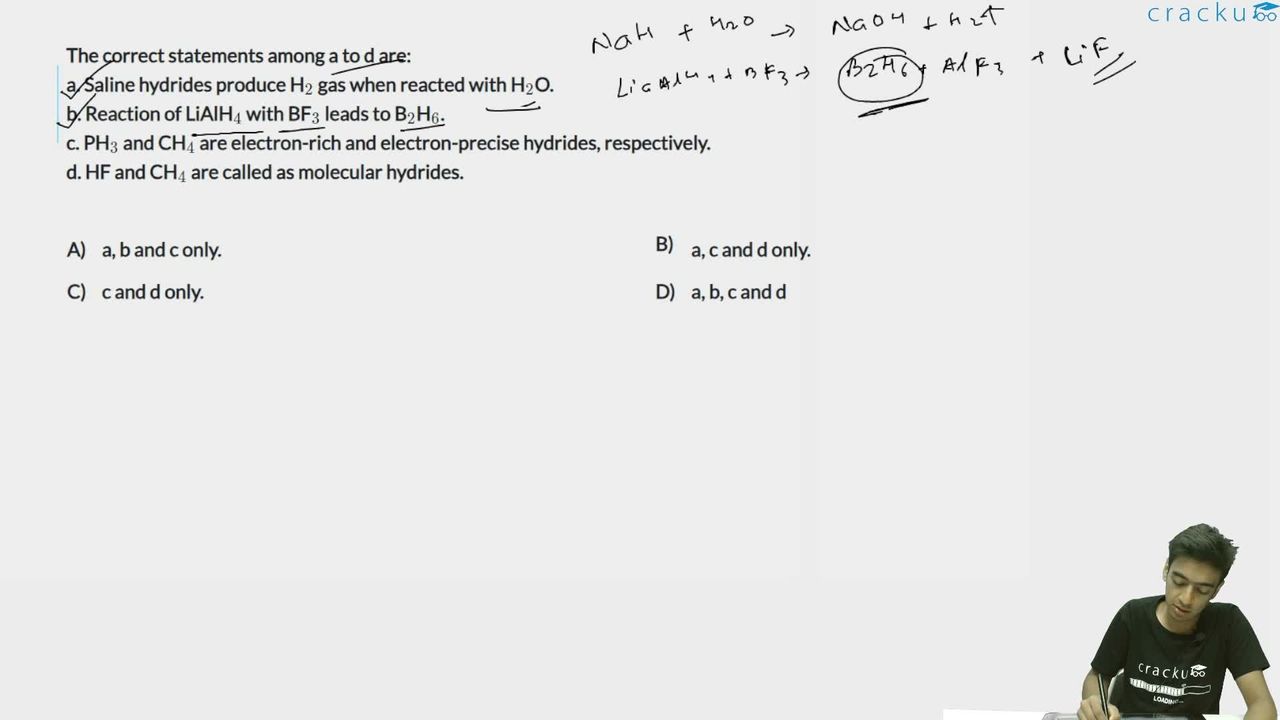
The correct statements among a to d are:
a. Saline hydrides produce H$$_2$$ gas when reacted with H$$_2$$O.
b. Reaction of LiAlH$$_4$$ with BF$$_3$$ leads to B$$_2$$H$$_6$$.
c. PH$$_3$$ and CH$$_4$$ are electron-rich and electron-precise hydrides, respectively.
d. HF and CH$$_4$$ are called as molecular hydrides.
First, we recall that saline (or ionic) hydrides are compounds of hydrogen with highly electropositive metals such as $$\text{Na},\ \text{K},\ \text{Ca},\ \text{Ba}$$ etc. Because the $$\text{H}^-$$ ion is a very strong base, it abstracts a proton from water immediately. Using $$\text{NaH}$$ as a representative example, we write the reaction
$$\text{NaH}+ \text{H}_2\text{O} \;\longrightarrow\; \text{NaOH}+ \text{H}_2\uparrow$$
The arrow pointing upward indicates the liberation of hydrogen gas. Since every saline hydride behaves analogously, statement a is correct.
Now we turn to the behaviour of $$\text{LiAlH}_4$$, which is a powerful reducing agent. A well‐known reduction that it performs is upon $$\text{BF}_3$$, in which two $$\text{BH}_3$$ units generated in situ combine to give diborane $$\text{B}_2\text{H}_6$$. Stating the complete stoichiometric equation, we have
$$4\,\text{BF}_3 \;+\; 3\,\text{LiAlH}_4 \;\longrightarrow\; 2\,\text{B}_2\text{H}_6 \;+\; 3\,\text{LiF} \;+\; 3\,\text{AlF}_3$$
The appearance of $$\text{B}_2\text{H}_6$$ on the product side confirms that statement b is also correct.
Next, we classify hydrides on the basis of valence‐shell electron count. A hydride is called electron-precise when the total number of valence electrons exactly satisfies the octet (or duet) rule for every atom, with no surplus electrons left as lone pairs. Conversely, a hydride is termed electron-rich when one or more atoms possess lone pairs in addition to the bonding pairs.
• The molecule $$\text{CH}_4$$ contains carbon in the centre with four $$\sigma$$ bonds to hydrogen and no lone pair: total $$8$$ electrons around carbon, neither more nor less. Hence $$\text{CH}_4$$ is electron-precise.
• In $$\text{PH}_3$$, phosphorus forms three $$\sigma$$ bonds to hydrogen and still retains one lone pair. Thus the electron count exceeds that needed merely for bonding, placing $$\text{PH}_3$$ in the electron-rich category.
Therefore statement c saying “$$\text{PH}_3$$ is electron-rich and $$\text{CH}_4$$ is electron-precise” stands correct.
Finally, we discuss the nomenclature “molecular (or covalent) hydrides”. A molecular hydride is simply a compound in which hydrogen is linked to a non-metal by covalent bonds, the discrete molecules being held together in the solid or liquid state by comparatively weak intermolecular forces.
• Hydrofluoric acid, $$\text{HF}$$, has the covalent bond $$\text{H-F}$$ and exists as associated but distinct molecules.
• Methane, $$\text{CH}_4$$, is likewise a purely covalent molecule.
Since both $$\text{HF}$$ and $$\text{CH}_4$$ satisfy the definition, statement d is also correct.
Combining our assessments:
a: correct}, \quad \text{b: correct}, \quad \text{c: correct}, \quad \text{d: correct
All four statements are true. The only option that includes a, b, c and d together is Option D.
Hence, the correct answer is Option D.
Was this solution helpful?
Click on the Email ☝️ to Watch the Video Solution
Create a FREE account and get:
_1.webp)

Educational materials for JEE preparation

Ask our AI anything

AI can make mistakes. Please verify important information.
AI can make mistakes. Please verify important information.
