
Join Our JEE Preparation Group
Prep with like-minded aspirants; Get access to free daily tests and study material.
Sign in
Please select an account to continue using cracku.in
↓ →
Join Our JEE Preparation Group
Prep with like-minded aspirants; Get access to free daily tests and study material.
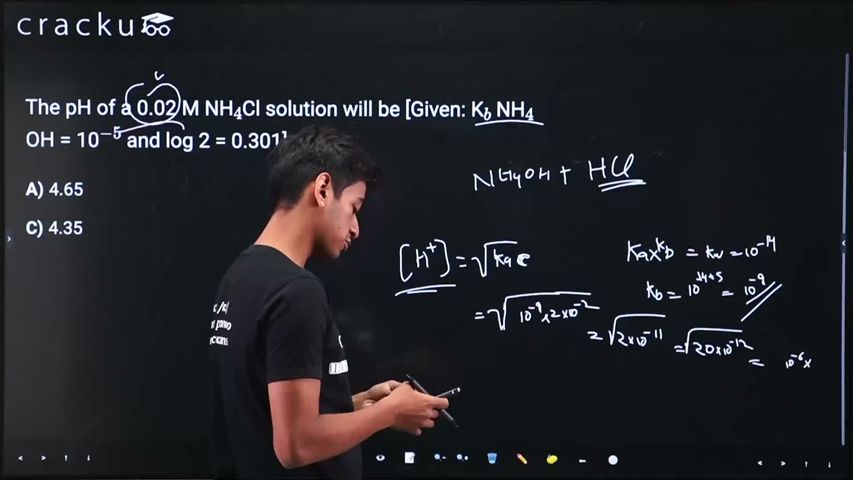
The pH of a 0.02 M NH$$_4$$Cl solution will be [Given: K$$_b$$ NH$$_4$$OH = 10$$^{-5}$$ and log 2 = 0.301]
We start by noting that NH4Cl is the salt of a weak base, NH4OH, and a strong acid, HCl. When this salt dissolves in water it furnishes the conjugate acid NH4+, which undergoes hydrolysis and makes the solution acidic.
The hydrolysis of the ammonium ion is
$$\text{NH}_4^{+} + \text{H}_2\text{O} \rightleftharpoons \text{NH}_4\text{OH} + \text{H}^{+}.$$
For a salt of a weak base (with base-dissociation constant $$K_b$$) and a strong acid, the acid-dissociation constant $$K_a$$ of its conjugate acid is given by the relation
$$K_a = \frac{K_w}{K_b},$$
where $$K_w = 1.0 \times 10^{-14}$$ is the ionic product of water. The data tell us $$K_b(\text{NH}_4\text{OH}) = 1.0 \times 10^{-5}.$$ Substituting these values, we get
$$K_a(\text{NH}_4^{+}) = \frac{1.0 \times 10^{-14}}{1.0 \times 10^{-5}} = 1.0 \times 10^{-9}.$$
Let the formal concentration of the salt solution be $$C = 0.02\ \text{M}.$$ In an aqueous solution of such a salt, the hydrogen-ion concentration produced by hydrolysis is given by the formula
$$[\text{H}^{+}] = \sqrt{K_a\,C}.$$
Substituting the numerical values,
$$[\text{H}^{+}] = \sqrt{(1.0 \times 10^{-9})(0.02)} = \sqrt{2.0 \times 10^{-11}}.$$
We rewrite the radicand in standard scientific form:
$$2.0 \times 10^{-11} = 2 \times 10^{-11}.$$
The square root of a product equals the product of the square roots, so
$$[\text{H}^{+}] = \sqrt{2}\,\sqrt{10^{-11}} = (\sqrt{2}) \times 10^{-5.5}.$$
Because $$\sqrt{2} \approx 1.414,$$ we have
$$[\text{H}^{+}] \approx 1.414 \times 10^{-5.5}.$$
Next we convert this hydrogen-ion concentration into pH. By definition,
$$\text{pH} = -\log[\text{H}^{+}].$$
Writing $$1.414 \times 10^{-5.5}$$ in logarithmic form,
$$\log(1.414 \times 10^{-5.5}) = \log 1.414 + \log 10^{-5.5} = 0.150 - 5.5.$$
(Here we used $$\log 1.414 = 0.150,$$ which is easily checked because $$\log 2 = 0.301$$ is given and $$\log 1.414 = \frac{1}{2}\log 2.$$)
Therefore,
$$\log[\text{H}^{+}] = -5.350,$$
and so
$$\text{pH} = -\left(-5.350\right) = 5.350.$$
Rounding to two decimal places gives
$$\text{pH} \approx 5.35.$$
This value of pH matches the fourth option in the list provided.
Hence, the correct answer is Option D.
Was this solution helpful?
Click on the Email ☝️ to Watch the Video Solution
Create a FREE account and get:
_1.webp)

Educational materials for JEE preparation

Ask our AI anything

AI can make mistakes. Please verify important information.
AI can make mistakes. Please verify important information.
