
Join Our JEE Preparation Group
Prep with like-minded aspirants; Get access to free daily tests and study material.
Sign in
Please select an account to continue using cracku.in
↓ →
Join Our JEE Preparation Group
Prep with like-minded aspirants; Get access to free daily tests and study material.
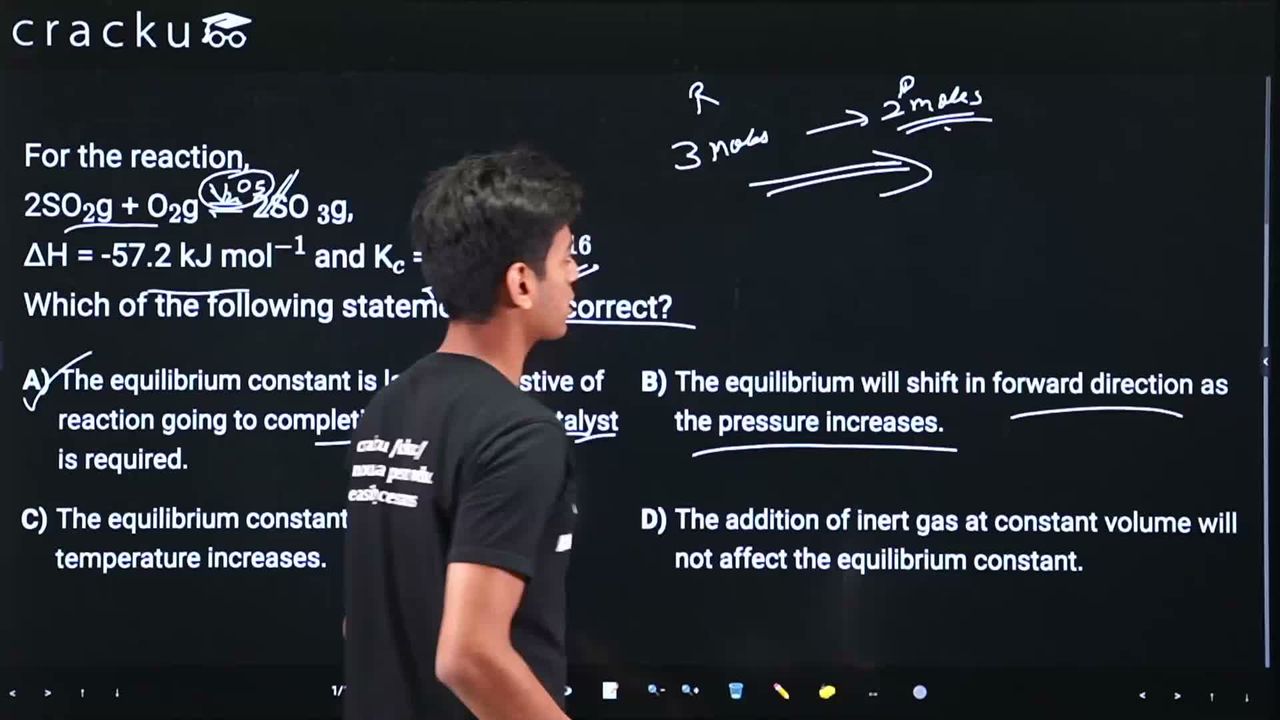
For the reaction,
2SO$$_2$$g + O$$_2$$g $$\rightleftharpoons$$ 2SO $$_3$$g,
ΔH = -57.2 kJ mol$$^{-1}$$ and K$$_c$$ = $$1.7 \times 10^{16}$$.
Which of the following statements is incorrect?
The balanced gaseous equilibrium under discussion is
$$2\,\text{SO}_2(g)+\text{O}_2(g)\; \rightleftharpoons \;2\,\text{SO}_3(g)$$
with the given data
$$\Delta H=-57.2\ \text{kJ mol}^{-1}\qquad\text{and}\qquad K_c=1.7\times10^{16}$$
We examine each statement one by one with the relevant principles of chemical equilibrium.
Statement A: “The equilibrium constant is large suggestive of reaction going to completion and so, no catalyst is required.”
The magnitude $$K_c=1.7\times10^{16}\gg1$$ certainly indicates that, at the stated temperature, the equilibrium lies far to the right; almost all $$\text{SO}_2$$ and $$\text{O}_2$$ will be converted into $$\text{SO}_3$$ once equilibrium is reached. However, the phrase “and so, no catalyst is required” is scientifically wrong. A catalyst affects only the rate at which equilibrium is attained; it has no influence on the value of $$K_c$$ or the equilibrium position itself. Even when $$K_c$$ is huge, the uncatalysed reaction may still be too slow for practical purposes, and industry in fact uses a $$\text{V}_2\text{O}_5$$ catalyst for this very conversion (Contact Process). Therefore, the logical connection asserted in the sentence is incorrect.
Statement B: “The equilibrium will shift in forward direction as the pressure increases.”
To apply Le Chatelier’s principle we compare gaseous moles:
Reactant side: $$2+1=3\ \text{mol}$$, Product side: $$2\ \text{mol}$$.
An increase in total pressure favours the side with fewer moles. Hence the equilibrium shifts to the right (forward) toward $$2\,\text{SO}_3(g)$$. The statement is correct.
Statement C: “The equilibrium constant decreases as the temperature increases.”
We recall the van ’t Hoff relation
$$\ln K = -\frac{\Delta H}{R}\frac1T + \text{constant}.$$
Because $$\Delta H$$ is negative (exothermic), the coefficient $$-\dfrac{\Delta H}{R}$$ is positive. As temperature $$T$$ increases, the term $$\dfrac1T$$ decreases, so $$\ln K$$ decreases and hence $$K$$ itself decreases. Therefore, the statement is correct.
Statement D: “The addition of inert gas at constant volume will not affect the equilibrium constant.”
The equilibrium constant $$K_c$$ depends only on temperature, not on total pressure, volume or the presence of inert components. Introducing an inert gas at fixed volume raises the total pressure but leaves the partial-pressure ratios (and the concentration ratios) unchanged, so $$K_c$$ is unaffected. Thus the statement is correct.
Summarising, statements B, C and D are correct, while statement A contains an incorrect inference regarding the necessity of a catalyst.
Hence, the correct answer is Option A.
Was this solution helpful?
Click on the Email ☝️ to Watch the Video Solution
Create a FREE account and get:
_1.webp)

Educational materials for JEE preparation

Ask our AI anything

AI can make mistakes. Please verify important information.
AI can make mistakes. Please verify important information.
