
Join Our JEE Preparation Group
Prep with like-minded aspirants; Get access to free daily tests and study material.
Sign in
Please select an account to continue using cracku.in
↓ →
Join Our JEE Preparation Group
Prep with like-minded aspirants; Get access to free daily tests and study material.
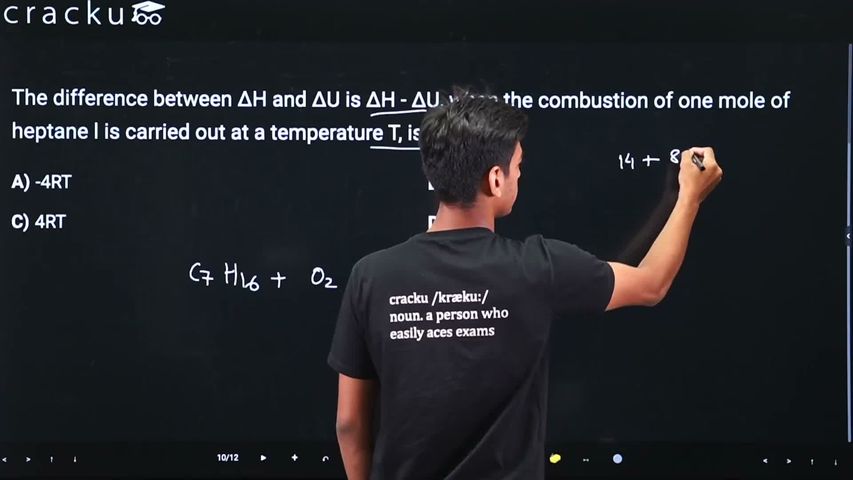
The difference between ΔH and ΔU is ΔH - ΔU, when the combustion of one mole of heptane l is carried out at a temperature T, is equal to:
We start with the thermodynamic relation that connects the enthalpy change $$\Delta H$$ with the internal energy change $$\Delta U$$ for a chemical reaction carried out at temperature $$T$$ and pressure $$P$$.
The formula is stated as
$$\Delta H = \Delta U + \Delta n_g\,R\,T$$
where $$\Delta n_g$$ is the algebraic change in the number of moles of gaseous species between products and reactants, $$R$$ is the universal gas constant and $$T$$ is the absolute temperature. Rearranging, we obtain
$$\Delta H - \Delta U = \Delta n_g\,R\,T$$
So, to evaluate $$\Delta H - \Delta U$$ for the combustion of one mole of liquid heptane, $$\mathrm{C_7H_{16}(l)}$$, we must first write and balance the chemical equation.
The complete combustion equation is
$$\mathrm{C_7H_{16}(l)} \;+\; 11\;\mathrm{O_2(g)} \;\longrightarrow\; 7\;\mathrm{CO_2(g)} \;+\; 8\;\mathrm{H_2O(l)}$$
Now we calculate $$\Delta n_g$$, remembering that only gaseous species are counted:
Number of moles of gaseous products = $$7$$ (from $$7\;\mathrm{CO_2(g)}$$)
Number of moles of gaseous reactants = $$11$$ (from $$11\;\mathrm{O_2(g)}$$)
Hence,
$$\Delta n_g = n_{\text{products (g)}} - n_{\text{reactants (g)}} = 7 - 11 = -4$$
Substituting this value of $$\Delta n_g$$ into the rearranged relation, we get
$$\Delta H - \Delta U = (-4)\,R\,T = -4RT$$
This result exactly matches the expression given in Option A.
Hence, the correct answer is Option A.
Was this solution helpful?
Click on the Email ☝️ to Watch the Video Solution
Create a FREE account and get:
_1.webp)

Educational materials for JEE preparation

Ask our AI anything

AI can make mistakes. Please verify important information.
AI can make mistakes. Please verify important information.
