
Join Our JEE Preparation Group
Prep with like-minded aspirants; Get access to free daily tests and study material.
Sign in
Please select an account to continue using cracku.in
↓ →
Join Our JEE Preparation Group
Prep with like-minded aspirants; Get access to free daily tests and study material.
We wish to arrange the carbonates of the alkaline-earth metals Mg, Ca, Sr and Ba in the order of their thermal stability, that is, the ease with which they resist decomposition on heating:
$$\text{MCO}_3 \; \longrightarrow \; \text{MO} \;+\; \text{CO}_2$$
Higher thermal stability means a higher temperature is required for the above decomposition, whereas lower thermal stability means the salt breaks up more readily.
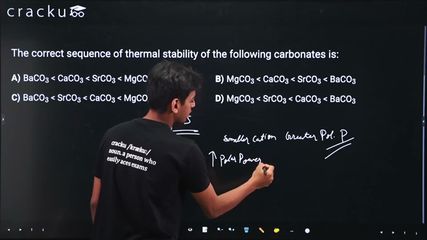
First, we recall the Fajan’s rule statement: “The smaller the cation and the larger its charge, the greater its polarising power, and hence the greater the covalent character of the compound.” Conversely, a larger cation possesses lower polarising power, thereby creating a more ionic lattice.
Now, for the alkaline-earth metals in the order
$$\text{Mg}^{2+},\; \text{Ca}^{2+},\; \text{Sr}^{2+},\; \text{Ba}^{2+}$$
we note that ionic radius increases as we move down the group. Because the charge $$+2$$ is the same for all of them, the polarising power depends only on the size. Hence
$$\text{polarising power:}\; \text{Mg}^{2+} \;>\; \text{Ca}^{2+} \;>\; \text{Sr}^{2+} \;>\; \text{Ba}^{2+}$$
Greater polarising power distorts the electron cloud of the carbonate ion $$\text{CO}_3^{2-}$$ more strongly, weakening the $$\text{C-O}$$ bonds and facilitating decomposition. Therefore, the carbonate with the smallest cation (MgCO$$_3$$) is the least thermally stable, while the carbonate with the largest cation (BaCO$$_3$$) is the most thermally stable.
Writing this out explicitly, we obtain
$$\text{thermal stability:}\; \text{MgCO}_3 \;<\; \text{CaCO}_3 \;<\; \text{SrCO}_3 \;<\; \text{BaCO}_3$$
We now simply match this derived sequence with the alternatives provided:
Option A states: $$\text{BaCO}_3 < \text{CaCO}_3 < \text{SrCO}_3 < \text{MgCO}_3$$ - this is the reverse of what we derived; it is incorrect.
Option B states: $$\text{MgCO}_3 < \text{CaCO}_3 < \text{SrCO}_3 < \text{BaCO}_3$$ - this exactly matches our result; it is correct.
Option C and Option D similarly disagree with the correct order.
Hence, the correct answer is Option B.
Click on the Email ☝️ to Watch the Video Solution
Create a FREE account and get:
_1.webp)

Educational materials for JEE preparation

Ask our AI anything

AI can make mistakes. Please verify important information.
AI can make mistakes. Please verify important information.


