
Join Our JEE Preparation Group
Prep with like-minded aspirants; Get access to free daily tests and study material.
Sign in
Please select an account to continue using cracku.in
↓ →
Join Our JEE Preparation Group
Prep with like-minded aspirants; Get access to free daily tests and study material.
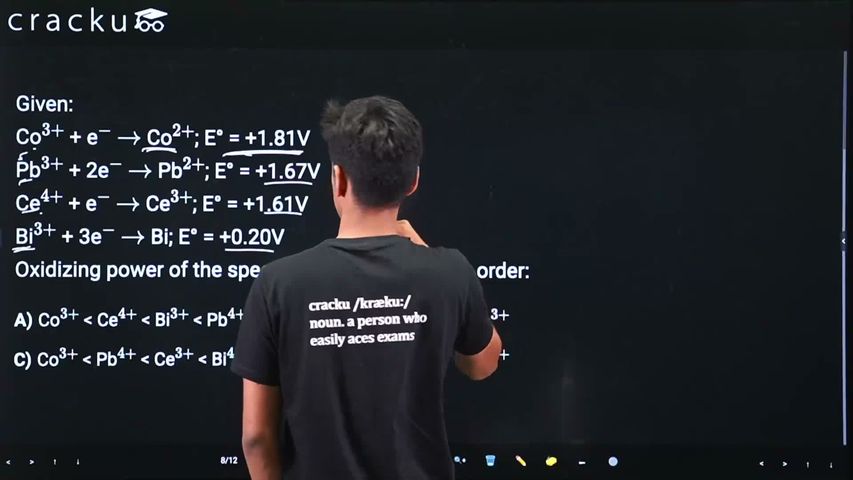
Given:
Co$$^{3+}$$ + e$$^-$$ $$\to$$ Co$$^{2+}$$; E° = +1.81V
Pb$$^{3+}$$ + 2e$$^-$$ $$\to$$ Pb$$^{2+}$$; E° = +1.67V
Ce$$^{4+}$$ + e$$^-$$ $$\to$$ Ce$$^{3+}$$; E° = +1.61V
Bi$$^{3+}$$ + 3e$$^-$$ $$\to$$ Bi; E° = +0.20V
Oxidizing power of the species will increase in the order:
We begin by recalling the basic electrochemical fact that the standard reduction potential $$E^\circ$$ of a half-cell tells us how readily the species on the left side of that half-reaction accepts electrons and gets reduced. The larger (more positive) the value of $$E^\circ$$, the greater is this tendency to be reduced and, correspondingly, the stronger is that species as an oxidizing agent. In other words, if we have two species $$A^{m+}$$ and $$B^{n+}$$ with $$E^\circ_A < E^\circ_B$$, then
$$A^{m+} \; \text{is a weaker oxidizing agent than} \; B^{n+}.$$
Keeping this criterion in mind, let us list the given half-reactions together with their standard reduction potentials:
$$\text{(1)}\; \mathrm{Co^{3+} + e^- \to Co^{2+}},\qquad E^\circ = +1.81\ \text{V}$$ $$\text{(2)}\; \mathrm{Pb^{4+} + 2e^- \to Pb^{2+}},\qquad E^\circ = +1.67\ \text{V}$$ $$\text{(3)}\; \mathrm{Ce^{4+} + e^- \to Ce^{3+}},\qquad E^\circ = +1.61\ \text{V}$$ $$\text{(4)}\; \mathrm{Bi^{3+} + 3e^- \to Bi},\qquad\;\; E^\circ = +0.20\ \text{V}$$
(The problem statement writes $$\mathrm{Pb^{3+}}$$, but the tabulated value $$+1.67\ \text{V}$$ actually corresponds to the well-known $$\mathrm{Pb^{4+}/Pb^{2+}}$$ couple, so we use $$\mathrm{Pb^{4+}}$$ in the comparison, exactly as appears in the options.)
Now we arrange these species in order of increasing $$E^\circ$$ because, as argued above, increasing $$E^\circ$$ means increasing oxidizing power:
$$E^\circ(\mathrm{Bi^{3+}}) = +0.20\ \text{V} \lt\; E^\circ(\mathrm{Ce^{4+}}) = +1.61\ \text{V} \lt\; E^\circ(\mathrm{Pb^{4+}}) = +1.67\ \text{V} \lt\; E^\circ(\mathrm{Co^{3+}}) = +1.81\ \text{V}.$$
Translating this numerical order back into words, we obtain the sequence from the weakest to the strongest oxidizing agent:
$$\mathrm{Bi^{3+}} \lt \mathrm{Ce^{4+}} \lt \mathrm{Pb^{4+}} \lt \mathrm{Co^{3+}}.$$
This exactly matches Option B in the given list.
Hence, the correct answer is Option B.
Was this solution helpful?
Click on the Email ☝️ to Watch the Video Solution
Create a FREE account and get:
_1.webp)

Educational materials for JEE preparation

Ask our AI anything

AI can make mistakes. Please verify important information.
AI can make mistakes. Please verify important information.
