
Join Our JEE Preparation Group
Prep with like-minded aspirants; Get access to free daily tests and study material.
Sign in
Please select an account to continue using cracku.in
↓ →
Join Our JEE Preparation Group
Prep with like-minded aspirants; Get access to free daily tests and study material.
First, we recall the definition of a disproportionation reaction. A single species undergoes simultaneous oxidation as well as reduction, producing two different products that contain the same element in two different oxidation states. In symbolic terms:
$$\text{A}^{n+} \;\longrightarrow\; \text{A}^{(n+m)+} \;+\; \text{A}^{(n-k)+}$$
Here one portion of A loses electrons (oxidation, oxidation state increases by $$m$$) while another portion gains electrons (reduction, oxidation state decreases by $$k$$).
We now analyse each option by writing the oxidation state of the key element in reactants and products.
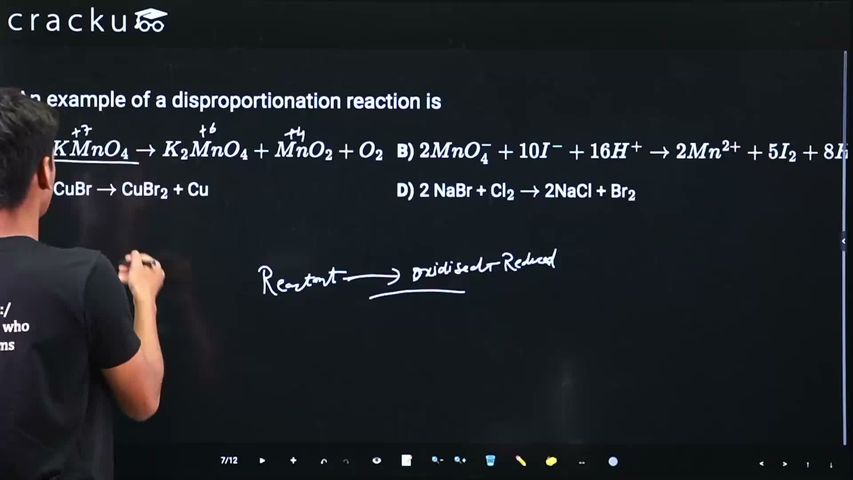
Option A: $$2KMnO_4 \;\longrightarrow\; K_2MnO_4 + MnO_2 + O_2$$
In $$KMnO_4$$, manganese has oxidation state $$+7$$ (because $$K$$ is $$+1$$ and each $$O$$ is $$-2$$: $$+1 + x + 4(-2)=0 \implies x=+7$$). In $$K_2MnO_4$$, manganese is $$+6$$ ($$2(+1)+x+4(-2)=0 \implies x=+6$$). In $$MnO_2$$, manganese is $$+4$$ ($$x+2(-2)=0 \implies x=+4$$).
Both changes $$+7 \to +6$$ and $$+7 \to +4$$ are reductions; there is no simultaneous oxidation. Hence this is not disproportionation.
Option B: $$2MnO_4^- + 10I^- + 16H^+ \;\longrightarrow\; 2Mn^{2+} + 5I_2 + 8H_2O$$
$$Mn$$ goes $$+7 \to +2$$ (reduction) while $$I$$ goes $$-1 \to 0$$ (oxidation). Two different elements change oxidation state, so again it is not disproportionation.
Option C: $$2\,CuBr \;\longrightarrow\; CuBr_2 + Cu$$
Let us calculate the oxidation states step by step.
• In $$CuBr$$ the bromide ion is $$-1$$. Setting the sum to zero: $$x+(-1)=0 \implies x=+1$$. So copper is $$+1$$.
• In $$CuBr_2$$ we have $$x+2(-1)=0 \implies x=+2$$. Thus copper becomes $$+2$$ — this is oxidation because the oxidation state increases from $$+1$$ to $$+2$$ (loss of one electron).
• In metallic $$Cu$$ the oxidation state is $$0$$. The change $$+1 \to 0$$ is reduction because the oxidation state decreases (gain of one electron).
We see the same species $$Cu^{+}$$ has simultaneously undergone oxidation ($$+1 \to +2$$) and reduction ($$+1 \to 0$$). This exactly fits the definition of disproportionation.
Option D: $$2 NaBr + Cl_2 \;\longrightarrow\; 2NaCl + Br_2$$
Here $$Cl$$ goes $$0 \to -1$$ (reduction) and $$Br$$ goes $$-1 \to 0$$ (oxidation). Two different elements again; so it is not disproportionation.
Only Option C satisfies the criterion that one element in a single oxidation state splits into two different oxidation states, evidencing both oxidation and reduction of that element.
Hence, the correct answer is Option C.
Was this solution helpful?
Click on the Email ☝️ to Watch the Video Solution
Create a FREE account and get:
_1.webp)

Educational materials for JEE preparation

Ask our AI anything

AI can make mistakes. Please verify important information.
AI can make mistakes. Please verify important information.
