
Join Our JEE Preparation Group
Prep with like-minded aspirants; Get access to free daily tests and study material.
Sign in
Please select an account to continue using cracku.in
↓ →
Join Our JEE Preparation Group
Prep with like-minded aspirants; Get access to free daily tests and study material.
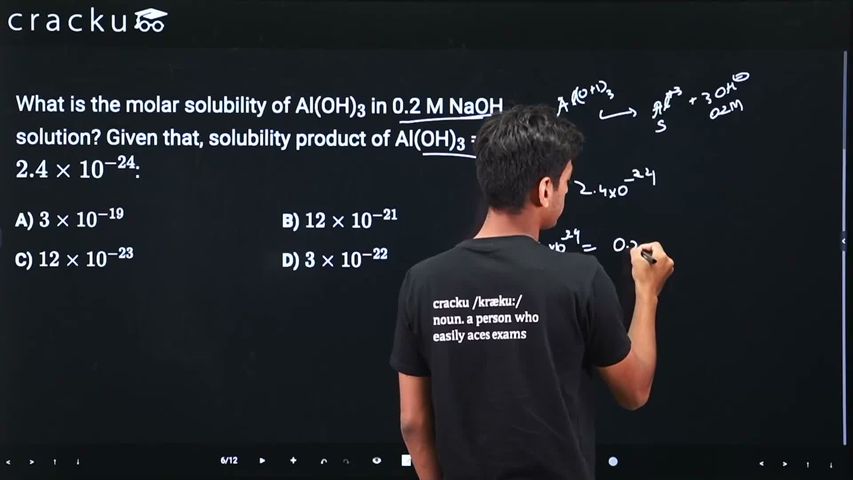
What is the molar solubility of Al(OH)$$_3$$ in 0.2 M NaOH solution? Given that, solubility product of Al(OH)$$_3$$ = $$2.4 \times 10^{-24}$$:
We begin by writing the dissolution equilibrium of solid aluminium hydroxide in water:
$$\mathrm{Al(OH)_3(s) \rightleftharpoons Al^{3+}(aq) + 3\,OH^{-}(aq)}$$
If the molar solubility of $$\mathrm{Al(OH)_3}$$ in the given solution is $$s\ \text{mol L}^{-1}$$, then at equilibrium
$$[\,\mathrm{Al^{3+}}\,] = s$$
and the dissolution itself would contribute $$3s$$ moles per litre of hydroxide ions. However, the solution already contains hydroxide ions coming from the added sodium hydroxide:
$$[\mathrm{OH^-}]_{\text{initial}} = 0.2\ \text{M}$$
Therefore the total hydroxide-ion concentration at equilibrium will be
$$[\mathrm{OH^-}] = 0.2 + 3s$$
Because 0.2 M is many orders of magnitude larger than the tiny solubility we are about to compute, we may safely approximate
$$[\mathrm{OH^-}] \approx 0.2\ \text{M}$$
Now we invoke the definition of the solubility product. For the equilibrium shown, the expression is
$$K_{sp} = [\mathrm{Al^{3+}}]\,[\mathrm{OH^-}]^{3}$$
Substituting the equilibrium concentrations we have just established,
$$2.4 \times 10^{-24} = s\,(0.2)^{3}$$
We evaluate the cube of 0.2 first:
$$0.2^{3} = 0.2 \times 0.2 \times 0.2 = 0.008$$
Inserting this numerical value, the equation becomes
$$2.4 \times 10^{-24} = s \times 0.008$$
To isolate $$s$$, we divide both sides by 0.008:
$$s = \frac{2.4 \times 10^{-24}}{0.008}$$
Since $$0.008 = 8 \times 10^{-3}$$, the division can be performed as follows:
$$s = \frac{2.4}{8}\times10^{-24+3} = 0.3 \times 10^{-21}$$
Rewriting $$0.3 \times 10^{-21}$$ in proper scientific notation gives
$$s = 3 \times 10^{-22}\ \text{mol L}^{-1}$$
This quantity is the molar solubility of aluminium hydroxide in 0.2 M sodium hydroxide solution.
Hence, the correct answer is Option D.
Click on the Email ☝️ to Watch the Video Solution
Create a FREE account and get:
_1.webp)

Educational materials for JEE preparation

Ask our AI anything

AI can make mistakes. Please verify important information.
AI can make mistakes. Please verify important information.


