
Join Our JEE Preparation Group
Prep with like-minded aspirants; Get access to free daily tests and study material.
Sign in
Please select an account to continue using cracku.in
↓ →
Join Our JEE Preparation Group
Prep with like-minded aspirants; Get access to free daily tests and study material.
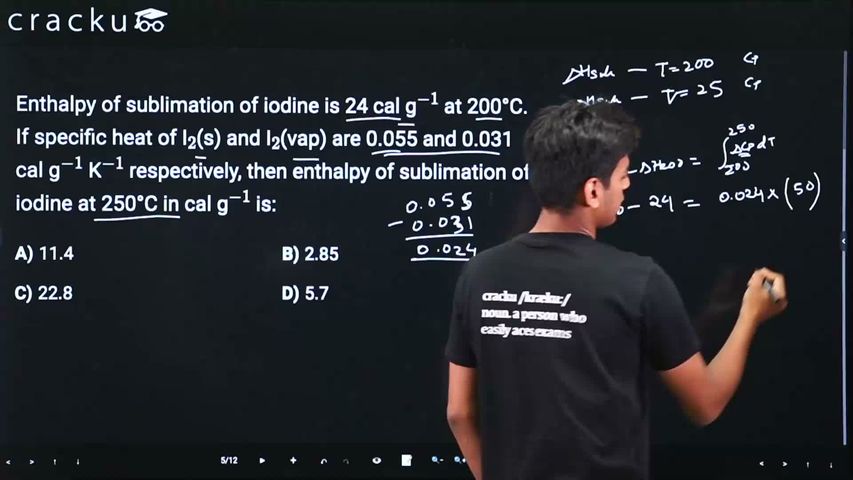
Enthalpy of sublimation of iodine is 24 cal g$$^{-1}$$ at 200°C. If specific heat of I$$_2$$(s) and I$$_2$$(vap) are 0.055 and 0.031 cal g$$^{-1}$$ K$$^{-1}$$ respectively, then enthalpy of sublimation of iodine at 250°C in cal g$$^{-1}$$ is:
We are given that the enthalpy of sublimation of iodine at $$200^{\circ}\text{C}$$ (which is $$T_1 = 200 + 273 = 473\ \text{K}$$) is $$\Delta H_{\text{sub},\,1}=24\ \text{cal g}^{-1}$$. We want the same quantity at $$250^{\circ}\text{C}$$, i.e. at $$T_2 = 250 + 273 = 523\ \text{K}$$.
The temperature dependence of an enthalpy change is obtained from Kirchhoff’s relation, which in its integral form reads
$$\Delta H_{2}=\Delta H_{1}+\int_{T_1}^{T_2}\Delta C_p\,dT,$$
where $$\Delta C_p=C_{p,\text{vap}}-C_{p,\text{solid}}$$ is the difference in specific heats between the two phases involved in the process.
From the data, we have
$$C_{p,\text{vap}}=0.031\ \text{cal g}^{-1}\text{K}^{-1},\qquad C_{p,\text{solid}}=0.055\ \text{cal g}^{-1}\text{K}^{-1}.$$
So the specific-heat difference is
$$\Delta C_p=C_{p,\text{vap}}-C_{p,\text{solid}} =0.031-0.055 =-0.024\ \text{cal g}^{-1}\text{K}^{-1}.$$
Because both specific heats are given as constants over the temperature range, the integral simplifies to multiplication:
$$\int_{T_1}^{T_2}\Delta C_p\,dT =\Delta C_p\,(T_2-T_1).$$
The temperature rise is
$$T_2-T_1 = 523\ \text{K}-473\ \text{K}=50\ \text{K}.$$
Therefore, the change in enthalpy due to heating is
$$\Delta C_p\,(T_2-T_1)=(-0.024)\times50=-1.2\ \text{cal g}^{-1}.$$
Adding this correction to the original enthalpy of sublimation, we get
$$\Delta H_{\text{sub},\,2} =\Delta H_{\text{sub},\,1}+(-1.2) =24-1.2 =22.8\ \text{cal g}^{-1}.$$
Hence, the correct answer is Option C.
Click on the Email ☝️ to Watch the Video Solution
Create a FREE account and get:
_1.webp)

Educational materials for JEE preparation

Ask our AI anything

AI can make mistakes. Please verify important information.
AI can make mistakes. Please verify important information.


