
Join Our JEE Preparation Group
Prep with like-minded aspirants; Get access to free daily tests and study material.
Sign in
Please select an account to continue using cracku.in
↓ →
Join Our JEE Preparation Group
Prep with like-minded aspirants; Get access to free daily tests and study material.
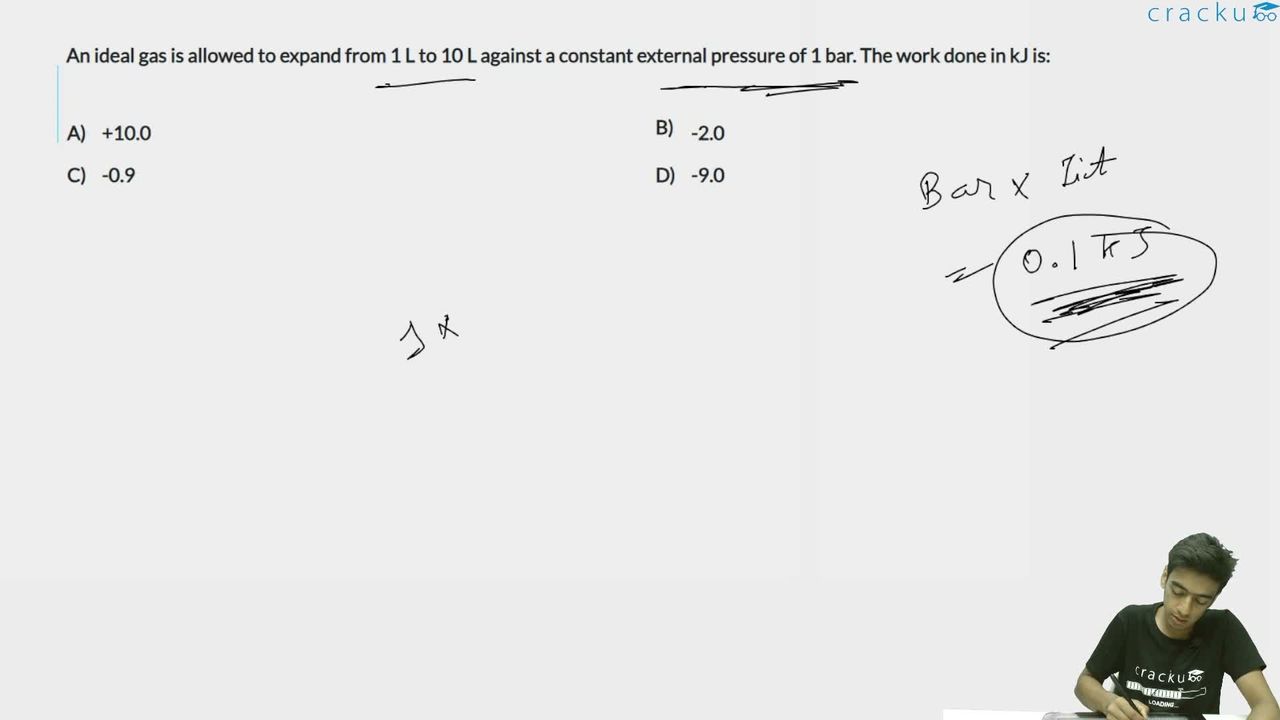
An ideal gas is allowed to expand from 1 L to 10 L against a constant external pressure of 1 bar. The work done in kJ is:
We have an isothermal, irreversible expansion carried out against a constant external pressure. For any such process, the mechanical work done by the gas is given by the formula $$W = -P_{\text{ext}}\Delta V$$ where $$P_{\text{ext}}$$ is the unchanging external pressure and $$\Delta V = V_{\text{final}}-V_{\text{initial}}$$ is the change in volume.
First, we determine the change in volume. The gas starts at $$V_{\text{initial}} = 1\;\text{L}$$ and finishes at $$V_{\text{final}} = 10\;\text{L}$$. Hence,
$$\Delta V = V_{\text{final}} - V_{\text{initial}} = 10\;\text{L} - 1\;\text{L} = 9\;\text{L}.$$
Now we substitute the numerical values into the work formula. The external pressure is given as $$P_{\text{ext}} = 1\;\text{bar}$$ and we have just found $$\Delta V = 9\;\text{L}$$, so
$$W = -P_{\text{ext}}\Delta V = -\left(1\;\text{bar}\right)\left(9\;\text{L}\right) = -9\;\text{L·bar}.$$
We must express the result in kilojoules. The unit conversion required is a standard relation in thermodynamics:
$$1\;\text{L·bar} = 100\;\text{J}.$$
Therefore,
$$-9\;\text{L·bar} = -9 \times 100\;\text{J} = -900\;\text{J}.$$
Finally, convert joules to kilojoules:
$$-900\;\text{J} = -\dfrac{900}{1000}\;\text{kJ} = -0.9\;\text{kJ}.$$
Thus, the work done by the gas during the expansion is $$-0.9\;\text{kJ}$$, the negative sign indicating that energy leaves the system as useful work.
Hence, the correct answer is Option C.
Click on the Email ☝️ to Watch the Video Solution
Create a FREE account and get:
_1.webp)

Educational materials for JEE preparation

Ask our AI anything

AI can make mistakes. Please verify important information.
AI can make mistakes. Please verify important information.


