
Join Our JEE Preparation Group
Prep with like-minded aspirants; Get access to free daily tests and study material.
Sign in
Please select an account to continue using cracku.in
↓ →
Join Our JEE Preparation Group
Prep with like-minded aspirants; Get access to free daily tests and study material.
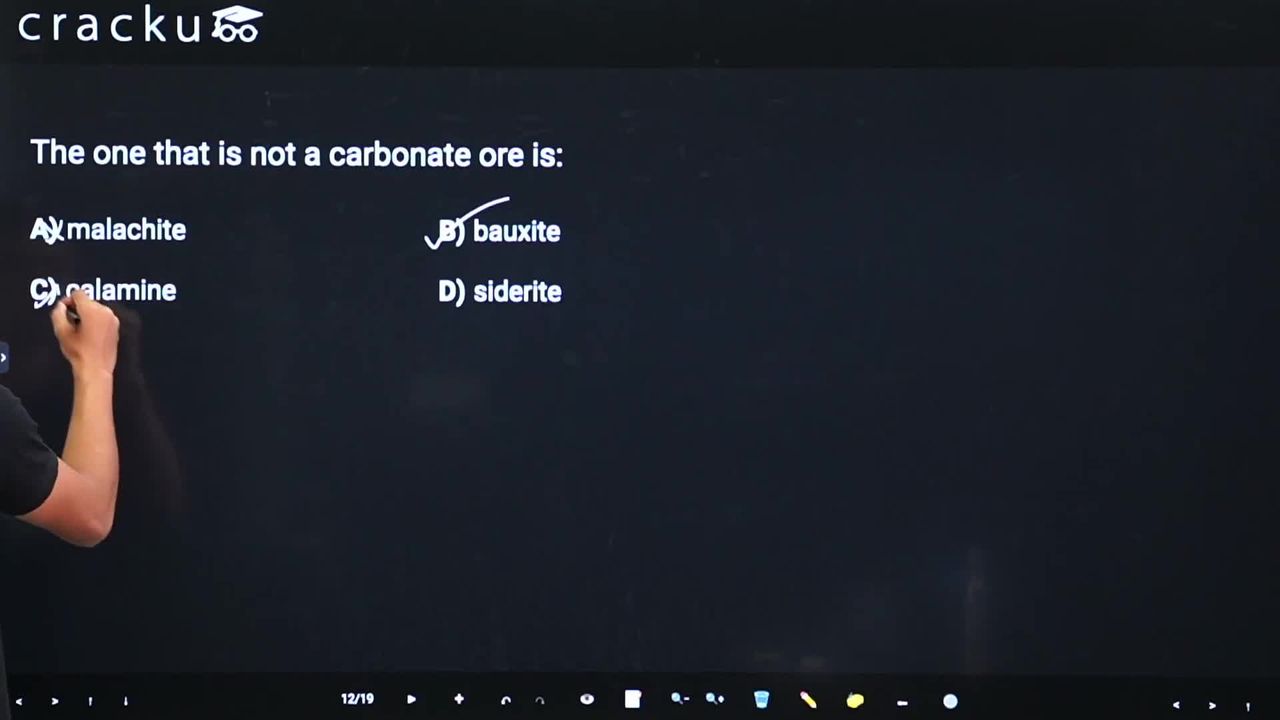
We begin by recalling that a carbonate ore is one which contains the $$\mathrm{CO_3^{2-}}$$ ion as an essential part of its chemical composition. In simple words, the formula of a carbonate ore must show the carbonate group $$\mathrm{(CO_3)}$$ joined to a metal.
Now let us write the chemical formulas of all the four ores mentioned in the options so that we can clearly see whether the carbonate group is present or absent in each case.
For malachite (Option A) the chemical formula is $$\mathrm{CuCO_3 \cdot Cu(OH)_2}$$. We notice the separate unit $$\mathrm{CuCO_3}$$ inside this formula, and that obviously contains the carbonate ion $$\mathrm{CO_3^{2-}}$$. So malachite is a carbonate ore of copper.
For bauxite (Option B) the commonly accepted formula is $$\mathrm{Al_2O_3 \cdot 2H_2O}$$. There is no $$\mathrm{CO_3}$$ group in this formula; instead it is an oxide combined with water of hydration, making it an aluminium oxide ore, not a carbonate.
For calamine (Option C) the formula is $$\mathrm{ZnCO_3}$$. The carbonate group is directly attached to zinc, so calamine is definitely a carbonate ore of zinc.
For siderite (Option D) the formula is $$\mathrm{FeCO_3}$$, and once again the carbonate ion $$\mathrm{CO_3^{2-}}$$ is present, making siderite a carbonate ore of iron.
Comparing all four formulas, we see that malachite, calamine, and siderite each contain the $$\mathrm{CO_3}$$ group, while bauxite does not. Therefore bauxite is the only ore in the list that is not a carbonate ore.
Hence, the correct answer is Option B.
Was this solution helpful?
Click on the Email ☝️ to Watch the Video Solution
Create a FREE account and get:
_1.webp)

Educational materials for JEE preparation

Ask our AI anything

AI can make mistakes. Please verify important information.
AI can make mistakes. Please verify important information.


