
Join Our JEE Preparation Group
Prep with like-minded aspirants; Get access to free daily tests and study material.
Sign in
Please select an account to continue using cracku.in
↓ →
Join Our JEE Preparation Group
Prep with like-minded aspirants; Get access to free daily tests and study material.
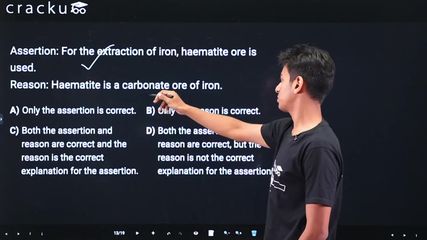
Assertion: For the extraction of iron, haematite ore is used.
Reason: Haematite is a carbonate ore of iron.
First, we consider the statement of the assertion. In the blast-furnace extraction of iron, the industry generally employs the ore haematite. Chemically, haematite is represented as $$\text{Fe}_2\text{O}_3$$ and is abundant, cheap, and easily reducible. Because of these practical advantages, haematite really is the ore chosen for large-scale iron production. Therefore, the assertion “For the extraction of iron, haematite ore is used” is true.
Now we examine the reason. The reason claims “Haematite is a carbonate ore of iron.” Let us recall the basic classification of iron ores. An oxide ore has iron combined with oxygen, while a carbonate ore has iron combined with the $$\text{CO}_3^{2-}$$ group.
Specifically,
$$\text{Haematite} = \text{Fe}_2\text{O}_3 \quad(\text{oxide ore})$$
$$\text{Siderite} = \text{FeCO}_3 \quad(\text{carbonate ore})$$
Clearly, haematite contains only iron and oxygen; there is no carbonate group present. Hence haematite is an oxide ore, not a carbonate ore. Consequently, the reason given in the question is false.
We have found that the assertion is correct while the reason is incorrect. The option that matches this situation is Option A: “Only the assertion is correct.”
Hence, the correct answer is Option A.
Was this solution helpful?
Click on the Email ☝️ to Watch the Video Solution
Create a FREE account and get:
_1.webp)

Educational materials for JEE preparation

Ask our AI anything

AI can make mistakes. Please verify important information.
AI can make mistakes. Please verify important information.


