
Join Our JEE Preparation Group
Prep with like-minded aspirants; Get access to free daily tests and study material.
Sign in
Please select an account to continue using cracku.in
↓ →
Join Our JEE Preparation Group
Prep with like-minded aspirants; Get access to free daily tests and study material.
First, let us recall the general idea that the boiling point of a substance is directly related to the strength of the intermolecular forces holding its molecules together in the liquid state. When these forces are strong, a greater amount of energy (in the form of heat) is required to overcome them and convert the liquid into the gaseous phase, leading to a higher boiling point.
Among the hydrogen halides $$\text{HX}$$ where $$\text{X} = \text{F, Cl, Br, I}$$, we experimentally observe the boiling-point order
$$\text{HF} \; > \; \text{HI} \; > \; \text{HBr} \; > \; \text{HCl}.$$
Now, we must identify the specific type of intermolecular force that makes $$\text{HF}$$ stand out. In molecular systems, three main kinds of intermolecular attractions are normally considered:
1. van der Waals’ (London dispersion) forces - present in all molecules but generally weak and increasing with molecular size.
2. Dipole-dipole interactions - present when the molecule is polar.
3. Hydrogen bonding - a special, particularly strong type of dipole-dipole interaction that occurs when hydrogen is covalently bonded to a highly electronegative atom such as $$\text{F, O,}$$ or $$\text{N}$$, and the hydrogen atom simultaneously interacts with a lone pair on another electronegative atom.
We have $$\text{HF}$$ containing hydrogen directly attached to fluorine, the most electronegative element. Because of this, the $$\text{H-F}$$ bond is highly polar, giving a large partial positive charge on hydrogen ($$ \delta^+ $$) and a large partial negative charge on fluorine ($$ \delta^- $$). Consequently, very strong hydrogen bonds of the form
$$\text{F}\;\!\!\!\delta^- \; \cdots \; \text{H}\;\!\!\!\delta^+ - \text{F}\;\!\!\!\delta^-$$
are formed between one $$\text{HF}$$ molecule and its neighbors. These hydrogen bonds are far stronger than ordinary van der Waals’ forces or simple dipole-dipole attractions. As a result, to break this network of hydrogen bonds and vaporize $$\text{HF}$$, a large amount of energy is needed, and the boiling point becomes exceptionally high.
Let us now examine each option in the problem statement:
Option A speaks of “lowest dissociation enthalpy.” Lower bond-dissociation enthalpy would imply a weaker $$\text{H-F}$$ covalent bond, but in reality the $$\text{H-F}$$ bond is the strongest among the $$\text{H-X}$$ bonds, not the weakest. Therefore this option cannot explain the high boiling point.
Option B mentions “strongest van der Waals’ interactions.” While dispersion forces do increase with molecular mass, fluorine is the lightest halogen, so $$\text{HF}$$ actually has the weakest van der Waals’ dispersive attraction among the series. Hence this option is also incorrect.
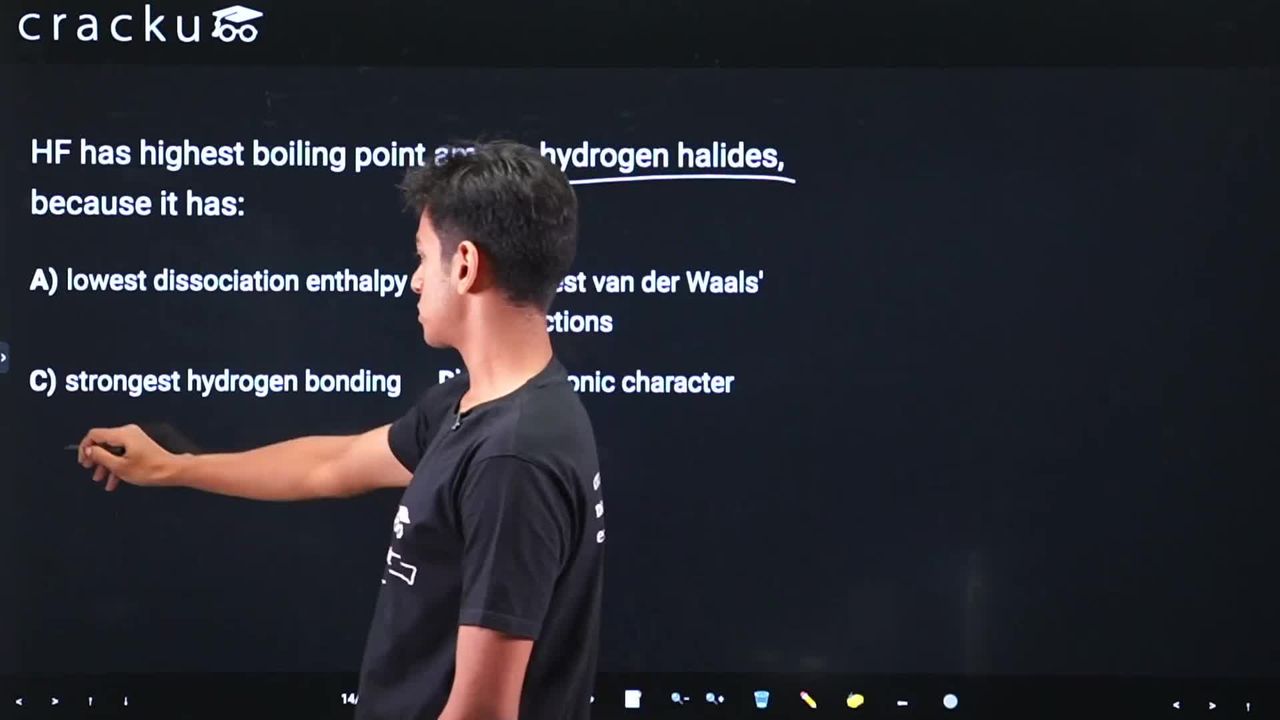
Option C states “strongest hydrogen bonding.” As explained, hydrogen bonded to the most electronegative atom fluorine allows exceptionally strong intermolecular hydrogen bonds, making the liquid difficult to boil. This perfectly accounts for the observation.
Option D claims “lowest ionic character.” Ionic character affects properties like lattice energy in solids such as $$\text{NaF}$$ or $$\text{KCl}$$, but liquid $$\text{HF}$$ is molecular, not ionic. Thus this option is irrelevant to its boiling point.
Among the provided choices, only Option C correctly identifies the dominant factor responsible for the highest boiling point of $$\text{HF}$$.
Hence, the correct answer is Option C.
Was this solution helpful?
Click on the Email ☝️ to Watch the Video Solution
Create a FREE account and get:
_1.webp)

Educational materials for JEE preparation

Ask our AI anything

AI can make mistakes. Please verify important information.
AI can make mistakes. Please verify important information.


