
Join Our JEE Preparation Group
Prep with like-minded aspirants; Get access to free daily tests and study material.
Sign in
Please select an account to continue using cracku.in
↓ →
Join Our JEE Preparation Group
Prep with like-minded aspirants; Get access to free daily tests and study material.
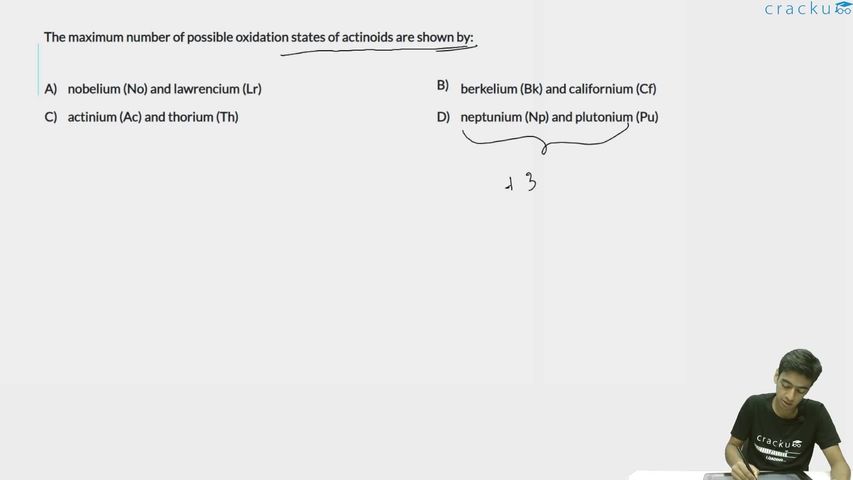
We recall the basic fact that the number of different oxidation states an element can show depends on the availability and comparable energies of its outer-shell electrons. For the actinoids, the relevant subshells are $$5f,\;6d,\;\text{and}\;7s,$$ so the middle members, where all three subshells are partly filled, usually exhibit the greatest variety of oxidation states. We now examine each option in turn, explicitly listing every oxidation state reported in the literature for the pair of elements mentioned.
For Option A, nobelium (No) and lawrencium (Lr):
• Nobelium: experimentally verified oxidation states $$+2$$ and $$+3.$$
• Lawrencium: essentially confined to the oxidation state $$+3.$$
Thus the total count for each is only two or one.
For Option B, berkelium (Bk) and californium (Cf):
• Berkelium: shows $$+3$$ and $$+4$$ (rare).
• Californium: shows $$+2$$ and $$+3,$$ with $$+4$$ being extremely uncertain.
Again, the maximum for either of them does not exceed three.
For Option C, actinium (Ac) and thorium (Th):
• Actinium: essentially fixed at $$+3.$$
• Thorium: mainly $$+4,$$ occasionally $$+3$$ and $$+2$$ under highly reducing conditions, so at best three.
For Option D, neptunium (Np) and plutonium (Pu):
• Neptunium: stable aqueous oxidation states $$+3,\; +4,\; +5,\; +6,\; +7,$$ and even $$+2$$ in some solid complexes, giving at least six.
• Plutonium: well-characterised oxidation states $$+3,\; +4,\; +5,\; +6$$ in solution, with $$+7$$ and $$+2$$ observed in specialised conditions, again yielding six or more.
Comparing the counts, neptunium and plutonium clearly exhibit the maximum number of different oxidation states among all actinoids listed. None of the other pairs approach this breadth.
Hence, the correct answer is Option D.
Was this solution helpful?
Click on the Email ☝️ to Watch the Video Solution
Create a FREE account and get:
_1.webp)

Educational materials for JEE preparation

Ask our AI anything

AI can make mistakes. Please verify important information.
AI can make mistakes. Please verify important information.


