
Join Our JEE Preparation Group
Prep with like-minded aspirants; Get access to free daily tests and study material.
Sign in
Please select an account to continue using cracku.in
↓ →
Join Our JEE Preparation Group
Prep with like-minded aspirants; Get access to free daily tests and study material.
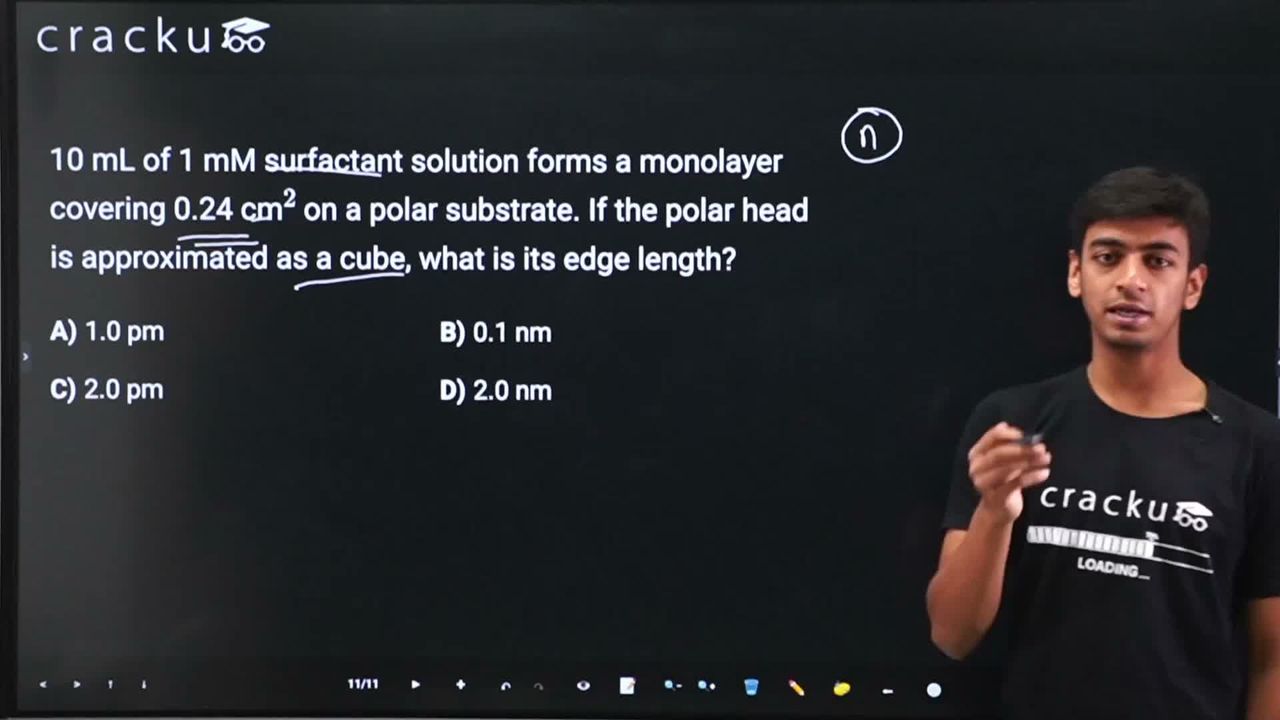
10 mL of 1 mM surfactant solution forms a monolayer covering 0.24 cm$$^2$$ on a polar substrate. If the polar head is approximated as a cube, what is its edge length?
Step 1: Calculate the total number of moles of surfactant Volume of the surfactant solution = 10 mL = 0.01 L Concentration of the solution = 1 mM = 0.001 mol/L Number of moles = Concentration * Volume Number of moles = 0.001 mol/L * 0.01 L = 10^-5 moles
Step 2: Calculate the total number of surfactant molecules Using Avogadro's number (6 * 10^23 molecules/mol): Number of molecules = 10^-5 mol * 6 * 10^23 molecules/mol = 6 * 10^18 molecules
Step 3: Calculate the area occupied by a single molecule Total Area = 0.24 cm^2 Area per molecule = Total Area / Number of molecules Area per molecule = 0.24 cm^2 / (6 * 10^18) = 4 * 10^-20 cm^2
Step 4: Find the edge length of the cubic polar head Since the polar head is approximated as a cube, the area it occupies on the substrate is the area of one face (a^2), where a is the edge length: a^2 = 4 * 10^-20 cm^2
Taking the square root of both sides: a = 2 * 10^-10 cm
Step 5: Convert the unit to picometers (pm) Convert centimeters to meters: a = 2 * 10^-12 m
Since 1 pm = 10^-12 m: a = 2 pm
Final Answer: The edge length of the polar head is 2 pm (or 2 * 10^-12 m).
Was this solution helpful?
Click on the Email ☝️ to Watch the Video Solution
Create a FREE account and get:
_1.webp)

Educational materials for JEE preparation

Ask our AI anything

AI can make mistakes. Please verify important information.
AI can make mistakes. Please verify important information.


