
Join Our JEE Preparation Group
Prep with like-minded aspirants; Get access to free daily tests and study material.
Sign in
Please select an account to continue using cracku.in
↓ →
Join Our JEE Preparation Group
Prep with like-minded aspirants; Get access to free daily tests and study material.
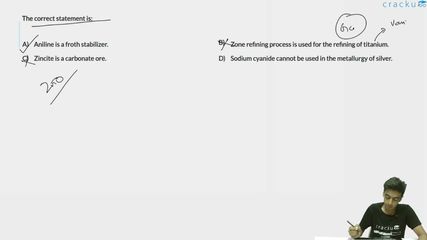
We begin by reading all the four statements one by one and recalling the fundamental facts of metallurgy and surface chemistry that are needed to judge their correctness.
Statement (A) reads: “Aniline is a froth stabilizer.” In the froth-flotation process, collectors such as $$KCN$$, xanthates etc. adsorb on the mineral surface and make it hydrophobic, while froth stabilizers are substances that keep the bubbles from breaking too quickly. Text-book froth stabilizers include cresols and aniline. Therefore, Statement (A) is true.
Statement (B) says: “Zone refining process is used for the refining of titanium.” The zone-refining (or zone-melting) technique is based on the principle that impurities are more soluble in the melt than in the solid, so a narrow molten zone moved along a bar sweeps the impurities ahead of it. This method is employed for extremely high-purity elements of high electronic grade such as silicon, germanium and gallium. Titanium, however, is purified industrially by the van Arkel-de Boer (iodide) process, not by zone refining. Hence Statement (B) is false.
Statement (C) claims: “Zincite is a carbonate ore.” Zincite has the formula $$ZnO$$ and is therefore an oxide ore. Typical carbonate ores of zinc would be smithsonite $$ZnCO_{3}$$, not zincite. Thus Statement (C) is false.
Statement (D) declares: “Sodium cyanide cannot be used in the metallurgy of silver.” The well-known MacArthur-Forrest cyanide leaching process dissolves both gold and silver by forming the complex $$[Ag(CN)2]^-$$ in the presence of oxygen and water:
$$4\,Ag + 8\,NaCN + O_{2} + 2\,H_{2}O \;\longrightarrow\; 4\,Na[Ag(CN)2] + 4\,NaOH$$
Because $$NaCN$$ is actually the reagent used for extracting silver, Statement (D) is also false.
Out of the four statements, only Statement (A) is correct.
Hence, the correct answer is Option A.
Was this solution helpful?
Click on the Email ☝️ to Watch the Video Solution
Create a FREE account and get:
_1.webp)

Educational materials for JEE preparation

Ask our AI anything

AI can make mistakes. Please verify important information.
AI can make mistakes. Please verify important information.
