
Join Our JEE Preparation Group
Prep with like-minded aspirants; Get access to free daily tests and study material.
Sign in
Please select an account to continue using cracku.in
↓ →
Join Our JEE Preparation Group
Prep with like-minded aspirants; Get access to free daily tests and study material.
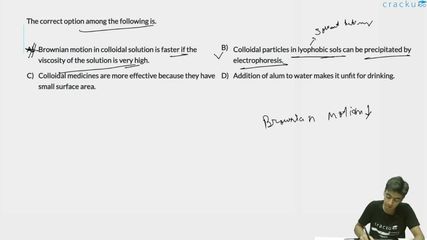
We recall that colloidal particles are always in continuous, random motion known as Brownian motion. According to the kinetic theory of colloids, the velocity of Brownian motion $$v_B$$ is inversely proportional to the viscosity $$\eta$$ of the dispersion medium, that is $$v_B \propto \dfrac{1}{\eta}$$. So if the viscosity is increased, Brownian motion slows down, not speeds up. Therefore the statement in Option A, which claims Brownian motion becomes faster when viscosity is very high, is wrong.
Next, we look at lyophobic (solvent-hating) sols. These sols carry an electric charge on their particles. In the process of electrophoresis, we apply an external electric field; the charged colloidal particles migrate towards the oppositely charged electrode. When the particles reach the electrode, the charge on them is neutralised and they lose their stability, sticking together and settling out. Thus electrophoresis can indeed precipitate lyophobic colloids. Option B states exactly this fact, so Option B is correct.
Now consider colloidal medicines. Their therapeutic efficiency is high because colloidal particles provide an enormous surface area for the same mass of material. A larger surface area allows faster and more thorough interaction with body tissues. Option C says colloidal medicines are effective because they have small surface area, which is the opposite of the true reason, so Option C is incorrect.
Finally, alum (potash alum, $$\mathrm{K_2SO_4\cdot Al_2(SO_4)_3\cdot 24H_2O}$$) is widely used in water purification. When added, it produces $$\mathrm{Al(OH)_3}$$ flocs that adsorb suspended impurities and bacteria, causing them to coagulate and settle. This treatment makes water fit for drinking, not unfit. Therefore Option D is also wrong.
From the above detailed examination, only Option B is in agreement with accepted colloid science.
Hence, the correct answer is Option B.
Was this solution helpful?
Click on the Email ☝️ to Watch the Video Solution
Create a FREE account and get:
_1.webp)

Educational materials for JEE preparation

Ask our AI anything

AI can make mistakes. Please verify important information.
AI can make mistakes. Please verify important information.
