
Join Our JEE Preparation Group
Prep with like-minded aspirants; Get access to free daily tests and study material.
Sign in
Please select an account to continue using cracku.in
↓ →
Join Our JEE Preparation Group
Prep with like-minded aspirants; Get access to free daily tests and study material.
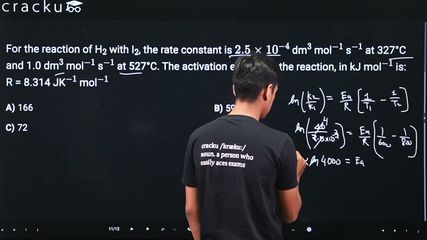
For the reaction of H$$_2$$ with I$$_2$$, the rate constant is $$2.5 \times 10^{-4}$$ dm$$^3$$ mol$$^{-1}$$ s$$^{-1}$$ at 327°C and 1.0 dm$$^3$$ mol$$^{-1}$$ s$$^{-1}$$ at 527°C. The activation energy for the reaction, in kJ mol$$^{-1}$$ is:
R = 8.314 JK$$^{-1}$$ mol$$^{-1}$$
First, we recall the Arrhenius equation in its logarithmic two-temperature form:
$$\ln\!\left(\dfrac{k_2}{k_1}\right)=\dfrac{E_a}{R}\left(\dfrac{1}{T_1}-\dfrac{1}{T_2}\right)$$
Here $$k_1$$ and $$k_2$$ are the rate constants at absolute temperatures $$T_1$$ and $$T_2$$, $$E_a$$ is the activation energy, and $$R$$ is the gas constant.
We have the given data:
$$k_1 = 2.5 \times 10^{-4}\ \text{dm}^3\ \text{mol}^{-1}\ \text{s}^{-1}$$ at $$327^{\circ}\text{C}$$, $$k_2 = 1.0\ \text{dm}^3\ \text{mol}^{-1}\ \text{s}^{-1}$$ at $$527^{\circ}\text{C}$$.
Temperatures must be converted to Kelvin:
$$T_1 = 327 + 273 = 600\ \text{K}$$ $$T_2 = 527 + 273 = 800\ \text{K}$$
Next we form the ratio of the rate constants:
$$\dfrac{k_2}{k_1}= \dfrac{1.0}{2.5 \times 10^{-4}} = \dfrac{1.0}{0.00025}=4000$$
Taking the natural logarithm,
$$\ln\!\left(\dfrac{k_2}{k_1}\right)=\ln(4000)$$ $$= \ln(4\times10^3)=\ln4+\ln10^3$$ $$=1.3863+6.9078=8.2941$$
Now we evaluate the temperature term:
$$\dfrac{1}{T_1}-\dfrac{1}{T_2}= \dfrac{1}{600}-\dfrac{1}{800}$$ $$=0.0016667-0.00125$$ $$=0.00041667\ \text{K}^{-1}$$
Substituting these numerical values and $$R = 8.314\ \text{J K}^{-1}\ \text{mol}^{-1}$$ into the Arrhenius expression:
$$8.2941 = \dfrac{E_a}{8.314}\,(0.00041667)$$
First multiply $$R$$ and the reciprocal-temperature difference:
$$8.314 \times 0.00041667 = 0.0034657$$
Then multiply both sides of the equation by this product to isolate $$E_a$$:
$$E_a = \dfrac{8.2941}{0.00041667}\times 8.314$$ $$= 68.985\ \text{J mol}^{-1}\times \dfrac{1}{0.00041667}$$ $$= 68.985 \div 0.00041667$$ $$\approx 1.6556 \times 10^{5}\ \text{J mol}^{-1}$$
Converting joules to kilojoules,
$$E_a = 165.6\ \text{kJ mol}^{-1} \approx 166\ \text{kJ mol}^{-1}$$
Hence, the correct answer is Option A.
Was this solution helpful?
Click on the Email ☝️ to Watch the Video Solution
Create a FREE account and get:
_1.webp)

Educational materials for JEE preparation

Ask our AI anything

AI can make mistakes. Please verify important information.
AI can make mistakes. Please verify important information.
