
Join Our JEE Preparation Group
Prep with like-minded aspirants; Get access to free daily tests and study material.
Sign in
Please select an account to continue using cracku.in
↓ →
Join Our JEE Preparation Group
Prep with like-minded aspirants; Get access to free daily tests and study material.
We start by recalling a general principle about oxidation states in the actinide series. As we move from thorium $$\left( Z = 90 \right)$$ to lawrencium $$\left( Z = 103 \right)$$, the 5f, 6d and 7s electrons can all participate in bonding. The rule we use is that the maximum attainable oxidation state corresponds, in most cases, to the total number of valence electrons that can be lost or shared.
First we consider uranium. The ground-state electronic configuration of uranium is
$$\text{U} : [\text{Rn}]\,5f^{3}\,6d^{1}\,7s^{2}.$$
Counting the electrons outside the radon core, we have $$3 + 1 + 2 = 6$$ electrons in the $$5f$$, $$6d$$ and $$7s$$ subshells. In favourable chemical environments, all six of these electrons can be used for bonding. This gives a highest possible oxidation state of
$$+6.$$
Well-known compounds that exhibit this state are $$\text{UF}_6$$ and the uranyl ion $$\text{UO}_2^{2+}$$.
Now we turn to plutonium. The ground-state electronic configuration of plutonium is
$$\text{Pu} : [\text{Rn}]\,5f^{6}\,6d^{0}\,7s^{2}.$$
Here we have $$6 + 0 + 2 = 8$$ valence electrons. However, in practice not all eight are removed. The maximum experimentally observed oxidation state corresponds to the removal or sharing of seven of these electrons, giving
$$+7.$$
This state is found, for example, in the ionic species $$\text{PuO}_6^{7-}$$ and $$\text{PuO}_2^{+3}$$ formed in highly oxidising conditions. Hence the highest attainable oxidation state of plutonium is $$+7.$$
Summarising, we have
$$\text{U}_{\text{max}} = +6, \qquad \text{Pu}_{\text{max}} = +7.$$
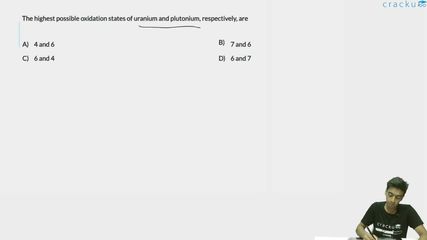
Among the given choices, this pair corresponds to Option D.
Hence, the correct answer is Option D.
Was this solution helpful?
Click on the Email ☝️ to Watch the Video Solution
Create a FREE account and get:
_1.webp)

Educational materials for JEE preparation

Ask our AI anything

AI can make mistakes. Please verify important information.
AI can make mistakes. Please verify important information.
