
Join Our JEE Preparation Group
Prep with like-minded aspirants; Get access to free daily tests and study material.
Sign in
Please select an account to continue using cracku.in
↓ →
Join Our JEE Preparation Group
Prep with like-minded aspirants; Get access to free daily tests and study material.
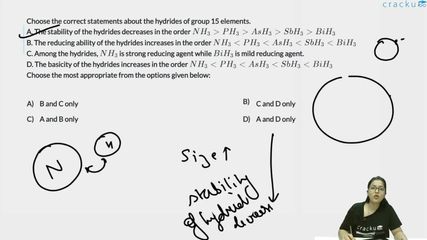
Choose the correct statements about the hydrides of group 15 elements.
A. The stability of the hydrides decreases in the order $$NH_3 > PH_3 > AsH_3 > SbH_3 > BiH_3$$
B. The reducing ability of the hydrides increases in the order $$NH_3 < PH_3 < AsH_3 < SbH_3 < BiH_3$$
C. Among the hydrides, $$NH_3$$ is strong reducing agent while $$BiH_3$$ is mild reducing agent.
D. The basicity of the hydrides increases in the order $$NH_3 < PH_3 < AsH_3 < SbH_3 < BiH_3$$
Choose the most appropriate from the options given below:
We need to evaluate the statements about hydrides of Group 15 elements ($$NH_3, PH_3, AsH_3, SbH_3, BiH_3$$).
Statement A: The stability of hydrides decreases in the order $$NH_3 > PH_3 > AsH_3 > SbH_3 > BiH_3$$.
As we go down the group, the bond length between the central atom and hydrogen increases (N-H < P-H < As-H < Sb-H < Bi-H). Longer bonds are weaker, so the thermal stability decreases down the group. This statement is correct. ✓
Statement B: The reducing ability of hydrides increases in the order $$NH_3 < PH_3 < AsH_3 < SbH_3 < BiH_3$$.
Reducing ability is the tendency to donate electrons or get oxidized. As the stability decreases down the group, the hydride is more easily decomposed and more readily donates its electron pair. Therefore, reducing character increases from $$NH_3$$ to $$BiH_3$$. This statement is correct. ✓
Statement C: Among the hydrides, $$NH_3$$ is a strong reducing agent while $$BiH_3$$ is a mild reducing agent.
This is the opposite of what is true. $$NH_3$$ is the weakest reducing agent (most stable hydride), while $$BiH_3$$ is the strongest reducing agent (least stable). This statement is incorrect. ✗
Statement D: The basicity of hydrides increases in the order $$NH_3 < PH_3 < AsH_3 < SbH_3 < BiH_3$$.
Basicity depends on the availability of the lone pair. As the size of the central atom increases down the group, the electron density on the lone pair decreases (spread over a larger orbital), making it less available for donation. Therefore, basicity decreases down the group: $$NH_3 > PH_3 > AsH_3 > SbH_3 > BiH_3$$. This statement claims the opposite, so it is incorrect. ✗
The correct statements are A and B only.
The correct answer is Option (3): A and B only.
Was this solution helpful?
Click on the Email ☝️ to Watch the Video Solution
Create a FREE account and get:
_1.webp)

Educational materials for JEE preparation

Ask our AI anything

AI can make mistakes. Please verify important information.
AI can make mistakes. Please verify important information.
