
Join Our JEE Preparation Group
Prep with like-minded aspirants; Get access to free daily tests and study material.
Sign in
Please select an account to continue using cracku.in
↓ →
Join Our JEE Preparation Group
Prep with like-minded aspirants; Get access to free daily tests and study material.
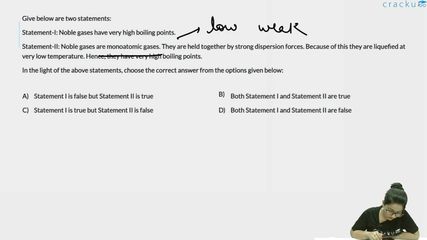
Give below are two statements:
Statement-I: Noble gases have very high boiling points.
Statement-II: Noble gases are monoatomic gases. They are held together by strong dispersion forces. Because of this they are liquefied at very low temperature. Hence, they have very high boiling points.
In the light of the above statements, choose the correct answer from the options given below:
We need to evaluate two statements about noble gases.
Analysis of Statement I: "Noble gases have very high boiling points."
This is FALSE. Noble gases have very low boiling points. For example: He boils at 4.2 K (-269°C), Ne at 27.1 K, Ar at 87.3 K, Kr at 119.9 K, and Xe at 165.1 K. These are among the lowest boiling points of all elements because noble gases exist as monoatomic species with only weak London dispersion forces between atoms.
Analysis of Statement II: "Noble gases are monoatomic gases. They are held together by strong dispersion forces. Because of this they are liquefied at very low temperature. Hence, they have very high boiling points."
This statement contains internal contradictions and is FALSE. While it correctly states that noble gases are monoatomic, the claim that they have "strong dispersion forces" is incorrect — they have very weak dispersion forces (London forces), which is why they must be cooled to very low temperatures to be liquefied. Furthermore, the conclusion "they have very high boiling points" contradicts the fact that they liquefy at very low temperatures — low liquefaction temperature means low boiling points.
Since both statements are false, the correct answer is Option (4): Both Statement I and Statement II are false.
Was this solution helpful?
Click on the Email ☝️ to Watch the Video Solution
Create a FREE account and get:
_1.webp)

Educational materials for JEE preparation

Ask our AI anything

AI can make mistakes. Please verify important information.
AI can make mistakes. Please verify important information.
