
Join Our JEE Preparation Group
Prep with like-minded aspirants; Get access to free daily tests and study material.
Sign in
Please select an account to continue using cracku.in
↓ →
Join Our JEE Preparation Group
Prep with like-minded aspirants; Get access to free daily tests and study material.
Identify correct statements from below:
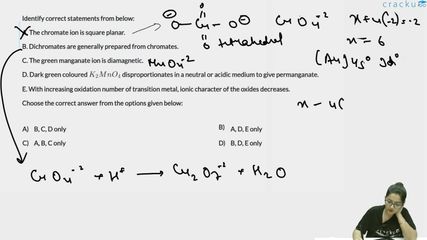
A. The chromate ion is square planar.
B. Dichromates are generally prepared from chromates.
C. The green manganate ion is diamagnetic.
D. Dark green coloured $$K_2MnO_4$$ disproportionates in a neutral or acidic medium to give permanganate.
E. With increasing oxidation number of transition metal, ionic character of the oxides decreases.
Choose the correct answer from the options given below:
We need to identify which statements about chromium and manganese compounds are correct.
Statement A: "The chromate ion is square planar."
In $$CrO_4^{2-}$$, Cr is in the +6 oxidation state with 0 d-electrons. It bonds to 4 oxygen atoms. Using VSEPR theory, with 4 bond pairs and no lone pairs, the geometry is tetrahedral, not square planar. Statement A is INCORRECT.
Statement B: "Dichromates are generally prepared from chromates."
This is correct. Dichromates ($$Cr_2O_7^{2-}$$) are prepared by acidifying chromate ($$CrO_4^{2-}$$) solutions: $$2CrO_4^{2-} + 2H^+ \rightarrow Cr_2O_7^{2-} + H_2O$$. Statement B is CORRECT.
Statement C: "The green manganate ion is diamagnetic."
The manganate ion $$MnO_4^{2-}$$ has Mn in +6 oxidation state: Mn is $$[Ar]3d^1$$ (since Mn normally has 7 electrons beyond Ar, minus 6 gives 1). With 1 unpaired d-electron, it is paramagnetic, not diamagnetic. Statement C is INCORRECT.
Statement D: "Dark green $$K_2MnO_4$$ disproportionates in neutral or acidic medium to give permanganate."
This is correct. The reaction is: $$3MnO_4^{2-} + 4H^+ \rightarrow 2MnO_4^- + MnO_2 + 2H_2O$$. Here Mn(+6) disproportionates to Mn(+7) in $$MnO_4^-$$ and Mn(+4) in $$MnO_2$$. Statement D is CORRECT.
Statement E: "With increasing oxidation number of transition metal, ionic character of the oxides decreases."
This is correct. Higher oxidation states lead to greater polarizing power of the cation, increasing covalent character (and decreasing ionic character), consistent with Fajans' rules. For example, $$CrO$$ (Cr²⁺) is more ionic while $$CrO_3$$ (Cr⁶⁺) is covalent. Statement E is CORRECT.
Correct statements: B, D, and E.
The correct answer is Option (4): B, D, E only.
Was this solution helpful?
Click on the Email ☝️ to Watch the Video Solution
Create a FREE account and get:
_1.webp)

Educational materials for JEE preparation

Ask our AI anything

AI can make mistakes. Please verify important information.
AI can make mistakes. Please verify important information.
