
Join Our JEE Preparation Group
Prep with like-minded aspirants; Get access to free daily tests and study material.
Sign in
Please select an account to continue using cracku.in
↓ →
Join Our JEE Preparation Group
Prep with like-minded aspirants; Get access to free daily tests and study material.
The correct statements from the following are:
A. The strength of anionic ligands can be explained by crystal field theory.
B. Valence bond theory does not give a quantitative interpretation of kinetic stability of coordination compounds.
C. The hybridization involved in formation of $$[Ni(CN)_4]^{2-}$$ complex is $$dsp^2$$.
D. The number of possible isomer(s) of cis-$$[PtCl_2(en)_2]^{2+}$$ is one.
Choose the correct answer from the options given below:
We need to identify the correct statements about coordination compounds.
Statement A: "The strength of anionic ligands can be explained by crystal field theory."
Crystal Field Theory (CFT) explains the splitting of d-orbitals by ligands based on their electrostatic interactions. However, CFT cannot fully explain why certain anionic ligands (like $$CN^-$$) are strong field while others (like $$Cl^-$$) are weak field. The spectrochemical series ordering of anionic ligands requires Ligand Field Theory (which includes covalent interactions). So Statement A is not correct.
Statement B: "Valence bond theory does not give a quantitative interpretation of kinetic stability of coordination compounds."
This is correct. VBT deals with bonding and geometry but does not provide quantitative information about the kinetic stability (lability) of coordination compounds.
Statement C: "The hybridization involved in formation of $$[Ni(CN)_4]^{2-}$$ complex is $$dsp^2$$."
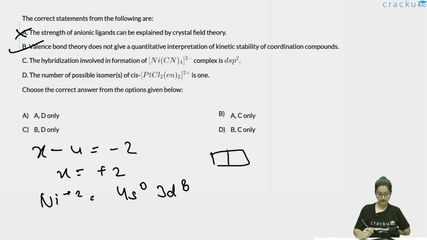
$$Ni^{2+}$$ has configuration $$[Ar]3d^8$$. $$CN^-$$ is a strong field ligand, so it forces pairing of the two unpaired electrons in $$3d$$. This frees one $$3d$$ orbital. The hybridization is $$dsp^2$$ (one $$3d$$, one $$4s$$, two $$4p$$ orbitals), giving a square planar geometry. Statement C is correct.
Statement D: "The number of possible isomer(s) of cis-$$[PtCl_2(en)_2]^{2+}$$ is one."
The complex $$[PtCl_2(en)_2]^{2+}$$ is octahedral. It can have cis and trans isomers. The cis isomer itself can exhibit optical isomerism (non-superimposable mirror images). So the cis form has 2 optical isomers (d and l forms). Therefore, the number of possible isomers of the cis form is not one. Statement D is not correct.
The correct statements are B and C.
The correct answer is Option D: B, C only.
Was this solution helpful?
Click on the Email ☝️ to Watch the Video Solution
Create a FREE account and get:
_1.webp)

Educational materials for JEE preparation

Ask our AI anything

AI can make mistakes. Please verify important information.
AI can make mistakes. Please verify important information.
