
Join Our JEE Preparation Group
Prep with like-minded aspirants; Get access to free daily tests and study material.
Sign in
Please select an account to continue using cracku.in
↓ →
Join Our JEE Preparation Group
Prep with like-minded aspirants; Get access to free daily tests and study material.
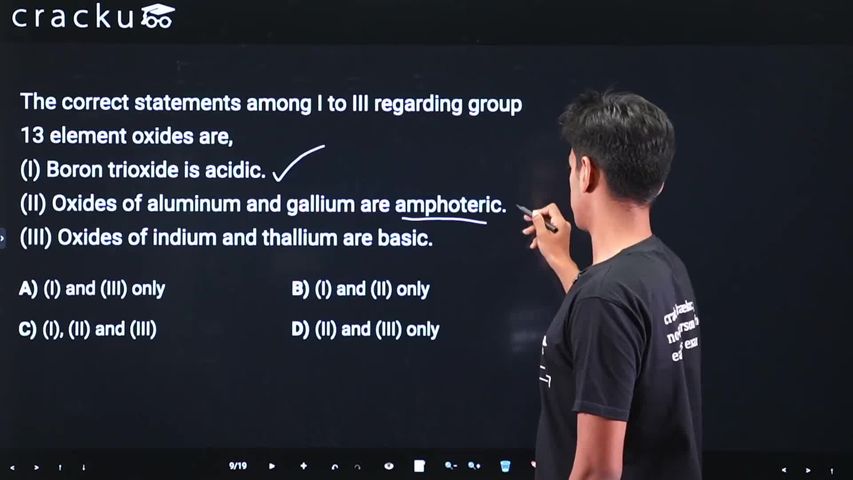
The correct statements among I to III regarding group 13 element oxides are,
(I) Boron trioxide is acidic.
(II) Oxides of aluminum and gallium are amphoteric.
(III) Oxides of indium and thallium are basic.
In p-block chemistry, a very important periodic trend concerns the acidic-basic nature of the oxides. The general rule is that when we go across a period from left to right, the oxides change from basic to acidic, while when we go down a group, metallic character increases and therefore the oxides become progressively more basic.
Group 13 (also called the boron group) contains the elements $$B,\;Al,\;Ga,\;In,\;Tl$$. In this family, boron is a typical non-metal whereas the rest are metals of increasing metallic character as we proceed downward. Consequently, their oxides exhibit the following nature:
• For the top member, boron, the oxide is $$B_2O_3$$. Because boron is a non-metal, $$B_2O_3$$ shows non-metallic, i.e. acidic, behaviour. It dissolves in strong bases to give borates: $$B_2O_3\;+\;2\,OH^- \;\longrightarrow\;2\,BO_2^- \;+\;H_2O$$. Hence statement (I) is correct.
• Aluminium and gallium are positioned after boron and are much more metallic, yet they still possess some covalent character. Therefore their oxides $$Al_2O_3$$ and $$Ga_2O_3$$ can react both with acids and with bases. Oxides that behave like this are called amphoteric. Example reactions are
$$Al_2O_3 + 6\,HCl \;\longrightarrow\; 2\,AlCl_3 + 3\,H_2O$$
$$Al_2O_3 + 2\,NaOH + 3\,H_2O \;\longrightarrow\; 2\,Na[Al(OH)_4]$$
Thus statement (II) is also correct.
• Indium and thallium are even more metallic than aluminium and gallium. Their oxides $$In_2O_3$$ and $$Tl_2O_3$$ react almost exclusively with acids, showing a basic nature, for example
$$In_2O_3 + 6\,HCl \;\longrightarrow\; 2\,InCl_3 + 3\,H_2O$$
They do not readily dissolve in aqueous alkali, confirming that they are not amphoteric but predominantly basic. Hence statement (III) is correct as well.
Because all three statements I, II and III are correct, the set that lists all of them is Option C.
Hence, the correct answer is Option C.
Was this solution helpful?
Click on the Email ☝️ to Watch the Video Solution
Create a FREE account and get:
_1.webp)

Educational materials for JEE preparation

Ask our AI anything

AI can make mistakes. Please verify important information.
AI can make mistakes. Please verify important information.


