
Join Our JEE Preparation Group
Prep with like-minded aspirants; Get access to free daily tests and study material.
Sign in
Please select an account to continue using cracku.in
↓ →
Join Our JEE Preparation Group
Prep with like-minded aspirants; Get access to free daily tests and study material.
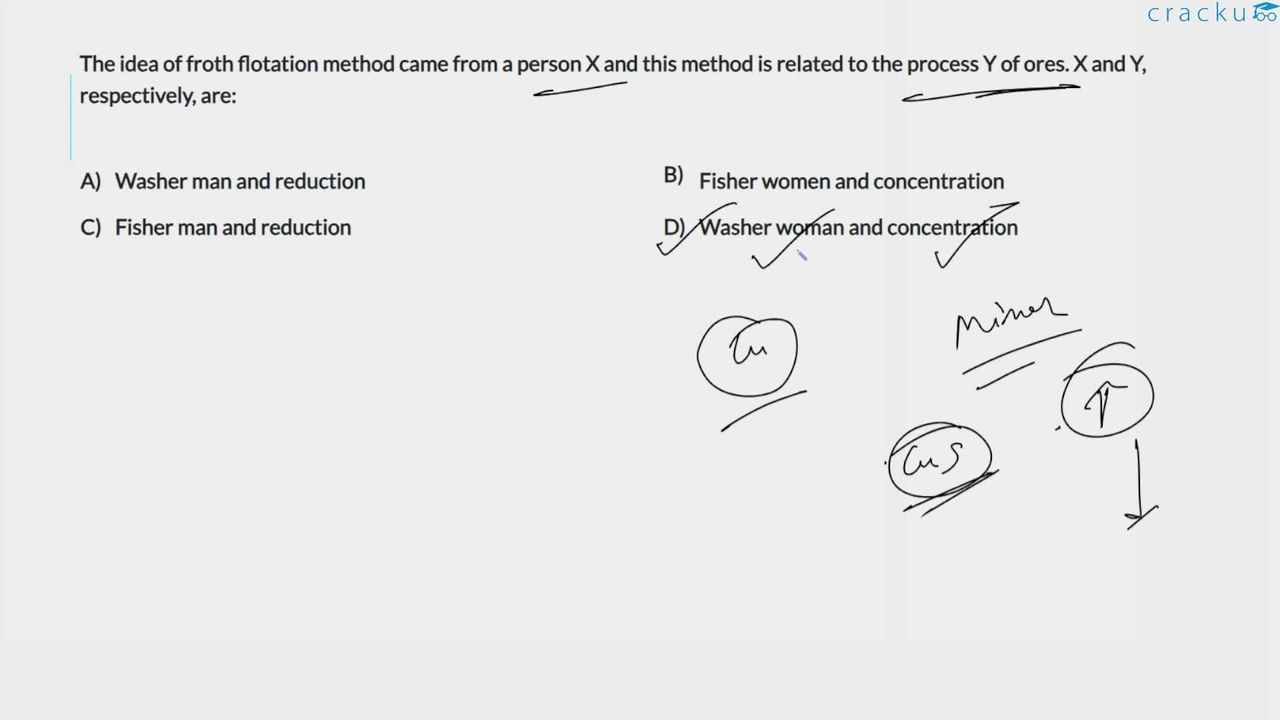
The idea of froth flotation method came from a person X and this method is related to the process Y of ores. X and Y, respectively, are:
We first recall that the sequence of metallurgical operations carried out on an ore is: $$\text{(i) Concentration} \;\;\longrightarrow\;\; \text{(ii) Reduction} \;\;\longrightarrow\;\; \text{(iii) Refining}.$$
The froth-flotation technique is employed before reduction, because its sole purpose is to enrich or concentrate the ore by removing gangue. So, for the variable $$Y$$ we definitely obtain $$Y = \text{concentration}.$$
Next, we look at the historical origin of the idea. It is well recorded that an early observation, central to the development of froth-flotation, was made while clothes were being washed: wetting agents (soaps) caused dirt particles to preferentially attach to soap froth and rise to the surface. A washer woman noticed that the dirt floated away with bubbles, inspiring engineers to apply the same principle to sulphide ores in water containing collectors and frothers. Hence, for the variable $$X$$ we have $$X = \text{washer woman}.$$
Putting these two deductions together gives the ordered pair $$\bigl(X , Y \bigr) = \bigl(\text{washer woman},\; \text{concentration}\bigr).$$
Comparing with the given options, this corresponds to Option D.
Hence, the correct answer is Option D.
Was this solution helpful?
Click on the Email ☝️ to Watch the Video Solution
Create a FREE account and get:
_1.webp)

Educational materials for JEE preparation

Ask our AI anything

AI can make mistakes. Please verify important information.
AI can make mistakes. Please verify important information.
