
Join Our JEE Preparation Group
Prep with like-minded aspirants; Get access to free daily tests and study material.
Sign in
Please select an account to continue using cracku.in
↓ →
Join Our JEE Preparation Group
Prep with like-minded aspirants; Get access to free daily tests and study material.
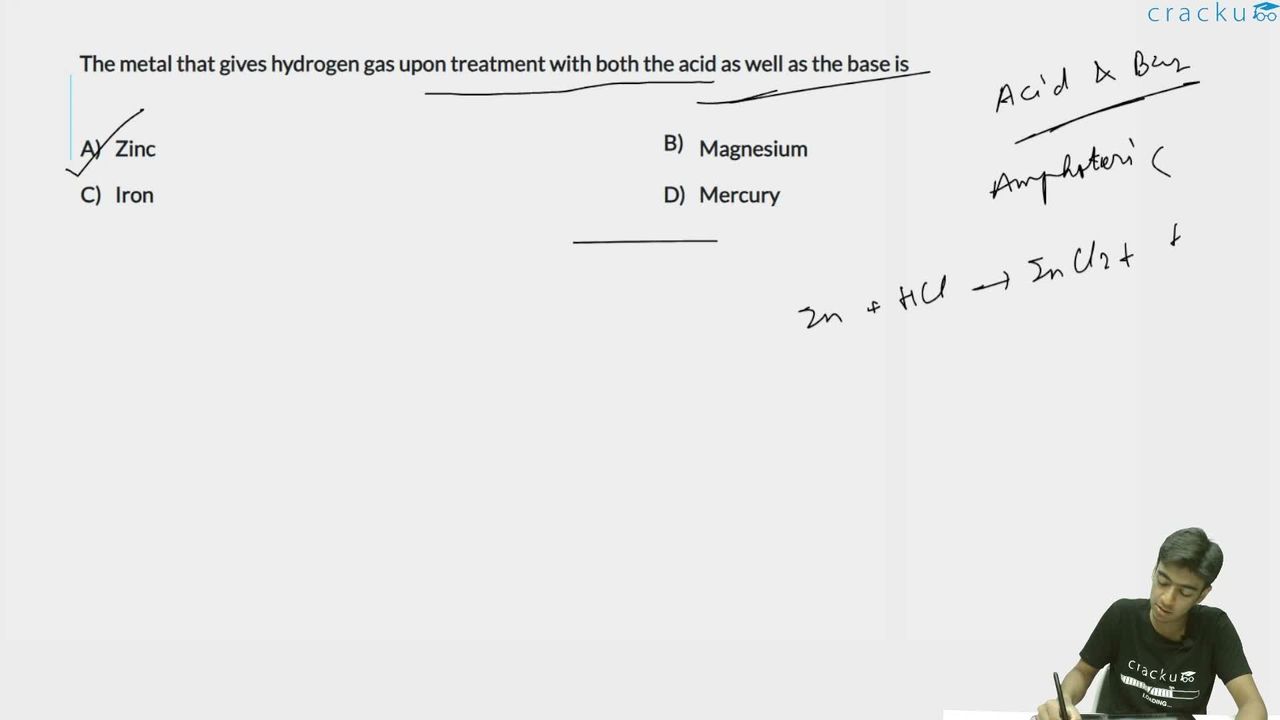
The metal that gives hydrogen gas upon treatment with both the acid as well as the base is
The problem asks us to identify that one metal which is capable of evolving hydrogen gas when it is treated (i) with an acid and also (ii) with a base. The key chemical fact we need is that only amphoteric metals possess this dual reactivity. An amphoteric metal dissolves in common mineral acids, giving a salt of the metal and $$\mathrm{H_2}$$, and the same metal also dissolves in aqueous alkali, again liberating $$\mathrm{H_2}$$ while giving a complex zincate, aluminate, etc., depending on the metal.
First, let us recall the basic reactions involved. Whenever a metal (M) is placed in a dilute acid such as $$\mathrm{HCl}$$ or $$\mathrm{H_2SO_4}$$, the general reaction is stated as:
$$\mathrm{M\;+\;2H^+\;\longrightarrow\;M^{2+}\;+\;H_2\uparrow}$$
Similarly, an amphoteric metal can also react with hydroxide ions from a base (e.g., $$\mathrm{NaOH}$$) in the presence of water. The generalized equation is:
$$\mathrm{M + 2OH^- + 2H_2O \longrightarrow [M(OH)_4]^{2-} + H_2\uparrow}$$
Now we must test each metal listed in the options.
Testing Zinc (Option A)
1. Reaction with a dilute acid (say, hydrochloric acid):
$$\mathrm{Zn\;+\;2HCl\;\longrightarrow\;ZnCl_2\;+\;H_2\uparrow}$$
We plainly see the liberation of hydrogen gas $$\mathrm{H_2}$$.
2. Reaction with a strong base (say, aqueous sodium hydroxide):
$$\mathrm{Zn + 2NaOH + 2H_2O \longrightarrow Na_2[Zn(OH)_4] + H_2\uparrow}$$
Here again hydrogen gas is evolved, and the product $$\mathrm{Na_2[Zn(OH)_4]}$$ is called sodium zincate. Hence zinc satisfies both conditions.
Testing Magnesium (Option B)
Magnesium certainly reacts with dilute acids:
$$\mathrm{Mg\;+\;2H^+\;\longrightarrow\;Mg^{2+}\;+\;H_2\uparrow}$$
However, magnesium does not dissolve in dilute sodium hydroxide to give hydrogen gas; it is not amphoteric. Therefore it fails the base test.
Testing Iron (Option C)
Iron also reacts with acids:
$$\mathrm{Fe\;+\;2H^+\;\longrightarrow\;Fe^{2+}\;+\;H_2\uparrow}$$
But iron does not react with aqueous alkali at ordinary conditions, so no hydrogen is produced with a base. Hence iron does not meet the requirement.
Testing Mercury (Option D)
Mercury is a noble metal with respect to hydrogen; it lies below hydrogen in the electrochemical series. It neither reacts with dilute acids to release $$\mathrm{H_2}$$ nor with dilute bases. Therefore mercury clearly fails both criteria.
From the detailed comparison we observe that only zinc exhibits the necessary amphoteric behaviour, producing hydrogen gas in reactions with both acids and bases.
Hence, the correct answer is Option A.
Click on the Email ☝️ to Watch the Video Solution
Create a FREE account and get:
_1.webp)

Educational materials for JEE preparation

Ask our AI anything

AI can make mistakes. Please verify important information.
AI can make mistakes. Please verify important information.


