
Join Our JEE Preparation Group
Prep with like-minded aspirants; Get access to free daily tests and study material.
Sign in
Please select an account to continue using cracku.in
↓ →
Join Our JEE Preparation Group
Prep with like-minded aspirants; Get access to free daily tests and study material.
The complex ion that will lose its crystal field stabilization energy upon oxidation of metal to +3 state is:
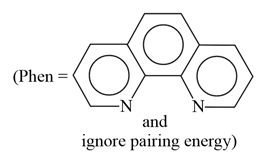
(Phen = phenanthroline, ignore pairing energy)
Phenanthroline ($$\text{phen}$$) is a strong field bidentate ligand. In an octahedral crystal field, it forces electrons to pair up in the lower-energy $$t_{2g}$$ orbitals before filling the higher-energy $$e_g$$ orbitals (low-spin complexes). The CFSE formula for an octahedral complex (ignoring pairing energy) is:
$$\text{CFSE} = [(-0.4 \times n_{t2g}) + (0.6 \times n_{eg})]\Delta_o$$
1. $$\mathbf{[Ni(phen)_3]^{2+}}\rightarrow\mathbf{[Ni(phen)_3]^{3+}}$$
2. $$\mathbf{[Fe(phen)_3]^{2+}}\rightarrow\mathbf{[Fe(phen)_3]^{3+}}$$
3. $$\mathbf{[Co(phen)_3]^{2+}} \rightarrow \mathbf{[Co(phen)_3]^{3+}}$$
4. $$\mathbf{[Zn(phen)_3]^{2+}} \rightarrow \mathbf{[Zn(phen)_3]^{3+}}$$
Only the iron complex undergoes a decrease in its crystal field stabilization energy upon oxidation from $$+2$$ to $$+3$$.
Answer: Option B — [Fe(phen)₃]²⁺
Was this solution helpful?
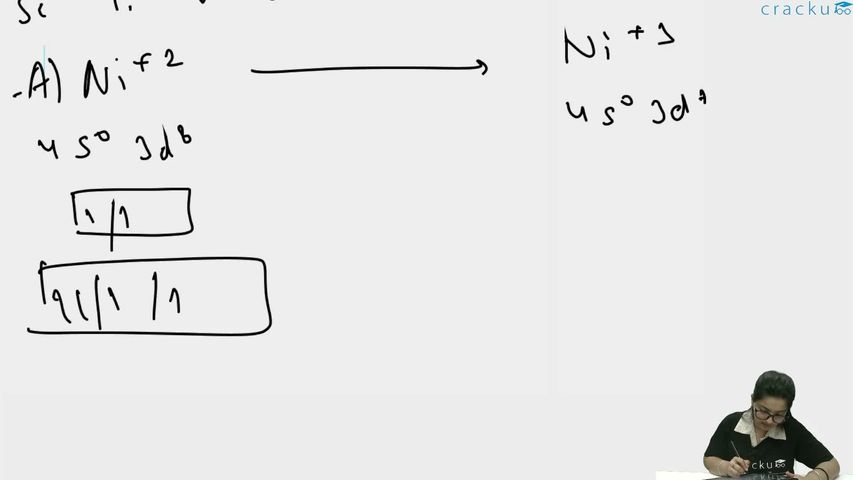
Click on the Email ☝️ to Watch the Video Solution
Create a FREE account and get:
_1.webp)

Educational materials for JEE preparation

Ask our AI anything

AI can make mistakes. Please verify important information.
AI can make mistakes. Please verify important information.
