Join WhatsApp Icon JEE WhatsApp Group
Question 54

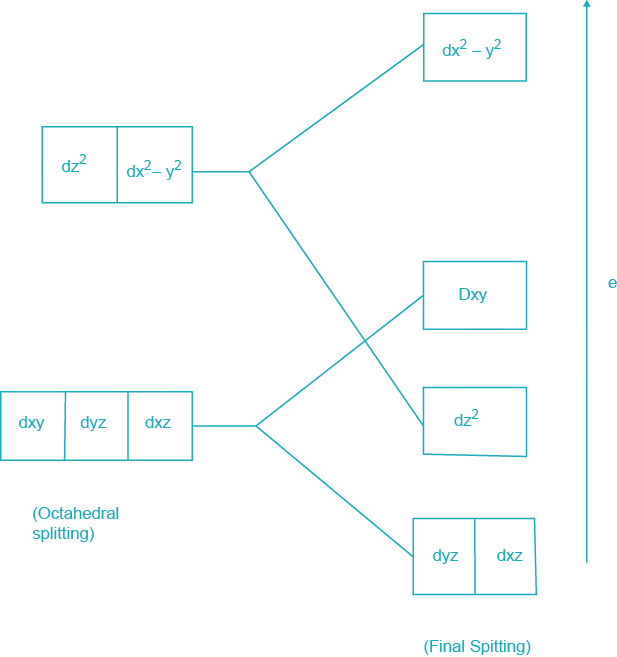
Complete removal of both the axial ligands (along the z-axis) from an octahedral complex leads to which of the following splitting patterns? (relative orbital energies not on scale).
image


Square Planar Splitting

In a standard octahedral complex, the five $$d$$-orbitals split into two groups: the higher-energy $$e_g$$ pair ($$d_{x^2-y^2}$$, $$d_{z^2}$$) and the lower-energy $$t_{2g}$$ triplet ($$d_{xy}$$, $$d_{xz}$$, $$d_{yz}$$).

When the two ligands along the z-axis are completely pulled away:

  • The electrostatic repulsion experienced by all $$d$$-orbitals containing a "z" component ($$d_{z^2}$$, $$d_{xz}$$, and $$d_{yz}$$) drops significantly, causing their energy levels to plummet.
  • Conversely, the four remaining ligands in the $$xy$$-plane exert relatively stronger repulsion on the orbitals lying within that plane ($$d_{x^2-y^2}$$ and $$d_{xy}$$), causing their relative energies to rise.

Final Energy Level Ordering:

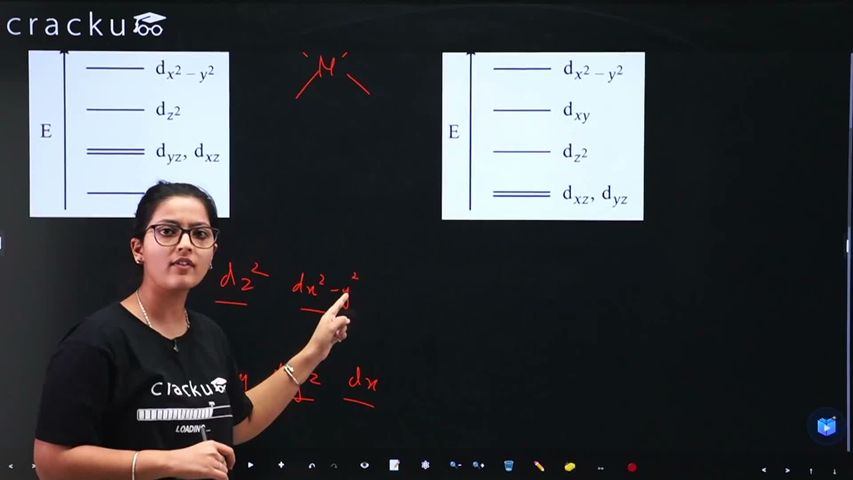
The resulting square planar crystal field splitting pattern from highest energy to lowest energy is:

$$\mathbf{d_{x^2-y^2} > d_{xy} > d_{z^2} > (d_{xz} = d_{yz})}$$

  • $$d_{x^2-y^2}$$: Highest energy because its lobes point directly at the remaining four equatorial ligands.
  • $$d_{xy}$$: Lies in the equatorial plane between the ligands, making it the second highest.
  • $$d_{z^2}$$: Drops drastically below $$d_{xy}$$ due to the total absence of axial ligands.
  • $$d_{xz}, d_{yz}$$: Remain a degenerate pair at the lowest energy level since they interact least with the equatorial plane.

Conclusion:

The correct diagram must show a 4-level splitting pattern ordered as $$d_{x^2-y^2}$$ at the top, followed by $$d_{xy}$$, then $$d_{z^2}$$, and the degenerate pair $$d_{xz}, d_{yz}$$ at the bottom.

Answer: Option D
Get AI Help

Video Solution

video

Create a FREE account and get:

  • Free JEE Mains Previous Papers PDF
  • Take JEE Mains paper tests

JEE Quant Questions | JEE Quantitative Ability

JEE DILR Questions | LRDI Questions For JEE

JEE Verbal Ability Questions | VARC Questions For JEE

Free JEE Topicwise Questions

JEE Rotational MotionJEE Units & MeasurementsJEE Atomic StructureJEE GravitationJEE Periodic Table & PeriodicityJEE StatisticsJEE Inverse Trigonometric FunctionsJEE Magnetism & Magnetic MaterialsJEE Sequences & SeriesJEE MatricesJEE Alternating CurrentsJEE Carboxylic AcidsJEE Permutations & CombinationsJEE Work, Energy & PowerJEE Electromagnetic InductionJEE Electronic DevicesJEE d and f-Block ElementsJEE Chemical KineticsJEE Heat TransferJEE Three Dimensional GeometryJEE Magnetic Effects of CurrentJEE Hydrocarbons - AromaticJEE Electromagnetic WavesJEE Aldehydes & KetonesJEE Hydrocarbons - AlkanesJEE Applications of DerivativesJEE EquilibriumJEE Indefinite IntegrationJEE Chemical ThermodynamicsJEE ElectrochemistryJEE ProbabilityJEE BiomoleculesJEE Continuity & DifferentiabilityJEE Kinetic Theory of GasesJEE Vector AlgebraJEE Hydrocarbons - AlkynesJEE Differential EquationsJEE Current & ResistanceJEE Straight LinesJEE WavesJEE Redox ReactionsJEE Hydrocarbons - AlkenesJEE DeterminantsJEE SolutionsJEE Ray OpticsJEE Dual Nature of Matter & RadiationJEE Chemical Bonding & Molecular StructureJEE Complex NumbersJEE Sets, Relations & FunctionsJEE Electric Charges & FieldsJEE Laws of MotionJEE Fluid MechanicsJEE Basic Concepts in ChemistryJEE Trigonometric FunctionsJEE LimitsJEE Laws of ThermodynamicsJEE Kinematics - 2D MotionJEE p-Block Elements (Groups 13-18)JEE Simple Harmonic MotionJEE Electric Potential & CapacitanceJEE Coordination CompoundsJEE JEE 2D GeometryJEE CirclesJEE Definite IntegrationJEE EMF & Circuit AnalysisJEE Surface TensionJEE Atoms & NucleiJEE Laboratory Experiments - XIJEE Number SystemJEE Basic Principles of Organic ChemistryJEE Wave OpticsJEE Quadratic EquationsJEE Alcohols, Phenols & EthersJEE Organic Compounds with HalogensJEE DifferentiationJEE Conic SectionsJEE Nitrogen-Containing CompoundsJEE ElasticityJEE Practical Organic ChemistryJEE Kinematics - 1D MotionJEE Purification & CharacterisationJEE Binomial Theorem
Ask AI


