
Join Our JEE Preparation Group
Prep with like-minded aspirants; Get access to free daily tests and study material.
Sign in
Please select an account to continue using cracku.in
↓ →
Join Our JEE Preparation Group
Prep with like-minded aspirants; Get access to free daily tests and study material.
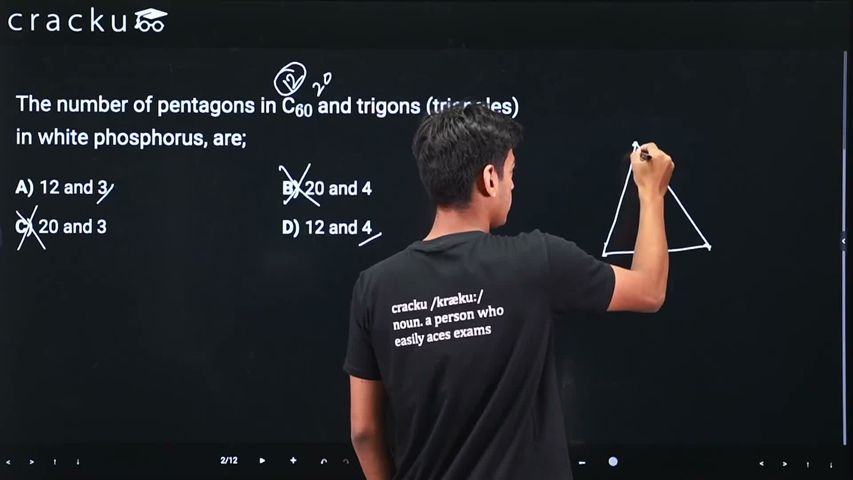
The number of pentagons in C$$_{60}$$ and trigons (triangles) in white phosphorus, are;
We begin with the fullerene molecule $$\mathrm{C}_{60}$$, commonly called buckminsterfullerene. Its carbon atoms occupy the vertices of a polyhedron that is topologically identical to a soccer ball, i.e. a truncated icosahedron. In such a solid we observe that two types of regular polygons are present: pentagons and hexagons. Let us let $$P$$ denote the number of pentagons, $$H$$ denote the number of hexagons, $$F$$ denote the total number of faces, $$E$$ the total number of edges and $$V$$ the total number of vertices.
First, the truncated icosahedron has $$V = 60$$ because there are sixty carbon atoms. Every carbon atom is bonded to three others, so every vertex is of degree $$3$$. Because each edge is shared by exactly two vertices, we have the relation
$$2E = 3V.$$
Substituting $$V = 60$$ gives
$$2E = 3 \times 60 = 180,$$
so
$$E = \frac{180}{2} = 90.$$
Next we write Euler’s polyhedral formula, which states
$$V - E + F = 2.$$
Placing the known values $$V = 60$$ and $$E = 90$$, we have
$$60 - 90 + F = 2,$$
so
$$F = 2 + 90 - 60 = 32.$$
Thus the truncated icosahedron has $$32$$ faces in total. These faces consist only of pentagons and hexagons, so
$$F = P + H.$$
Therefore
$$P + H = 32. \quad-(\text{1})$$
Now we examine the edge count in terms of faces. A pentagon possesses $$5$$ edges and a hexagon possesses $$6$$ edges. Because each edge belongs to exactly two faces, the following relation also holds:
$$5P + 6H = 2E.$$
We already calculated $$E = 90$$, hence
$$5P + 6H = 2 \times 90 = 180. \quad-(\text{2})$$
We now have two simultaneous linear equations, (1) and (2), in the unknowns $$P$$ and $$H$$:
$$\begin{aligned} P + H &= 32, \\ 5P + 6H &= 180. \end{aligned}$$
To solve them, we first express $$H$$ from the first equation:
$$H = 32 - P.$$
Substituting this into the second equation gives
$$5P + 6(32 - P) = 180.$$
Simplifying, we obtain
$$5P + 192 - 6P = 180,$$
which reduces to
$$(5P - 6P) + 192 = 180,$$
so
$$-P + 192 = 180.$$
Therefore
$$-P = 180 - 192 = -12,$$
and hence
$$P = 12.$$
Substituting $$P = 12$$ back into $$H = 32 - P$$ gives
$$H = 32 - 12 = 20.$$
Thus the fullerene $$\mathrm{C}_{60}$$ contains $$12$$ pentagonal faces.
Now we turn our attention to white phosphorus, whose molecular formula is $$\mathrm{P}_{4}$$. In white phosphorus, four phosphorus atoms occupy the corners of a regular tetrahedron. A tetrahedron is defined as the polyhedron possessing four triangular faces, six edges and four vertices. Therefore, the number of triangular faces, which the question calls trigons, equals the total count of faces of a tetrahedron, namely
$$\text{number of triangles} = 4.$$
So, for white phosphorus $$\mathrm{P}_{4}$$, there are exactly four triangular faces.
Combining the two parts, we have
$$\begin{aligned} \text{Pentagons in } \mathrm{C}_{60} &= 12,\\ \text{Triangles in white phosphorus} &= 4. \end{aligned}$$
Examining the options, we see that these values correspond to Option D, which lists “12 and 4”.
Hence, the correct answer is Option D.
Was this solution helpful?
Click on the Email ☝️ to Watch the Video Solution
Create a FREE account and get:
_1.webp)

Educational materials for JEE preparation

Ask our AI anything

AI can make mistakes. Please verify important information.
AI can make mistakes. Please verify important information.
