
Join Our JEE Preparation Group
Prep with like-minded aspirants; Get access to free daily tests and study material.
Sign in
Please select an account to continue using cracku.in
↓ →
Join Our JEE Preparation Group
Prep with like-minded aspirants; Get access to free daily tests and study material.
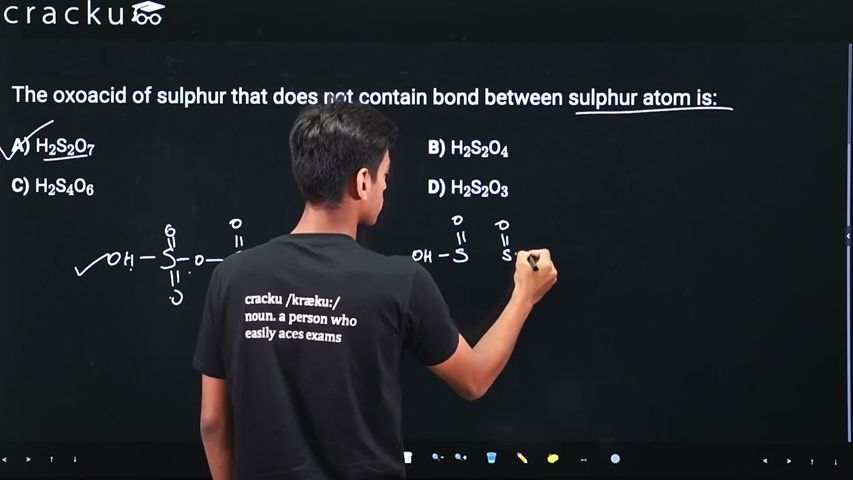
We first note that in all oxo-acids of sulphur the presence or absence of a direct bond between two sulphur atoms can be inferred most easily from their accepted structural formulae. The four formulae that correspond to the given options are written below in conventional form.
For pyrosulphuric (also called disulphuric) acid the structure is
$$\mathrm{HO\!-\!S(=O)_2\!-\!O\!-\!S(=O)_2\!-\!OH}$$
Here the two sulphur atoms are not joined to each other directly; instead they are linked through an intervening oxygen atom. Thus there is an $$\mathrm{S\!-\!O\!-\!S}$$ bridge and no $$\mathrm{S\!-\!S}$$ bond.
For dithionous acid the accepted structure is
$$\mathrm{HO\!-\!S(=O)\!-\!S(=O)\!-\!OH}$$
In this case the two sulphur atoms are neighbours with no atom between them, giving a clear $$\mathrm{S\!-\!S}$$ single bond.
For tetrathionic acid the chain of atoms is longer:
$$\mathrm{HO\!-\!S(=O)_2\!-\!S\!-\!S\!-\!S(=O)_2\!-\!OH}$$
Inside this molecule consecutive sulphur atoms are directly connected, so more than one $$\mathrm{S\!-\!S}$$ bond is present.
For thiosulphurous acid the formula is
$$\mathrm{HO\!-\!S\!-\!S(=O)\!-\!OH}$$
Again the two sulphur atoms are adjacent, providing one $$\mathrm{S\!-\!S}$$ bond.
By simple inspection of each displayed structure we see that only the first compound, $$\mathrm{H_2S_2O_7}$$, completely lacks an $$\mathrm{S\!-\!S}$$ bond; the sulphur atoms are separated by oxygen. All the remaining three acids undeniably contain at least one direct sulphur-sulphur linkage.
Hence, the correct answer is Option A.
Was this solution helpful?
Click on the Email ☝️ to Watch the Video Solution
Create a FREE account and get:
_1.webp)

Educational materials for JEE preparation

Ask our AI anything

AI can make mistakes. Please verify important information.
AI can make mistakes. Please verify important information.
