
Join Our JEE Preparation Group
Prep with like-minded aspirants; Get access to free daily tests and study material.
Sign in
Please select an account to continue using cracku.in
↓ →
Join Our JEE Preparation Group
Prep with like-minded aspirants; Get access to free daily tests and study material.
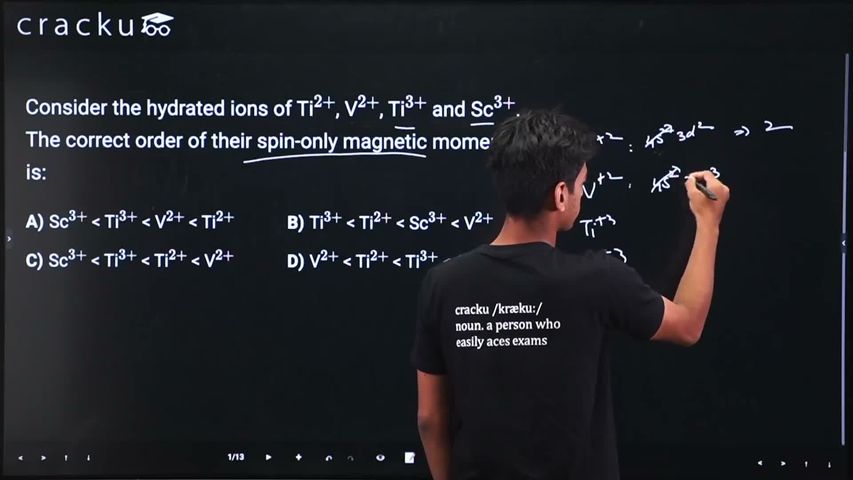
Consider the hydrated ions of Ti$$^{2+}$$, V$$^{2+}$$, Ti$$^{3+}$$ and Sc$$^{3+}$$. The correct order of their spin-only magnetic moments is:
For any transition‐metal ion the spin-only magnetic moment is calculated by the formula
$$\mu_{\text{spin}}=\sqrt{n(n+2)}\ \text{Bohr magnetons (BM)}$$
where $$n$$ is the number of unpaired (parallel-spin) electrons present in the ion.
Because the question speaks of “hydrated ions”, we assume the ligand is water, a weak-field ligand; thus the complexes are high-spin, so the number of unpaired electrons is exactly the number expected from the gas-phase $$3d$$ configuration of the ion.
We therefore begin by writing the ground-state electron configurations of the neutral atoms and then remove electrons equal to the charge of each ion, always removing the $$4s$$ electrons before the $$3d$$ electrons.
Scandium: $$\text{Sc}\;(Z=21):\;[\,\text{Ar}\,]\,3d^{1}4s^{2}$$
Titanium: $$\text{Ti}\;(Z=22):\;[\,\text{Ar}\,]\,3d^{2}4s^{2}$$
Vanadium: $$\text{V}\;(Z=23):\;[\,\text{Ar}\,]\,3d^{3}4s^{2}$$
Now we create each required ion.
1. Sc$$^{3+}$$
We must remove three electrons: two from $$4s$$ and one from $$3d$$.
$$[\,\text{Ar}\,]\,3d^{1}4s^{2}\;-\;2(4s)\;-\;1(3d)= [\,\text{Ar}\,]\,3d^{0}$$
Thus $$n=0$$ unpaired electrons.
$$\mu_{\text{spin}}=\sqrt{0(0+2)}=0\ \text{BM}$$
2. Ti$$^{3+}$$
Remove three electrons from $$[\,\text{Ar}\,]\,3d^{2}4s^{2}$$: two from $$4s$$, one from $$3d$$.
$$[\,\text{Ar}\,]\,3d^{2}4s^{2}\;\longrightarrow\;[\,\text{Ar}\,]\,3d^{1}$$
So $$n=1$$ unpaired electron.
$$\mu_{\text{spin}}=\sqrt{1(1+2)}=\sqrt{3}\ \text{BM}$$
3. Ti$$^{2+}$$
Remove two electrons, both from $$4s$$.
$$[\,\text{Ar}\,]\,3d^{2}4s^{2}\;\longrightarrow\;[\,\text{Ar}\,]\,3d^{2}$$
Here $$n=2$$ unpaired electrons.
$$\mu_{\text{spin}}=\sqrt{2(2+2)}=\sqrt{8}\ \text{BM}$$
4. V$$^{2+}$$
Remove two electrons from $$[\,\text{Ar}\,]\,3d^{3}4s^{2}$$, again both from $$4s$$.
$$[\,\text{Ar}\,]\,3d^{3}4s^{2}\;\longrightarrow\;[\,\text{Ar}\,]\,3d^{3}$$
So $$n=3$$ unpaired electrons.
$$\mu_{\text{spin}}=\sqrt{3(3+2)}=\sqrt{15}\ \text{BM}$$
Comparing the four values, we clearly have
$$0\;{\text{BM}}\lt\sqrt{3}\;{\text{BM}}\lt\sqrt{8}\;{\text{BM}}\lt\sqrt{15}\;{\text{BM}}$$
That is, in terms of the ions themselves,
$$\text{Sc}^{3+}\lt\text{Ti}^{3+}\lt\text{Ti}^{2+}\lt\text{V}^{2+}$$
This sequence exactly matches Option C.
Hence, the correct answer is Option C.
Was this solution helpful?
Click on the Email ☝️ to Watch the Video Solution
Create a FREE account and get:
_1.webp)

Educational materials for JEE preparation

Ask our AI anything

AI can make mistakes. Please verify important information.
AI can make mistakes. Please verify important information.
