
Join Our JEE Preparation Group
Prep with like-minded aspirants; Get access to free daily tests and study material.
Sign in
Please select an account to continue using cracku.in
↓ →
Join Our JEE Preparation Group
Prep with like-minded aspirants; Get access to free daily tests and study material.
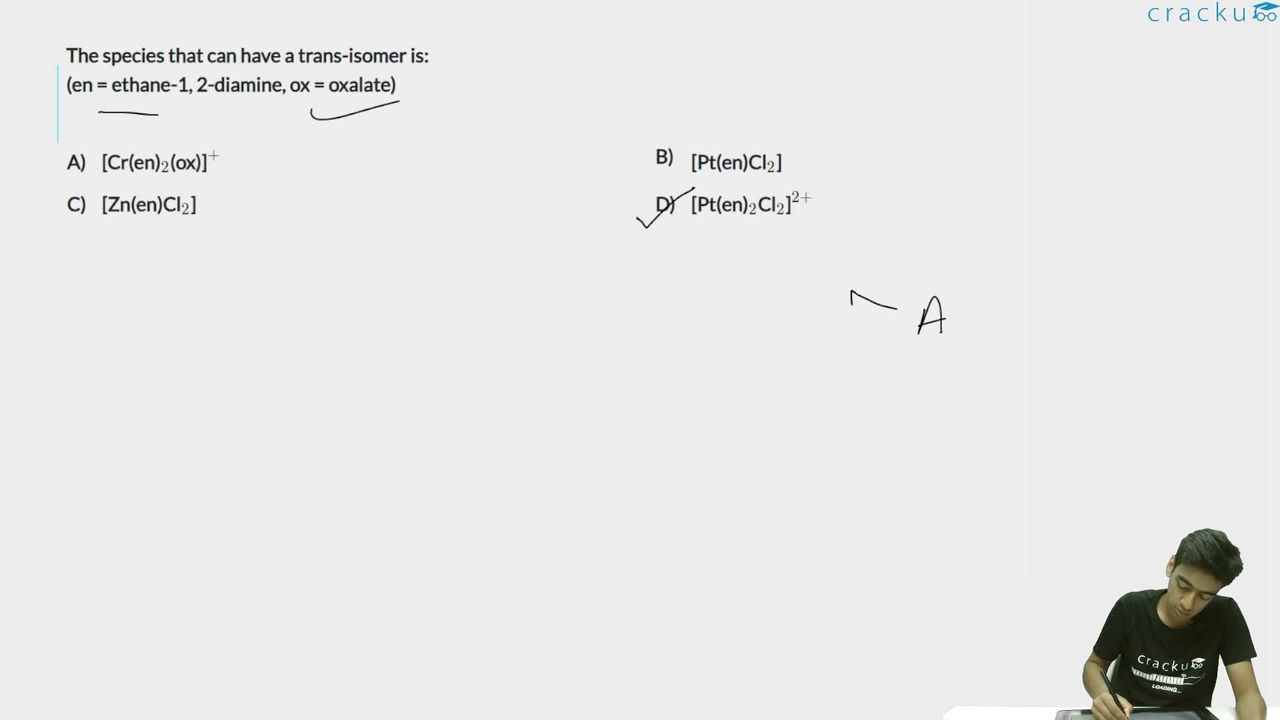
The species that can have a trans-isomer is:
(en = ethane-1, 2-diamine, ox = oxalate)
We begin by recalling the condition for the existence of cis‒trans (geometrical) isomerism. For a coordination compound to display a trans-isomer we must be able to place two identical ligands at 180° to each other. This is possible only
$$\text{(i)}$$ in an octahedral complex (coordination number $$6$$), or $$\text{(ii)}$$ in a square-planar complex (coordination number $$4$$).
If all the positions are equivalent, as in a tetrahedral complex, geometrical isomerism does not arise.
Now we examine each option one by one.
Option A : $$[\,\text{Cr(en)}_2(\text{ox})\,]^+$$
Here $$\text{en}$$ is bidentate and occupies $$2$$ sites, so $$2(\text{en}) = 4$$ sites. The oxalate ion $$\text{(ox)}^{2-}$$ is also bidentate and occupies the remaining $$2$$ sites. Hence coordination number $$=6$$ and the geometry is octahedral. However, all three ligands are bidentate; none of them is present as a pair of identical monodentate ligands. With three chelating ligands fixed in space, there is only one possible arrangement (apart from optical isomerism). Therefore no cis-trans pair can be formed.
Option B : $$[\,\text{Pt(en)Cl}_2\,]$$
Platinum(II) generally forms square-planar complexes. One $$\text{en}$$ ligand occupies two adjacent positions in the square plane. The remaining two positions are automatically filled by the two chloride ions, which lie opposite each other. Thus only one geometry exists; we cannot place the chlorides both adjacent and opposite, so cis-trans isomerism is absent.
Option C : $$[\,\text{Zn(en)Cl}_2\,]$$
Zinc(II) with two chlorides and one bidentate $$\text{en}$$ usually adopts a tetrahedral geometry (coordination number $$4$$). All four corners of a tetrahedron are equivalent; hence no geometrical isomerism (and therefore no trans-form) is possible.
Option D : $$[\,\text{Pt(en)}_2\text{Cl}_2\,]^{2+}$$
Let us determine the coordination number and geometry.
Each $$\text{en}$$ ligand is bidentate: $$2(\text{en}) \times 2 = 4$$ sites. Two monodentate $$\text{Cl}^-$$ ions occupy the remaining $$2$$ sites, giving a total of $$6$$ coordination positions. An $$\text{Pt}^{4+}$$ complex with coordination number $$6$$ is octahedral.
In an octahedron containing two identical monodentate ligands (the two $$\text{Cl}^-$$ ions) beside other ligands, we can arrange the two chlorides either
• adjacent, giving the cis-isomer, or • opposite each other, giving the trans-isomer.
Both arrangements are feasible because the two chlorides can be placed at 90° or 180° relative to each other without breaking the chelate rings formed by the $$\text{en}$$ ligands. Hence this complex definitely exhibits a trans-isomer.
Summarising our findings:
$$[\,\text{Cr(en)}_2(\text{ox})\,]^+$$ - no trans $$[\,\text{Pt(en)Cl}_2\,]$$ - no trans $$[\,\text{Zn(en)Cl}_2\,]$$ - no trans $$[\,\text{Pt(en)}_2\text{Cl}_2\,]^{2+}$$ - has a trans-isomer
Hence, the correct answer is Option 4.
Was this solution helpful?
Click on the Email ☝️ to Watch the Video Solution
Create a FREE account and get:
Educational materials for JEE preparation

Ask our AI anything

AI can make mistakes. Please verify important information.
AI can make mistakes. Please verify important information.

_1.webp)
