
Join Our JEE Preparation Group
Prep with like-minded aspirants; Get access to free daily tests and study material.
Sign in
Please select an account to continue using cracku.in
↓ →
Join Our JEE Preparation Group
Prep with like-minded aspirants; Get access to free daily tests and study material.
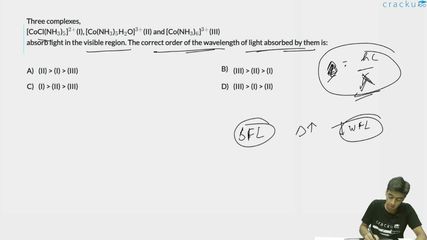
Three complexes,
[CoCl(NH$$_3$$)$$_5$$]$$^{2+}$$(I), [Co(NH$$_3$$)$$_5$$H$$_2$$O]$$^{3+}$$(II) and [Co(NH$$_3$$)$$_6$$]$$^{3+}$$(III)
absorb light in the visible region. The correct order of the wavelength of light absorbed by them is:
The colour shown by any coordination complex arises because an incident photon of suitable energy is absorbed to promote an electron from the lower $$t_{2g}$$ set of $$d$$-orbitals to the higher $$e_g$$ set. The energy difference between these two sets is called the crystal-field splitting energy and is denoted by $$\Delta$$.
According to the relation between energy and wavelength,
$$E = h\nu = \dfrac{hc}{\lambda} \qquad\Longrightarrow\qquad \Delta = \dfrac{hc}{\lambda}$$
We see that $$\lambda \propto \dfrac1{\Delta}$$ - a larger splitting energy corresponds to a smaller wavelength (higher-energy light) absorbed, and vice-versa.
Now, the magnitude of $$\Delta$$ depends on the position of the ligands in the spectrochemical series (weak-field ligands give small $$\Delta$$, strong-field ligands give large $$\Delta$$). The relevant part of the series is
$$\text{Cl}^- \;\lt \; H_2O \;\lt \; NH_3$$
Let us examine each complex, keeping in mind that every complex contains the same metal centre, cobalt in the +3 oxidation state ($$d^6$$ configuration):
1. Complex (I): $$[{\rm CoCl}(NH_3)_5]^{2+}$$ contains one weak-field ligand $$\text{Cl}^-$$ and five stronger ligands $$NH_3$$.
2. Complex (II): $$[{\rm Co}(NH_3)_5H_2O]^{3+}$$ contains one ligand $$H_2O$$, which is stronger than $$\text{Cl}^-$$ but weaker than $$NH_3$$.
3. Complex (III): $$[{\rm Co}(NH_3)_6]^{3+}$$ is bound exclusively to the stronger ligand $$NH_3$$.
Because a single weak ligand lowers the overall field strength of the entire octahedral set, the net order of crystal-field splitting is
$$\Delta_{\text{III}} \;\gt \; \Delta_{\text{II}} \;\gt \; \Delta_{\text{I}}$$
Applying $$\lambda \propto \dfrac1{\Delta}$$, we invert this order to obtain the wavelengths of light absorbed:
$$\lambda_{\text{I}} \;\gt \; \lambda_{\text{II}} \;\gt \; \lambda_{\text{III}}$$
Written in the language of the question,
$$(I) \;\gt \; (II) \;\gt \; (III)$$
Hence, the correct answer is Option C.
Was this solution helpful?
Click on the Email ☝️ to Watch the Video Solution
Create a FREE account and get:
_1.webp)

Educational materials for JEE preparation

Ask our AI anything

AI can make mistakes. Please verify important information.
AI can make mistakes. Please verify important information.
