JEE WhatsApp Group




JEE Current & Resistance PYQs
JEE Current & Resistance PYQs are an important part of the JEE Physics syllabus. This chapter introduces the basic ideas behind electric current, resistance, resistivity, drift velocity, Ohm’s law, electrical power, and different combinations of resistors.
Questions from Current and Resistance may look simple at first, but they can become tricky when the circuit contains several resistors or when the dimensions of a wire change. You may also come across graph-based questions, direct numerical problems, or conceptual questions involving current flow and resistance.
The best way to prepare for this chapter is to understand what is happening inside the conductor. Instead of memorising every formula, try to understand why current flows, what causes resistance, and how factors such as length, area, material, and temperature affect it.
Regular practice with JEE Current & Resistance Questions can improve your calculation speed and help you recognise common question patterns. Solving chapter-wise problems, revising JEE Advanced previous papers, and attempting a JEE Advanced Mock Test can also make you more comfortable with both direct and multi-step circuit questions.
In this blog, you will find important Current and Resistance PYQs in downloadable format, a useful formula sheet, common mistakes, and a simple approach for solving questions more efficiently. You can use this material for quick revision as well as regular chapter practice.
JEE Current & Resistance Important PYQs PDF
The PYQ PDF can include some of the most important previous-year questions from Current and Resistance. These questions may cover electric current, drift velocity, current density, resistance, resistivity, Ohm’s law, series and parallel combinations, electrical power, and the effect of temperature on resistance.
Practising previous-year questions helps you see how the same concept can be asked in different ways. Some questions may require only a direct formula, while others may involve simplifying a circuit or comparing two conductors.
A well-organised PYQ set can also help you improve your speed and avoid unnecessary calculations. With regular practice, you become better at identifying which formula or circuit rule should be used.
Important Current & Resistance Formula Sheet for JEE
You do not need to memorise a large number of formulas for this chapter. Most questions can be solved using a small set of standard relations.
Before using a formula, first check what the question is asking for. It may involve current, resistance, resistivity, drift velocity, power, or equivalent resistance.
You can add this chapter formula sheet to your JEE Mains Formula Sheet for quick revision before practice sessions and mock tests.
| Concept | Formula |
|---|---|
| Electric current | (I = \frac{Q}{t}) |
| Current in terms of drift velocity | (I = neAv_d) |
| Current density | (J = \frac{I}{A} = nev_d) |
| Ohm’s law | (V = IR) |
| Resistance of a conductor | (R = \rho\frac{L}{A}) |
| Resistivity | (\rho = \frac{RA}{L}) |
| Conductivity | (\sigma = \frac{1}{\rho}) |
| Equivalent resistance in series | (R = R_1 + R_2 + R_3) |
| Equivalent resistance in parallel | (\frac{1}{R} = \frac{1}{R_1}+\frac{1}{R_2}+\frac{1}{R_3}) |
| Electrical power | (P = VI = I^2R = \frac{V^2}{R}) |
| Electrical energy | (E = Pt = VIt) |
| Temperature dependence of resistance | (R = R_0[1+\alpha(T-T_0)]) |
These formulas are commonly used in questions involving wires, resistors, current flow, circuit combinations, and electrical power.
While revising, remember that resistance depends on the length and area of the conductor, while resistivity mainly depends on the material and temperature.
It is also important to check units before starting a calculation. Length should usually be converted into metres, area into square metres, current into amperes, and resistance into ohms.
Common Mistakes to Avoid in JEE Current & Resistance PYQs
Many errors in this chapter happen because students apply a familiar formula without checking the actual circuit or physical condition.
Confusing resistance with resistivity
Resistance depends on the dimensions of the conductor as well as the material. Resistivity, however, is a property of the material and does not depend on the conductor’s length or area.
Using the wrong formula for series and parallel combinations
In a series circuit, the same current passes through each resistor. In a parallel circuit, the potential difference across each branch is the same.
Always identify the arrangement before calculating the equivalent resistance.
Ignoring changes in the dimensions of a wire
If a wire is stretched, its length increases and its cross-sectional area decreases. Since the volume is usually taken as constant, both changes must be considered while calculating the new resistance.
Applying Ohm’s law in every situation
Ohm’s law is valid only when physical conditions such as temperature remain constant. Some devices, including diodes and filament lamps, may not follow a straight-line voltage-current relationship.
Confusing electron flow with conventional current
Electrons move from lower potential to higher potential. Conventional current is taken in the opposite direction, from higher potential to lower potential.
This difference is important in direction-based questions.
Making unit conversion errors
Resistivity, area, length, current, and voltage may be given in different units. Convert all quantities into SI units before using them in a formula.
Careful circuit drawing and regular practice can help you avoid most of these mistakes.
How to Solve Current & Resistance Questions Faster
Start by identifying the type of question. It may involve a single wire, a resistor network, drift velocity, electrical power, or temperature-dependent resistance.
Next, write down the known quantities and check their units. If a circuit is given, redraw it neatly and look for simple series or parallel combinations.
In resistor-network questions, simplify the circuit step by step instead of trying to solve the entire arrangement at once. This reduces confusion and makes the calculation easier to check.
Also decide what remains constant in the question. For example, when a wire is stretched, its volume may remain constant. In power questions, the voltage or current may be fixed. Recognising such conditions can save time.
While attempting a JEE Advanced Mock Test, avoid rushing through apparently easy circuit questions. A small mistake in resistance combination or unit conversion can change the final answer completely.
List of JEE Current & Resistance PYQs
Below is a test-style set of questions based on electric current, drift velocity, resistance, resistivity, Ohm’s law, series and parallel combinations, electrical power, and temperature dependence.
Try to solve each question independently before checking the answer. Draw the circuit wherever required, write the relevant formula, and simplify the steps clearly.
This approach will help you understand the chapter better and improve your accuracy in both JEE Main and JEE Advanced questions.
Question 1
A galvanometer has a coil of resistance $$200\Omega$$ with a full scale deflection at $$20\mu A$$. The value of resistance to be added to use it as an ammeter of range $$(0 - 20)$$ mA is :
correct answer:- 2
Question 2
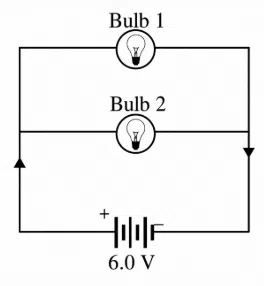
A $$6.0$$ volt battery is connected to two light bulbs as shown in figure. Light bulb 1 has resistance $$3$$ ohm while light bulb 2 has resistance $$6$$ ohm. Battery has negligible internal resistance. Which bulb will glow brighter?
correct answer:- 2
Question 3
The current flowing through a conductor connected across a source is $$2$$ A and $$1.2$$ A at $$0°$$C and $$100°$$C respectively. The current flowing through the conductor at $$50°$$C will be _____ $$\times 10^2$$ mA.
correct answer:- 15
Question 4
Two metallic wires of identical dimensions are connected in series. If $$\sigma_1$$ and $$\sigma_2$$ are the conductivities of these wires respectively, the effective conductivity of the combination is:
correct answer:- 2
Question 5
If the radius of earth is reduced to three-fourth of its present value without change in its mass then value of duration of the day of earth will be _________ hours 30 minutes.
correct answer:- 13

Question 6
A current of 5 A is passing through a non-linear magnesium wire of cross-section 0.04 m$$^2$$. At every point the direction of current density is at an angle of 60$$^\circ$$ with the unit vector of area of cross-section. The magnitude of electric field at every point of the conductor is: (resistivity of magnesium $$\rho = 44 \times 10^{-8}$$ $$\Omega$$m)
correct answer:- 3
Question 7
The $$H$$ amount of thermal energy is developed by a resistor in 10 s when a current of 4 A is passed through it. If the current is increased to 16 A, the thermal energy developed by the resistor in 10 s will be
correct answer:- 2
Question 8
In a large building, there are 15 bulbs of 40 W, 5 bulbs of 100 W, 5 fans of 80 W and 1 heater of 1 kW. The voltage of the electric mains is 220 V. The minimum capacity of the main fuse of the building will be:
correct answer:- 3
Question 9
The resistance of an electrical toaster has a temperature dependence given by $$R(T) = R_0[1 + \alpha(T - T_0)]$$ in its range of operation. At $$T_0 = 300$$ K, $$R = 100$$ $$\Omega$$ and at $$T = 500$$ K, $$R = 120$$ $$\Omega$$. The toaster is connected to a voltage source at 200 V and its temperature is raised at a constant rate from 300 to 500 K in 30 s. The total work done in raising the temperature is:
Note: This question was awarded as the bonus since all options were incorrect in the exam.
correct answer:- 1
Question 10
A constant voltage is applied between two ends of a metallic wire. If the length is halved and the radius of the wire is doubled, the rate of heat developed in the wire will be:
correct answer:- 1

Question 11
A metal wire of resistance 3 $$\Omega$$ is elongated to make a uniform wire of double its previous length. This new wire is now bent and the ends joined to make a circle. If two points on this circle make an angle 60° at the center, the equivalent resistance between these two points will be:
correct answer:- 1
Question 12
A uniform metallic wire has a resistance of 18 $$\Omega$$ and is bent into an equilateral triangle. Then, the resistance between any two vertices of the triangle is:
correct answer:- 4
Question 13
A copper rod of cross-sectional area A carries a uniform current I through it. At temperature T, if the volume charge density of the rod is $$\rho$$, how long will the charges take to travel a distance d?
correct answer:- 3
Question 14
Which of the following resistivity $$(\rho) v/s$$ temperature (T) curves is most suitable to be used in wire bound standard resistors?
correct answer:- 4
Question 15
By what percentage will the illumination of the lamp decrease if the current drops by 20%?
correct answer:- 3

Question 16
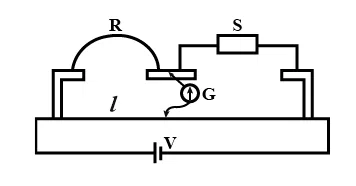
In a meter bridge experiment $$S$$ is a standard resistance. $$R$$ is a resistance wire. It is found that balancing length is $$l = 25$$ cm. If $$R$$ is replaced by a wire of half length and half diameter that of $$R$$ of same material, then the balancing distance $$l'$$ (in cm) will now be ___________.
correct answer:- 40
Question 17
In a conductor, if the number of conduction electrons per unit volume is $$8.5 \times 10^{28}$$ m$$^{-3}$$ and mean free time is 25 fs (femto second), it's approximate resistivity is: ($$m_e = 9.1 \times 10^{-31}$$ kg)
correct answer:- 4
Question 18
A uniform metallic wire carries a current 2 A, when 3.4 V battery is connected across it. The mass of uniform metallic wire is $$8.92 \times 10^{-3}$$ kg, density is $$8.92 \times 10^3$$ kg m$$^{-3}$$ and resistivity is $$1.7 \times 10^{-8}$$ $$\Omega$$ - m. The length of wire is:
correct answer:- 2
Question 19
Drift speed of electrons, when 1.5 A current flows in a copper wire of cross section 5 mm$$^2$$ is $$v_d$$. If the electron density in copper is $$9 \times 10^{28}$$ m$$^{-3}$$, the value of $$v_d$$ in mm s$$^{-1}$$ is close to (Take charge of an electron to be $$= 1.6 \times 10^{-19}$$ C)
correct answer:- 4
Question 20
Two equal resistances when connected in series to a battery, consume electric power of 60 W. If these resistance are now connected in parallel combination to the same battery, the electric power consumed will be:
correct answer:- 2

Question 21
Space between two concentric conducting spheres of radii a and b (b > a) is filled with a medium of resistivity $$\rho$$. The resistance between the two spheres will be:
correct answer:- 3
Question 22
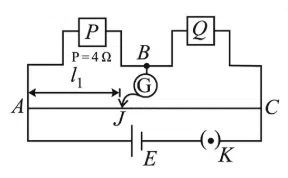
Resistances are connected in a meter bridge circuit as shown in the figure. The balancing length $$l_1$$ is $$40 \text{ cm}$$. Now an unknown resistance $$x$$ is connected in series with $$P$$ and new balancing length is found to be $$80 \text{ cm}$$ measured from the same end. Then the value of $$x$$ will be ______ $$\Omega$$.( Value of Q = 6 $$\Omega$$)
correct answer:- 20
Question 23
In a building there are 15 bulbs of 45 W, 15 bulbs of 100 W, 15 small fans of 10 W and 2 heaters of 1 kW. The voltage of electric main supply is 220 V. The minimum fuse capacity (rated value) of the building will be:
correct answer:- 4
Question 24
In a balanced Wheatstone bridge network, the resistances in the four arms taken in cyclic order are $$P = 10\ \Omega$$, $$Q = 20\ \Omega$$, $$S = 40\ \Omega$$, and $$R = X\ \Omega$$. Find the value of the unknown resistance $$X$$ in ohms ($$\Omega$$).
correct answer:- 20
Question 25
If a copper wire is stretched to increase its length by 20%. The percentage increase in resistance of the wire is _____%.
correct answer:- 44

Question 26
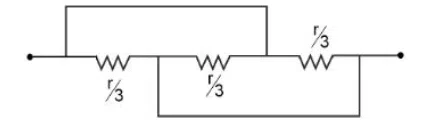
Find the equivalent resistance between two ends of the following circuit
correct answer:- 1
Question 27
Four bulbs B$$_1$$, B$$_2$$, B$$_3$$ and B$$_4$$ of 100 W each are connected to 220 V main as shown in the figure. The reading in the ideal ammeter will be:
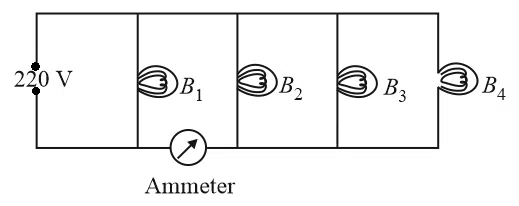
correct answer:- 2
Question 28
To find the resistance of a galvanometer by the half deflection method, the following circuit is used with resistances $$R_1 = 9970$$ $$\Omega$$, $$R_2 = 30$$ $$\Omega$$ and $$R_3 = 0$$. The deflection in the galvanometer is d. With $$R_3 = 107$$ $$\Omega$$, the deflection changed to $$\frac{d}{2}$$. The galvanometer resistance is approximately:
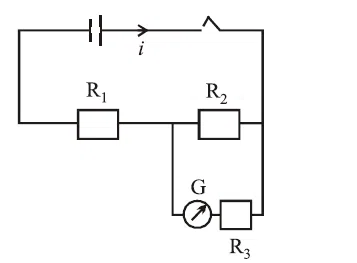
correct answer:- 4
Question 29
The Wheatstone bridge shown in the figure below, gets balanced when the carbon resistor used as $$R_1$$ has the colour code (orange, red, brown). The resistors $$R_2$$ and $$R_4$$ are 80 $$\Omega$$ and 40 $$\Omega$$, respectively. Assuming that the colour code for the carbon resistors gives their accurate values, the colour code for the carbon resistor, used as $$R_3$$, would be:
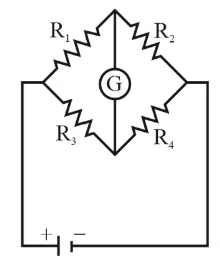
correct answer:- 2
Question 30
A 200 $$\Omega$$ resistor has certain colour code. If one replaced the red colour by green in the code, the new resistance will be:
correct answer:- 4