
Join Our JEE Preparation Group
Prep with like-minded aspirants; Get access to free daily tests and study material.
Sign in
Please select an account to continue using cracku.in
↓ →
Join Our JEE Preparation Group
Prep with like-minded aspirants; Get access to free daily tests and study material.
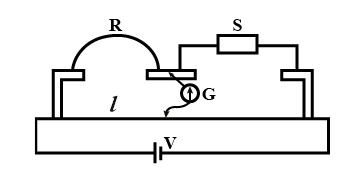
In a meter bridge experiment $$S$$ is a standard resistance. $$R$$ is a resistance wire. It is found that balancing length is $$l = 25$$ cm. If $$R$$ is replaced by a wire of half length and half diameter that of $$R$$ of same material, then the balancing distance $$l'$$ (in cm) will now be ___________.
Correct Answer: 40
In a meter bridge, the condition for a balanced Wheatstone bridge is given by the relation
$$\dfrac{R}{S} \;=\; \dfrac{l}{100 - l},$$
where $$R$$ is the resistance in the resistance box arm, $$S$$ is the standard resistance, $$l$$ is the balancing length measured from one end, and the total length of the bridge wire is taken as 100 cm.
We are first told that the balancing length is $$l = 25\text{ cm}$$. Substituting this value into the above relation, we obtain
$$\dfrac{R}{S} \;=\; \dfrac{25}{100 - 25} \;=\; \dfrac{25}{75} \;=\; \dfrac{1}{3}.$$
Hence we conclude that
$$\dfrac{R}{S} = \dfrac13 \quad\Longrightarrow\quad R = \dfrac{S}{3}.$$
Now the wire of resistance $$R$$ is replaced by another wire made of the same material but having half the length and half the diameter. To find the new resistance $$R'$$ of this wire, we recall the resistance formula
$$R = \rho\,\dfrac{L}{A},$$
where $$\rho$$ is the resistivity of the material (unchanged because the material is the same), $$L$$ is the length, and $$A$$ is the cross-sectional area. For a cylindrical wire, the area is
$$A = \pi\Bigl(\dfrac{d}{2}\Bigr)^2 = \dfrac{\pi d^{2}}{4},$$
with $$d$$ being the diameter.
Let the original wire have length $$L$$ and diameter $$d$$, so its area is $$A = \dfrac{\pi d^{2}}{4}$$ and its resistance is
$$R = \rho\,\dfrac{L}{A}.$$
The new wire has
• length $$L' = \dfrac{L}{2},$$
• diameter $$d' = \dfrac{d}{2}.$$
The new area is therefore
$$A' = \dfrac{\pi (d')^{2}}{4} = \dfrac{\pi}{4}\Bigl(\dfrac{d}{2}\Bigr)^{2} = \dfrac{\pi d^{2}}{16} = \dfrac{A}{4}.$$
Using the resistance formula again, the new resistance $$R'$$ is
$$R' = \rho\,\dfrac{L'}{A'} = \rho\,\dfrac{\dfrac{L}{2}}{\dfrac{A}{4}} = \rho\,\dfrac{L}{2}\cdot\dfrac{4}{A} = 2\,\rho\,\dfrac{L}{A} = 2R.$$
Thus we have the simple relation
$$R' = 2R.$$
Because the standard resistance $$S$$ remains unchanged, the new balance condition for the meter bridge becomes
$$\dfrac{R'}{S} = \dfrac{l'}{100 - l'},$$
where $$l'$$ is the new balancing length to be found. Substituting $$R' = 2R$$ and the earlier ratio $$\dfrac{R}{S} = \dfrac13$$, we get
$$\dfrac{R'}{S} = \dfrac{2R}{S} = 2\left(\dfrac{R}{S}\right) = 2\left(\dfrac13\right) = \dfrac23.$$
Hence we must satisfy
$$\dfrac{l'}{100 - l'} = \dfrac23.$$
Cross-multiplying, we write
$$3\,l' = 2\,(100 - l').$$
Expanding the right-hand side gives
$$3l' = 200 - 2l'.$$
Next we collect the $$l'$$ terms on one side:
$$3l' + 2l' = 200,$$
which simplifies to
$$5l' = 200.$$
Finally, dividing by 5 yields
$$l' = \dfrac{200}{5} = 40\text{ cm}.$$
So, the answer is $$40\text{ cm}$$.
Was this solution helpful?
Click on the Email ☝️ to Watch the Video Solution
Create a FREE account and get:
_1.webp)

Educational materials for JEE preparation

Ask our AI anything

AI can make mistakes. Please verify important information.
AI can make mistakes. Please verify important information.
